The Assault on Ebino
Part One: Deployment
Biagino had grown more and more furious on his journey from the defeat at Pontremola to the city of Ebino. When the duchess Maria had died, his mind, twisted with all the proud hatred and dark cruelty of vampirism, had been released from its slavish, besotted enthrallment to her, so that now he was enraged almost to madness by the thought of the glamour she had cast over him. As he progressed, anger had so suffused his being that he cared not a jot for the army that was pursuing him, and instead of fleeing further, as was surely the most sensible course of action considering the recent defeat and the enemy’s obvious strength, he decided he would possess and rule Maria’s city – take all that was once hers, as partial recompense for her belittling dominion over him.
He had been a pathetic creature in life, and even in undeath, until Maria’s demise, he had been the same.
Well, he decided, no more.
Now, a few weeks later, with the enemy soon about to attack the city, and having brought only his paltry, remnant army with him, his fury had abated to be replaced with much more mixed emotions, flavoured throughout with a substantial dose of self-interest. Luckily for her, the sorceress who Maria had left in charge of the city had not met Biagino immediately upon his arrival, otherwise he would most assuredly have killed her on sight, out of sheer spite. When he did finally meet her, he had regained sufficient composure to accept her servitude, listen to her report concerning what forces she commanded within the city, and to recognise he needed whatever help she could give to defend it.
The enemy had been preparing for their assault for days, fashioning up contraptions to gain entry. He knew full well the strength of their artillery, big and small, having watched the volleys at Norochia tear his most mighty and monstrous pawns to pieces, then witnessed the same yet again at Pontremola. Although the city was circumvallated with strong, moated walls, parapeted throughout, he was unwilling to risk receiving even a fraction of the battering the enemy had proved capable of delivering in the past, not when his own forces were so meagre. So, he commanded that none of his soldiers should mount the walls, but rather slink unseen in the shadows below and await his command before revealing themselves.
Thus it was that the Disciplinati di Nagash, commanded by the two remaining thralls of La Fraternita di Morti Irrequieti, were now mustered in their full remaining strength in the yard below him, silently waiting for his order to climb the steps.

Upon the other side of the city gate the sorceress’s garrison of skeletons stood similarly …

… with a corpse cart close by to augment the magical current feeding their animation.

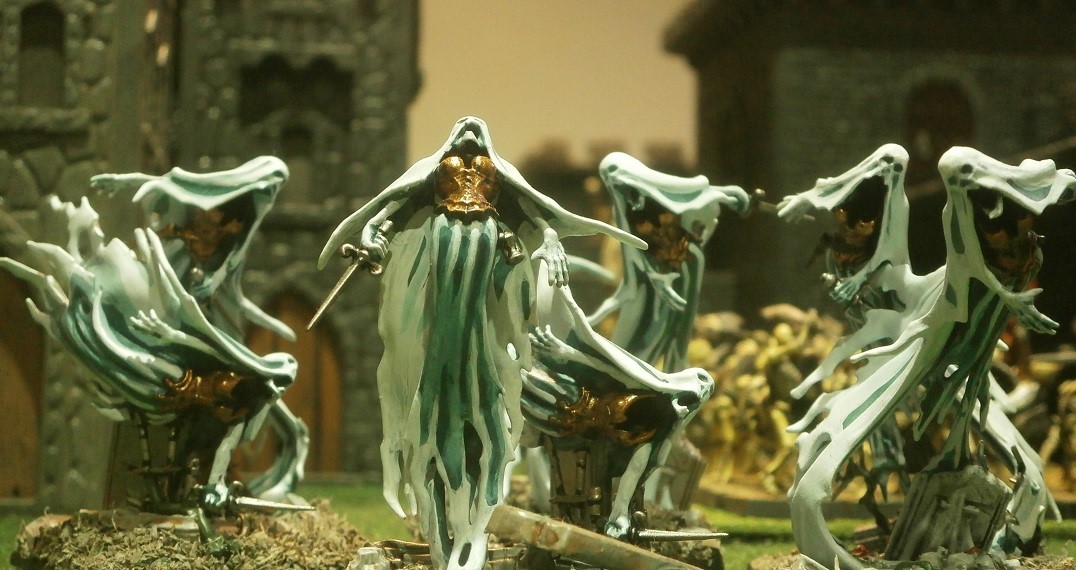
The sorceress had conjured a host of restless, accursed spirits from the most haunted corners of the city, and they too awaited command, swirling and swooshing around each other like the fronds of water plants plaiting and unwinding in the eddies of a stream.
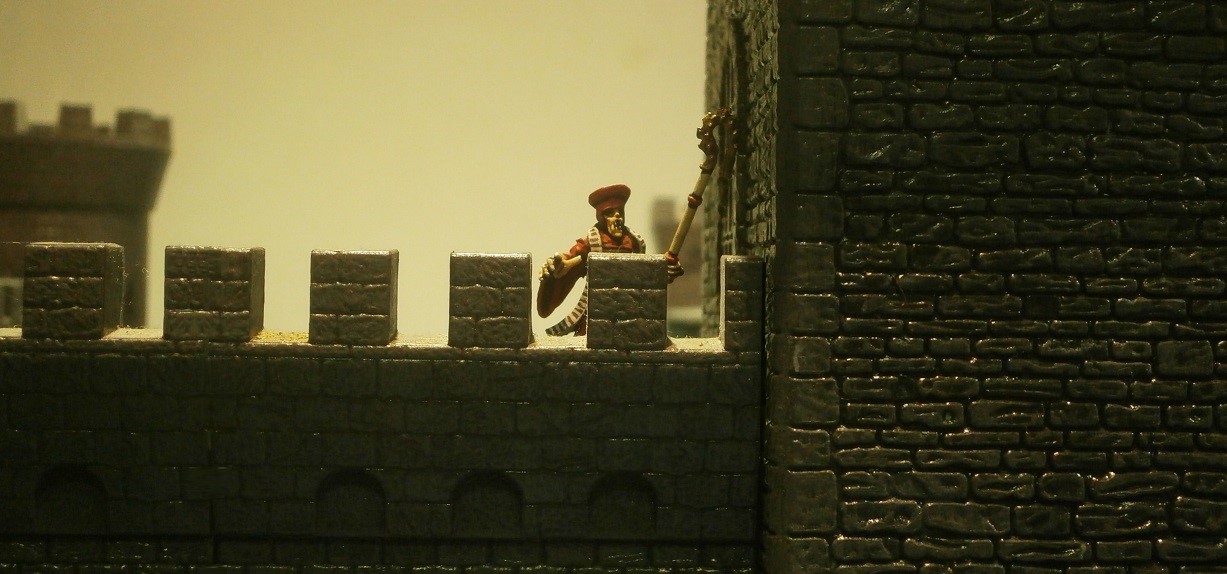
The sorceress herself, an old crone who had mastered little more than the rudiments of the necromantic art, yet to her credit had still managed over time to raise the force aforementioned, was hiding too. Like Biagino himself, she was tucked away on the battlements, in the shadow of a nearby tower, from where she could watch over her garrison force but also take an occasional peek at the enemy.

His chess pieces set, Biagino now waited impatiently for the enemy to make the opening move. Upon several recent occasions, one of his thralls had crept out in the darkest hours of the night to spy upon the foe and had reported the mustering of their force and their constructions. He knew they had bridges with which to cross the moat, but only a handful. Surely, Biagino mused, there is sufficient strength here to prevent frightened men clambering up ladders at only a few places along the walls? The walls of Ebino were in his favour, and he rated his chances. But then, the enemy also had their guns, and their magical colossus; their wizards and priests. At least their mounted men at arms, of which he had spied a good number at Pontremola, would be forced to wade through mud on foot, unable to bring their lances to bear, made little better than militia, if somewhat more armoured.
The duchess, he now realised, had been a vainglorious fool when it came to war. Despite knowing her uncle (and vampiric sire) Duke Alessandro, had perished in battle at the bridge of Pontremola, she had forsaken the stone walls and moat of the city which would hinder the foe tremendously, and had charged out to attack the enemy, entrenched at the very same bridge, there to die. He was glad of her folly, for her death had released his mind. All he had to do was survive this assault and he would have time to enjoy his newfound freedom, to revel in the power that could now be his.
…
Having glanced over the crenelations several times, Biagino saw that the enemy had indeed left all their horses behind. Even their wooden constructions were being pushed by men, not beasts. They were divided unevenly by the road to the city gate, with two of their bridges upon one side and the third on the other. Along the road itself they were pushing what at first appeared to be a bombard, but which Biagino’s wickedly nimble eyes made out to be a huge petard, so heavy it had to be mounted on a carriage.

The largest enemy regiment, consisting of spearmen, obliquely flanked the petard. It seemed plain that the enemy general intended those men to storm the gate as soon as it was blown. The rest of the soldiers on that flank were heavily armoured, and in smaller companies. They must be the nobility, he thought, deprived of their steeds by the necessities of an assault. He could not help but smile as he imagined their steel-carapaced bodies sinking deep in the moat or plummeting from a ladder to crash hard into the rock footings. Also on that flank were two cannons, which perhaps explained why the soldiers on that side had only one bridge. They must be expecting the artillery to breach one spot, so that they could pour across the moat to access the gap thus made.

Upon the other side of the road were the Reman contingent as well as more Portomaggiorans. Biagino had seen several of the regiments before, when his eyes were actually alive rather than just not dead, including the mercenary regiments of dwarves. The colossus drew his gaze first, as it would anyone’s, but there were also two bridges, a large regiment of armoured footsoldiers and three regiments of crossbowmen, one of which was pushing a bridge. And well they might, he thought, for they had nothing to shoot at!

The whole army was on the move. Soon, he decided, they would learn how much more difficult it would be to fight against him compared to the Duchess!
Game Notes
This was our third play-by-email battle. We are getting quite good at it!
The Tabletop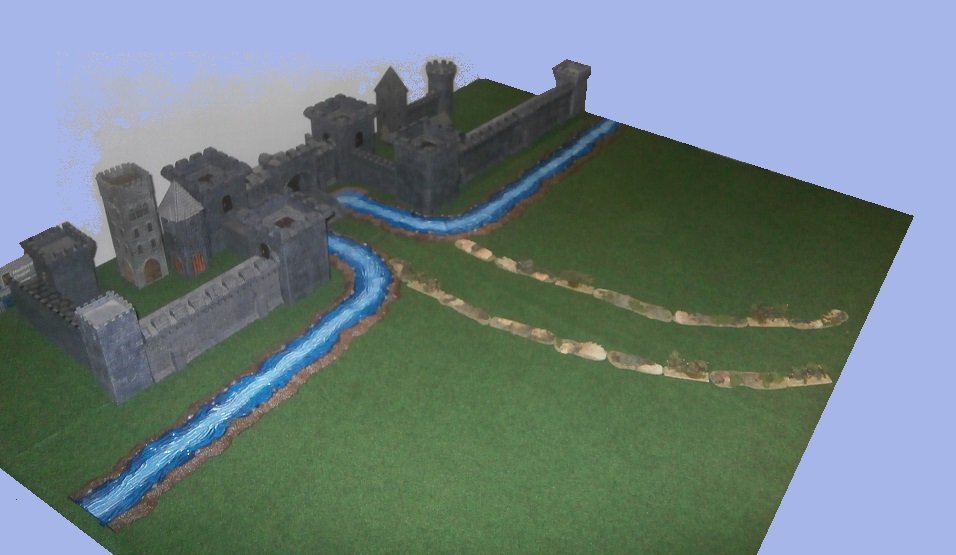
The Living Army Deployment, with labels
The Reman Brigade
This pic was sent, along with the army list, to the living army player, Damo (aka Lord Alessio Falconi) as orientation. He did not need a pic of his own forces, as they were his own figures which I had picked up several months ago from his house for the previous play-by-email!
The Undead Forces
This pic was sent, along with the army list, to the Undead army player, Matt, who is actually the villainous Duke Guidobaldo Gondi of Pavona in our campaign, but who had bravely volunteered to command this NPC force in battle.
The City Sections
This being a siege game, it would last for 8 turns, and victory was to be decided according to the number of sections held by an unengaged, unfleeing unit by the end of turn 8.
New Rules
PETARD
Movement: With 8 men attending, with 4 of them pushing, it can march move. Once the attendants fall below 2, it cannot march. Once there are no attendants, it loses 1″ movement per lost pusher. It must be pushed right up to the gate, then the fuse lit.
(The idea here is that the pushers are the muscle, while the attendants help shift it, direct it, remove obstacles, and add a bit of extra muscle in the moments such is required.)
Explosion: I reckon we should modify the shooting at the gates rules from 6th ed, p.252 -253. Auto hit the gate (for obvious reasons – it will be placed right against it). Roll artillery dice twice for misfire chance (as per the packing an extra charge rule) but the worst misfire result actually counts as a success (except the success also includes potential casualties – D [whatever number of men are present] deaths)! Damage cause = Str 10 + D6 +2. That’s a +2 to the standard rules. 15+ breaks the gate, 16 + destroys it utterly (so need a 3+ roll on the D6). If it’s a miss a turn type misfire, it can be relit by one of the petardiers for another try!
MOAT BRIDGES
These will start behind the 24″ line deployment, with the pushing unit behind. They should therefore be dropped at the start of turn 3, and although technically the carriage has to be pulled aside, I will allow the unit behind to declare a charge over and against the walls (should be a 10″ charge). A failed charge means that the rolling aside of the carriage prevented their progress! They can then attempt their charge in turn 4.
Movement: With 15 men pushing, and at least 5 attending, the bridge can march move normally. Once the attendants fall below 5, it can only march move in a straight line, if it turns it is a non-march move. Once it falls below 15 pushers, it cannot march move at all. At only 10 pushers it loses 1″ movement, then 2″ lost for 7, 3″ lost for 4. At 3 or less, it cannot move at all.
‘Other considerations’ (as passed on to the players) …
In past battles, including the recent Ravola game, it occurs to me that not all non-missile defenders, were on the walls, thus minimising further the damage from the attacker’s missiles. There were no missile troops in the undead army, and so they could perhaps (as Matt and I had already discussed) deploy behind the walls, ready to mount the parapets as the enemy close in, or defend any breaches?
If the defenders were not on the walls (apart from tower window wizards (perhaps) then the first few turns might be about the cannons’ battering and whatever magic is conjured. I could not really discuss anything else with both players, and shifted to individual e-mail threads for that.
A last consideration ….
Taking a walled and moated city should be hard. Although in this case the lack of defender missiles made it easier, the fact that they are undead might make it much, much harder to take the walls! The Portomaggiorans might finally face a real challenge, after two great, if easy, victories!
I told the players this could be a great and hard fought battle, and might even turn out to be a great ‘finale’ for Biagino (if it is his finale).
————————————————————————
The Assault
Turns 1 – 3
Considering his whole army was merely waiting, hiding, Biagino chanced a better look at the enemy, to ascertain what, if anything, he might have missed before. The wheeled petard was making progress up the road, but at a pace that meant it would be some time before it reached the gate – time he intended to make use of as best he could. His keen eyes could make out that the men pushing it were already tired – even from this distance he could see the throbbing arteries at their throats as their hearts pumped hard and fast to feed their muscles with sanguine sustenance. The thought caused a pang of hunger to suffuse his being – it had been some time since he ate!

Several handgunners escorted the petard and in its rear the large regiment of spearmen had angled their march to bring them onto the road behind. Biagino’s earlier guess was proving more likely to be correct – they obviously intended to swarm the gate once it was broken.
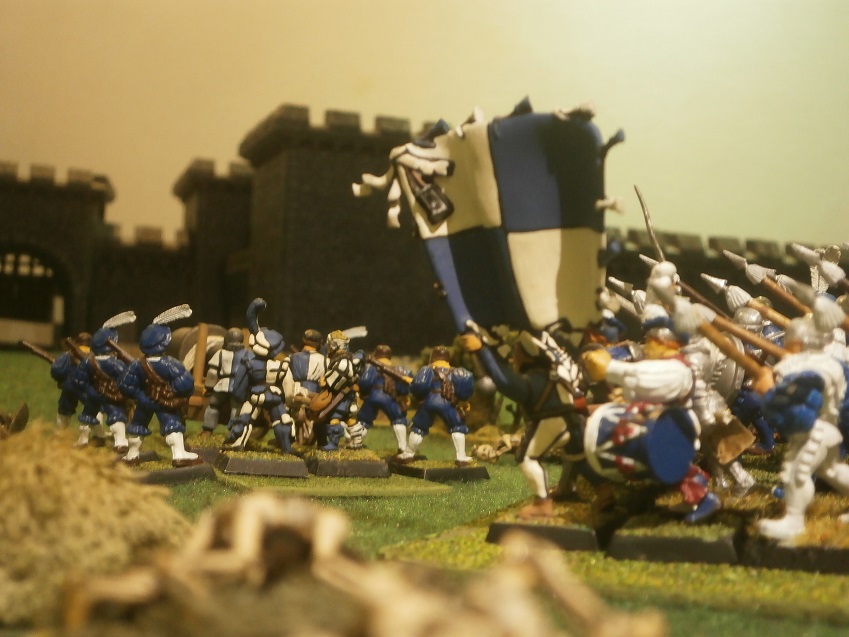
It occurred to him that all the enemy could presently see were stone walls, as if they were attacking an entirely undefended city.

He wondered now whether the sight would encourage or worry them. The living always feared his kind – he remembered feeling that fear himself before receiving the gift of vampirism. He laid his hand upon the stone wall, his mighty ally in this fight, and allowed himself a moment to recall his mortal years. What could be learned, he wondered, from his murky memories of that life which might help him here and now? Suddenly, however, his nascent train of thought was lost completely, as pain surged through him, sapping the unholy vigour that sustained his corpse-body in the material world. Clutching tight at the stone to prevent himself falling, he turned to look across the front of the gate at the wall upon the other side.

There was the sorceress, visibly reeling from a similar shock, and he knew full well what must have happened. Her amateurish bungling of the winds of magic, presumably intended to supplement the ranks of the osseous warriors below her, had whirled uncontrollably from her grasp and surged savagely in such a way as to sting both her and he!
Hissing in anger, he knew he been weakened, and before the enemy had so much as fired a shot or loosed a bolt! Why, he asked himself, did I not kill her as soon as I found her?
Shaking his head in an effort to clear it, he snuck another peek at the enemy. More time had passed than he had thought – his pain had been quite the distraction – for they were considerably closer than the last time he looked. The colossus strode ahead of all the rest, directly towards the moat. This intrigued Biagino, for he had watched the monstrous artefact move on two previous occasions, and knew its gait was stiff if steady, imbued with a sturdy deliberateness. He would be very surprised if it were able to cross the moat, for such a feat would surely require a nimbleness it did not possess?

Beside the colossus were two of the moat bridges. Perhaps the enemy intended their metal giant to step over one of those? This too seemed an unlikely prospect, for its weight would surely splinter the timbers to send its foot into the water and so topple the whole?

Lurching to one side, still dizzied by the magical harm, Biagino glanced instead at the enemy’s other flank. There the third bridge had made similar progress, pushed by the dismounted noblemen and flanked by more handgunners.

Just then he felt the enemy’s magic – not any harm from it, but merely its use. The etheric winds flowed through the foe, and he realised the fellow he had spied earlier walking behind the colossus, red-robed with a white turban, was their strongest wizard. Perhaps it was that man who gave the colossus its purpose, directing its mindless activities? Again, however, he sensed a burning sourness to the etheric flow, just enough to reveal that the enemy had also suffered harm in their attempts at conjuration. At first, he smiled in satisfaction, but that did not last long, for it now occurred to him that something might be tainting all the winds of magic here, making them somehow noxious, so any attempt to cast magic might prove further detrimental to his health.
(Game Note: In turn 1 alone, in the Undead magic phase a miscast roll of 9 had wounded both undead magic users, then in the Living magic phase a similar miscast result wounded Hakim the wizard and all three priests!)
Two loud thuds followed the sound of the enemy’s cannon blasts, announcing the first of their artillery shots, likely intended for the gate but instead hitting the wall that bore it. Splinters of stone spattered out to splash in the waters of the moat below. They will have to do much better than that, thought Biagino, then turned to look at the courtyard behind him. There his bambinos, commanded by his thralls, stood waiting, satisfactorily unperturbed by the sound of shooting.

Both Biagino and the sorceress now attempted to cure themselves magically of the injuries they had suffered, but Biagino’s attempt was quelled by the enemy’s countermagic, while she simply fumbled the words of her incantation. No matter, he thought, there is plenty of time yet. At least the winds seemed more favourable now, and less dangerous to casters.
Outside the enemy pushed onwards. Unknown to Biagino, Lord Alessio himself commanded his regiment of Sea Wolves, armed with great-swords and clad in plate armour, urging them on as they shoved their burden towards the defences.

Again, Biagino sensed the workings of the enemy’s magic, and although not all seemed to be successful, he knew that at least one of their spells had come to fruition. If he had been looking over the parapet just then, he would have seen the dismounted knights momentarily move with unnatural swiftness to push their bridge that bit closer to the moat. He did, however, look just in time to see all three moat bridges come crashing down to span the moat. The first had mercenary crossbowmen pushing it …

… the second was moved by the plate armoured footsoldiers …
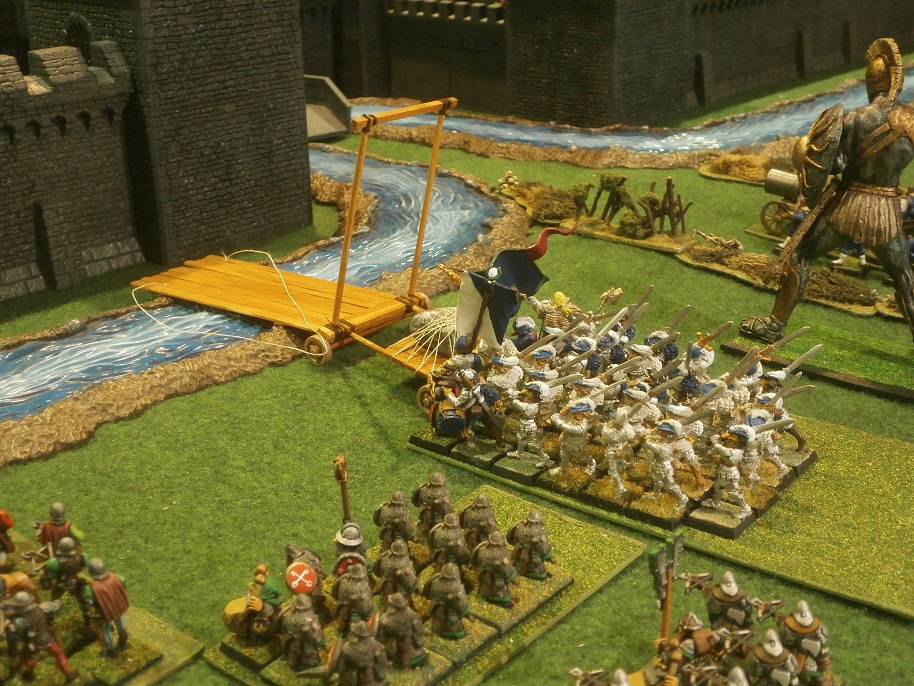
… and the third was attended by the dismounted nobility of Portomaggiore.
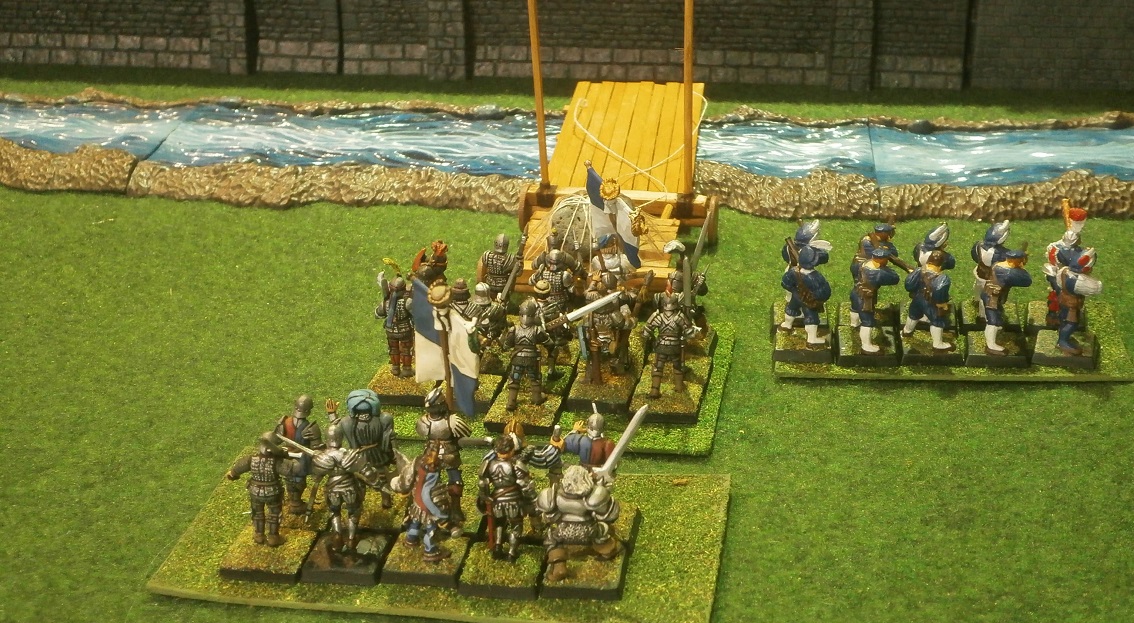
The men at the second, led by their general himself, were champing at the bit to get at the walls, and swiftly pulled aside the bridge’s boulder carrying carriage to allow themselves to begin pouring over immediately.

The enemy’s cannons now shifted their aim and lobbed two iron roundshots at the wall to the east of the gate. Once again, the shots buried themselves into the stone, flaring cracks from their points of impact, but the wall stood.
Now, thought Biagino, it was time to mount the walls, so that the attackers at the third bridge would see Ebino was not undefended! His command was unspoken, indeed little more than a thought, for his bambinos and thralls were like unto marionettes for him to make dance as he pleased with mere finger flicks. Up went half of the Disciplinati di Nagash, but not those behind the wall targeted by the enemy artillery, which no doubt the enemy intended to breach rather than assault with ladders. There his congregation stayed put, to face whatever attempted to climb through any breach caused.

The sorceress too ordered her city garrison up, to ensure the enemy’s commander would be required to work very hard if he was to take possession of the wall before him.

Embarrassed by her earlier failure, perhaps, the witch now wound together as many magical eddies as she could muster to cast the Invocation of Nehek, if only to restore herself to full strength, and so be best prepared to face the fight ahead. But the curse Biagino had sensed earlier still lingered, so that yet again she lost her hold on the slippery swirl of arcane energies. They spun instead into an uncontrollable maelstrom which once again knocked the (foetid) wind out of her. So befuddled was she by what had happened, she failed entirely to notice that this time, just like the last, several skeletons had nevertheless been raised to join the ranks of the regiment now climbing onto the wall.
Biagino felt the blow too, and as the pain of his fresh injuries fuelled the fury of his anger, he staggered on the battlements, struggling merely to stay on his feet. Somewhere in his mind, little more than a flicker within the whirling rage engulfing the rest, real doubt had crept in. Perhaps, said a whispered voice with a mocking tone, sounding ever so like the duchess, today is not your time after all?
(Game Note: Biagino down to one wound. The sorceress was a more complicated matter – which began a debate concerning the rules. See the note below this post, but if you do, brace yourself for a full and frantic foray deep into the 8th ed WFB rules!)
As both the undead commanders reeled, Lord General Alessio Falconi of Portomaggiore led his Sea Wolves in a ladder assault of the wall.
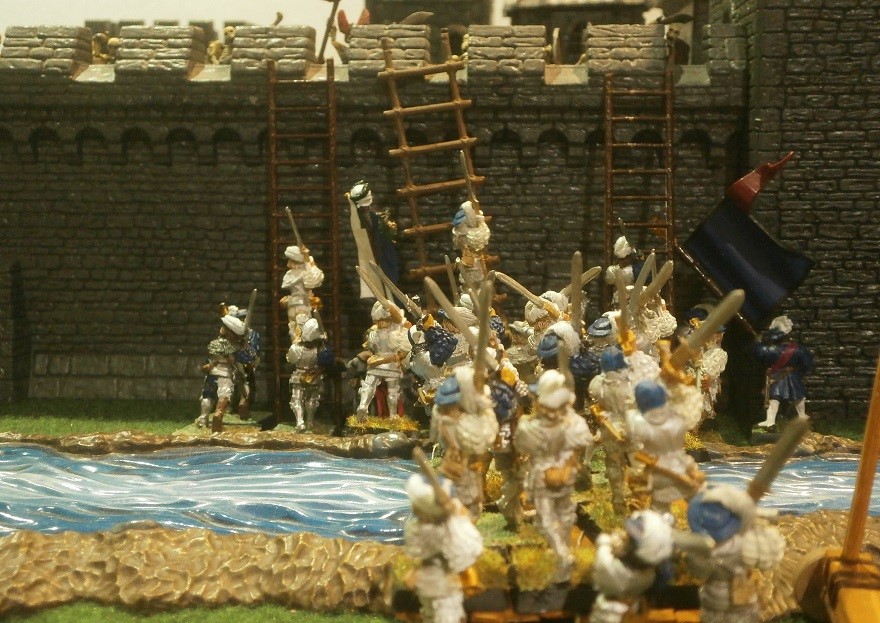
As yet, this was the only bridge being used for an assault. At the first bridge, the crossbowmen lugged the carriage away to allow a company of skirmishing bravi to cross, led by the Reman brigade’s commander Captain Soldatovya, while at the other bridge, the dismounted knights simply waited, for there was no point in crossing until the wall was breached. They watched as another roundshot shook the wall to the left of their bridge. then shuddered as a second, louder sound assaulted then. At the back several turned, to see that one of the guns had shivered apart, killing the crew and master gunner serving it.
(Game Note: Each gun had an ‘artillerist’ serving it, being the Tilean list equivalent of an Empire engineer, the second having bought their ‘mercenary skill’ at double the usual cost as per the rules. Both guns could thus re-roll misfires. Apparently, that does not always save a gun. Statistically I supposed it fails to save a gun 1 in 36 times, or fails to save an already misfired gun 1 in 6 times).
On the road the petard was gaining momentum, its pushers thankful that they now had a road to traverse and not rough ground.
Behind it, the spearmen came on too, with the famous Reman Morrite priest ‘fighting’ Father Antonello at their head, along with the Portomaggioran nobleman Marcus Portelli.

Biagino was vaguely aware of the flow of magic channelled by the enemy, but so dazed was he that he only managed to dispel one of their conjurations, and even then, he knew not what he had prevented. One spell that did get through was a Lore of Light blessing which enlivened the climbing Sea Wolves and perhaps was the reason the fully plate-armoured Lord Alessio was the quickest to top the wall, great hammer in one hand, to commence the first close combat of the assault.

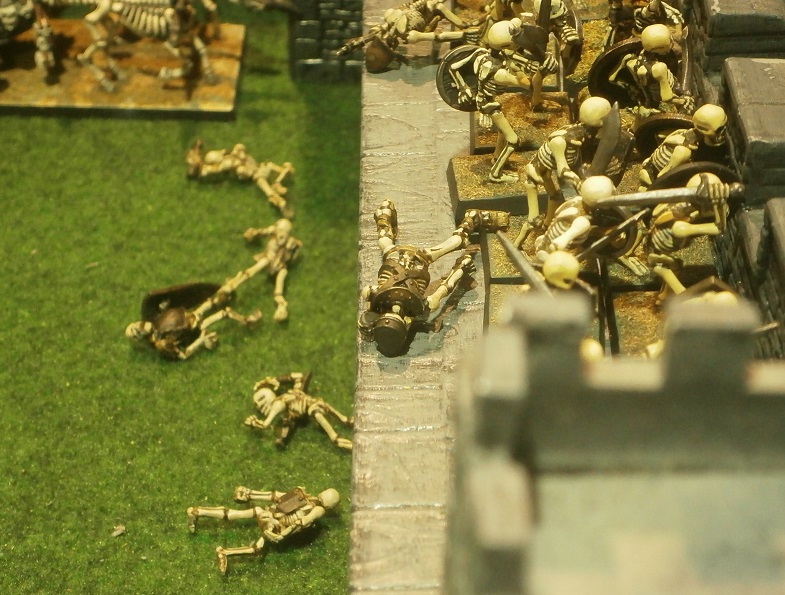
Despite all the disadvantages of assaulting a wall using ladders, the attackers, filled with hatred for the foe (divinely inspired by the presence of the Morrite priest, Father Dado Bendali), enspelled to move with unnatural speed, and with their leader armed with an enchanted warhammer, surged up to rain down blow after blow, and the fleshless defenders began tumbling from the wall in droves.
…
Turn 3 Completed. Turns 4-8 to follow!
……………………………………
Appendix to Turns 1 – 3 (for players who like detailed analysis of the rules)
Game Note
The miscasting witch (a level one necromancer) had been on her last wound, but just before I removed the figure as dead, I read the rules. There I was surprised by what I found and did not remove the figure! I began the inevitable debate with the players, which I fully expected as I too had initially believed the witch’s death was surely inevitable, but luckily I had just joined the ‘Eighth Edition For Life’ forum. So, looking for back up from a more knowledgeable and entirely disinterested source, I posted the following in the “Get the Rules Right” section of said forum …
Here is a ruling I have (as GM) just made in the play-by-email game we are running right now.
A Vampire Count’s army level 1 necromancer had only 1 wound left after a previous turn’s miscast had caused a S6 hit on him.
The necromancer now irresistibly casts ‘Invocation of Nehek’. The Lore attribute ‘Curse of Undeath’ says that “When a spell from the Lore of the Vampires is successfully cast, the wizard (or another friendly model with 12 inches) instantly recovers a single wound lost earlier in the battle”. The WFB core rulebook says (p.33) “A spell cast with irresistible force automatically succeeds…” so it is a ‘success’. And (p.34) it says that one should “… first resolve the effects of the spell the wizard was attempting to cast … [&] The casting player can enjoy the effects of his spell before something … bad happens to the wizard …” so the spell’s effects are sorted before rolling on the miscast table.
Thus I ruled that in terms of ‘rules as written’ (RAW), exactly in the order stated in the rules, the necromancer casts the spell successfully, instantly recovers her wound (part of the effects of the spell which the rules say she must ‘enjoy’ first), then when she then rolled 9 on the Miscast table and received another S6 wound, wounding her on a roll of 2, she goes back to 1 wound.
I checked and rechecked, made sure of the actual wording, and this seemed right. The non-vampire player however, disagreed, saying “As it is a lore bonus that happens after the spell” BUT as there is a GM in the game he then graciously wrote “but that is an argument for over a cold beer so happy with [the GM’s] view of the rules”.
I was very glad we could carry on. And [was] reminded how having a GM can really help (although we once lost a player from the campaign over his annoyance at army lists, etc).
I had tried to fully research the decision and felt I had gained a level of clarity that meant I didn’t even think we should ‘roll to decide’. However, I knew that my [own] initial perception before reading all the rules was that he surely must die and so I had dreaded the debate …
Fidelis Von Sigmaringen, self-styled “Attorney-at-RAW”, who has helped me several times on other forums, reassured me by posting the following …
Your judgment was correct. As specified in their respective rules, different Lore Attributes take effect at different times. It can be:
- when the spell is being cast by the Wizard (e.g. Wildheart, Kindleflame)
- when the spell has been cast succesfully (e.g. Lifebloom)
- when the spell is being resolved (e.g. Metalshifting, Exorcism, Roiling Skies)
- after the spell has been resolved (e.g. Smoke and Mirrors, Life Leeching).
It can even be later in the same Magic phase, when a spell is being cast by another Wizard. Indeed, it can even be in a later Magic phase (Roiling Skies in the case of Casandora’s Comet per FAQ – an error IMHO).
The relevant rules have already been quoted above:
Vampire AB p.60: “When a spell from the Lore of the Vampires is successfully cast, the Wizard (or another friendly model within 12 “) instantly recovers a single Wound lost earlier in the battle.”
BRB p. 34: “When irresistible force occurs, first resolve the effect of the spell that the Wizard was attempting to cast. As the spell has been cast with irresistible force, the casting player can at least enjoy the effect of his spell before something almost indescribably bad happens to the Wizard and everyone nearby. Once the effect of the spell has been resolved, the Wizard now needs to roll 2D6 on the Miscast table to see what happens to him.”
As far as I can tell, the BRB does not specifically state that the Lore Attribute as such is a spell effect, but it is indicated in the description of Roiling skies (BRB p. 497): “When a spell from the Lore of Heavens targets an enemy flying unit or a model with the Fly special rule, the target suffers , D6 Strength 4 hits, in addition to any other effects caused by the spell” (Italics mine).
In any case, the Curse of Undeath Lore Attribute takes instantly effect when the spell has been successfully cast, ergo before the spell resolution, ergo before rolling on the miscast table.
…
Thank you, BTW, to DamoB for the use of his Empire figures for this game. Huzzah!
Turns 4 – 8
Still more angry about his predicament than afraid, Biagino attempted to conjure a curse upon the massive marching body of spearmen closing in on the gate. Distracted by his foul mood, however, he fumbled his manipulations and failed to bring the spell to fruition. Aware that his efforts to spin the etheric winds must have been noticed by the enemy’s magic users, he moved along the wall in the hope that their own curses might not find him!
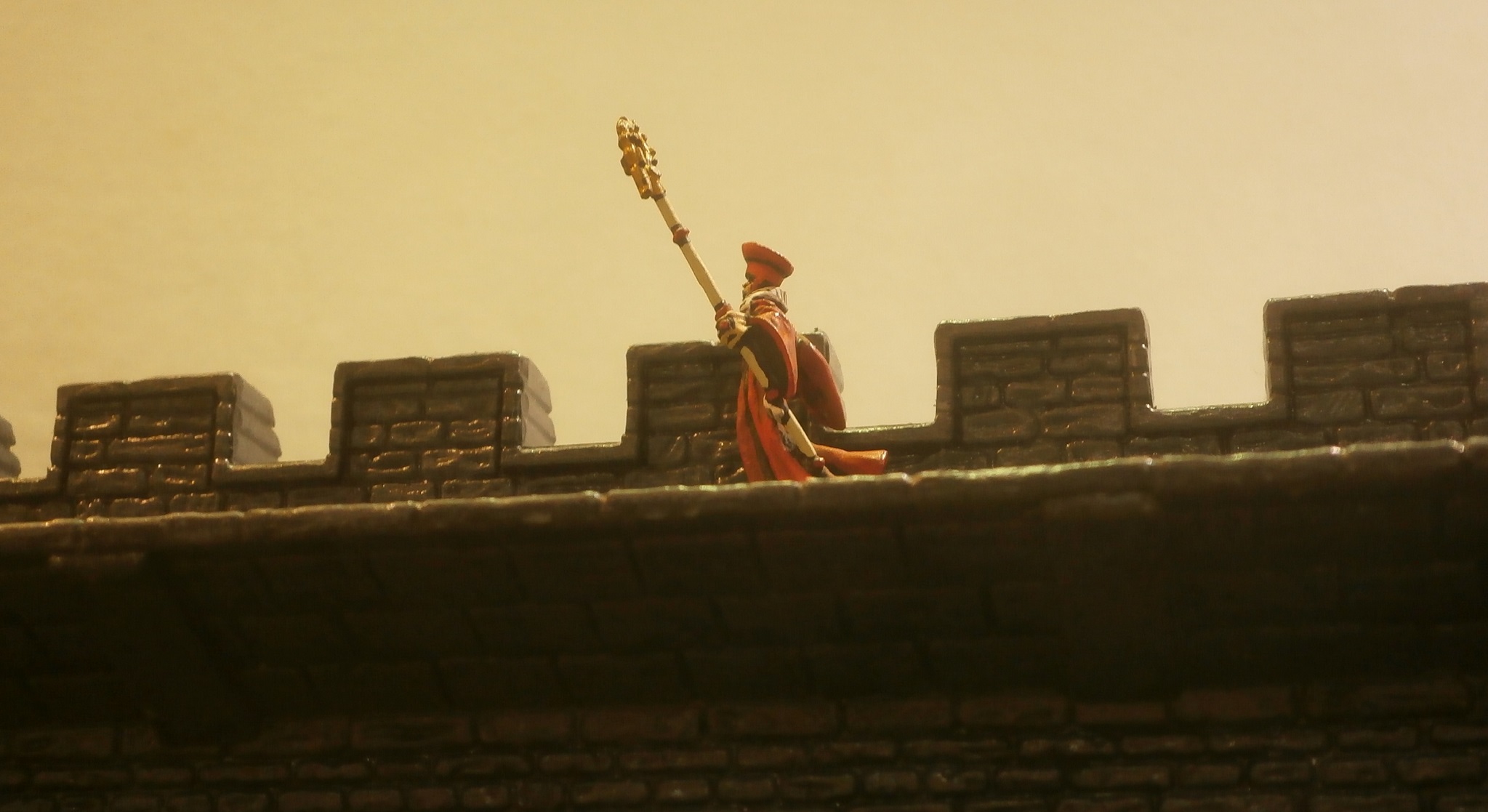
As the fight at the wall continued furiously, with more than half a dozen skeletons falling for every Portomaggioran who perished, the petard and spearmen moved ever closer to the city gate.

Captain Soldatovya led his bravi over the bridge and began moving around the city’s corner tower, hoping to find an undefended spot where he might gain entry.
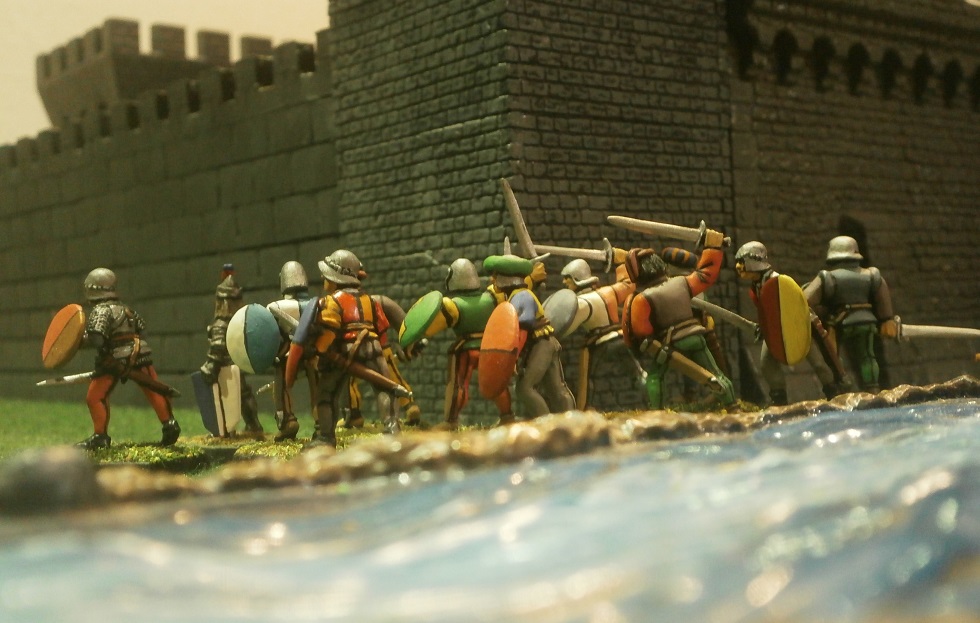
The wizard Hakim once again blessed the Sea Wolves, gifting magically enhanced swiftness to their blades, although the uncontrolled shards of magic released by his unintentionally overpowered spell spun away to visibly sting the colossus. With this continued magical imbalance, Hakim was beginning to wonder if this place was cursed by more than the presence of the undead.
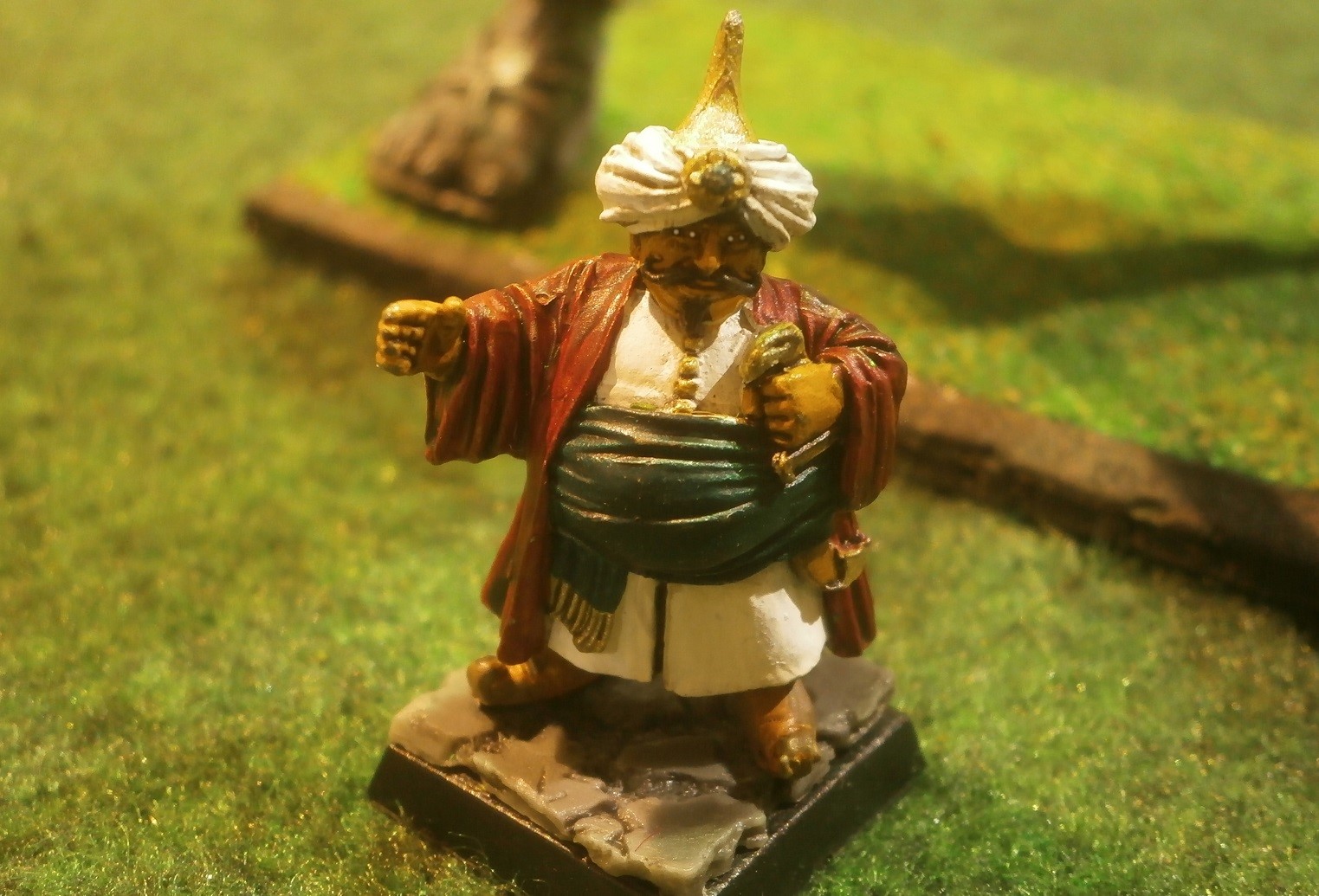
At the third moat bridge the dismounted knights simply stood their ground, watching as several of the robed zombies on the wall were felled by the handgunners’ bullets. Before the second bridge, however, the fight raged on, and as a consequence of their magical blessing, spurred on by the furious efforts of their commander Lord Alessio, the Sea Wolves hacked and slashed so vigorously at the skeletons that they felled the last foe and took possession of the wall.

The living had once again set foot within the city of Ebino. Whether they would stay there had yet to be ascertained.
Biagino spotted the sorceress fleeing along the wall into the tower by the gate …

… which spurred him also to conceal himself, dismounting the wall and entering the courtyard below. As he emerged, he saw the two brutes who had made it back from Pontremola standing patiently behind the gate.

Presuming they survived the petard’s blast, Biagino knew the pair could not hope to prevent the horde of spearmen from accessing the city. Most likely all they could do was cut down a few before they themselves fell – unless, it occurred to him, he himself could bring magical harm on the spearmen and weaken them. He decided he would try to do exactly that, despite the risks, and conjured the Curse of Years. Yet again the magical forces broiled so wildly as to be uncontrollable, and once more his body was wracked by the energies he had failed to properly channel, but this time he knew the spell had bitten, for his keen ears could hear their dying screams!
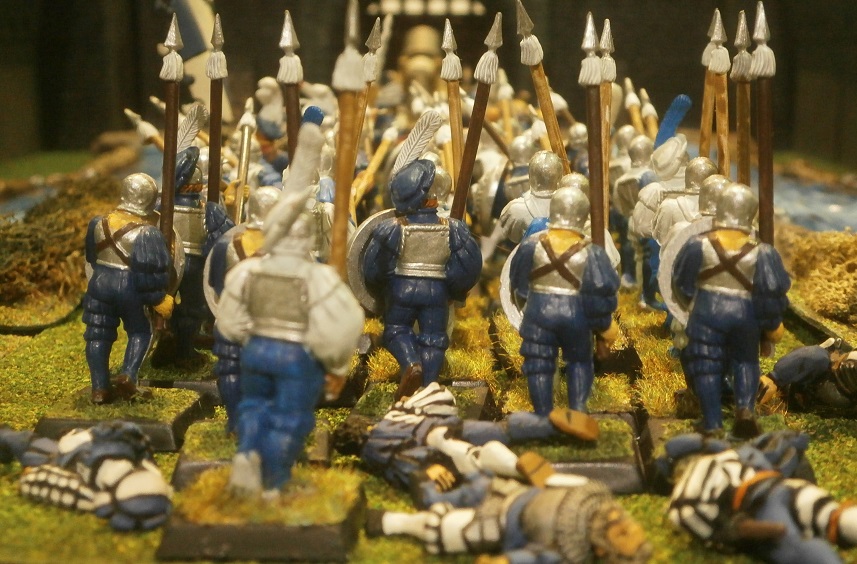
(Game Note: 9 spearmen died, Marcus Portelli was wounded. Biagino’s irresistible miscast wound was compensated, as with the necromancer before, by the Lore Attribute wound gained ‘instantly’ by the successful casting of the spell!)
Before the western wall, Soldatovya and his bravi were suddenly horrified to see a writhing swarm of ghostly beings emerge through the stones, surging forwards to block their path threateningly.
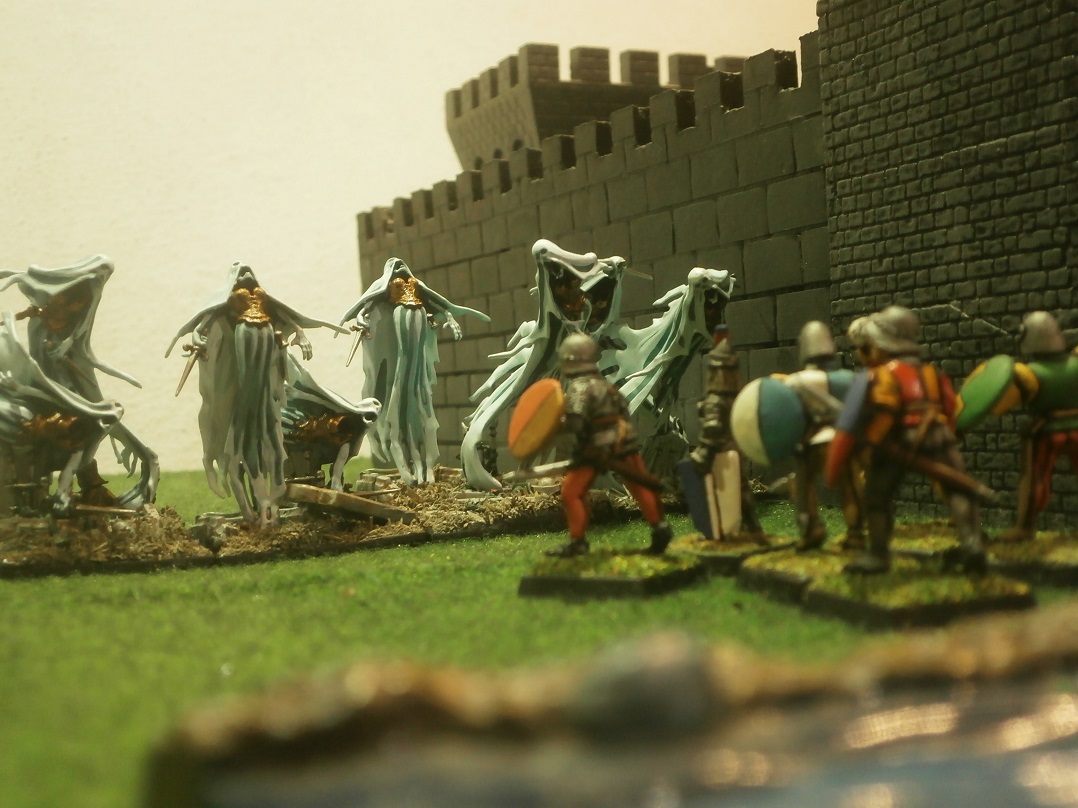
As they staggered back in surprise, the Sea Wolves above them had already begun pouring down into the courtyard to attack the corpse cart sitting therein.
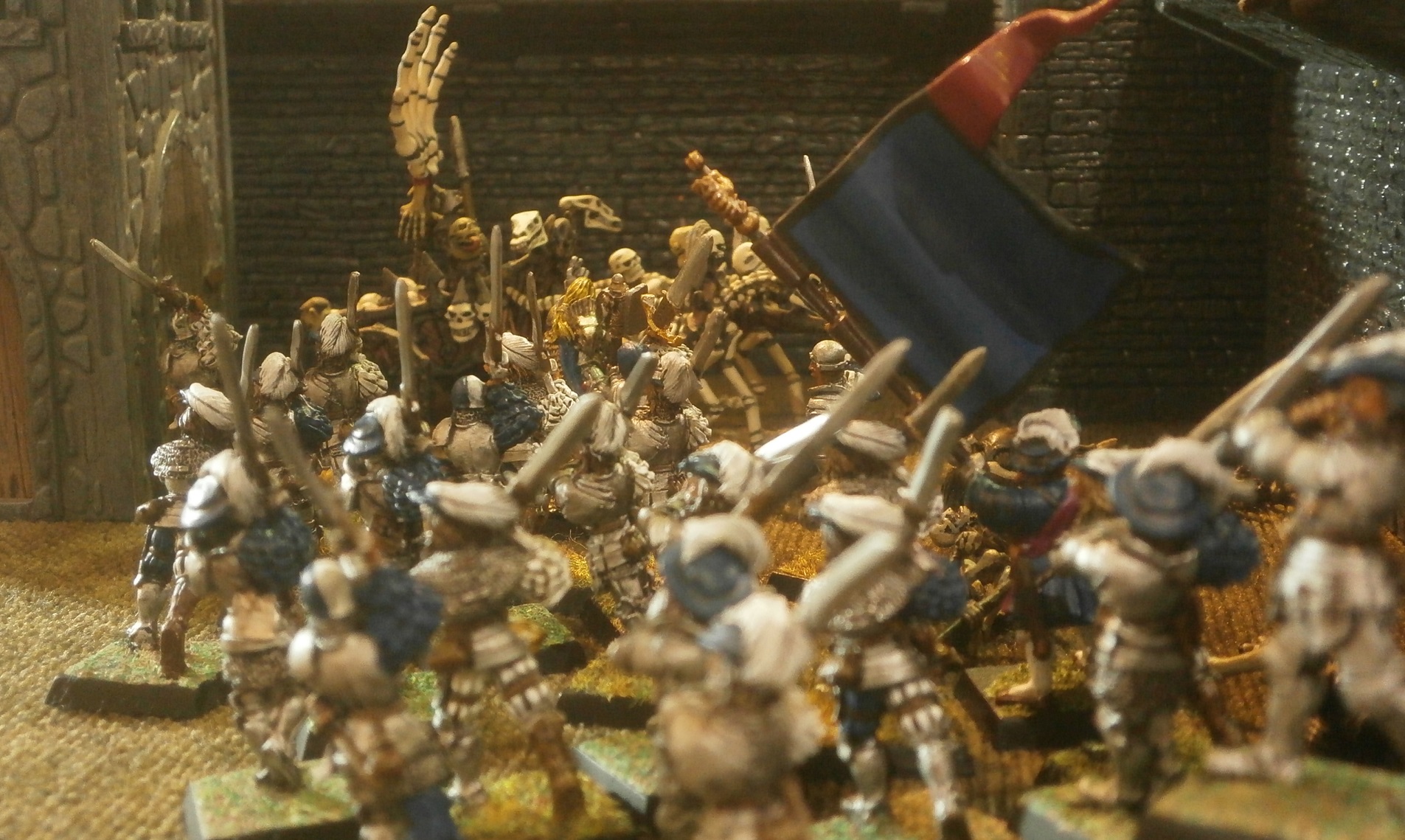
Known for his initiative in battle and a long military career forged by making the right decisions at just the right time, Captain Soldatovya shouted to his men and led them up the ladders (left behind by the Sea Wolves) onto the wall! Considering the alternative, the bravi were only too glad to obey.
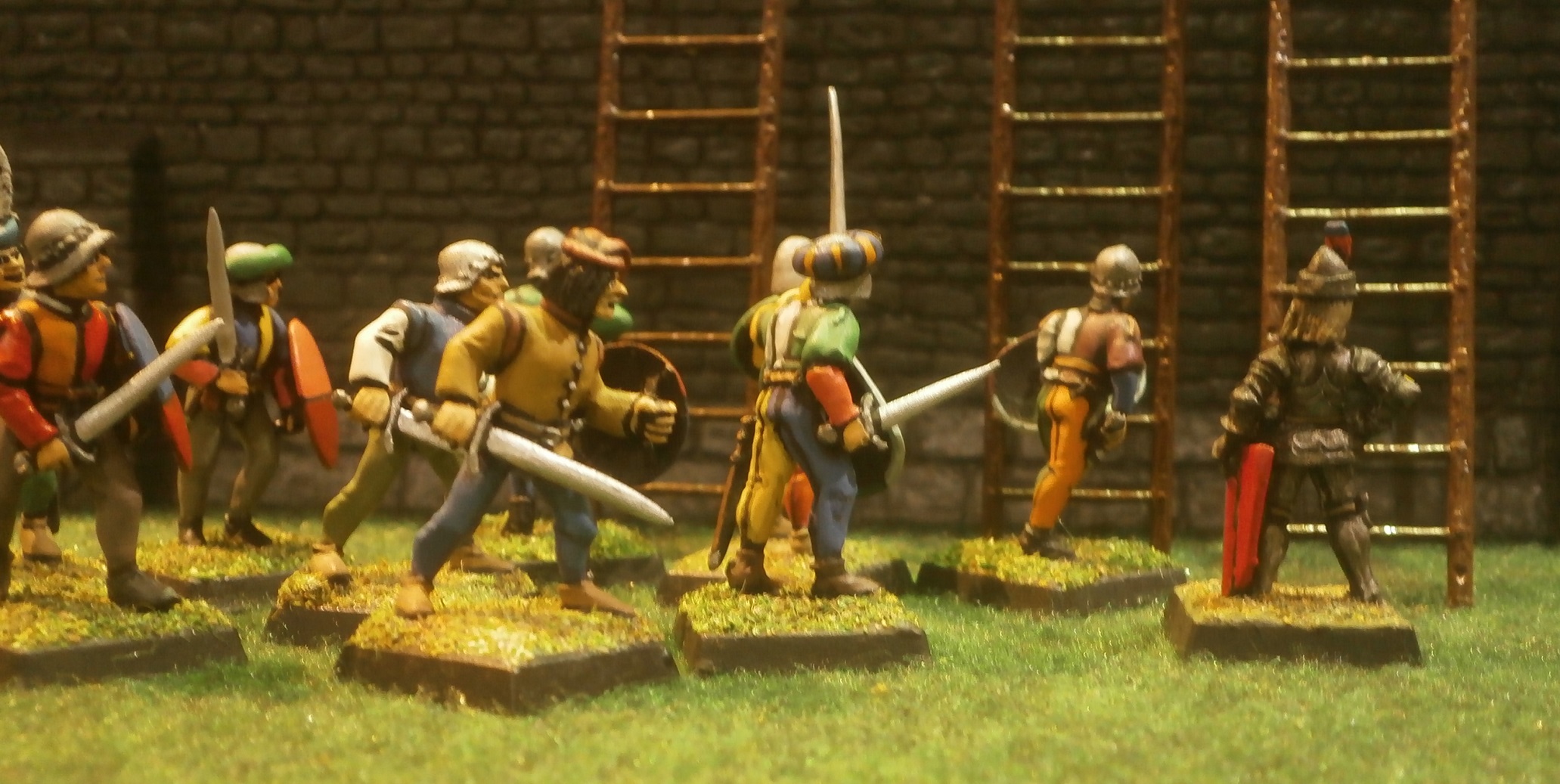
As they climbed, they glanced behind to see that the mercenary dwarfs were already crossing the first bridge, yet not one of them delayed their climb to forewarn their comrades of the threat which lay just around the corner!
As the petard was pushed and placed against the gate, the regiment of spearmen came to a halt. Despite being distracted by his wounds, Portelli knew that to advance them any further would leave the petardiers with only two options – to throw themselves into the moat waters or to die when the petard blew. Halting now meant the petardiers had space enough to escape back over the bridge.
The wizard Hakim used much of the magical power he could garner to dispel the curse afflicting the spearmen, so that neither he nor the colossus could find sufficient remaining etheric energies to successfully conjure any other spells – although both did try. At the same time, a cannon ball struck the already shaken wall and brought down a fair stretch of its crenelated top, but not the wall itself; while the famous captain Lupo ‘the wolf’ Lorenzo shot three blessed bolts from his magical arbalest at the spirits he now spied across the water, visibly diminishing their number.

All this was quickly forgotten a moment later, however, as the flame fizzling along the supposedly 25 second fuse (which the siege-master Guccio had lit exactly 17 seconds earlier) reached the petard’s touchhole to send a massive blast of flames and broiling smoke in all directions, shattering the gate into pieces and tearing off the bottom half of the portcullis.

Thanks to the noble Portelli, only half of the petardiers perished in the premature explosion, although those who did survive were so distracted, dazed and deafened that they could do little more than collapse to the ground, there to lie for the remainder of the battle. At the moat’s edge, near to the damaged but still (surprisingly) intact bridge, lay Guccio, with one leg torn and bloody, reddening the water. It would be some time before he woke – but he would live.
(Game Note: The petard, which by the rules had to roll two artillery dice, so doubling the chance of misfiring, did misfire, and the subsequent roll was a 1, a ‘catastrophic’ result. This meant it still blew up, causing the full damage that it would have done if it worked properly, but in the process it would also kill D(number of attendants). 5 out of the 10 died.)
In the courtyard, Alessio and his elite guard dispatched the corpse cart easily, while the bravi on the wall were torn between watching them and looking behind to see the dwarfs who had been assailed by the host of spirits. Several dwarfs died, but despite being entirely unable to harm the spirits with their mundane-steel blades, they fought on stubbornly.

The Sea Wolves now divided the better to clear out the city, with half going onto the nearby wall which overlooked the road, and the other half into the tower by the gate.

Alessio joined the latter company, and it was he who caught a glimpse of the witch fleeing across towards the other side.
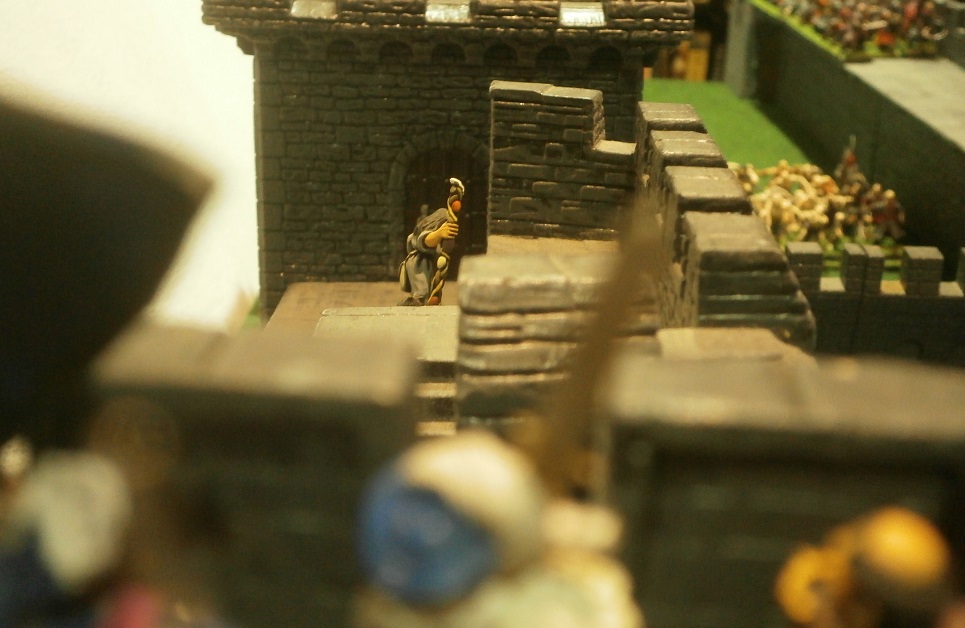
(Game Notes: (1) Our siege/assault rules allow the division of large units, 20+ models, into two, in order to occupy and thus hold more ‘sections’) (2) The petard had blown the gate open, but not destroyed the stone wall into which it was set, thus the witch was still able to move across the top.)
Meanwhile the bravi scrambled towards the corner tower, if only to allow more of their comrades to climb the wall …

… and outside the Reman crossbowmen were indeed manoeuvring to cross the second bridge and do exactly that – praying that the dwarfs could hold back the ghostly foe. And indeed the dwarfs, despite their utter inability to harm the foe with their weapons, did so, bravely holding their ground against the spirits, a defiance which in itself began to unwind some of the necromantic magic holding the foe in this world.
The dismounted knights at the far bridge chose the same moment to cross, but not to attempt a ladder assault, but rather to ready themselves for the fall of the wall to their left, so that they could storm it immediately when it did.
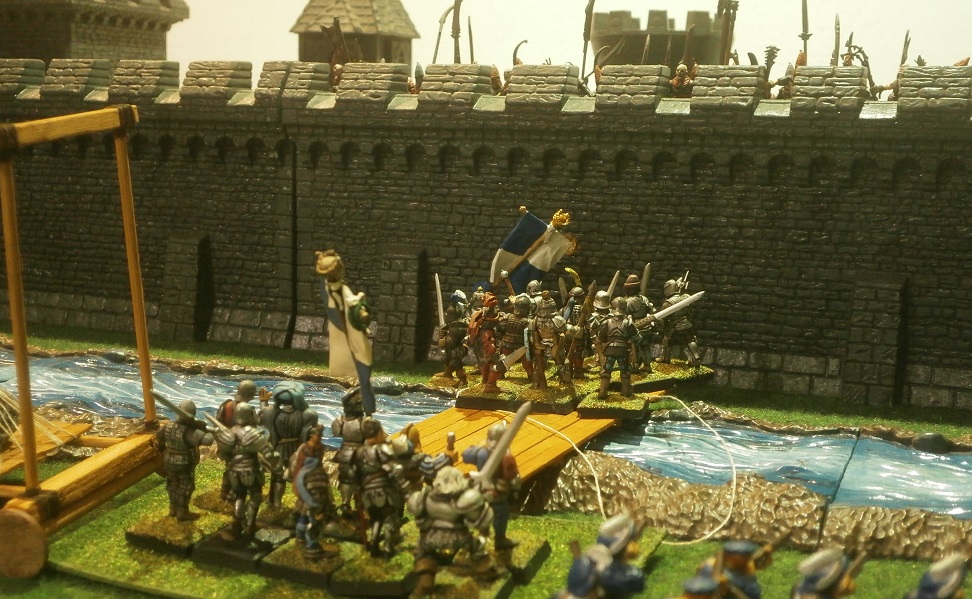
As the smoke at the gate thinned a little, Father Antonello, at the front of the spearmen who marching towards the breach, could just make out the silhouette of the two brutes upon the other side.
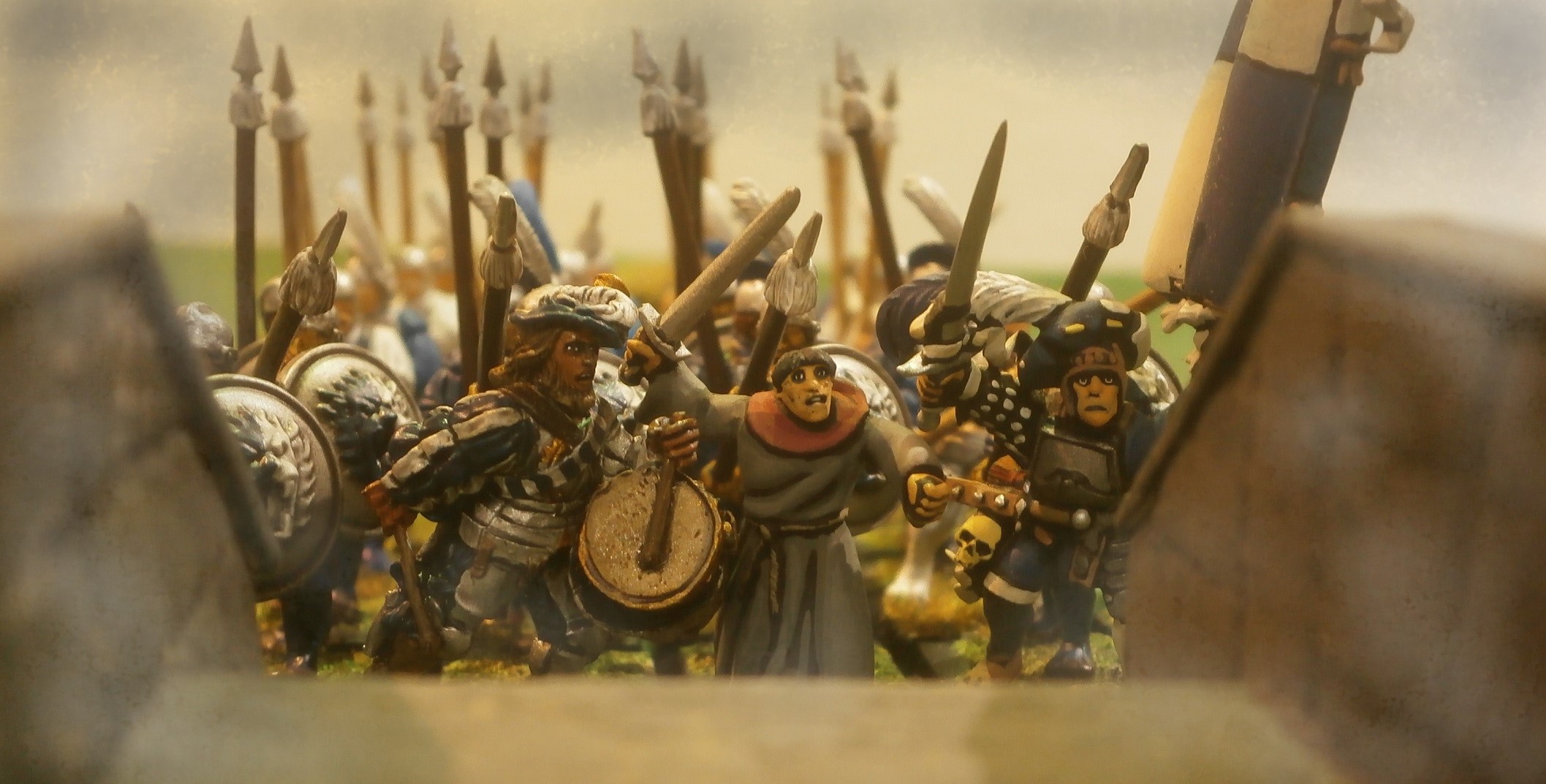
They had already been wounded by the blast, but both stood ready, for being zombies meant they felt no pain. He used his magical ring to hurl a fireball at them, but to little apparent effect beyond disturbing the smoke!
The cannon, firing again at the wall, had more luck, as this time the wall finally came tumbling down!

Several of the Disciplinati di Nagash were crushed by the collapsing masonry, the rest being entirely untroubled by the occurrence, just as they were untroubled by anything at all. Biagino watched the wall’s fall with fascination, his heightened senses magnifying the impressiveness of its collapse, an intricately clattering, part tumble, part slide of a hundred irregularly broken stones swathed in dust and smoke. With little more than a flick of his wrist, he commanded his bambinos in the courtyard to divide, sending half towards the gate while the other half remained to await whatever attempted to clamber over the rubble.
(Game note: Again, our campaign house rules allow big regiments to split into two to cover two different numbered sections of the defences.)
His half-hearted attempt to resurrect those crushed by the masonry proved a failure.

The petard’s explosion left the ears of every living soldier near the gate ringing, but not Biagino’s, and he now heard the cacophony of footfalls as spearmen advanced over the bridge.

Scowling, he summoned every scrap of the winds of magic he could and once again cursed the spearmen, slaying another ten and again wounding the nobleman Portelli.
As his men pushed by, Portelli let them pass, winded as well as wounded. He would take no more part in the battle. (Game Note: This is my way of interpreting the fact that he was not included in the ten models subsequently selected to assault the gate – using the p.129 ‘Assaulting a Building’ rules. Both the player and the fictional character seemed to know he was too close to death!)
Three more of the dwarfs fell to the deathly chill of the spirits, and panic finally got the better of them – they broke and fled away. The spirits, who tarried a while as if to revel in their success, failed to catch them.
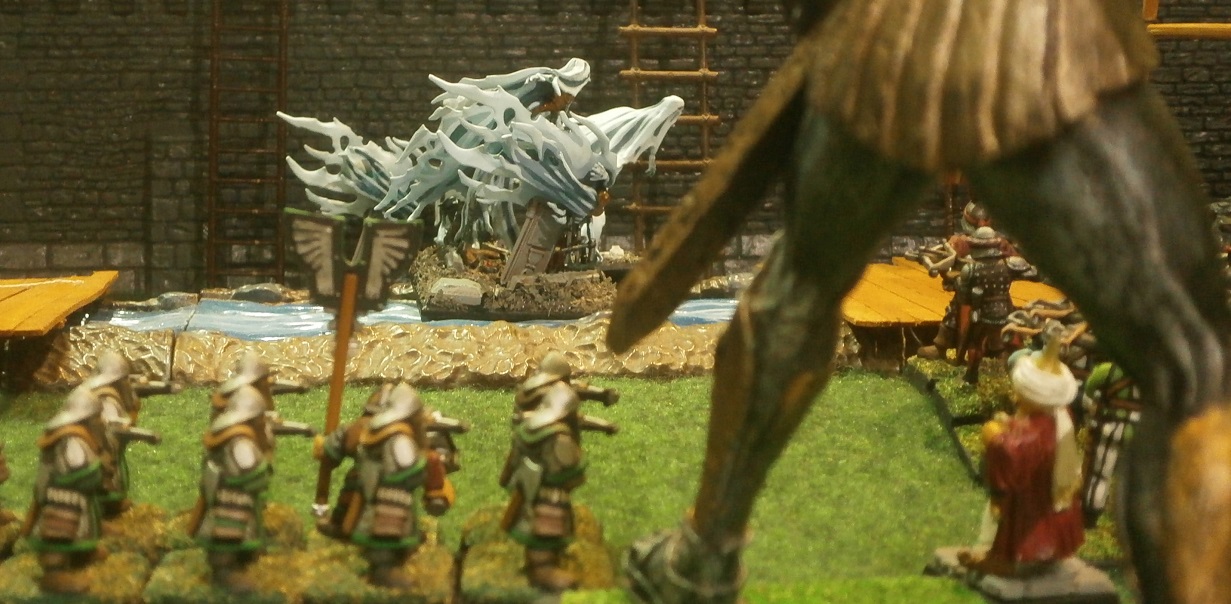
The Reman crossbowmen, several of which had already crossed the bridge, now rushed to climb the ladders, spurred on by the sight of the spirits heading their way, while Hakim the wizard stepped back as if to shelter in the shadow of the colossus!
Fighting Father Antonello now led the surviving spearmen, of which there were still many, in a charge through the shattered gate …
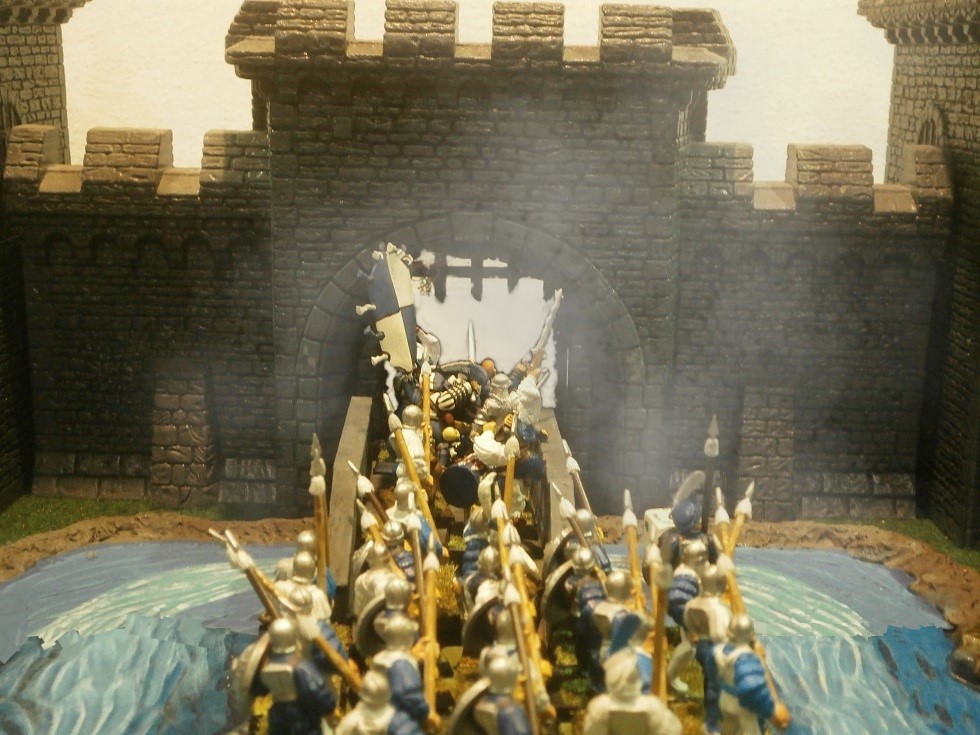
… and into the brute horrors waiting on the other side. Lord Alessio himself had also spied the brutes and, leaving his Sea Wolves to scour the tower for more enemies and to better guard that quarter of the city, he personally charged to join Antonello at the gate. While the priest and spearmen struggled to best the brute they faced, Lord Alessio’s blows landed hard, and he brought down the other with ease.
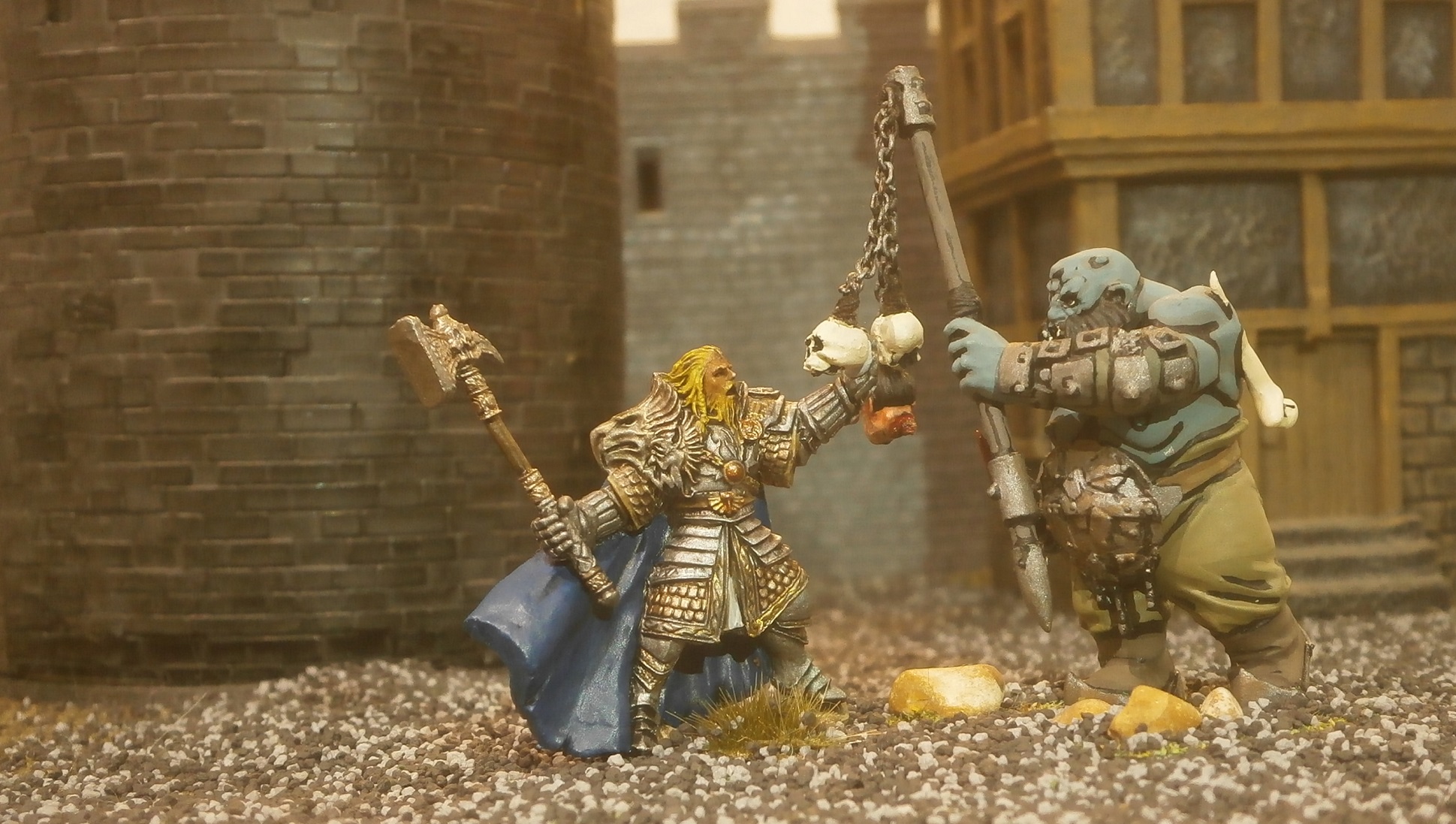
Father Antonello’s blade was somewhat less effective, however, and although the grey cassocked, sandaled holy man fought with rare courage …

… the brute finished him easily with a blade longer than the priest was tall. Then, even as the magical forces animating its corpse-body dissipated, the brute stamped down to crush the priest’s head under its foot, before falling itself on top of the priest.
(Game note: In the zombie ogre’s last moment, I rolled to see whether its stomp attack might be used in this manner, resulting in a kind of ‘overkill’ wound. It was. The Remans, although here commanded by Damian (whose character of Lord Alessio of Portomaggiore) are NPCs, as are the Undead, so as GM I like to roll on little hastily created tables sometimes just to decide between options! The significance was that Father Antonello, being ‘overkilled’, could now roll on the campaign rules’ character recovery chart. He was most definitely and very dead.)
Captain Hans Wiedmuller, the artillerist tending the last surviving cannon, was able to enchant the iron ammunition using his magical Matrix of Undoing, and so dissipated several more of the spirits with a very well-aimed shot.
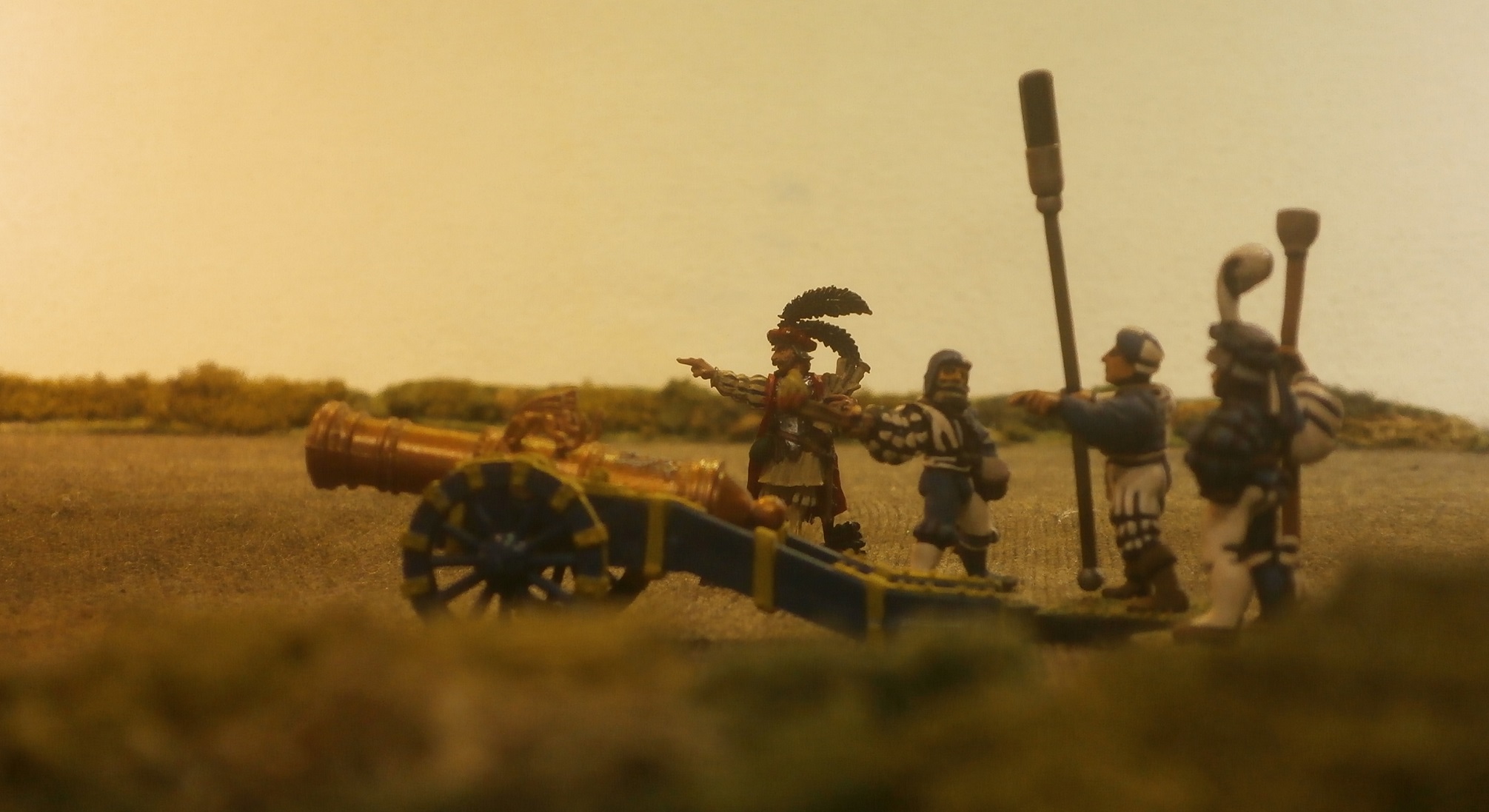
The surviving spirits’ attention had been caught instead by the crossbowmen hurtling past them to rush up the ladders, and so they swirled in a graceful arc up and over the wall, chasing the Remans before them and right across the courtyard into the city.

(Game Note: The crossbowmen declared a flee action.)
Outside the fallen wall the dismounted knights were approaching the breach.
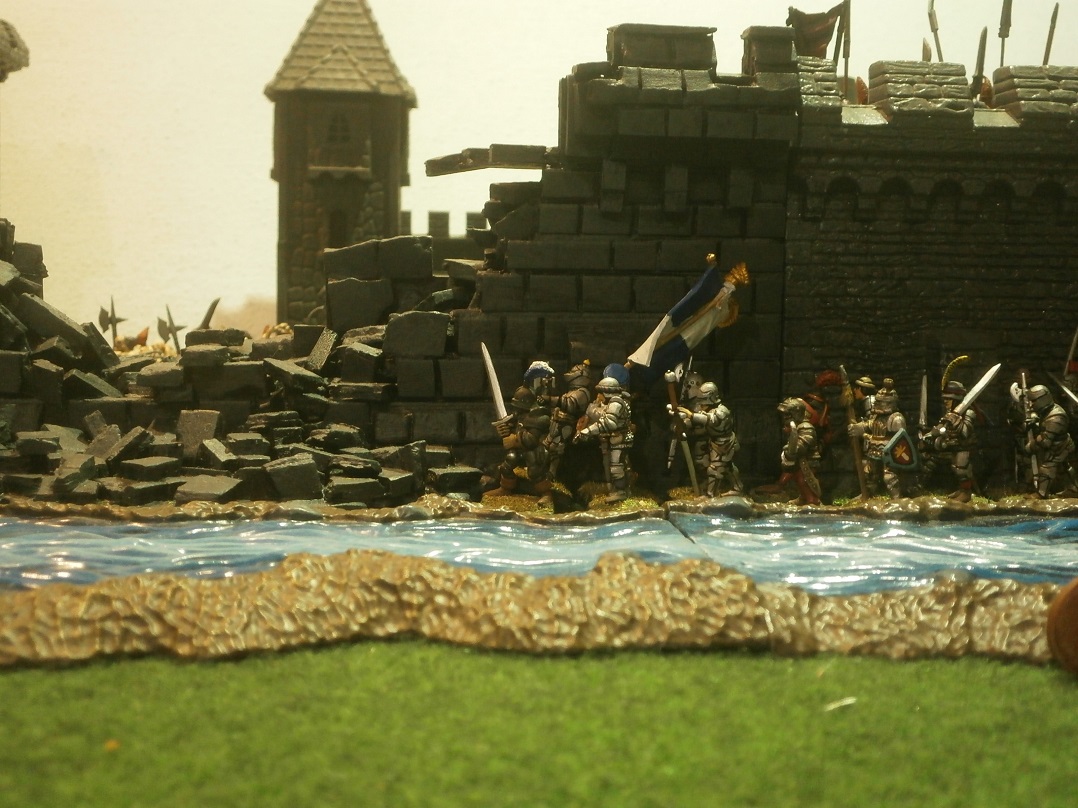
As they drew close, the Disciplinati lurched up and onto the rubble. The lesser nobles now realised that crossing the rubble was going to involve considerably more difficulty than merely a struggle to climb in full plate armour!
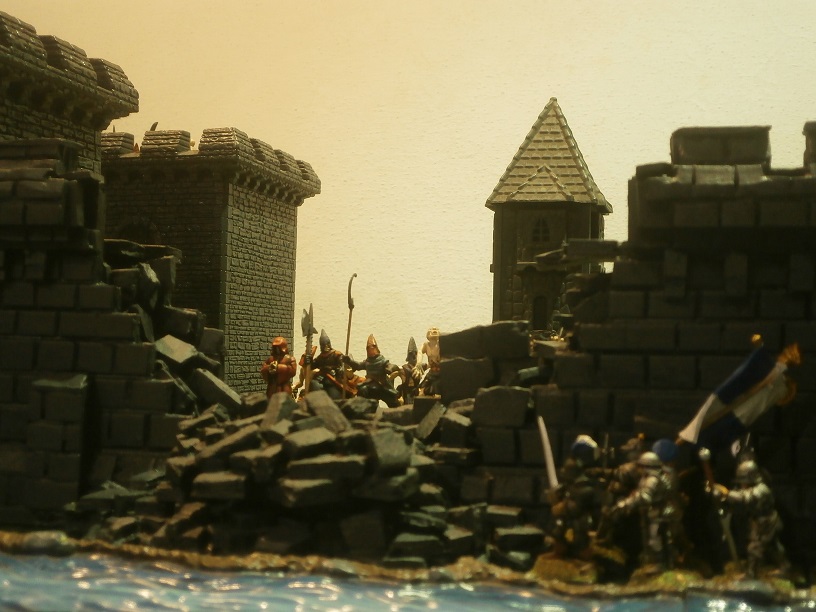
Biagino had willed the Disciplinati on, but at the same time he ordered the thrall upon the wall commanding the other company to come and join him. It was, he now acknowledged, time to leave. He was not willing to die attempting to hold on to Ebino. He had only really taken the place as a species of vengeance against Maria, and in truth he cared nothing for the city, nor had any real desire to remain.
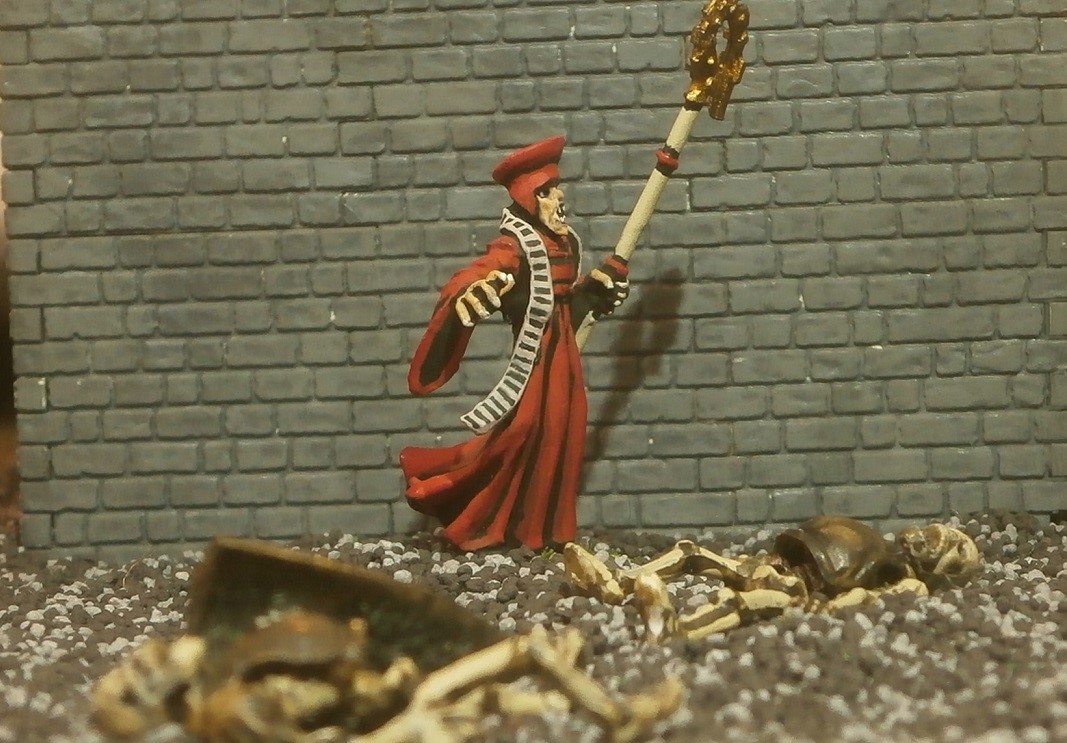
He satisfied himself that he had hurt the enemy enough to make them think twice about venturing any further north. Miragliano lay to the north, a much mightier realm, once ruled by the vampire Duke Alessandro, with greater walls and a wider moat. He would take his chances there – see if he could wrest it from whoever currently ruled, if indeed anyone did. And if the enemy chose to follow him, then he would fight again with whatever forces he could raise. Now that Lord Alessio’s army was even further weakened, surely that improved his chances of finally, properly defeating them?
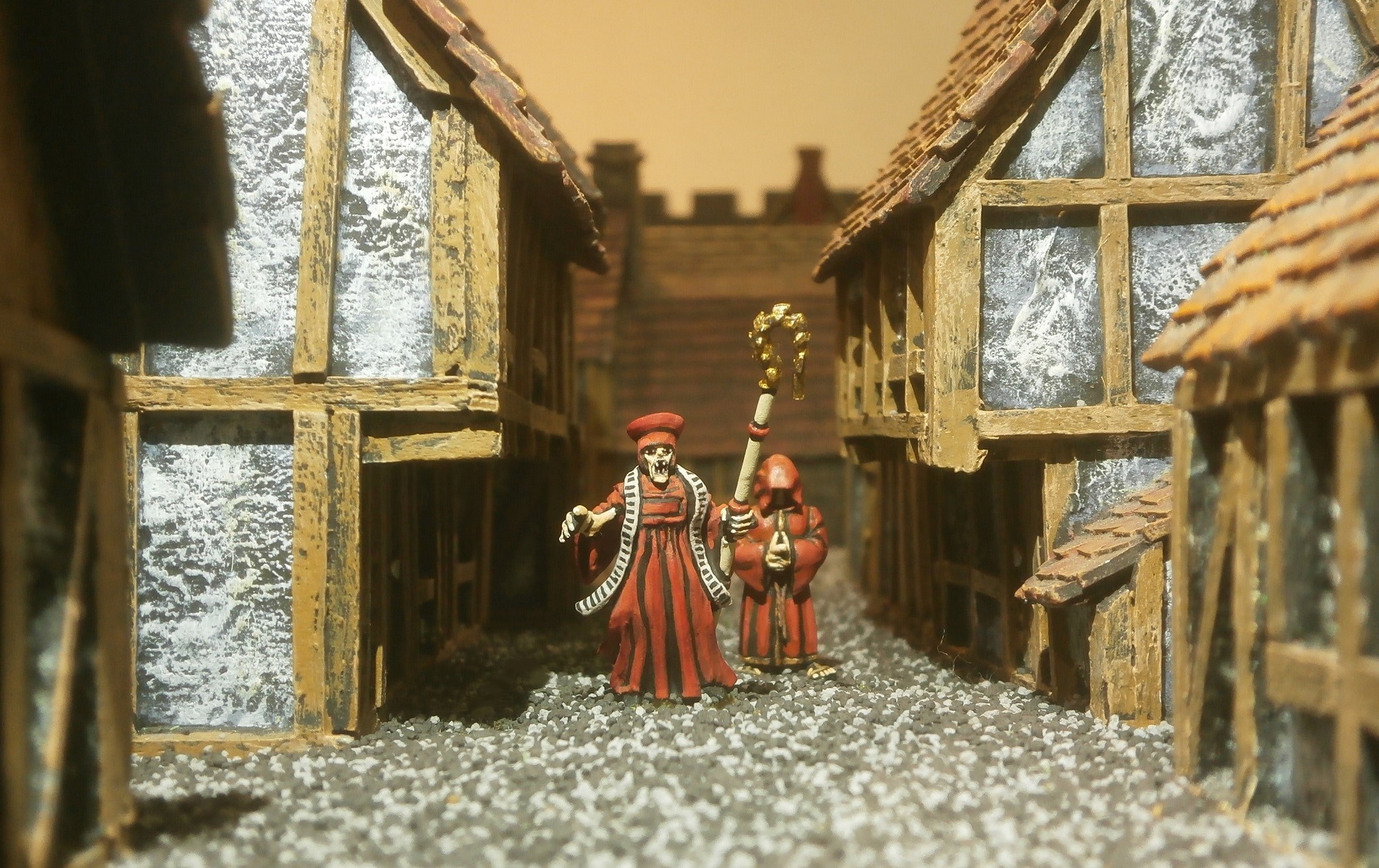
So it was that the vampire arch-priest Biagino, with his servant thrall loping behind to keep up, flew through the streets of Ebino and out through a hidden postern, leaving his bambinos to keep the enemy busy a while and so buy him time!
Which that they did.
While Father Bendali, the second Morrite priest with the army, summoned up the courage to attempt a prayer on the host of spirits pursuing the crossbowmen …
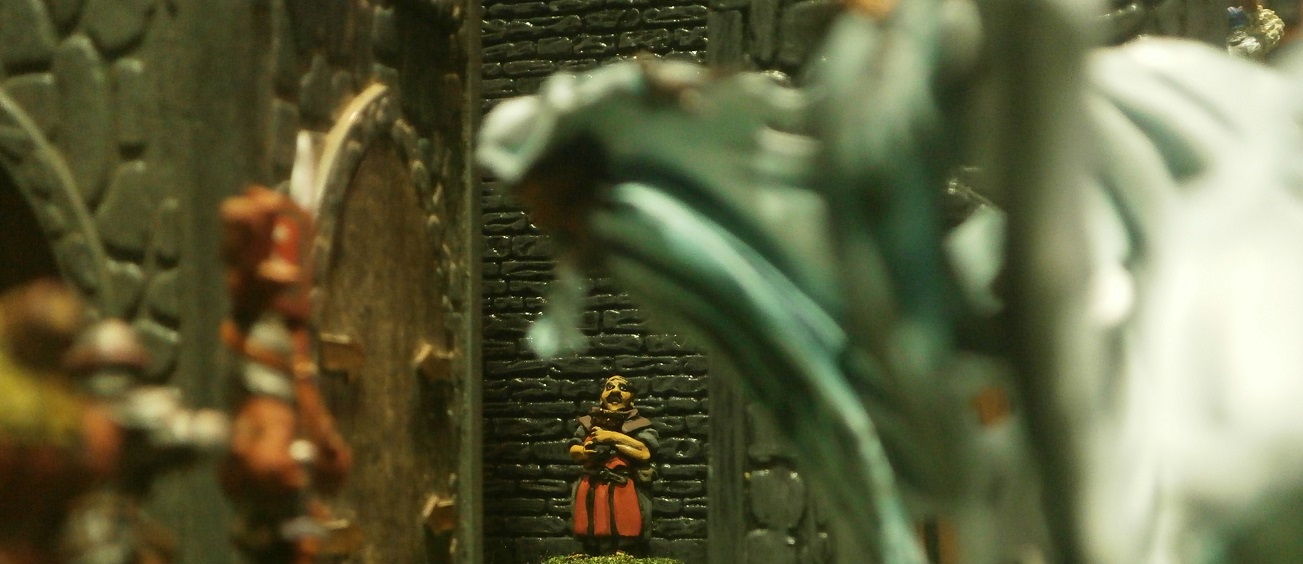
… the dismounted knights scrambled up the toppled masonry to become caught up in a frantic tangle of a fight with the frenzied, zombified dedicants of the Disciplinati di Morr, now having become what was once their own enemy!
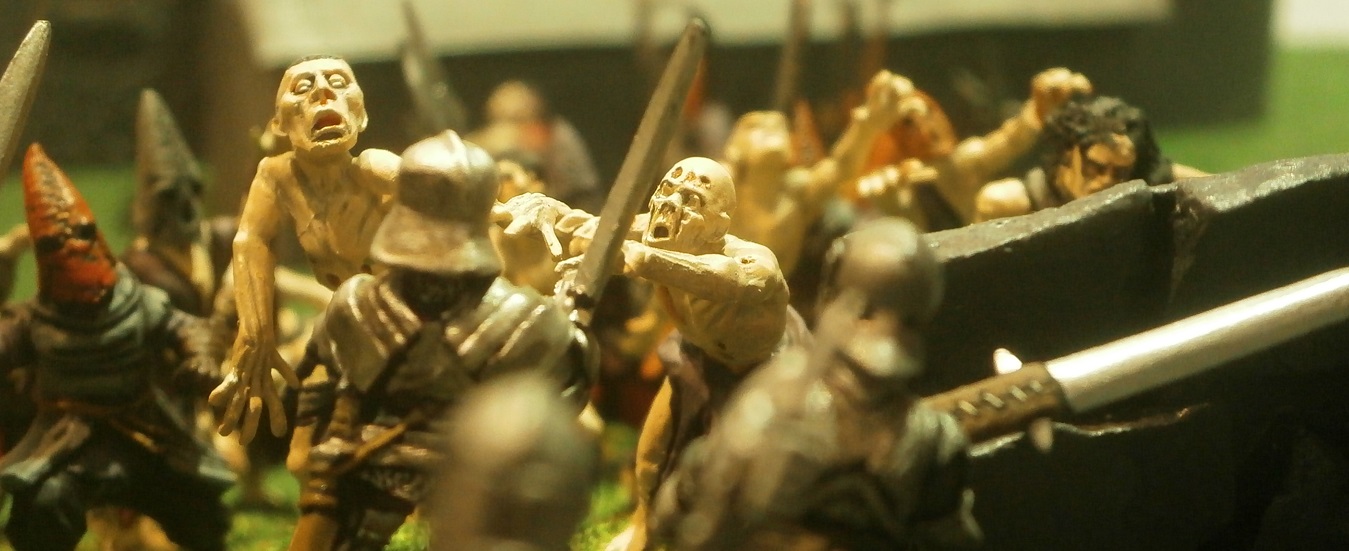
And as the other company of men at arms struggled up ladders to face as exactly similar foe …
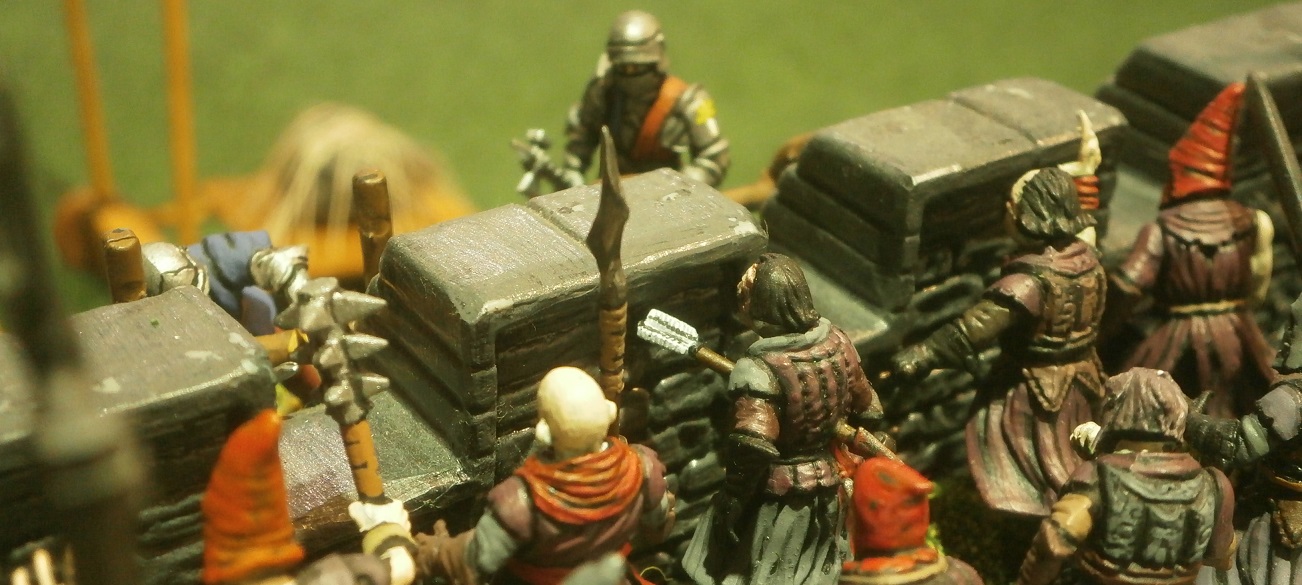
… Lord Alessio himself personally led the charge against the third such body of zombies, who defended the tower upon the other side of the shattered gate.

The living, armed and armoured well and with much greater fighting prowess than the walking corpses opposing them, were almost certain to prevail. And so they did. But it took time, which Biagino, exactly as he had intended, used well.
When the living finally wrested control of the city, Biagino was long gone, and entirely out of their reach.

Game Over, end of turn 8.
Thank you, Matt, for running the (NPC) Undead, and thank you Damian for commanding your army once again in a week long play by e-mail battle. That reminds me, when I am allowed, I must return your army to you!
Next Installment: Part 34

 BigSmallWorlds
One thought on “Tilea Campaign Part 33”