A Letter to King Jaldeog of Karak Borgo

This to His Highness King Jaldeog, writ in haste by your servant, Darnaec Whitmail, after consultation with some of those present at the recent fight against the ratmen beside the River Bisavera.
Further to my previous, short missive, concerning the sad news of the death of noble Thane Narhak, which was sent in haste immediately after the fight, and in obedience to your instructions to him, regarding that he provide a detailed description of the enemy and any fight against them, that you might better make plans for war, I have spoken to numerous captains present upon the field of battle, even as we made our way back to the defences we so recently abandoned, so that the fullest and most accurate picture of all that occurred, far beyond that which I myself witnessed, is here presented to you.
Upon Thane Narhak’s orders, mutually agreed with Lord Veluthil, we abandoned our fortified camp guarding the tower and bridge at Soncino, for intelligence had been received that the enemy had moved to the south of us and were intent on crossing the river there by some other means, thus avoiding our defences. Every part of our force was ordered to march, leaving nothing and no-one behind, for this was our opportunity to strike at the enemy’s main strength and hopefully end the threat they currently presented to the whole of Tilea. Thane Narhak revealed to me that the elves were expecting reinforcements – including more foot archers and horse soldiers (the reformed Sharlian riders), as well as whatever part of the alliance force near Viadaza had chosen to venture further north after the dispersal of their newly rancorous component parts – but that High Lord Veluthil was unwilling to wait and risk losing this chance to bring the foe to battle. If we had delayed, then the enemy might have crossed the river in strength and even now would be advancing south bent on destruction.
Our enemies, it seemed, were also keen to bring their full strength to bear, and to do so on favourable ground, so they too abandoned whatever works they had embarked upon and marched north to meet us.
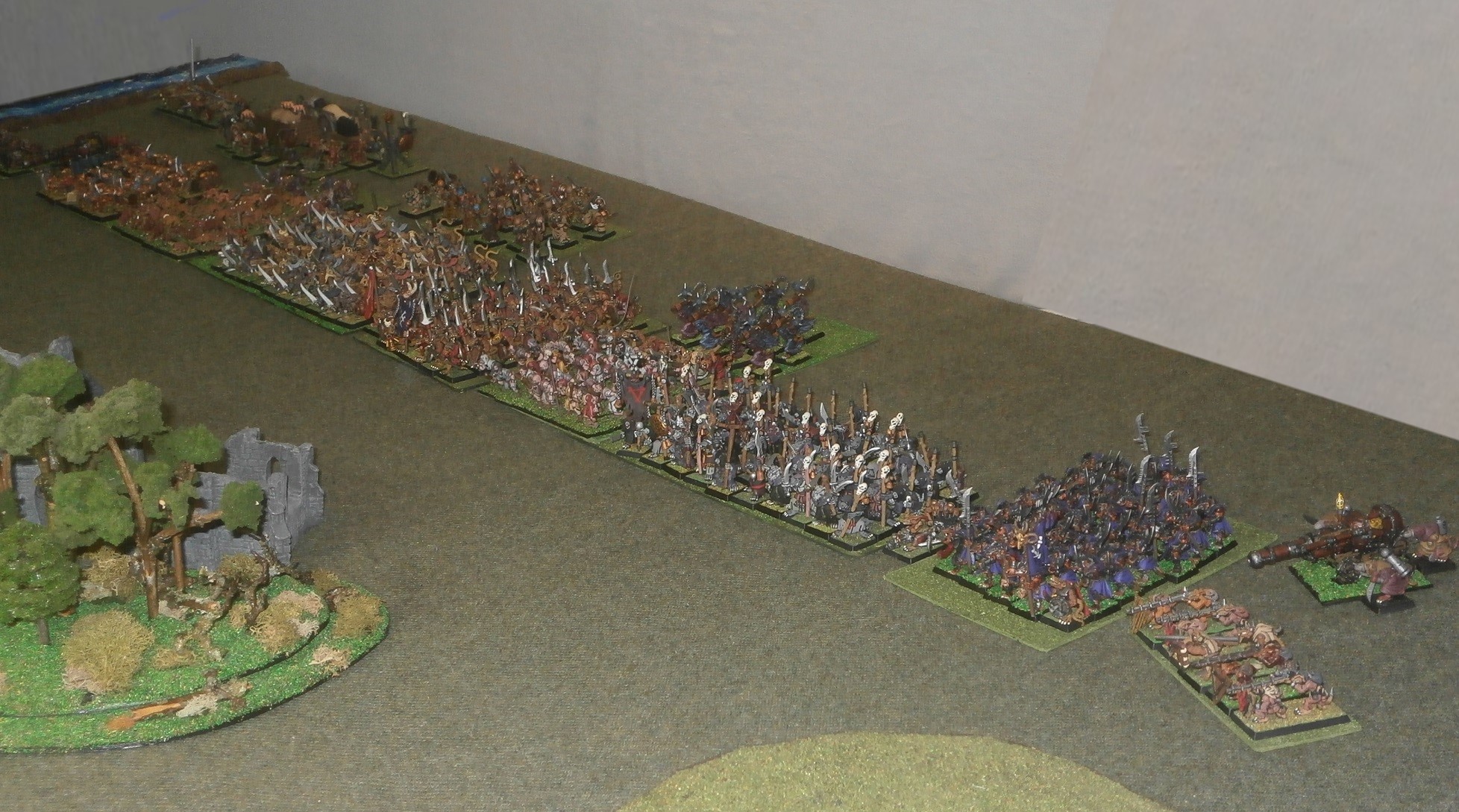
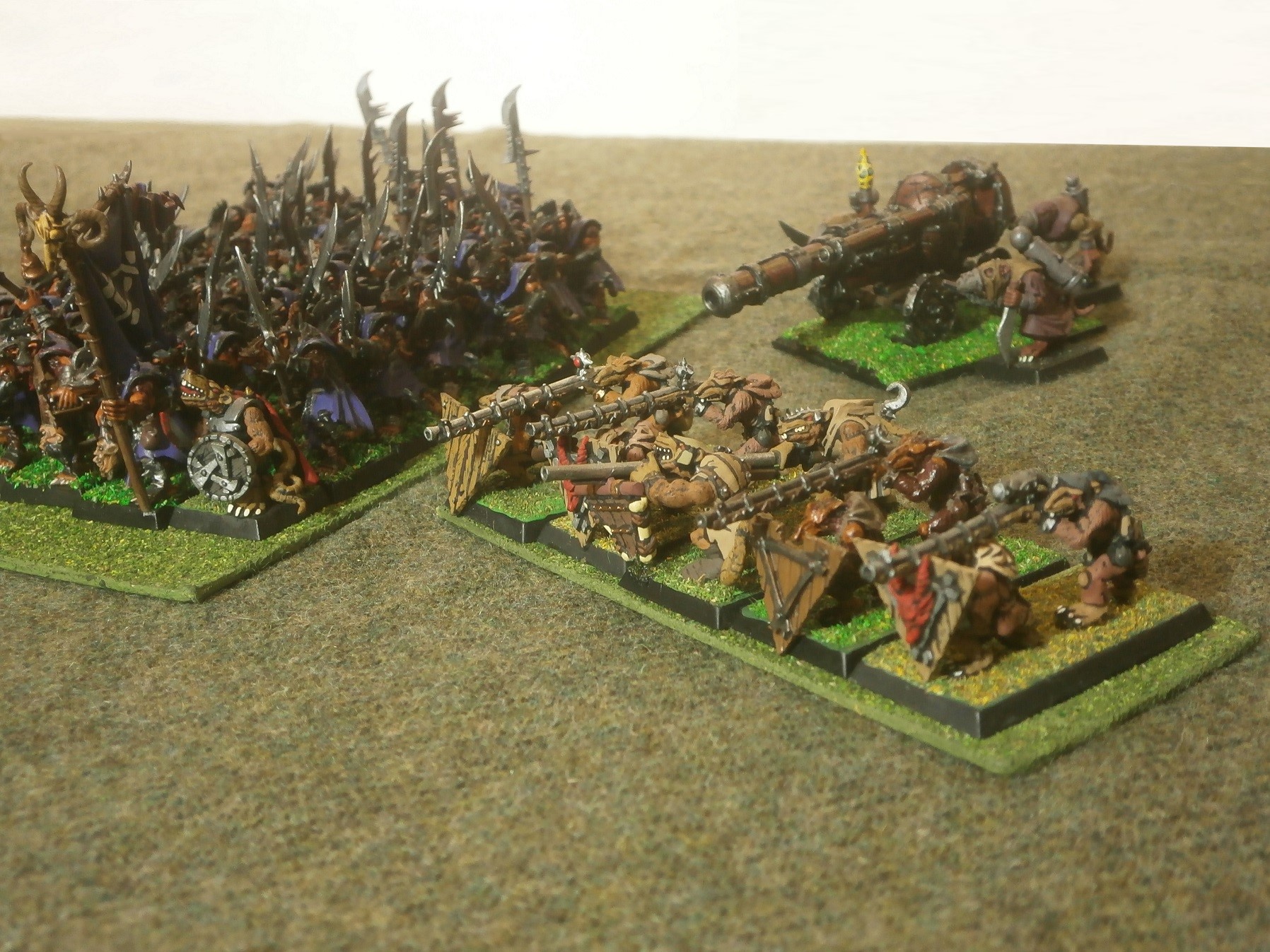
Their host was vast, truly a verminous horde, both in the numbers of regiments as well as in the size of those regiments, so that they stretched before us almost like an unbroken mass, sharing such close proximity with each other that any attempt to outflank any part of them would surely prove unaccomplishable. Their rightmost flank, abutting the river (which, without vessels of some kind, was reported by the Arrabiatti to be entirely impassable from the bridge at Soncino behind us all the way to the sea) was guarded by two companies carrying long-barrelled muskets, indeed so long that each required a second handler, who bore a triangular pavaise upon which the barrel could be rested.
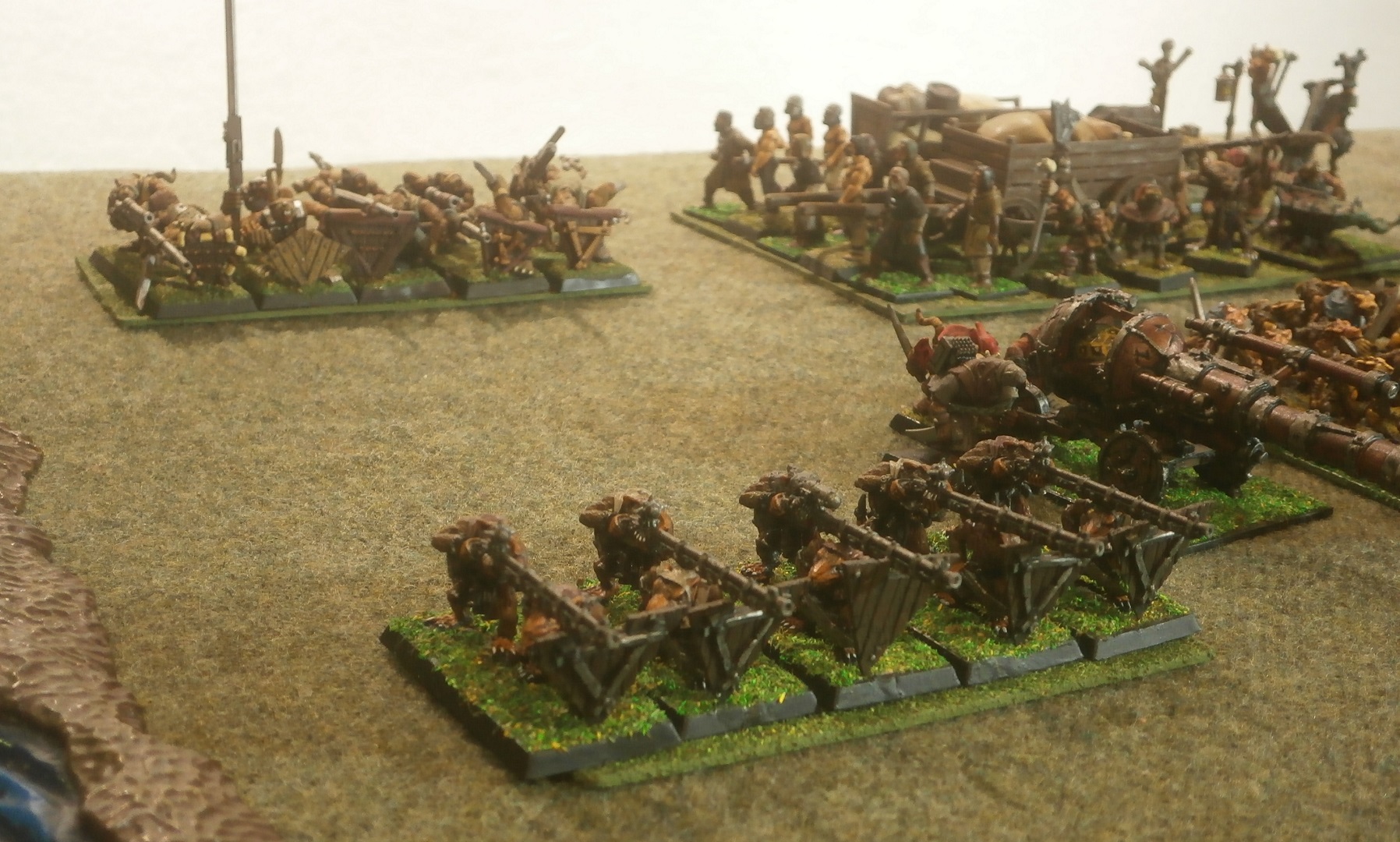
These would prove quite deadly from their first shots.
Beside these was a hulking, wheeled artillery piece that spat not round-shot but slivers of lightning-like flame.
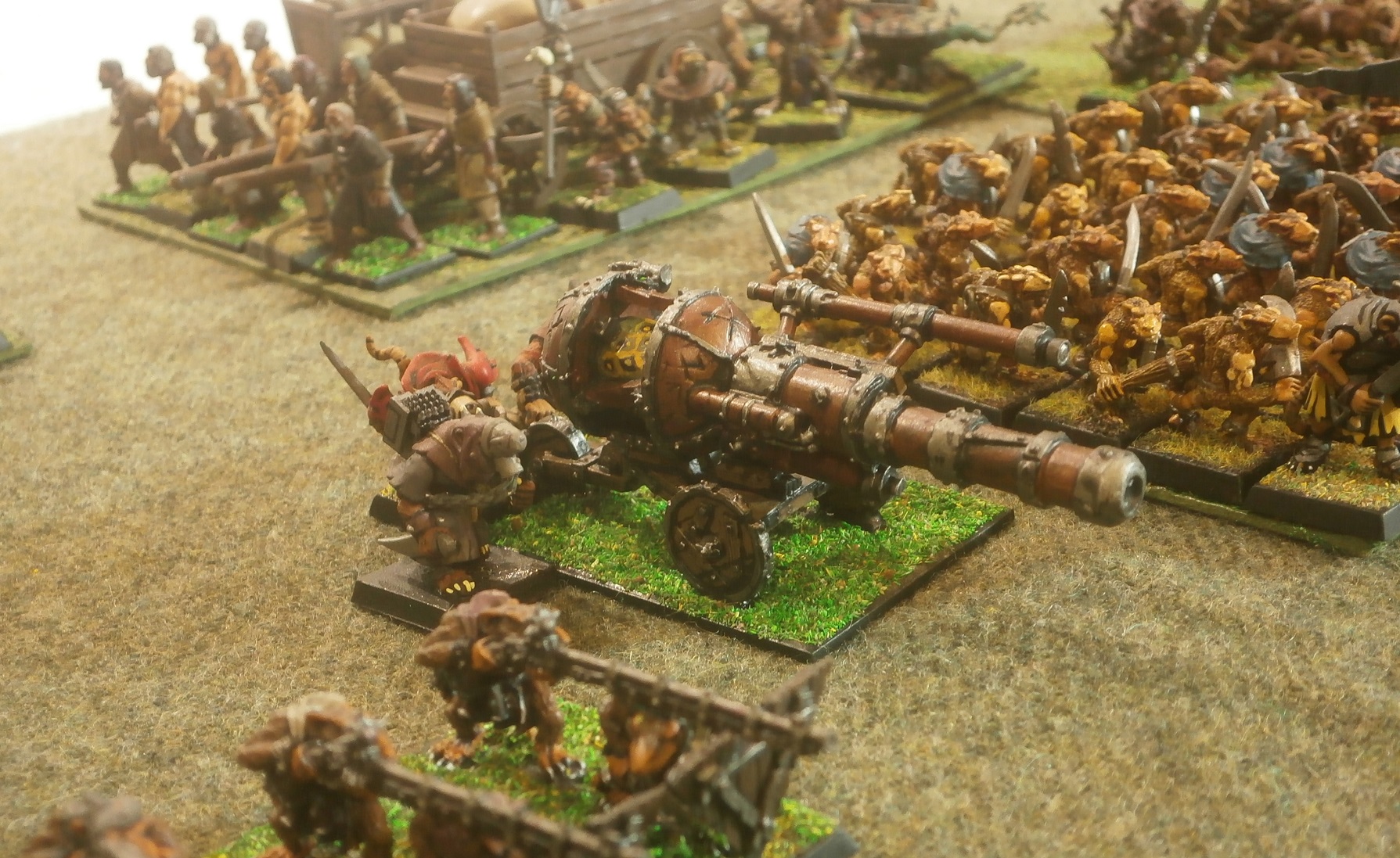
Next in line came a large body of ratmen, meagrely armed with only blade and shield, presumably among the least of their warriors. An elven rider told me that they were most likely slave-soldiers, and that there were more such bodies further down the line, for his keen eyes had spied shackles of iron upon their ankles through which chains might be passed to restrain them as necessary. Nevertheless, they were led by a larger captain, heavily armoured in iron plates, whose squealing commands seemed sufficient to keep them in order.

Beside them was a large mass of giant rats, some almost as big as the ratmen themselves, driven on by whip-wielding herders. Despite possessing only animal wits, and armed with nothing more than teeth and claws, these were to prove, due to their sheer number, a deadly foe. Any bolts or arrows shot at them seemed to us a waste, for the harm thereby caused would be barely noticeable, and of what real worth was the dispatch of such base animals? This was to prove a costly misapprehension.

Behind these and the aforementioned slaves, was the enemy’s baggage, in the form of several wagons and carts

Hauling these were prisoners, captured men no doubt beaten into submission and made to act the part of beasts of burden. We did not at first know it, but amongst this motley collection of baggage was a chest, carried upon a pallet by four ratmen, which presumably contained that mysterious cargo which we had heard reports of, delivered to the ruins of Miragliano by the crew of a plague ship. As the battle progressed, the etheric power emanating from this chest was sensed by the elven wizards, even Lord Veluthil himself.

Next in line, almost squarely in the centre of their army, were even more slaves – indeed a teeming mob of them …
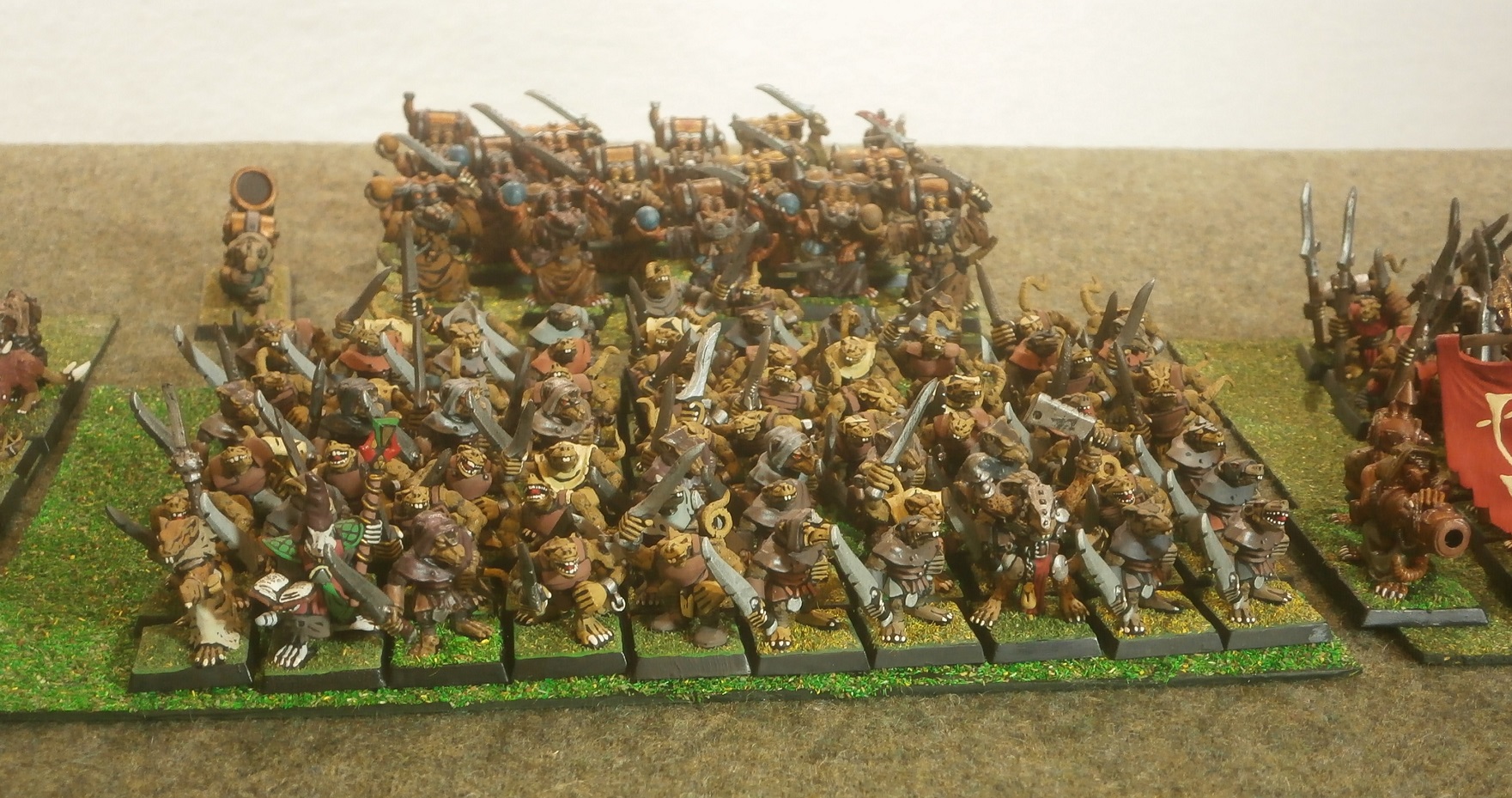
… which appeared at first, to my eyes (for they lay almost directly before me), to be an miserably amorphous mass of ragged ratmen. I later made out two individuals at the fore, quite different from the rest. The first was an armoured warrior, with a hook in place of one hand and in the other, what looked more like a cleaver than a sword. The second wore robes with a tall hood and carried an open book. Several amongst the elves (whose eyes seem keener in both daylight and the dark than myself or any amongst my arbalesters) have assured me this was undoubtedly none other the Grey Seer Cralk himself.

I was not easily convinced of this, for why would the enemy commander join the least of his warriors in line of battle, the very dregs of his army, least able and worst equipped to defend him? Yet even I spied his robes, staff and his grey fur, and it later occurred to me that such as he might even be keen to ensconce himself among the most massive of his regiments, despite the mean nature of its constituent parts, able there to hide better than amongst any of the other mobs – seeking safety in numbers, so to speak. This was to prove a mistake on his part, but sadly, not one that would cost him his life.
Behind this horde, unseen until later in the battle, and then only by a handful of witnesses, was a company of leather-robed skirmishers. Their robes, masks and the copper kettle-like contraptions they bore upon their backs made them appear large, but presumably they were ratmen inside, no different from the rest.

These bore strangely hued grenadoes and serrated blades, and were to spend the battle creeping about in the rear, perhaps ordered there to intercept any who might, like Arconvale’s war-hawks intended, circumvent their battle line to attack from behind.
Besides the massive mob of slaves marched a red-clad regiment of clanrats, bearing heavy, barbed spears, and two banners – presumably one being their own and the other being that of the army, although which was which I could not say.
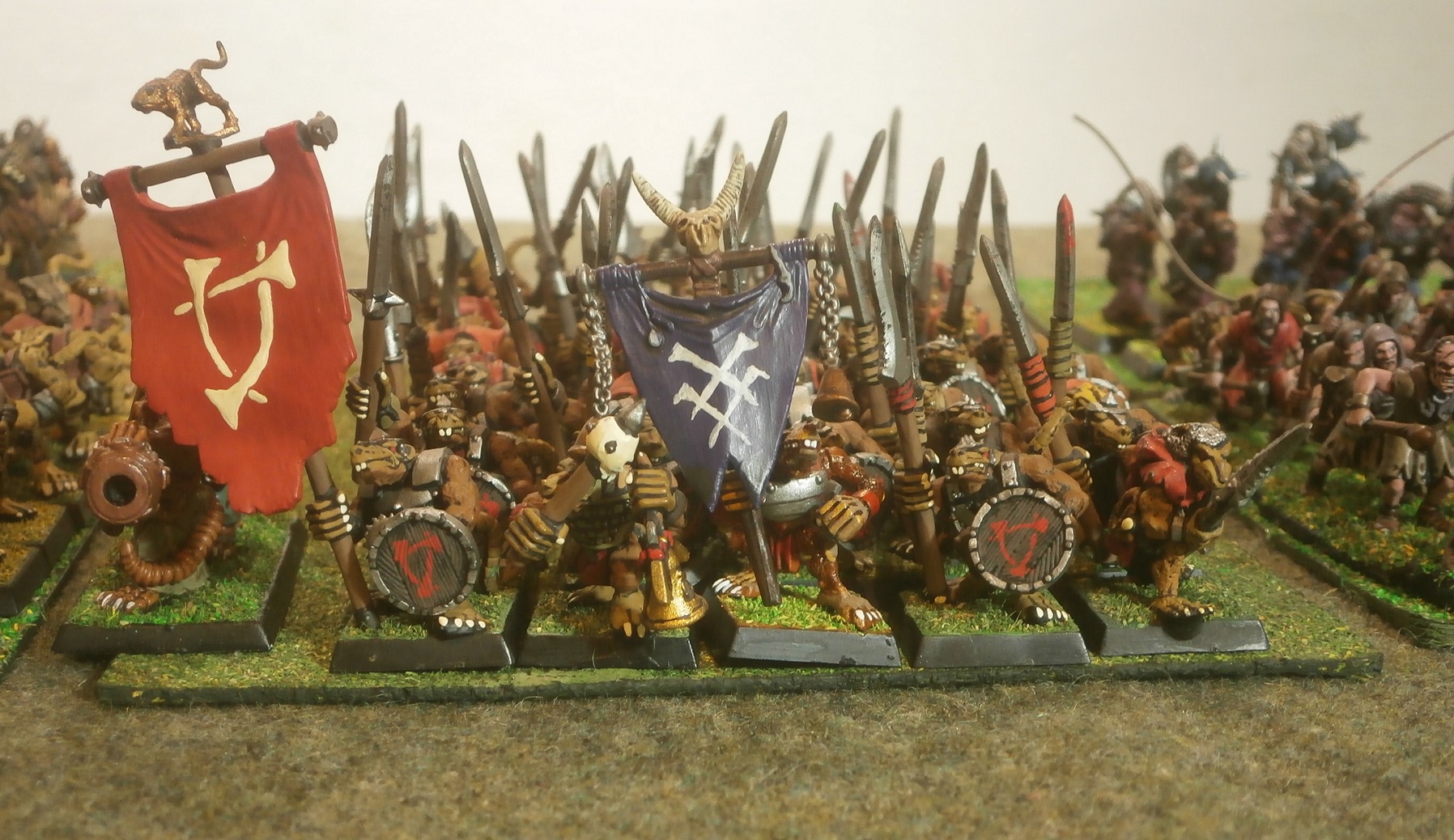
This regiment, dwarfed by the slaves to their right and appearing considerably less dangerous than the ferocious warriors on the far left of their line, were nevertheless to prove themselves horribly capable in battle.
Beyond them came yet another body of slaves, which I never laid eyes upon throughout the battle for they were concealed first by the ruins of a church and later by the trees in the centre of the field. Indeed, few survived who saw them, but I did speak to one poor soul who escaped what was to happen later, and he told me that they were men!
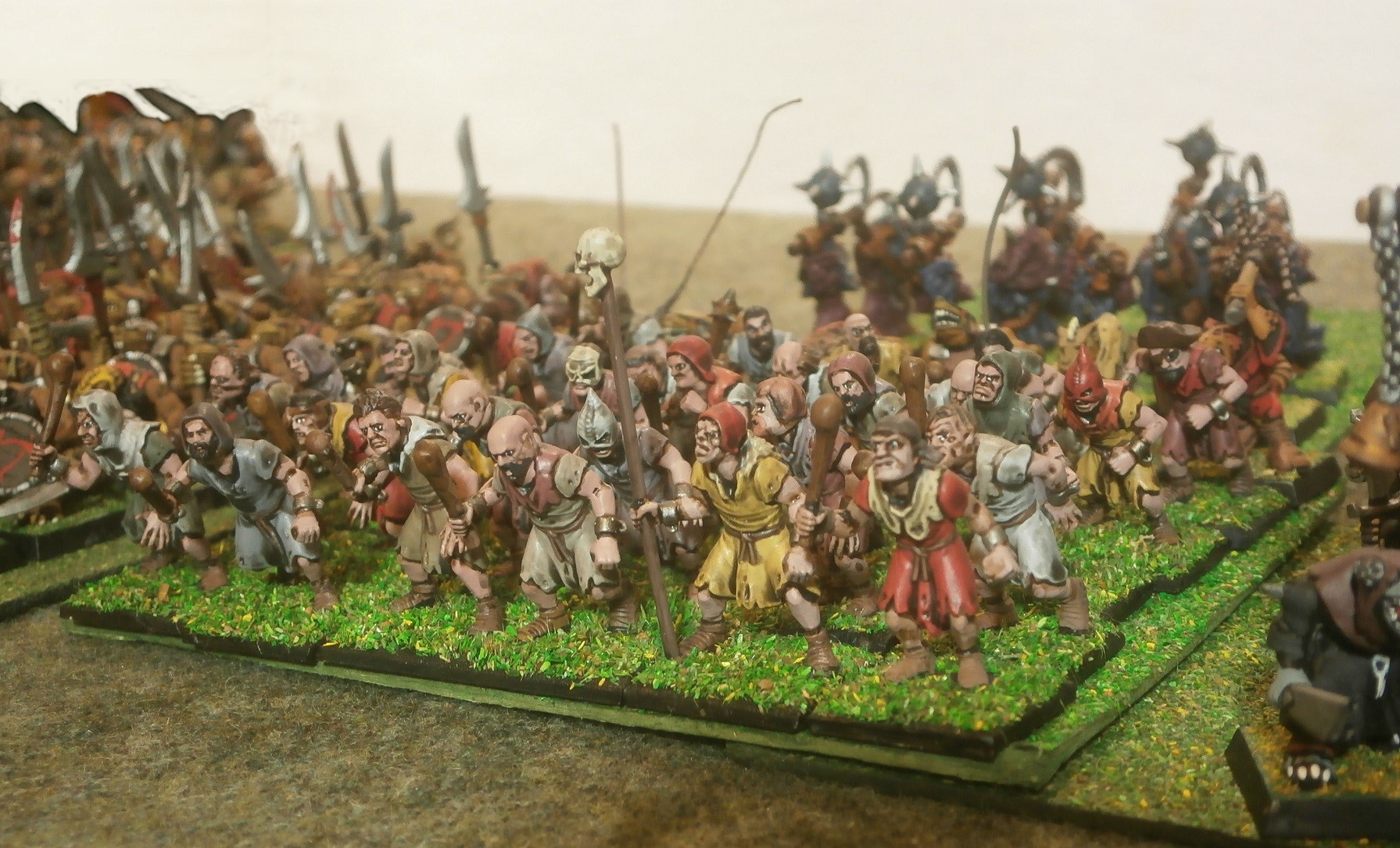
Or, at least, were once men, for he said they were malformed, both in body and mind, being as bent and twisted as they were manic and crazed, driven forwards by the whiplashing of a rank of ratmen at their rear. Bow-legged and clothed in rags, they nevertheless moved with surprising alacrity, as if infected with by a raving delirium. They too bore iron manacles, but at their wrists, and like the ratslaves, any restraining chains had been removed so that they might fight without hindrance.
Behind these came another company of skirmishers, only briefly glimpsed later by a handful of elves and some amongst the Arrabiatti riders. These carried heavy, spiked censers, like flails, from which a thin but foul mist spilled.

These, like the red-regiment, would prove deadly foes later in the battle.
Beside these, advancing towards the open space between the woods and the raised ground to the left of the enemy’s line of battle, came a swarm of black and grey-robed ratmen, armed with both viciously curved blades and iron-bound staffs. The Arrabiatti rider who described them to me said they strode in a peculiarly twitching manner, as if barely restraining themselves.
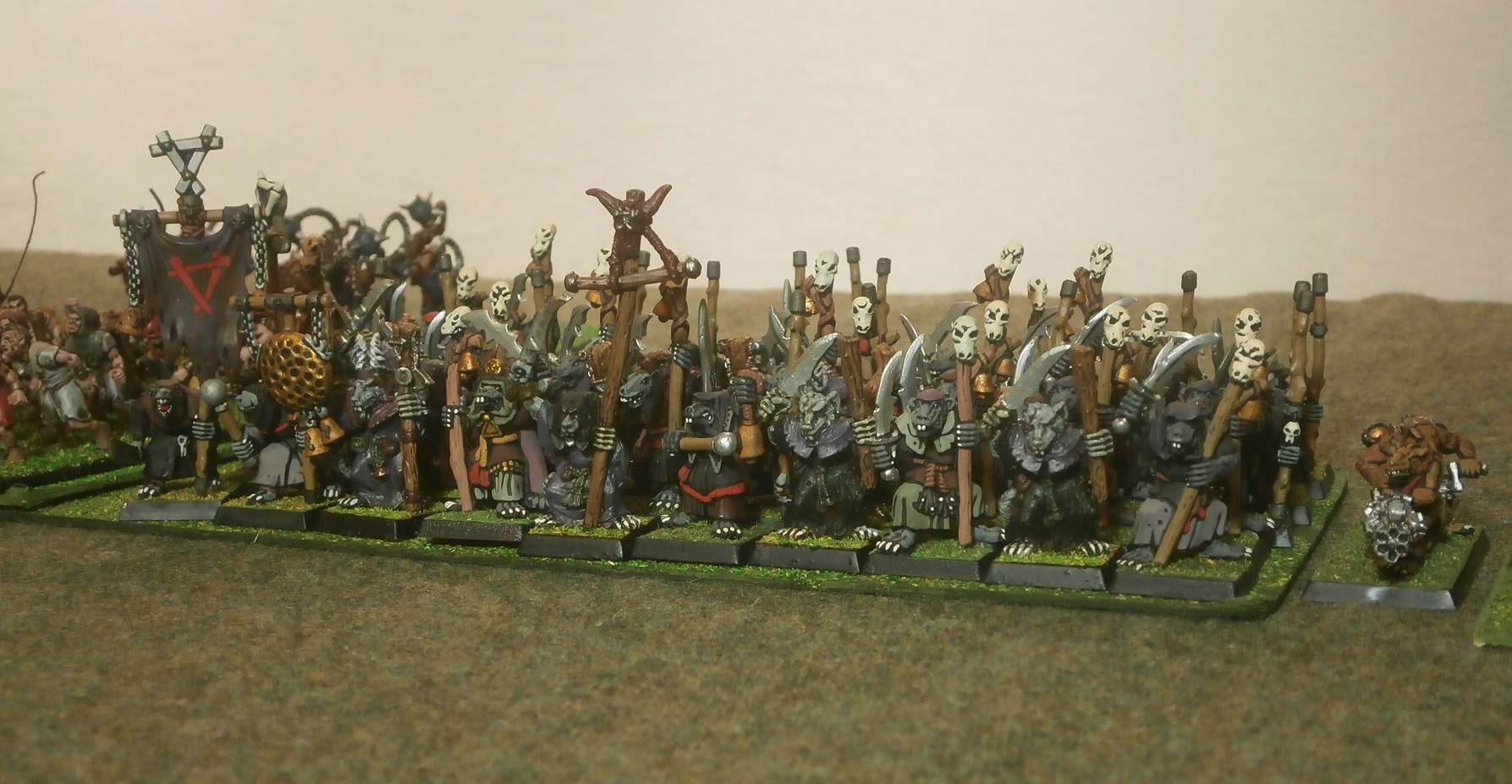
They were fifty strong or more, and their strange motions elicited a cacophony of discordant ringing from the brass bell carried by their musician, as well the many smaller ones decorating their banner and many of their staffs. That sound I myself could hear, although it was only after the battle that I learned of its source.
Beside these, being the last of the regimented bodies in their crowded battle line, came a regiment of brutish ratmen, standing head and shoulders above their kin, swathed in both purple robes and laminations of iron.

Upon their right side, and indeed beside several of the aforementioned regiments, strode a brace of ratmen carrying some form of portable artillery piece, the nature of which I did not discover.
Upon the very far left of their line, beside the steep slope of the hill, and just as on their other flank, came a body of long barreled musket teams and another lightning spewing engine.
Our alliance army attempted to match the enemy’s width of front, but this left very little depth to our line of battle.

Only the wizard Lord Uluar stood to the rear of the line, as if in reserve, with his bodyguard of riders.

Thane Narhak had seemed surprised that Uluar remained with us, what with his role as the elven high lord’s messenger and ambassador, but suggested to me that it was perhaps a sign of Lord Veluthil’s awareness of the dangerous disparity in numbers between our army and that of the foe. It is thus likely that the ambassador was ordered ride behind the line, ready to strike at any foe that broke through or perhaps at the flank of an enemy regiment threatening the destruction of one of our own.
Upon the far right of our line advanced a body of elven scouts – wilder seeming than many of the rest and almost entirely bereft of armour. They were to prove, as indeed was every elf on the field, very competent archers.

Indeed, such was the elves’ skill with their bows, and so nimble they were upon their feet, that had we been fighting a moderately sized enemy they could undoubtedly have felled a good half of the foe before blade struck blade anywhere upon the field. But against this enemy, their arrows, howsoever deadly in their accuracy, seemed simply to disappear into the vast swarm, to no particularly noticeable effect.

Next in line came one of the two bodies of glade guard, advancing a little behind the scouts.

No less skilled in archery than the scouts, this company could loose almost twice as many arrows, yet we would have needed many more such units to win the fight through shooting alone.
The Arrabiatti brigands rode to their left, also armed with bows, although lacking the elves’ skill and having a shorter range.
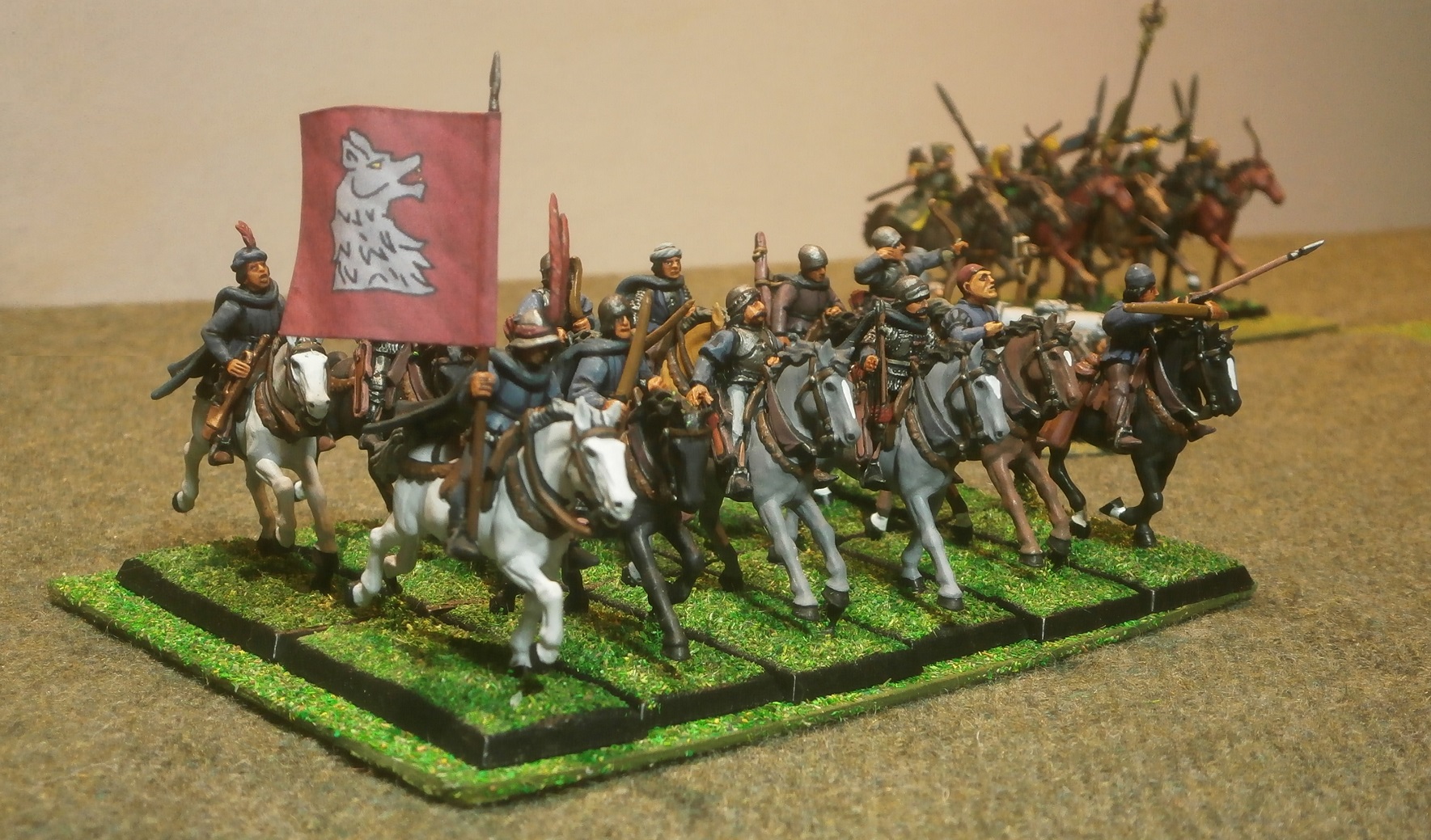
Lord Totto had ordered these to join our alliance force back at Ravola, for they had an unsurpassed knowledge of the lay of the land in the north of Tilea – its paths, rivers and the like – what with the men amongst them hailing from all over the north. That which they had learned before they became outlaws had only improved in the time since, as they sought the secret passages and useful vantage points needed to both surprise their prey and thwart those who sought to capture them.
I thought I would dislike these men, what with their criminal pasts, but I confess freely that I found them good company, and they and their captain, Valfrido Gesualdi, had proven both wise and keen. They were to do very little in this fight, but this was neither cowardice or tardiness on their behalf, but rather because there was little opportunity for them to do ought other than throw themselves at the foe to no gain for our cause, and at great loss to themselves. I pray they will now remain with us, for we may now need their particular knowledge more than ever before.
We ourselves deployed to the Arrabiatti’s left, first our gun …

… then Thane Narhak and the warriors …

… and then my regiment of crossbows.

Thane Narhak seemed calm before the fight, although now I believe he was in truth resigned to his fate, for such as he cannot have failed to understand the reality of our situation as the enemy hove into view. He must surely have known that we could not possibly win this fight, and that if we were to have a chance to retreat in any semblance of order, without great loss to our strength, then he and his warriors would have to make a desperate stand.

If he had bid me stand with him, I would have happily obeyed, but he conveyed no such order, as I believe he fully intended that we should leave, to fall back to our earthworks at the bridge, where our crossbows could prove most effective in defence.
We did not know it as we arrayed for battle, but ahead of us was a company of elves known as the Waywatchers, cunningly concealed by the slightest of scrub and the shallowest depression in the ground. Presumably they had crept there in the crepuscular hour. As the enemy began its advance, however, they got to their feet, appearing as if by magic!
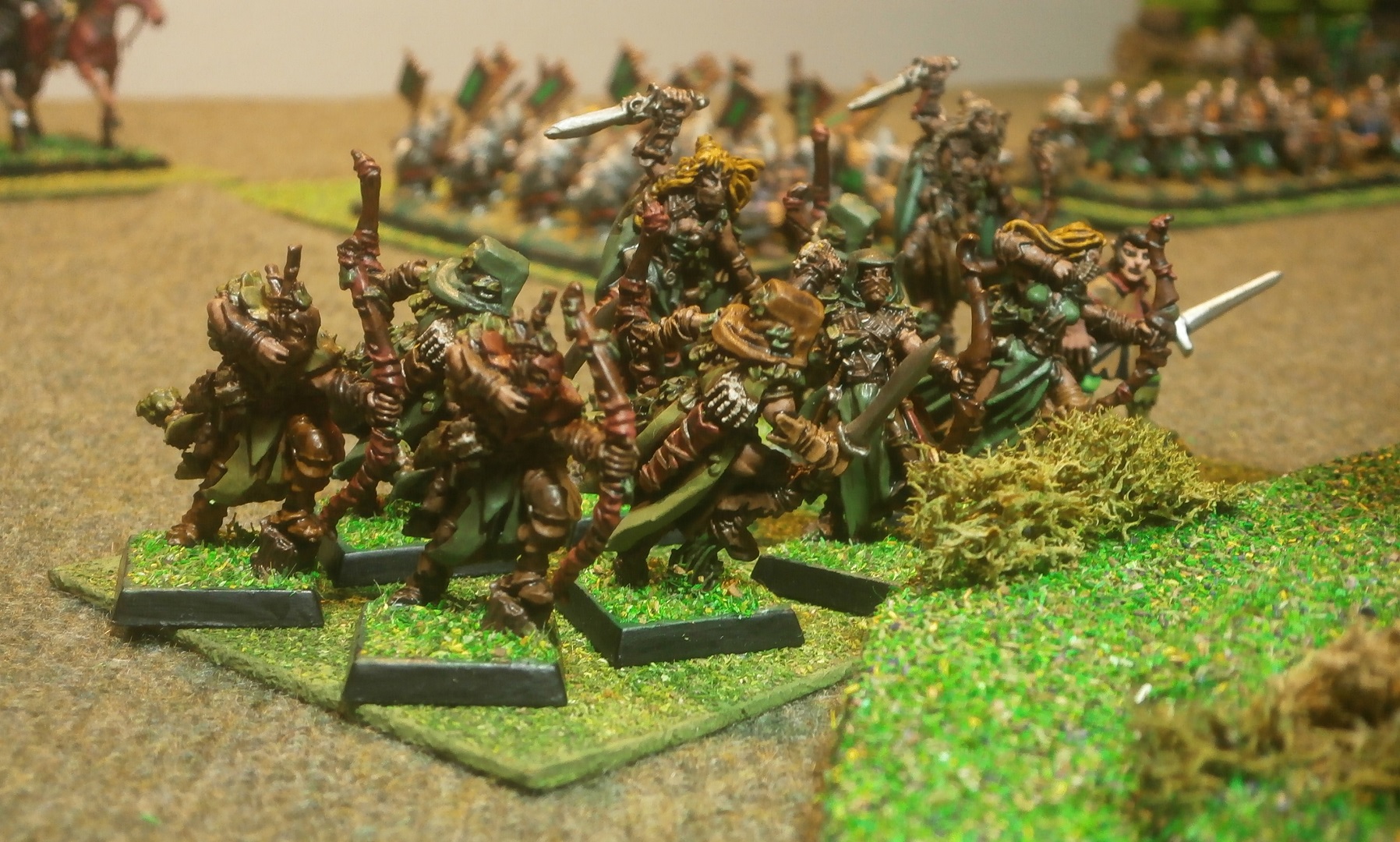
Cioran Brightmoon boldly led them, although as is their wont, they kept the woods between them and the foe, that they might better surprise the enemy with either their shooting or their charge.
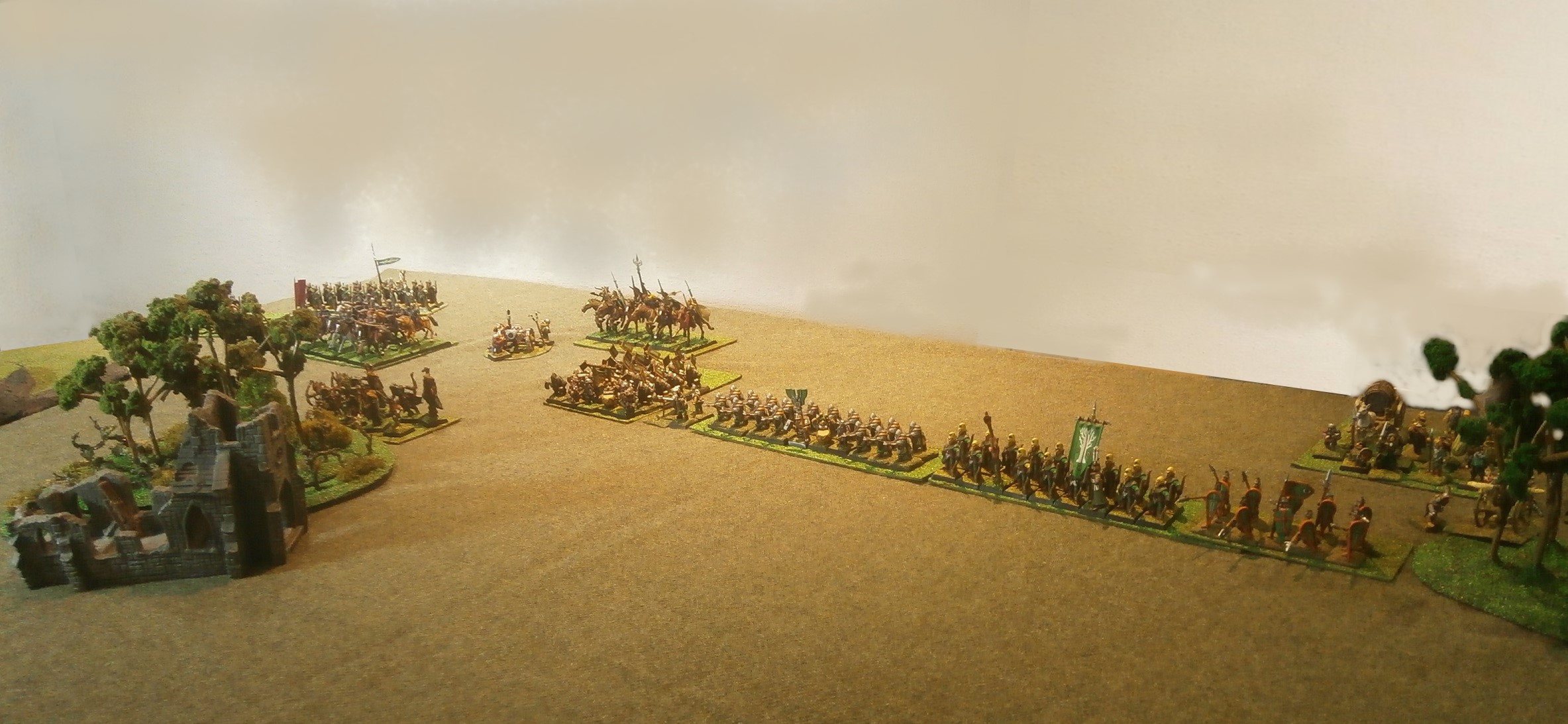
By our left stood the second company of elven archers …
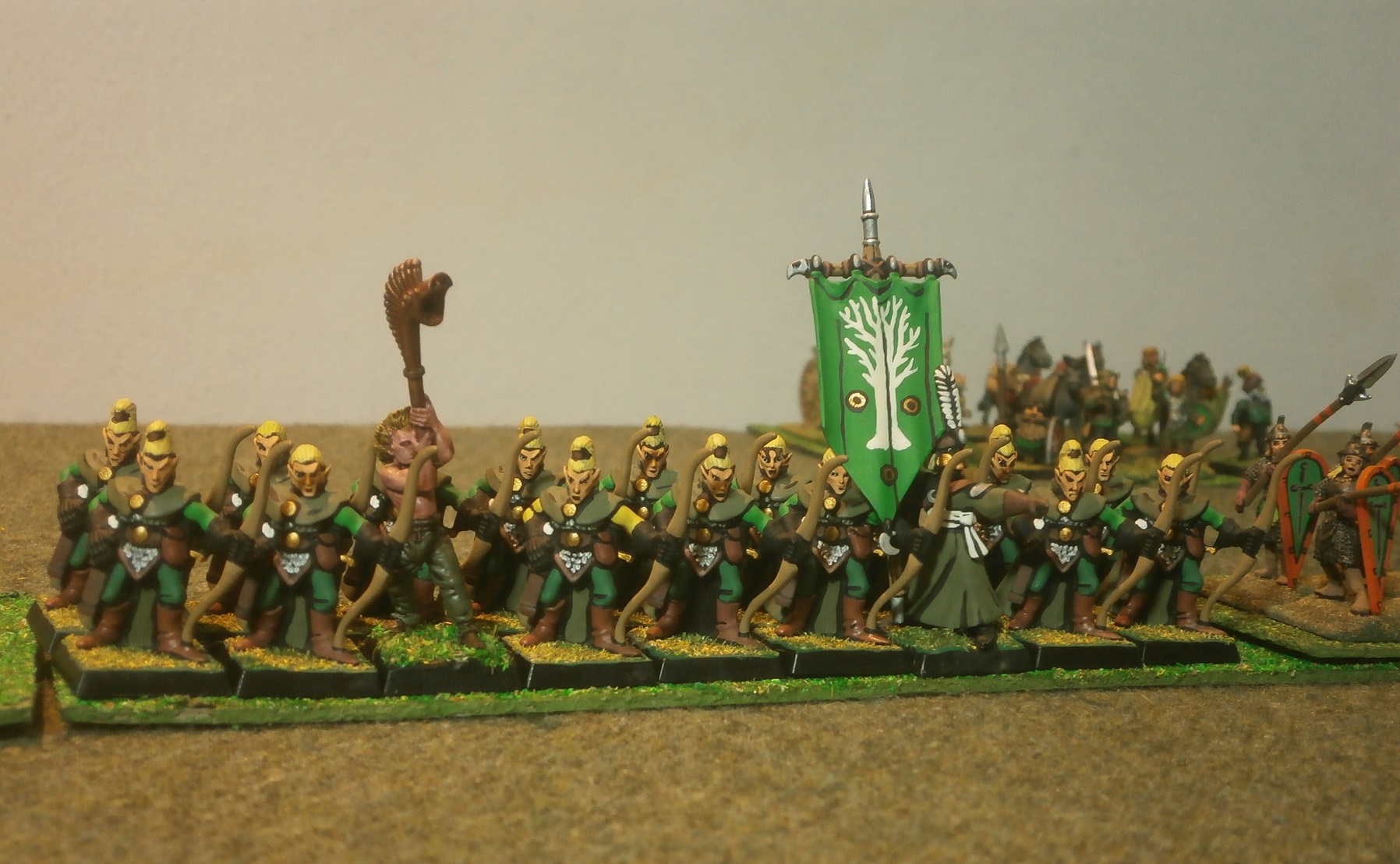
Which I was glad of, for I thought that with their longbows by our side, then surely whatever strayed before us should suffer severely from our conjoined volleys?
Beside them was Lord Veluthil’s small bodyguard company …

… although he himself was elsewhere, ahorse, which I presumed (mistakenly, it turned out) was to allow him to move more quickly to wherever his magic might be needed. This company was sufficiently large to stand watch over their lord’s tent as he slept and to serve his person as he travelled about the camp, but in truth not numerous enough to fight effectively on a field of battle. If they had been thrice as large, then the battle may just have gone differently, for standing beside our brave warriors, the two might have presented a keystone about which our defences could be secured firmly.

The rest of our alliance force was somewhat concealed, standing behind a copse of trees by the river. Something struck me as odd about those trees, which at first I could not put my finger on, but it later occurred to me that upon surveying the ground the previous evening, I had not noticed them. How I could have missed them, or forgot them, is a mystery to me, for with their proximity to the waters, they should have struck me as an important consideration for our intended line of battle.
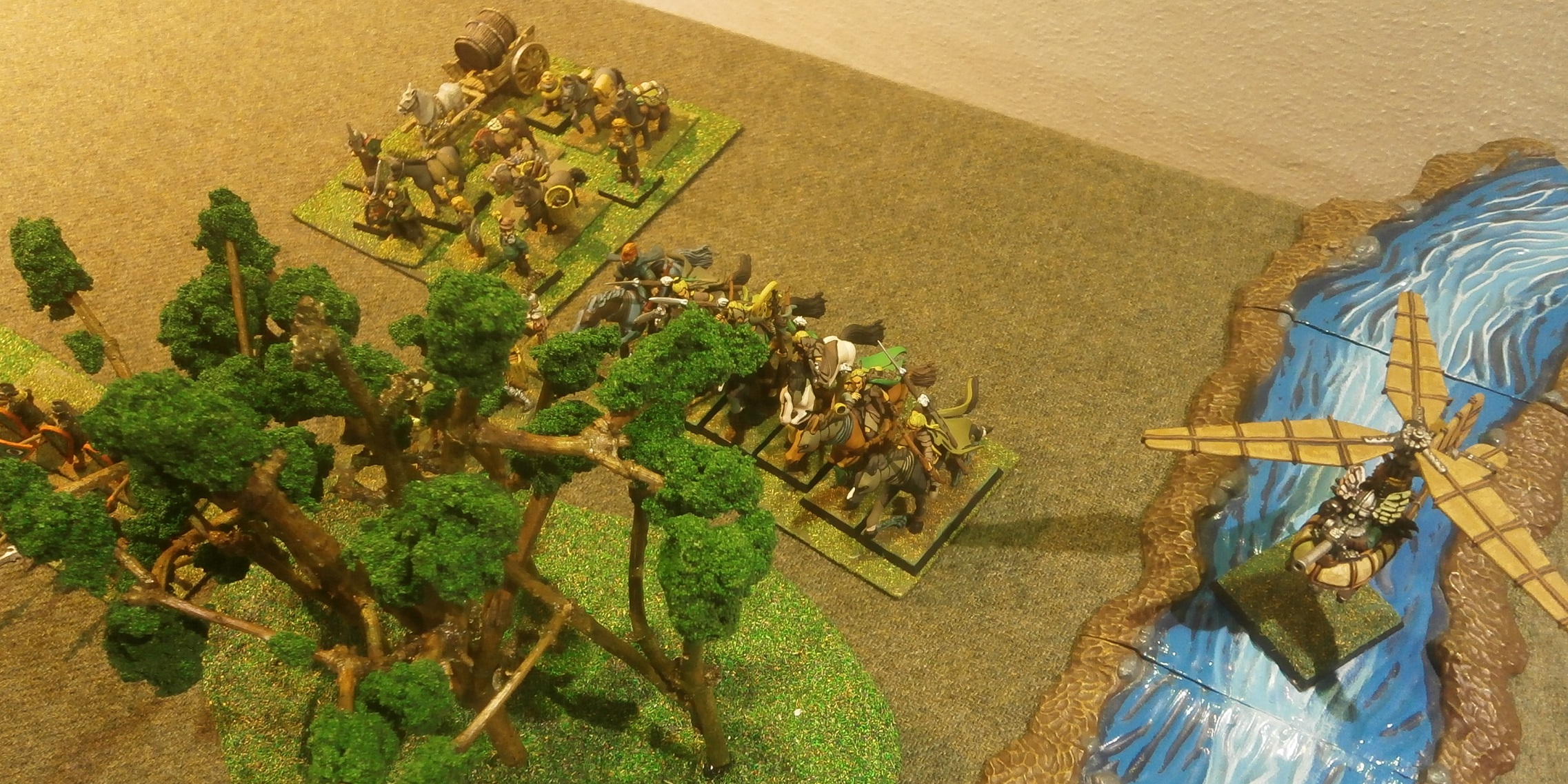
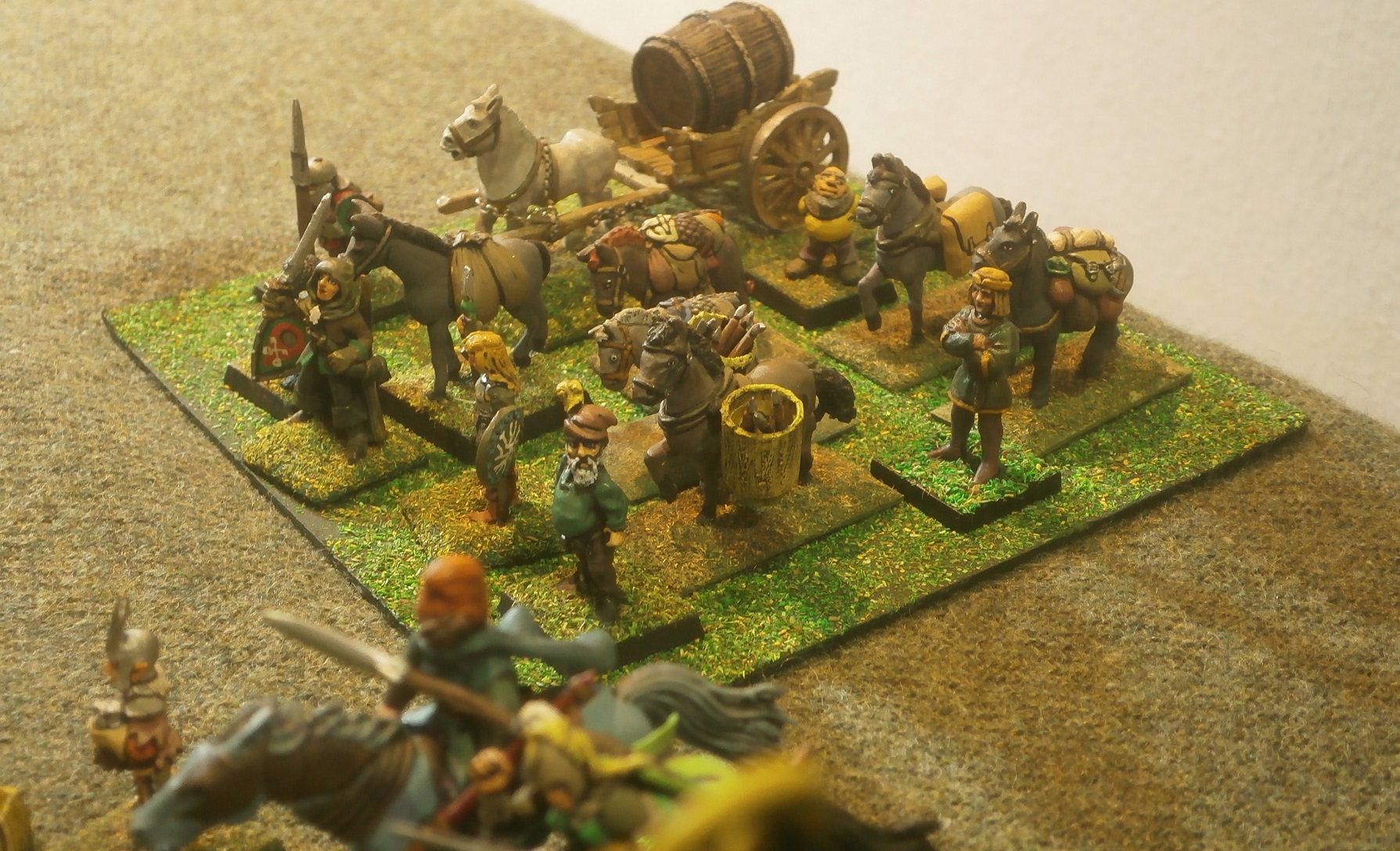
Our baggage lay there, for upon Veluthil’s orders we had left no provisions at the camp, to deny the possibility of their capture by enemy foragers.
Lord Veluthil perused what part of the field he could see from behind the trees – which was all but those enemy regiments beyond the ruined church and central woods upon their left flank.
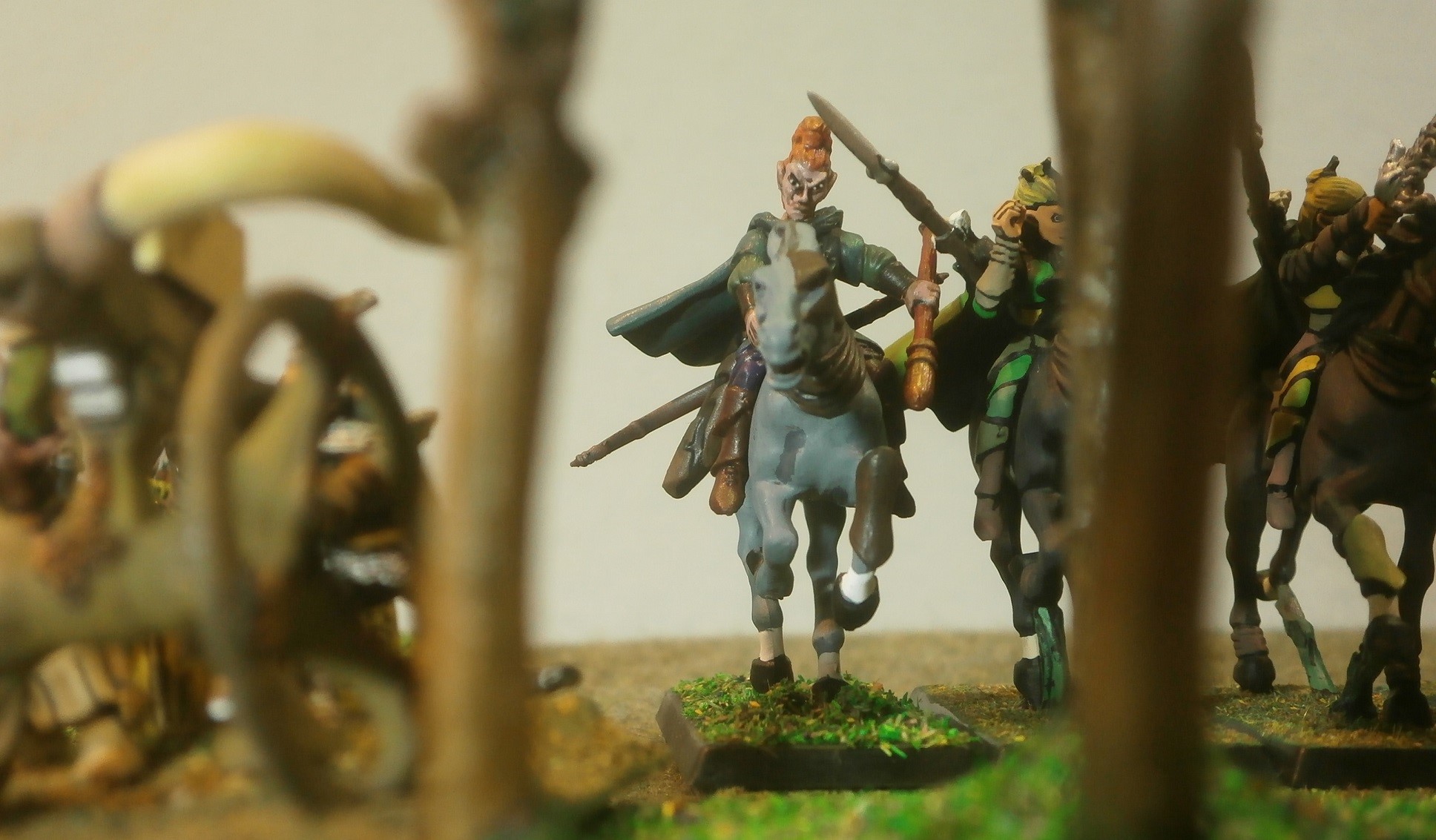
He rode with a company of horse-archers …
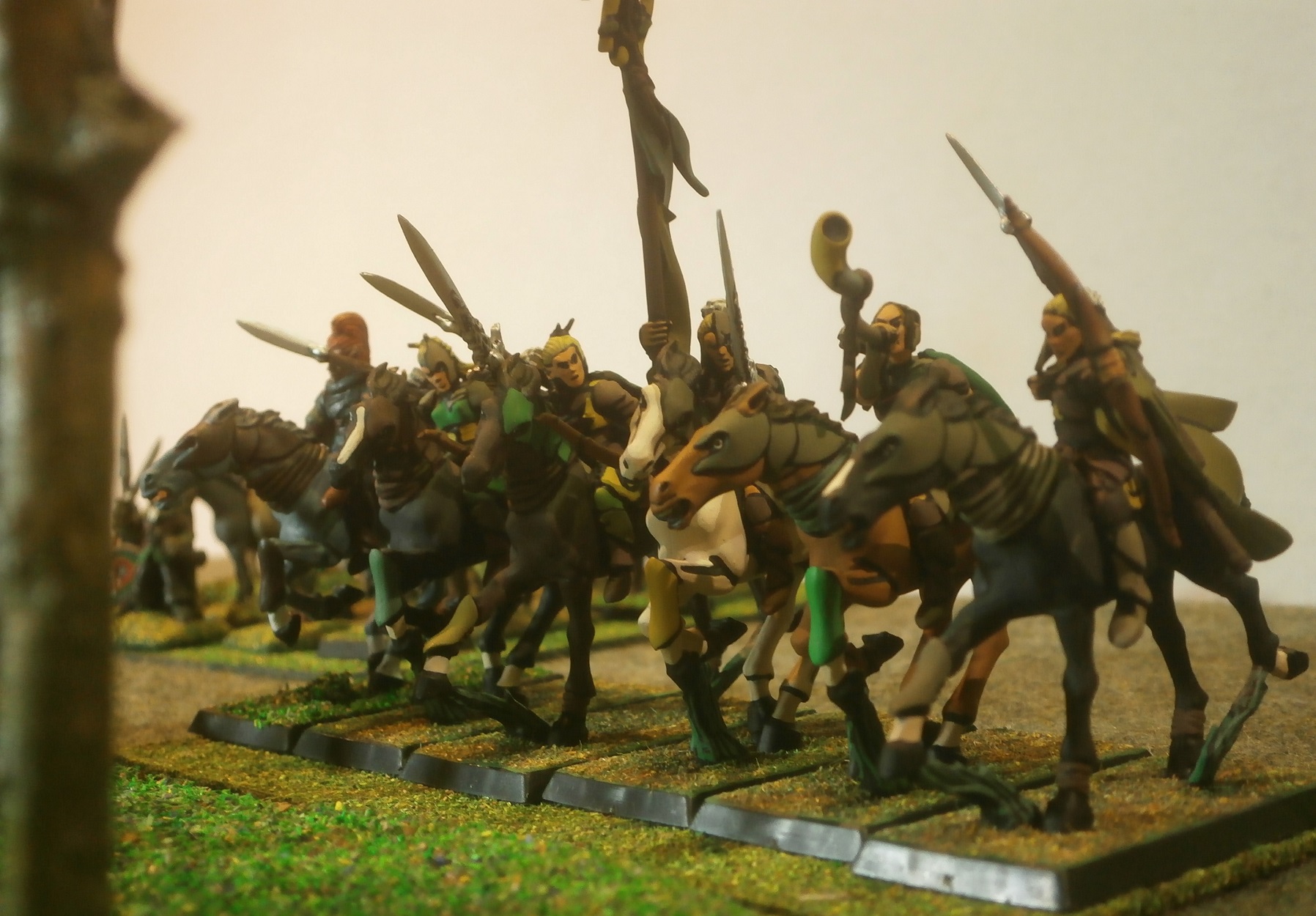
… and so was guarded. His magical prowess was to prove impressive, but of course, as is nearly always the case with such slippery and unreliable energies, insufficient to grant us victory.
The elven wizard Ascal Arconvale and her war hawks were not to be seen, having been ordered to fly in a wide arc, thus outflanking the foe, in the hope that they might prove a crucial distraction, or better yet, able to deliver a deadly strike at the foe’s rear, just when such was needed. But I could hear brave Thurdral and his steam engine flying out upon our far left …
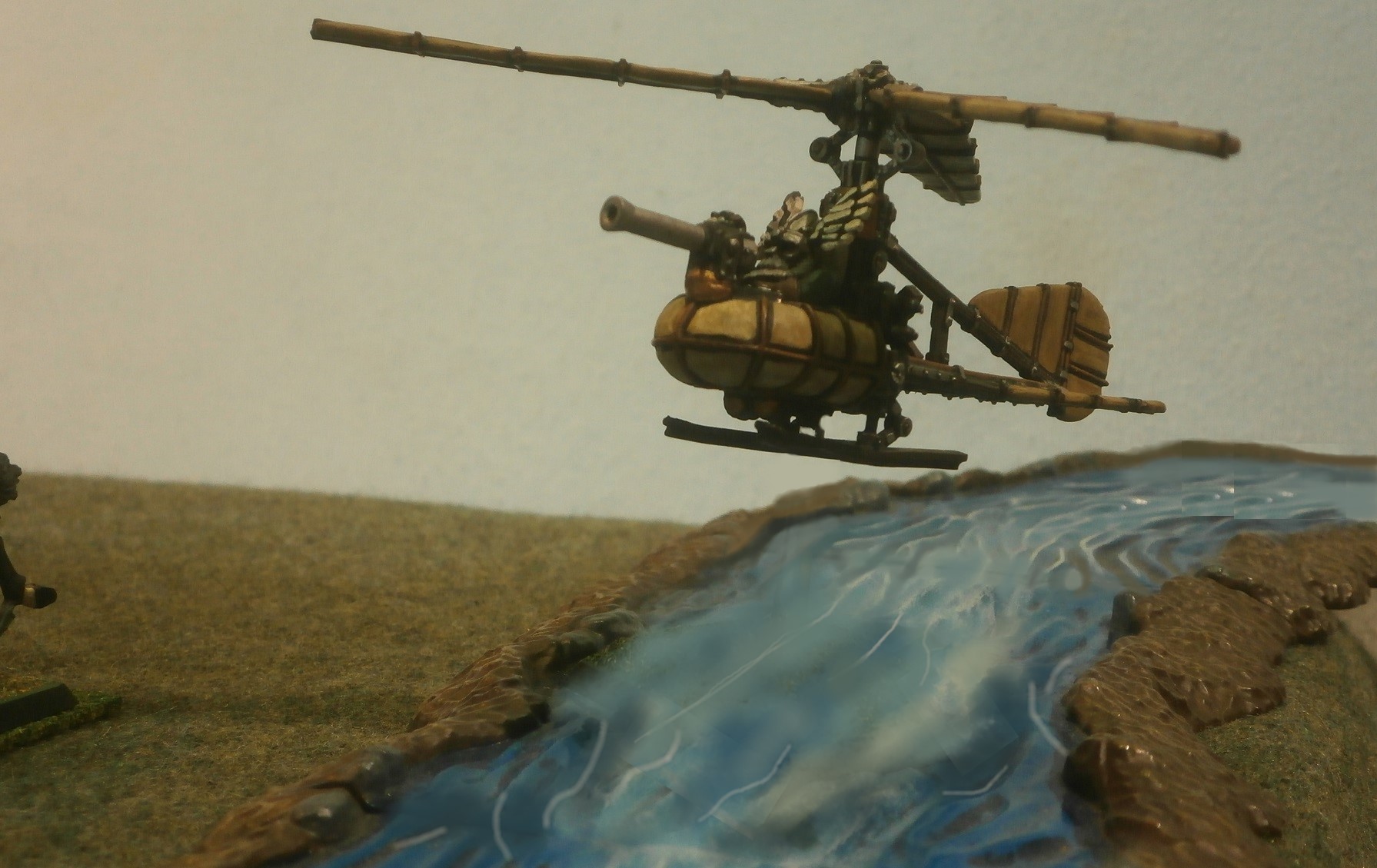
… moving where only he could move, above the river itself.
And so it was, we faced the foe, hoping, at best, to maul them so severely as to thwart their further advance upon Tilea; and, at least, to slow them sufficiently so that our reinforcements might join us. And if the latter was all that we could achieve, then we had to do so with the least loss to our force as possible, for otherwise the reinforcements would not strengthen us further, but merely partially replace our losses, leaving us no better able to face the foe in our next engagement.

 BigSmallWorlds
Wow! I sincerely hope their stand gained them something, for I cannot believe the outcome was pleasant for the allies.
LikeLike