To Pay the Toll. A Battle Report.
The Bridge at Casoli
Chapter One, Deployment.

The bridge of Casoli lay west of the city of Pavona, spanning the River Remo to carry a road southwards from the ancient Via Aurelia to the town of Scozzese. There were several humble dwellings close by, including a toll-keeper’s cottage upon the southern side, and the land around had pens for livestock, olive groves and fields of grain.
It was here that the soldiers of Pavona and Verezzo would meet in battle for the first time since Duke Guidobaldo Gondi’s murderous raid on Spomante, in which Lord Lucca Vescussi of Verezzo had been killed. The new ruler of Verezzo, the regent Barone Iacopo Brunetti, had harboured a hatred since, but he had concealed it, even speaking with the son of his beloved lord’s murderer, Lord Silvano, and apparently agreed to a truce. All the while, however, he had been increasing the strength of Verezzo’s army. His last and most effective trick, was sending some of his army to join with Lord Silvano’s army in the north, there to hunt the ratmen. By doing so, he convinced the Pavonans to drop their guard, to believe the animosity between the two realms had finally dissipated. As a consequence, Lord Silvano led more than half of Pavona’s marching army north, while the barone sent only a small fraction of his strength, so that what remained under his personal command outnumbered the defenders of Pavona sufficiently for him to believe he could, at long last, properly punish them for their crimes.
First he marched on the town of Scozzese, and after issuing demands for an immediate and large compensatory payment (which he assumed they could not raise), he captured and plundered it thoroughly. Then, not wanting to lose the initiative, and keen to engage the Pavonans long before Lord Silvano could return with his marching army to assist in their defence, he struck for the bridge. It was the quickest and easiest way to cross the river, and if he could reach the other side with his army, he could loot the rest of the city realm and exact a far more satisfactory recompense. His grief would not be lessened, nor his hatred of the Pavonans, but as he said to his officers, the punishment would teach the Pavonans a lesson they were clearly in need of, and allow him to maintain a larger standing army to ensure that Verezzo might never be ravaged by the Gondi’s armies ever again! To a lesser few he seemed to hint that he might even be considering conquering Pavona, thus subduing it for decades to come.
The barone decided not to wait for his own reinforcements, currently marching from Verezzo towards Scozzese …
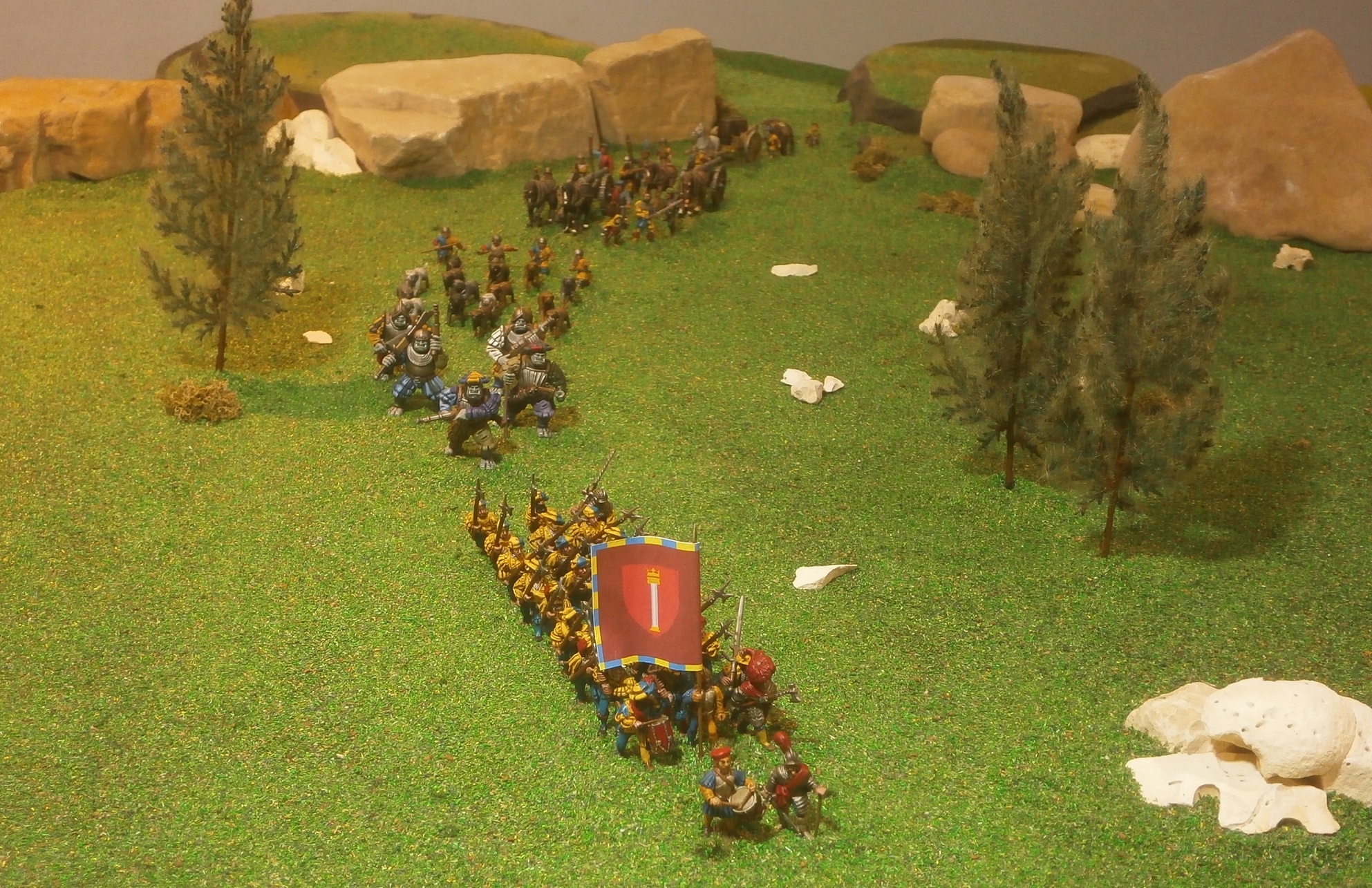
… as such a delay might allow the enemy to better their own defences, muster more forces, or worse, allow the return of their young prince, Silvano, and his substantial army. So it was that the barone would be fighting without his newly promoted captains and his freshly raised regiments of halberdiers and handgunners …
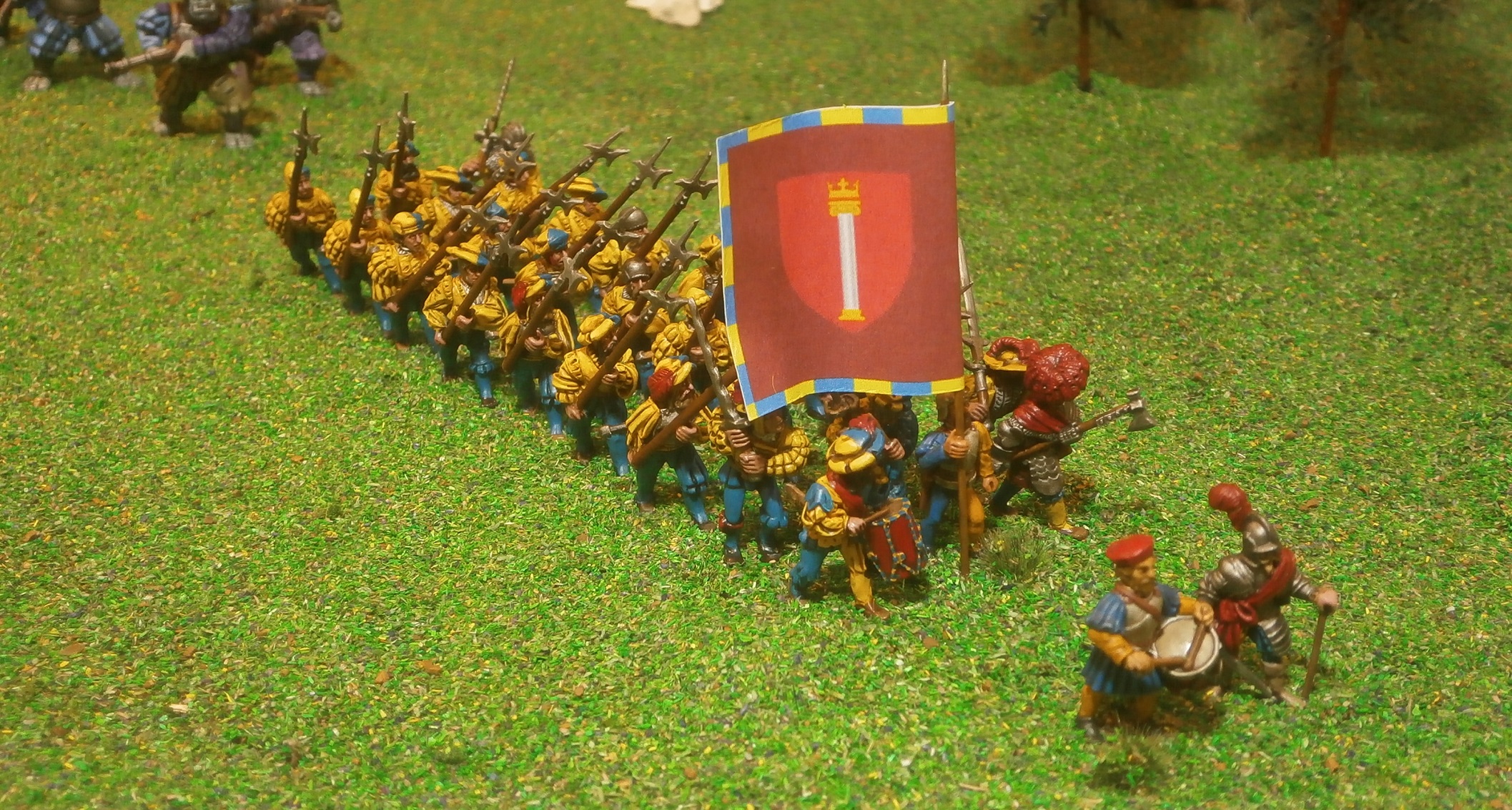
… without the pack of sharp-teethed hunting dogs the halfling master of hounds in Terrene had promised to bring.
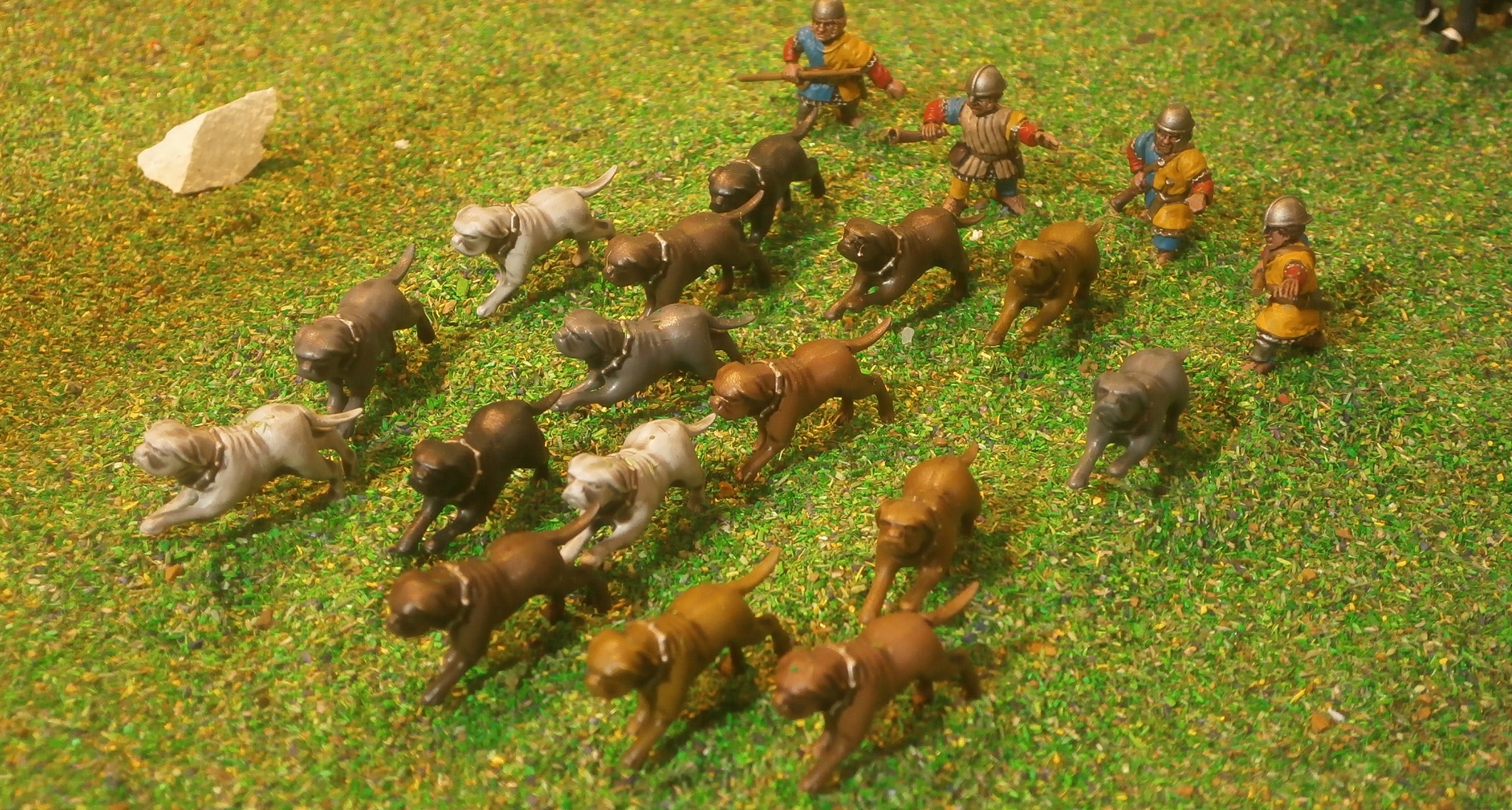
Perhaps more importantly, he would not have the help of a newly hired band of mercenary ogres …
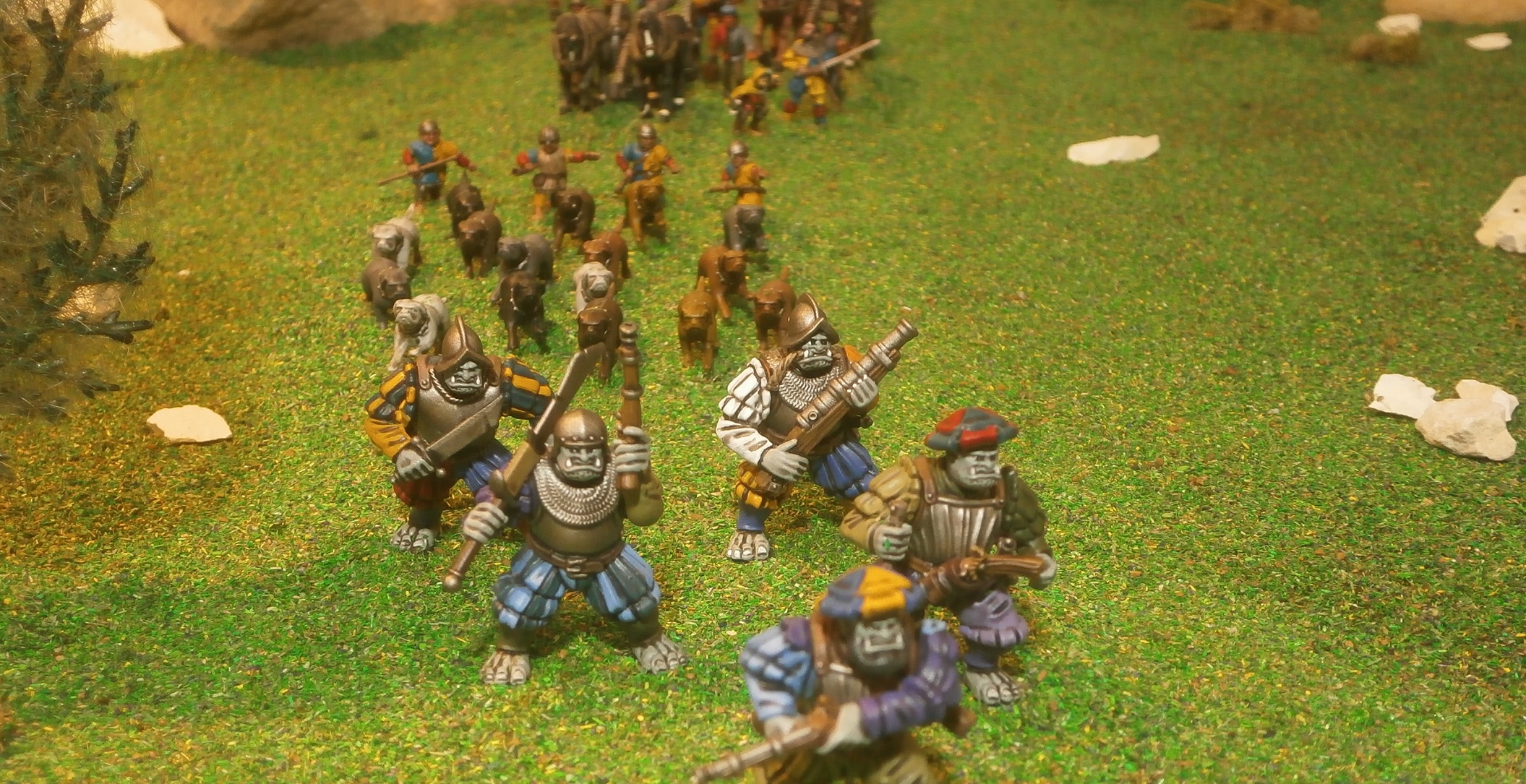
… or the brace of heavy cannons recently acquired from Ridraffa at no small cost.
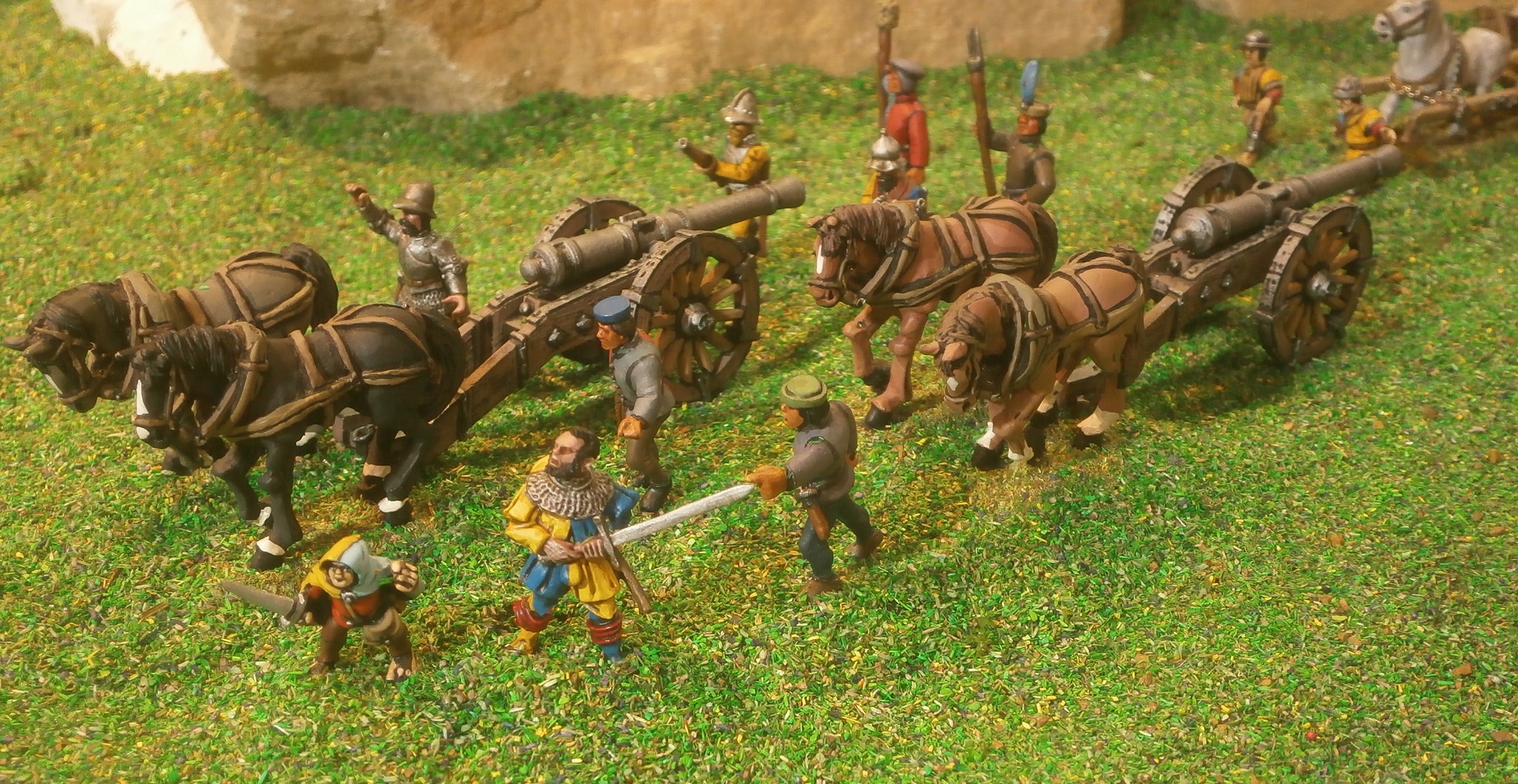
What he did have, however, he believed was entirely capable of gaining victory – if they struck quickly, before the enemy made any further preparations.

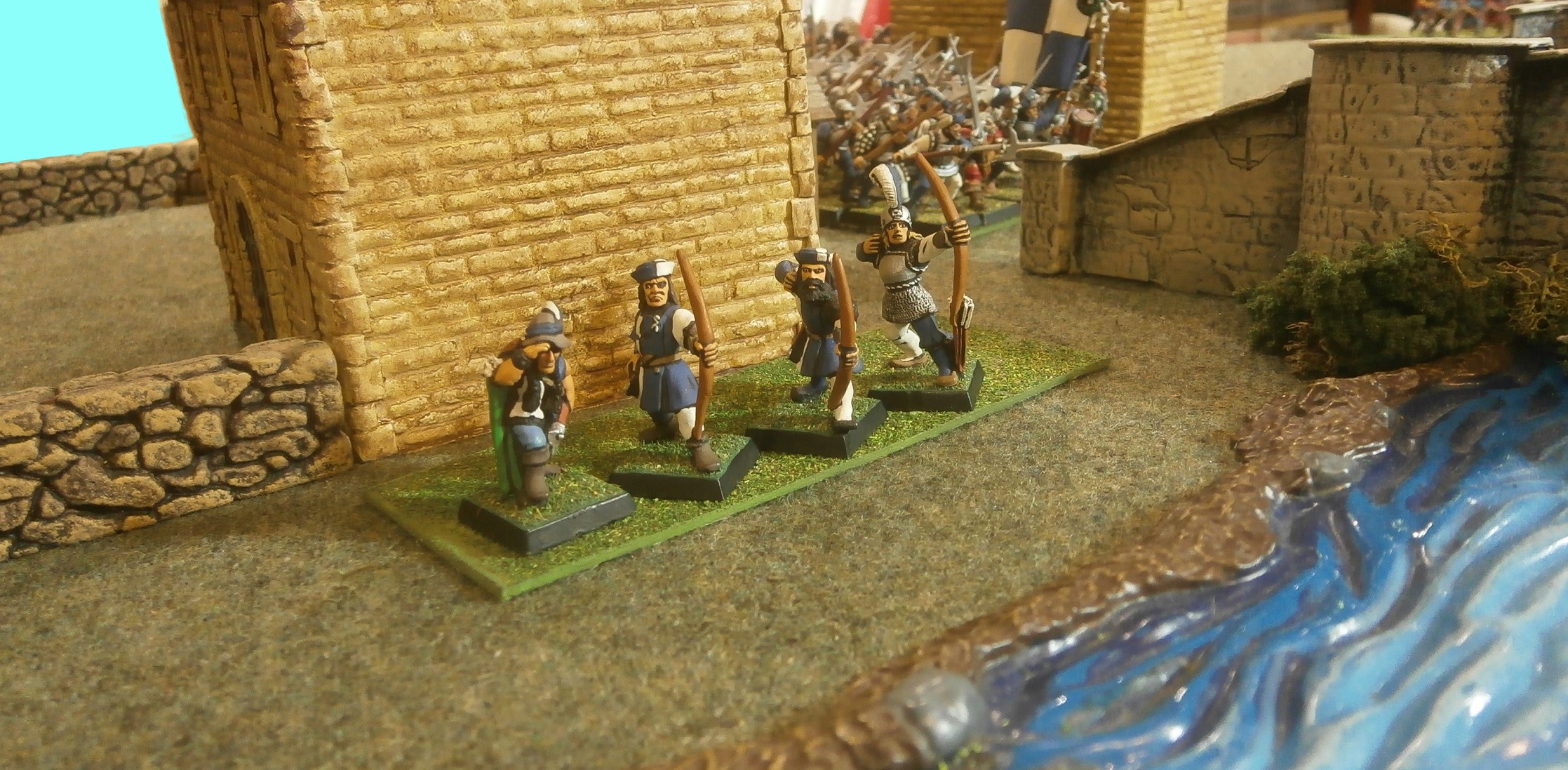
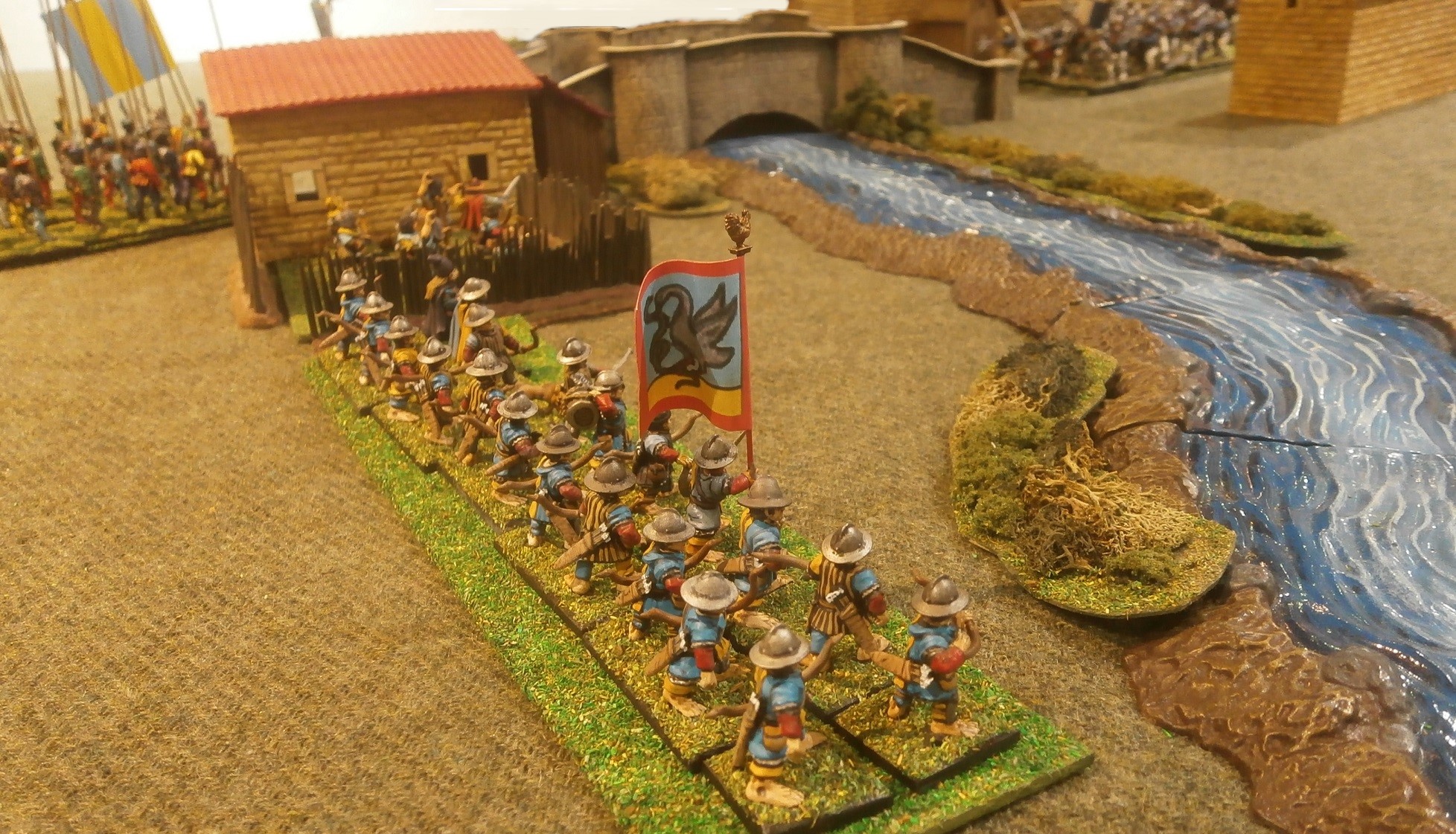
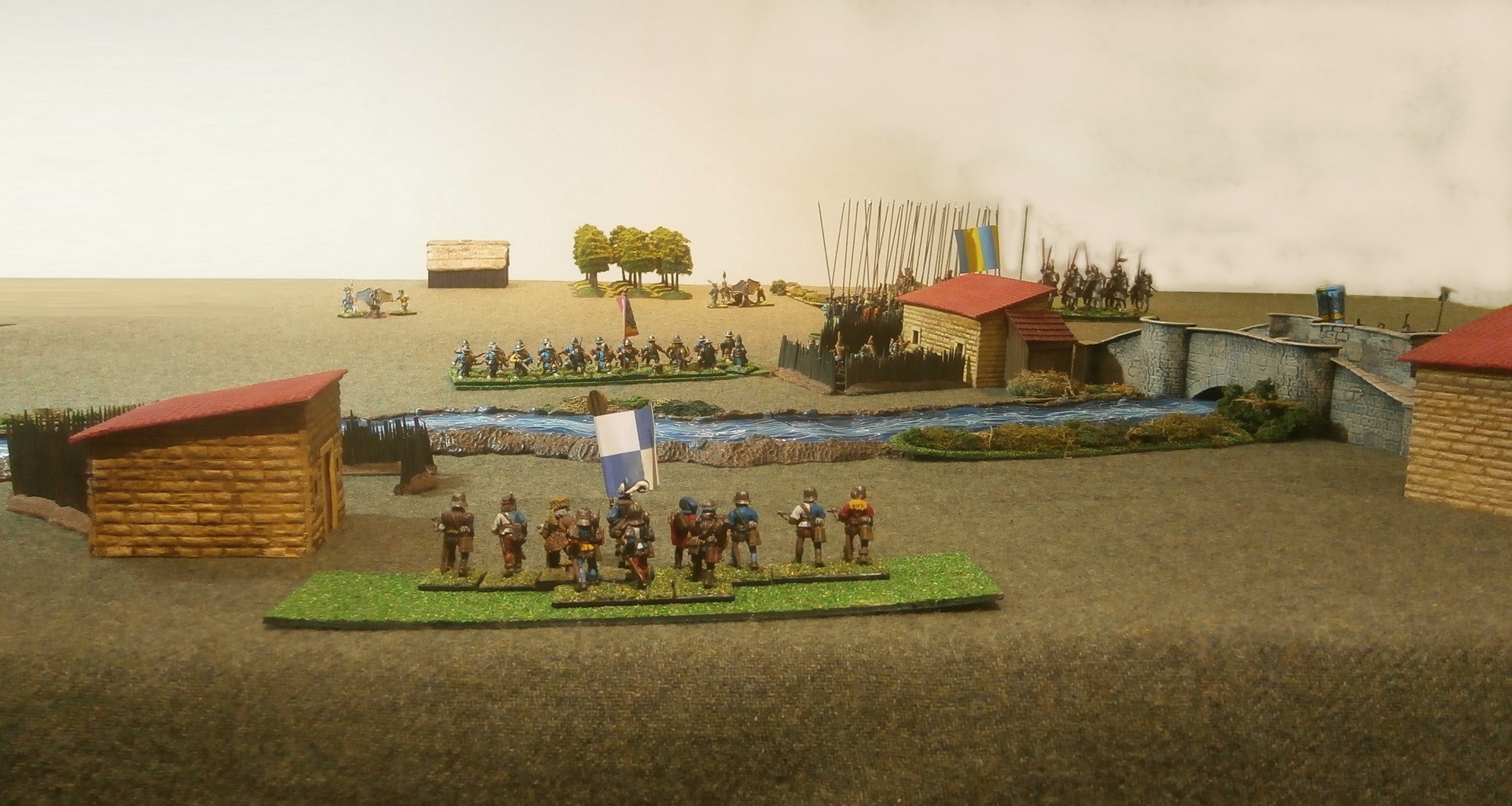
As his army closed upon the bridge, Roberto Cappuccio (the infamous ‘Pettirosso’), and his band of archers scouted ahead, intending to occupy the fenced yard by the tollkeeper’s cottage.

By the time they reached the fence, the army had formed a line of battle behind.

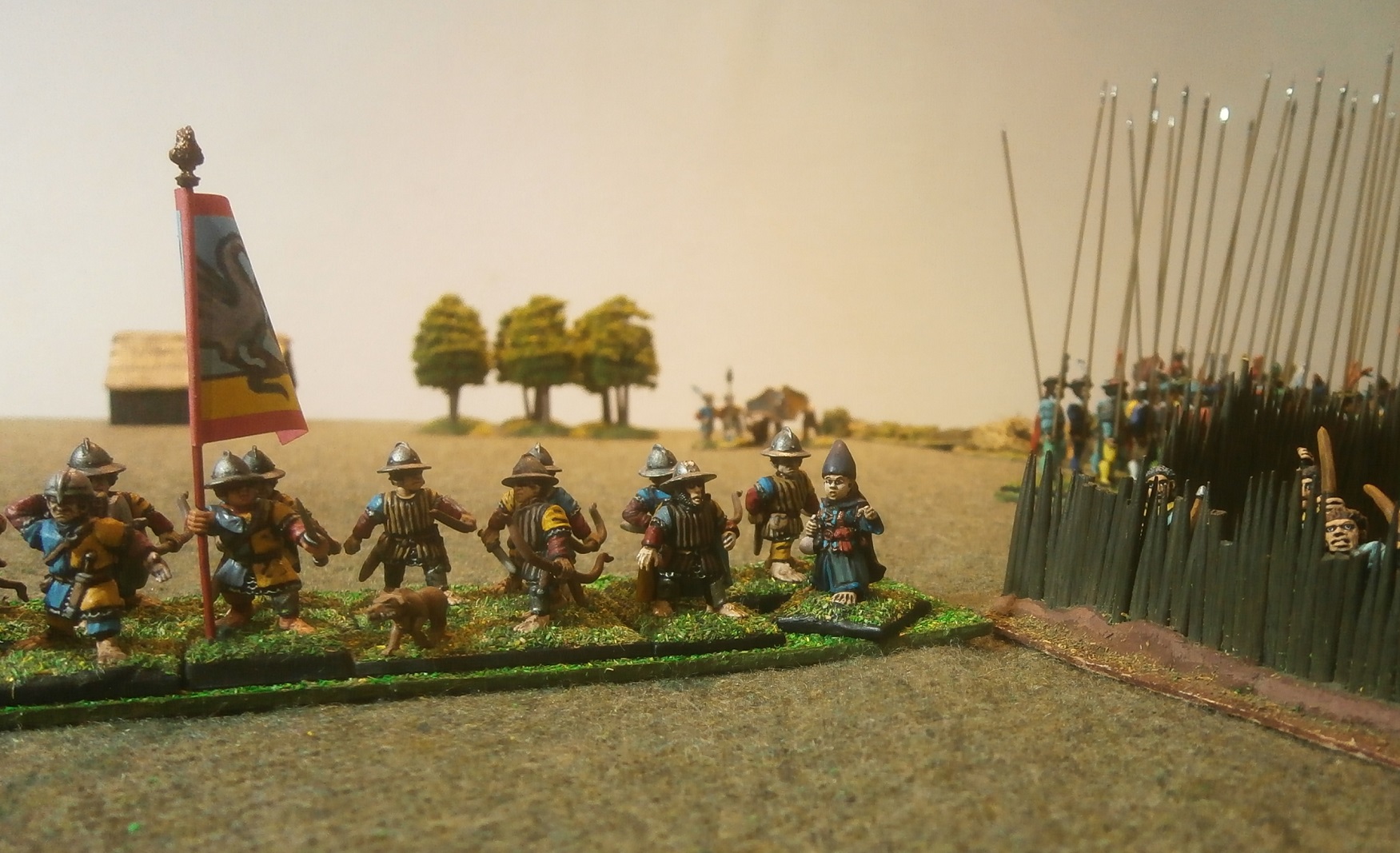
The barone led the largest halfling regiment, being his armoured archers, with the lesser wizard Zita Scadutto by his side.
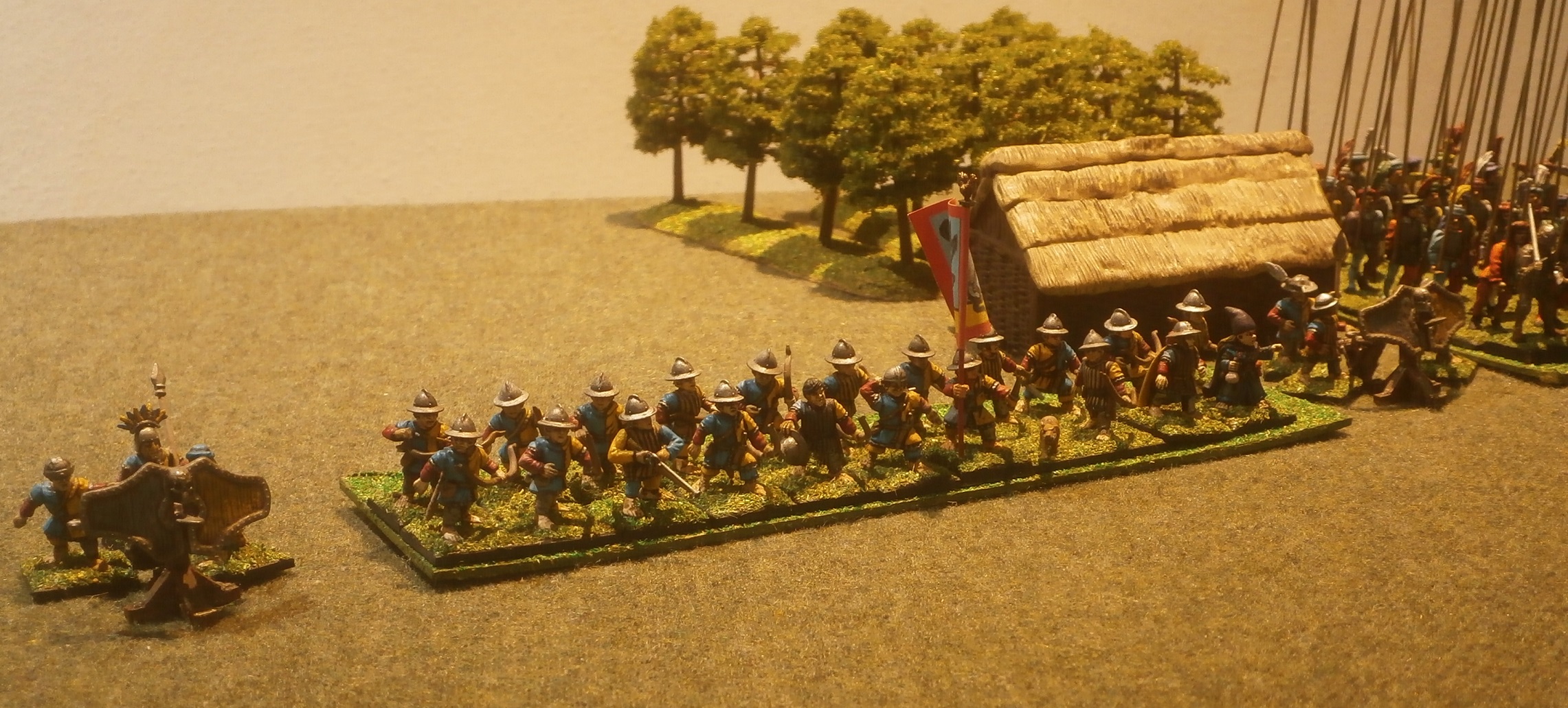
One of the brace of bolt throwers was out on his right, being the furthest flank of the line of battle, tended by the army’s doctor ballistarum, Coraggioso Massetti, sporting a sprayed plume of yellow and blue upon his helm, while the other thrower was immediately to the barone’s left. Had they been able to simply stand and receive the foe’s advance, then what with the barone’s ability to inspire the rapid archery of those he led, whose accuracy was renowned, combined with the power of the ballistae, the enemy would surely have suffered brutal losses.

But today, what with the river between them and the enemy, it was they themselves who had to do the advancing. Of course, the barone knew he must leave the hand to hand fighting over the bridge to the men in his army, but the halflings would still be needed, both to thin the enemy’s ranks before that fight as well as to distract the foe throughout.
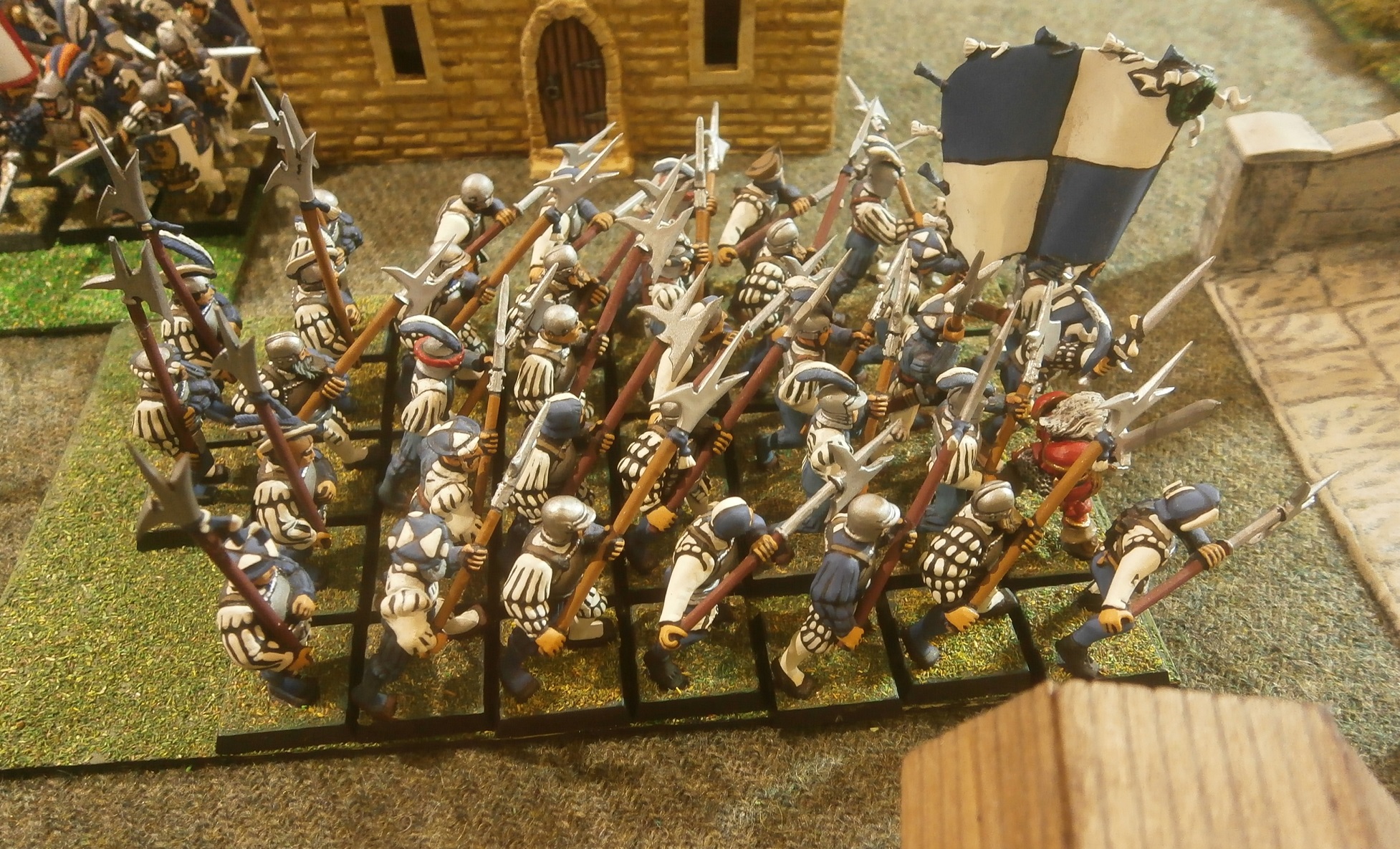
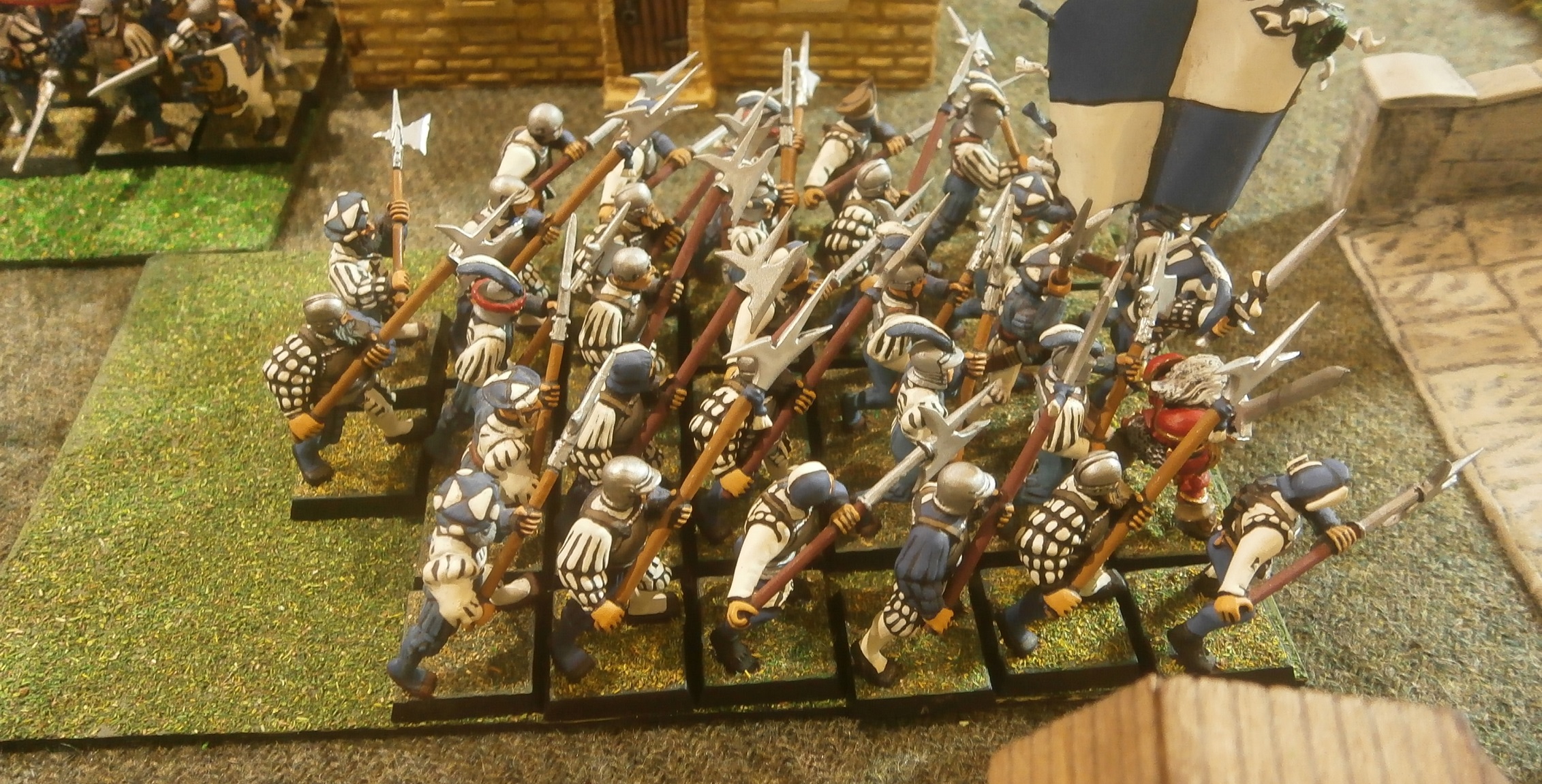
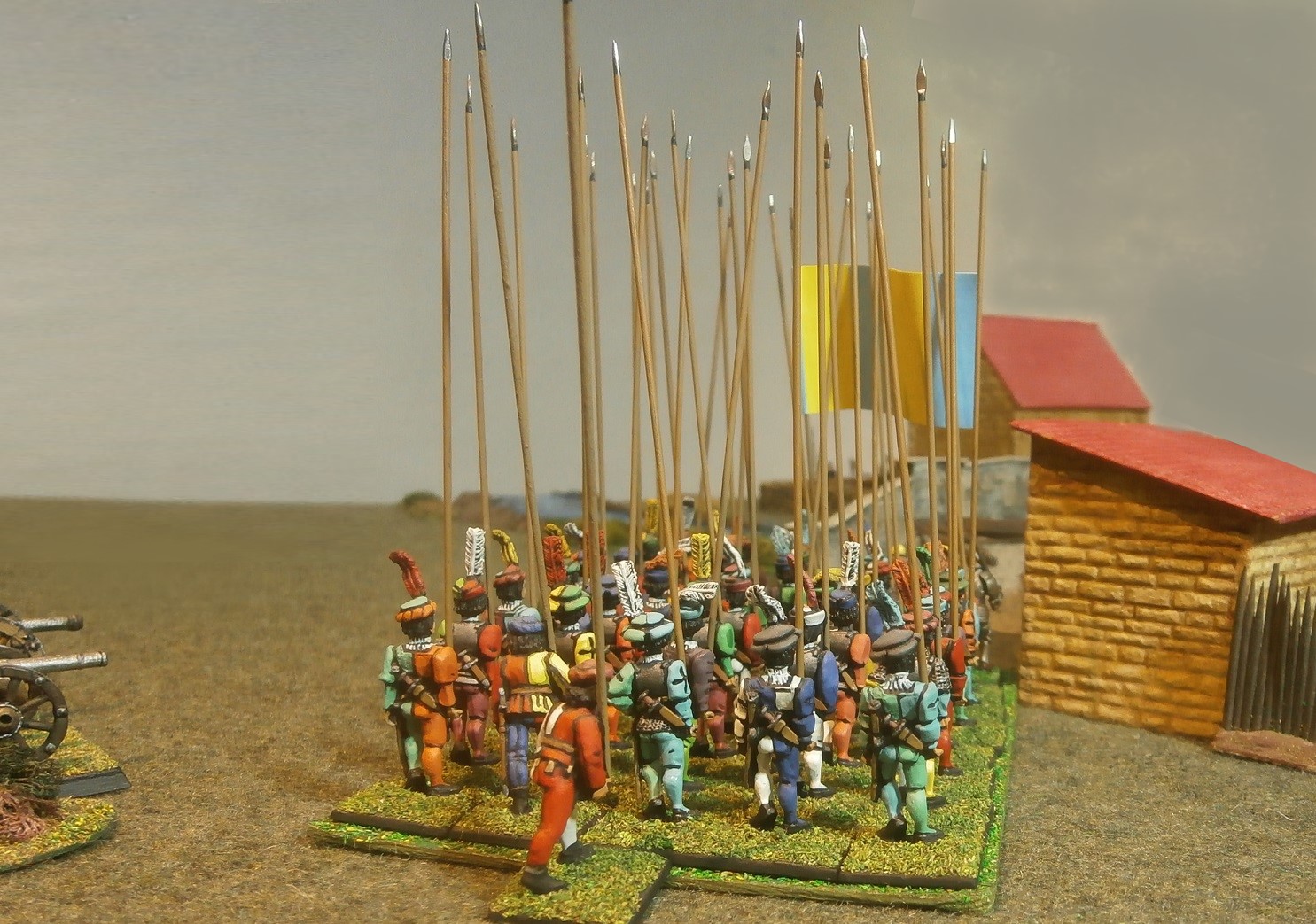
To the left of the bolt-thrower marched the regiment of pike, one of two possible contenders for the taking of the bridge.
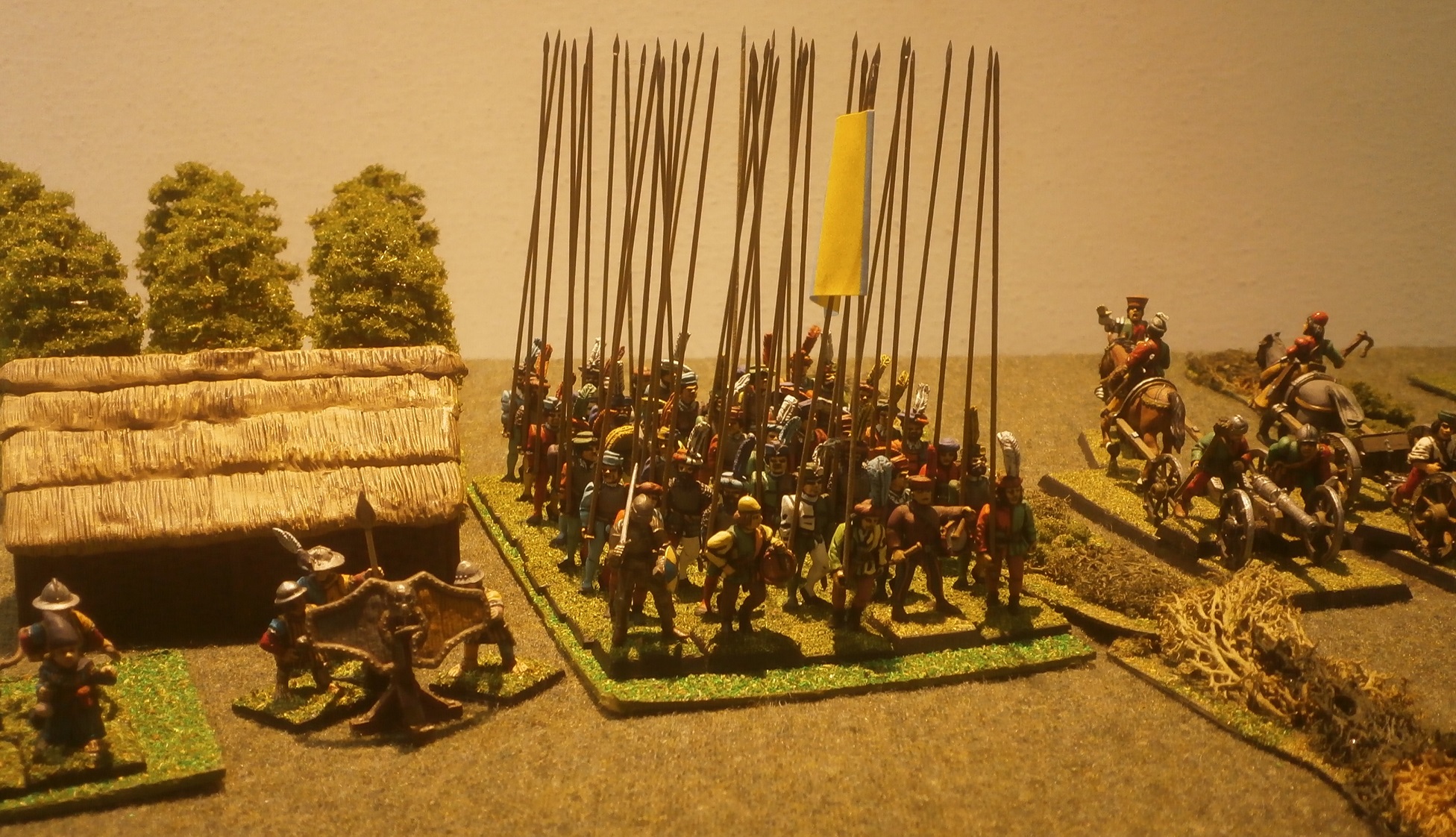
These were led by Captain Maffeo Bugni, who had dismounted to do so, for the barone had ordered that in the first instance, it should be the pike who led the attack, with the mounted men at arms joining the fight should it be required. Wearing his full armour and carrying his blue and yellow quartered shield, his legs bowed from years in the saddle, Captain Bugni did not complain about being ‘reduced to the capacity of a foot soldier’, for he felt pride that he was to lead the crucial attack.
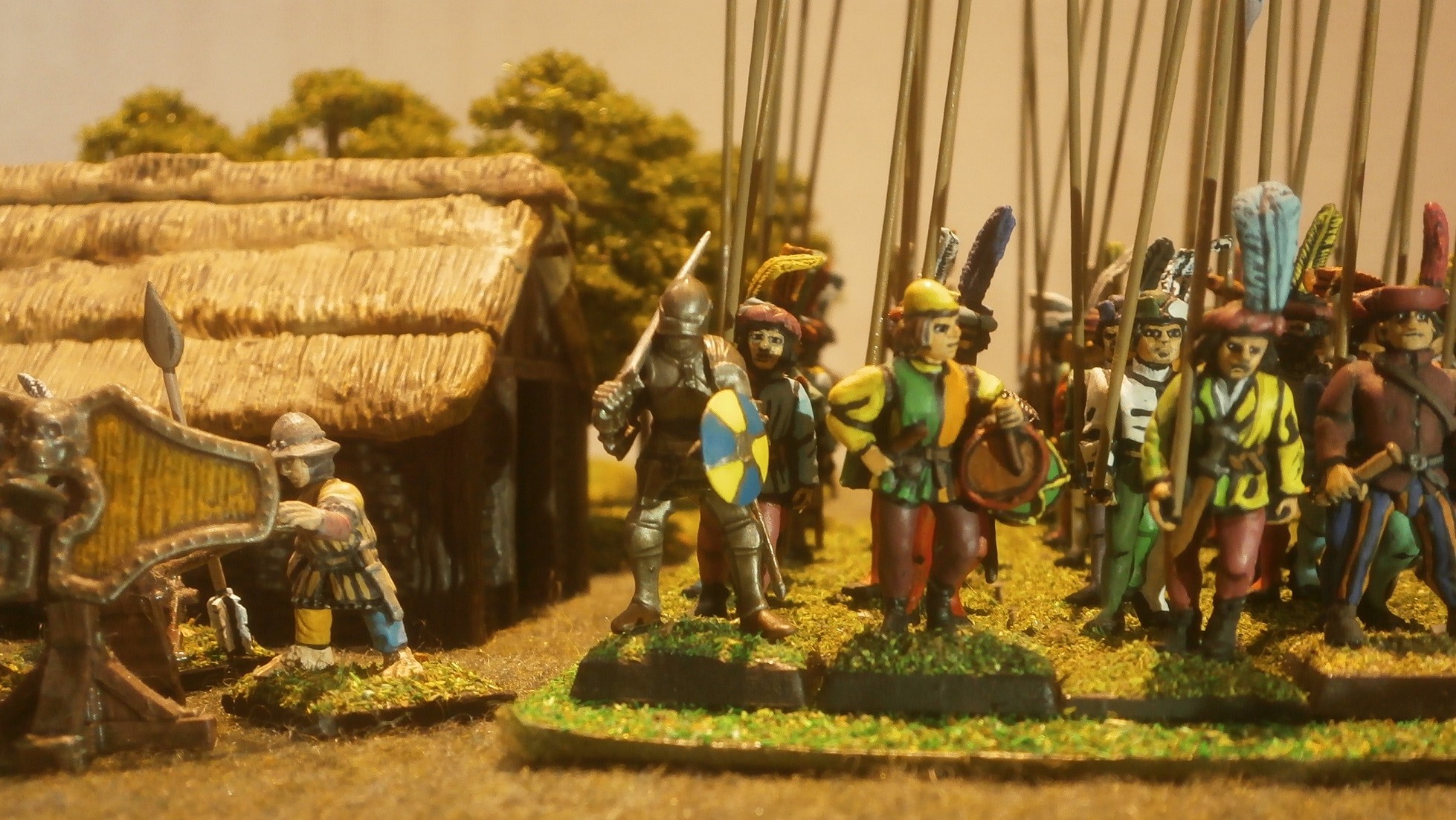
Captain Pandolfo’s galloper guns moved up the road, intent on smashing the hastily built defences before the pike charged across the bridge.
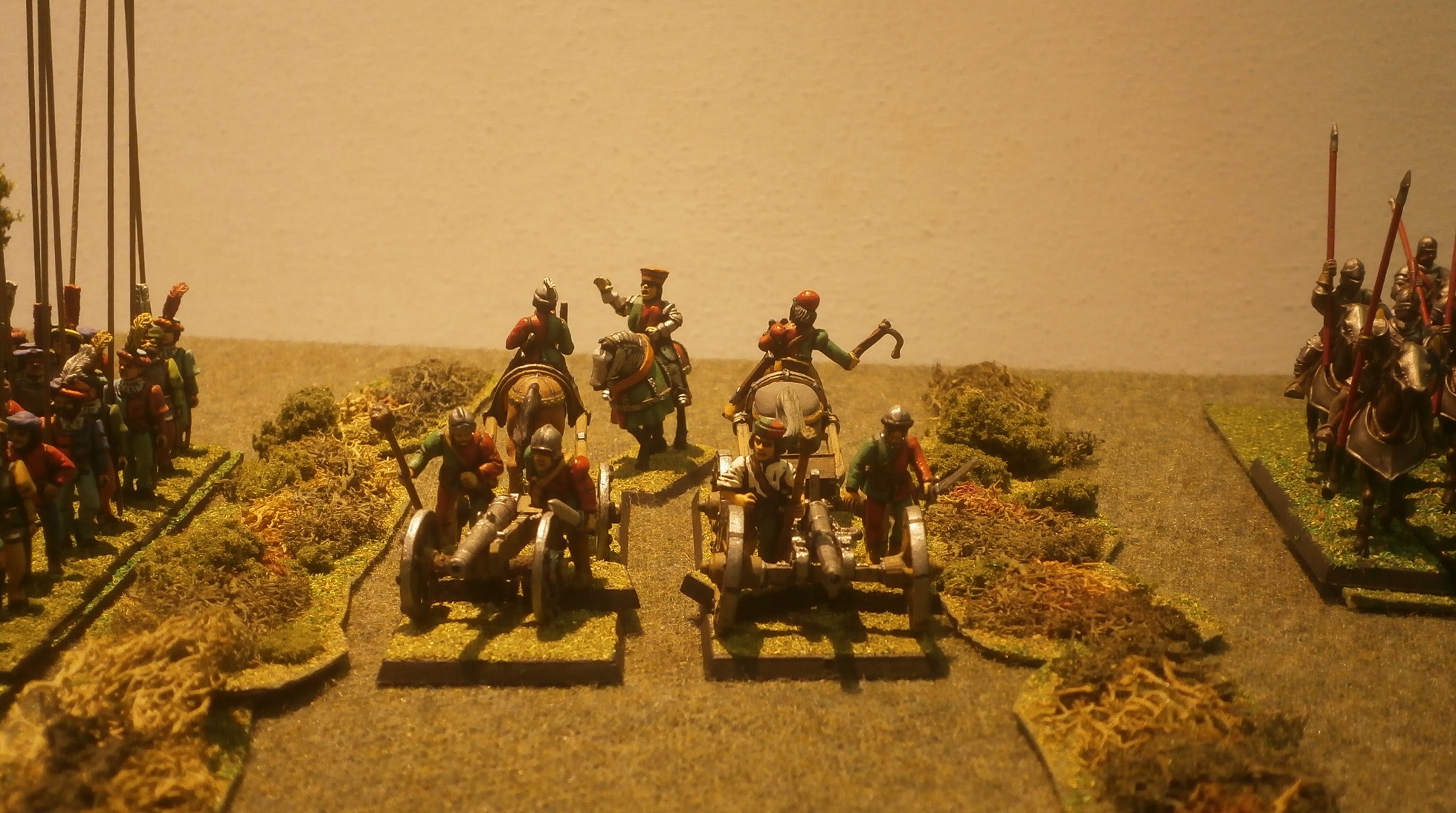
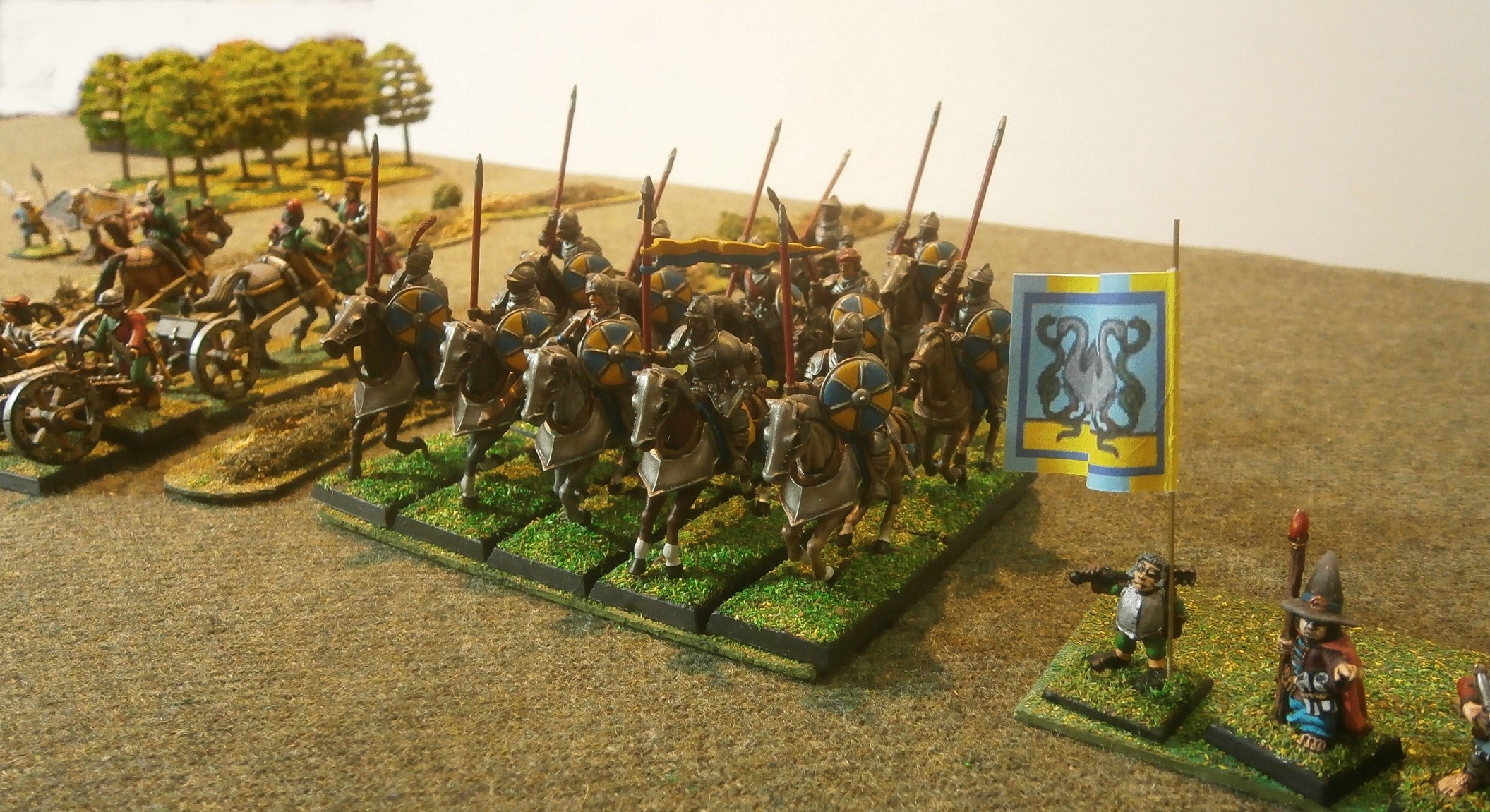
By their left were the heavy horsemen …
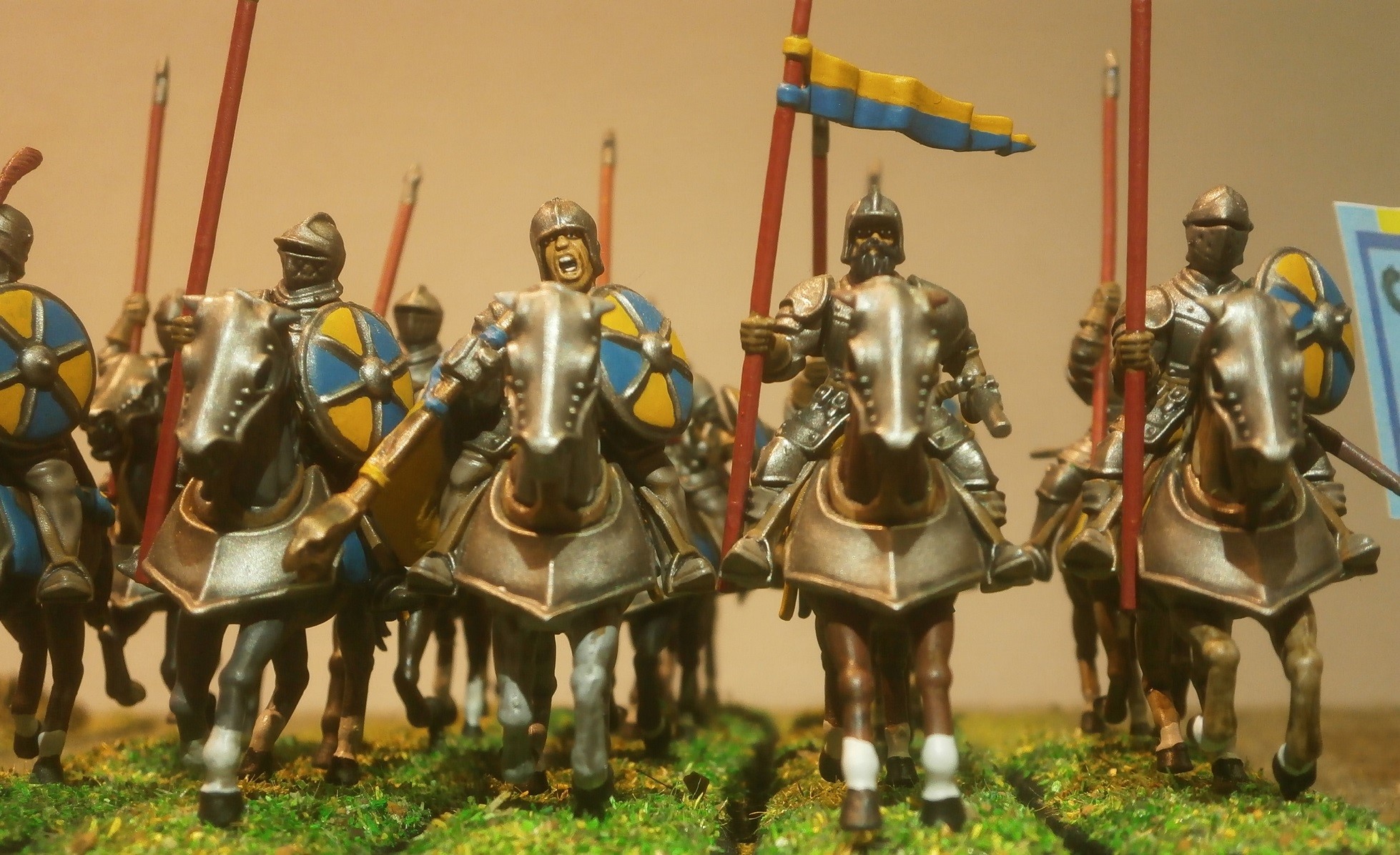
… and then the halfling crossbows, led by the army’s standard bearer, Gildo Pecoraro.
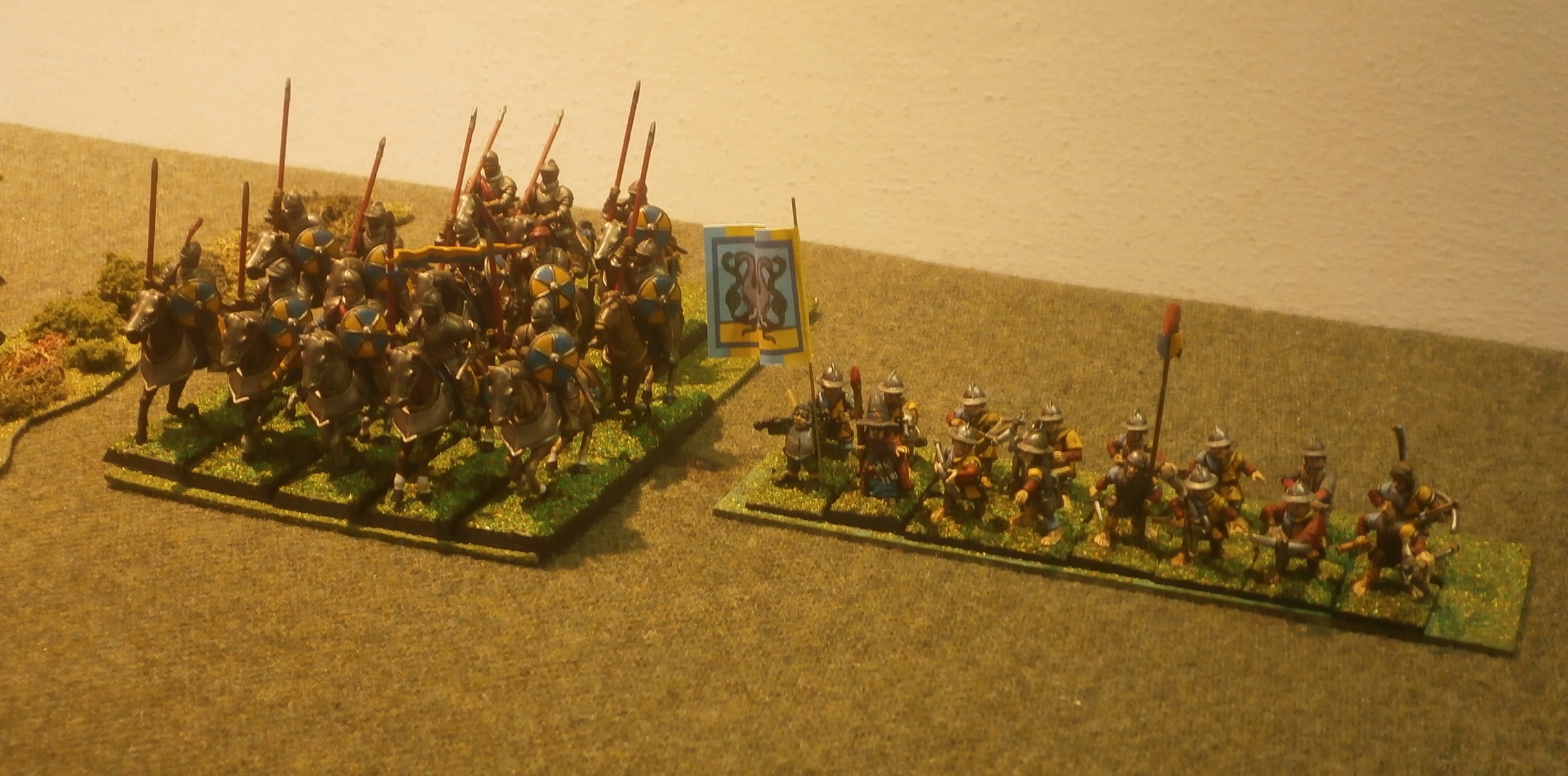
His little flock bore what men would call light crossbows, the kind that mounted crossbowmen carried, with a shorter range but still delivering a powerful punch. Halflings had not the strength to span the heavier kind, and the carrying of windlasses would be too heavy a burden for them. Still, Gildo had trained them well in marksmanship, and his magical banner blessed their quarrels with more than natural potency.
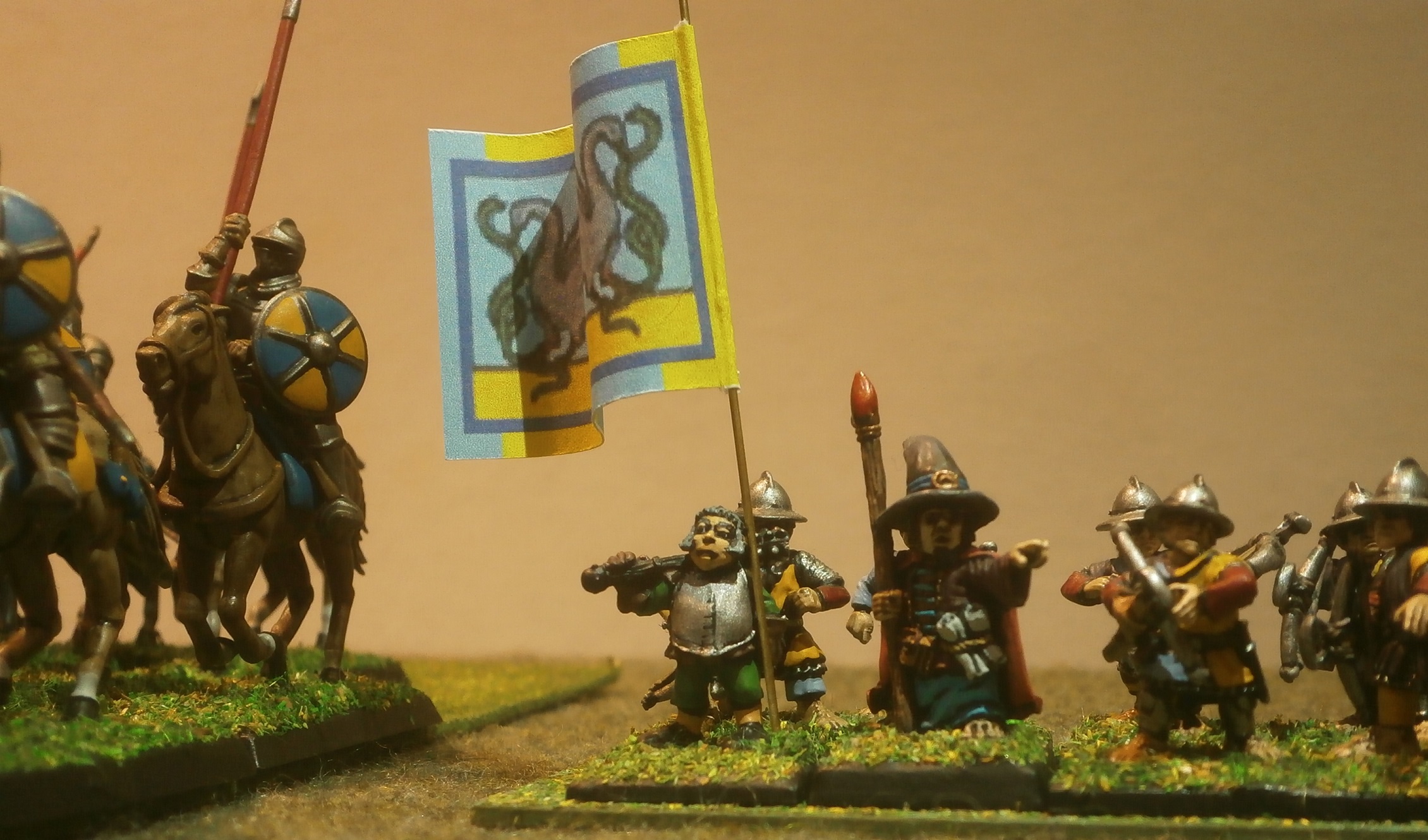
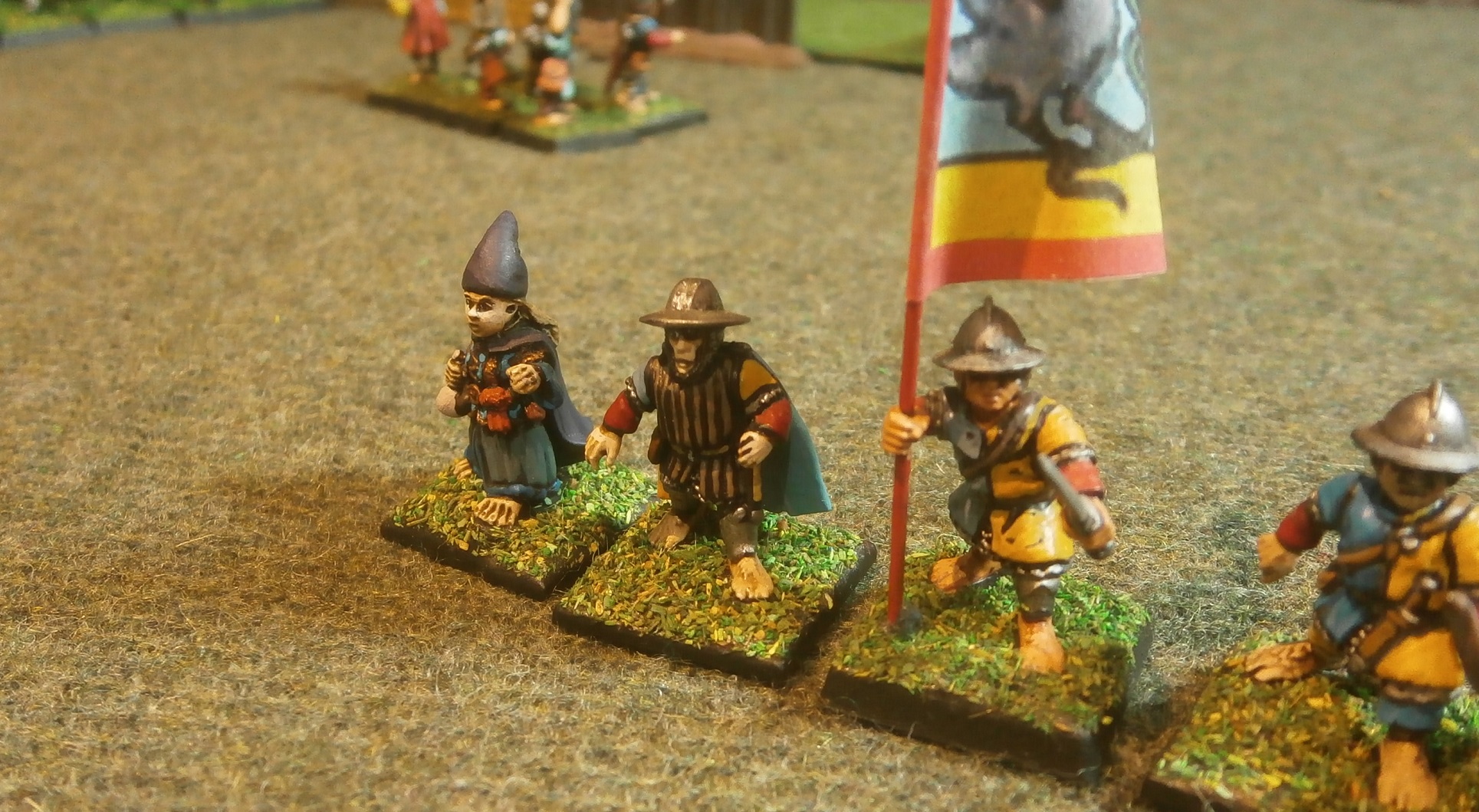
Next to Gildo stood the army’s chief wizard, Pellegrino Magoldi, who had prepared several Heavens’ spells for the battle, and had solemnly sworn to the barone that he would do his utmost to assist the assault on the bridge. Wearing robes and an oversized hat, he clutched his staff tight while scrutinising the foe, looking for opportunities to use one of the scrolls tucked into his belt.
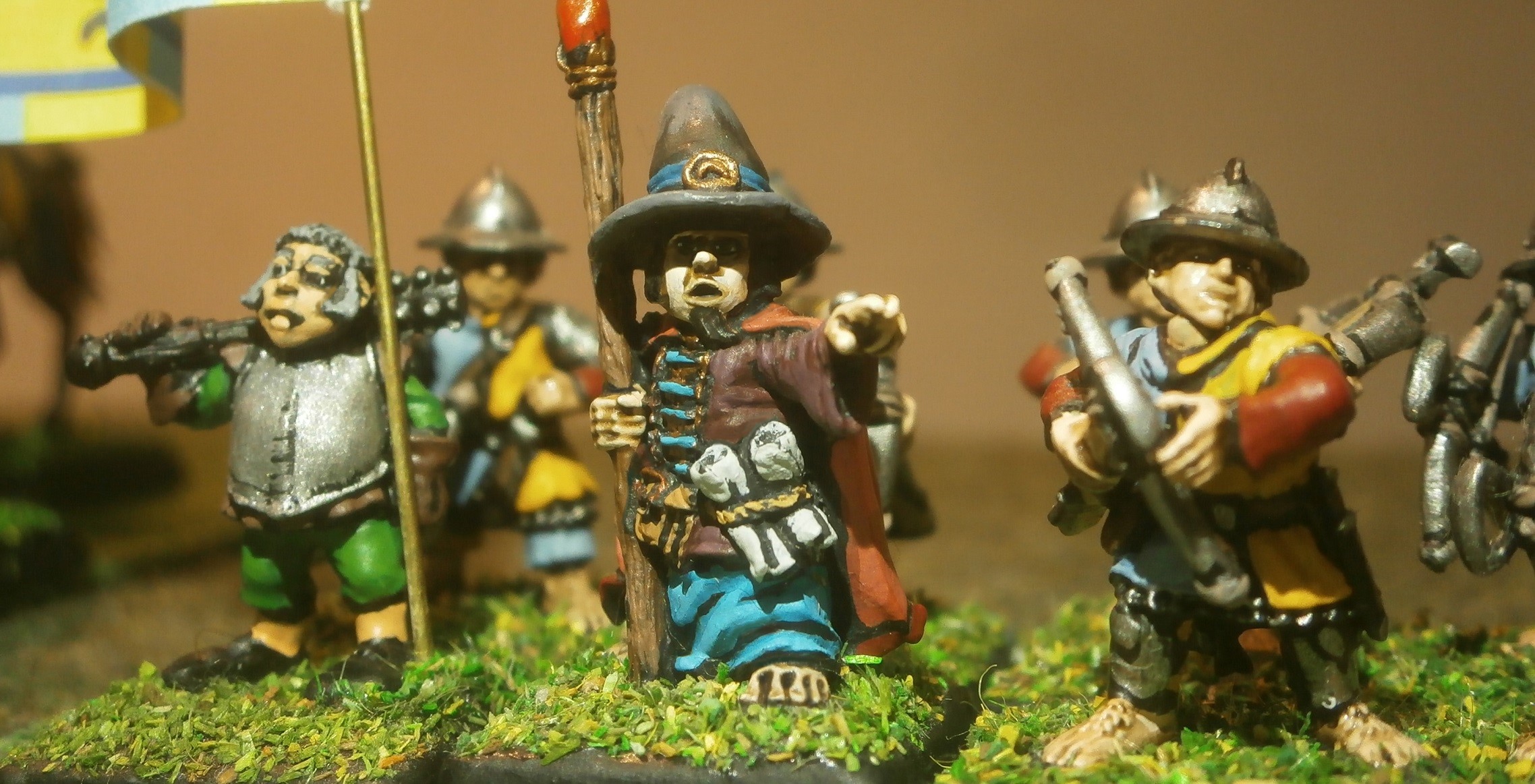
For a moment, the army halted, as Iacopo also looked upon the foe. Directly before him was a body of crossbowmen, busy spanning their weapons while a blue and white Pavonan banner fluttered over their heads.

The rest of the enemy force was clustered by the bridge, clearly intent on resisting any attempt to cross it.
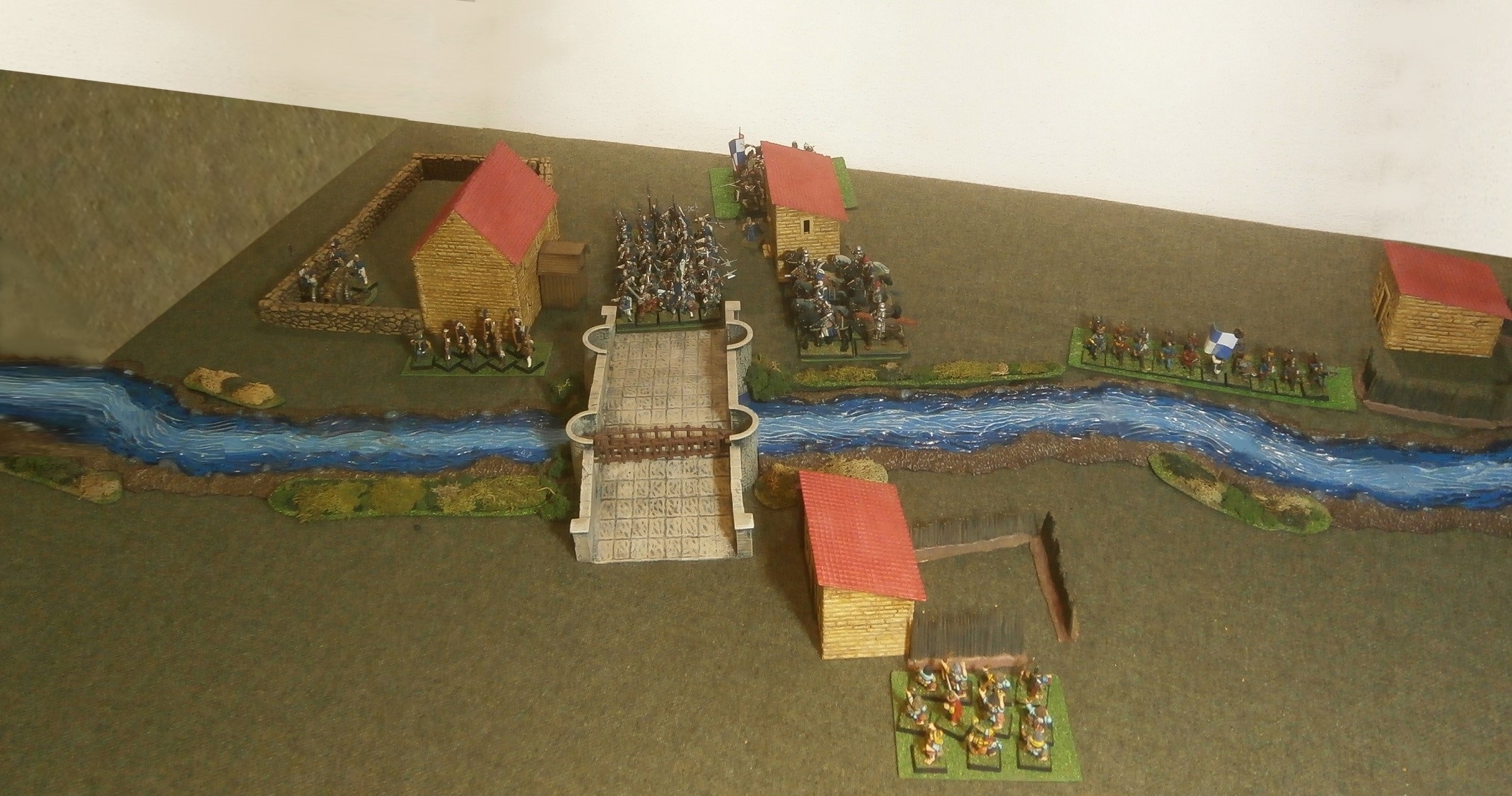
The bridge itself had been adorned with a wooden barricade, but the enemy had chosen not to stand behind it. (Game Note: I ruled that the player could do so if they wished, but otherwise the river’s near-side edge was their deployment limit. Matt chose not do to so, perhaps to avoid learning too soon just how harmful the enemy’s missile could be?)

On the bridge’s left, as the Verezzan’s viewed it, was a stone house and wall, behind which the Pavonans had placed a cannon. Before the house, on the river bank, was a small company of archers.
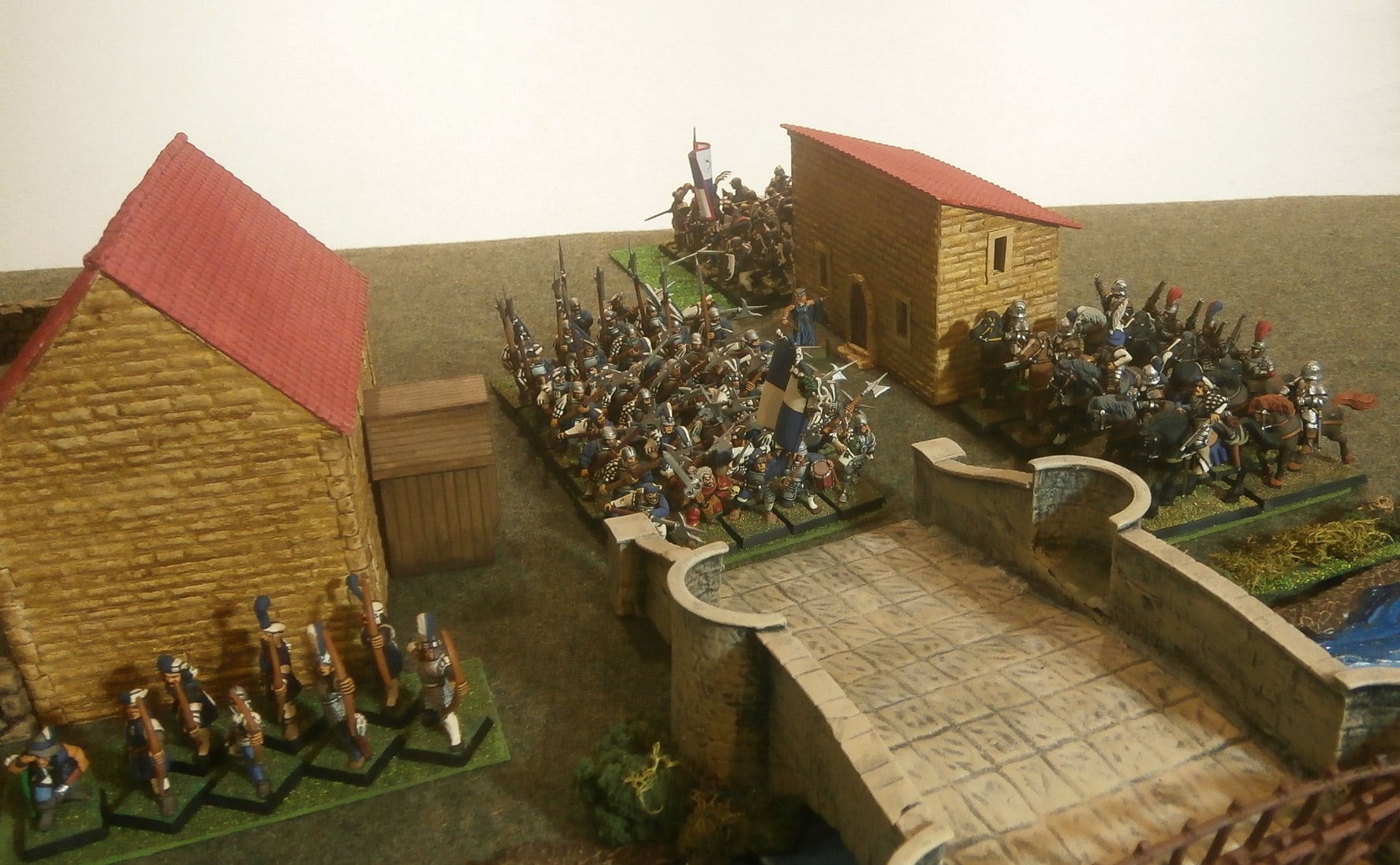
From his position, it was hard for Iacopo to see what lay directly before the bridge, for a large company of pistoliers and high walls blocked his view, but he had already been told that a regiment of halberdiers was stationed there. When he heard loud cheering from that part of the enemy line, he knew there must be plenty of them. The cries were joyous in tone, even victorious, and he pondered what this could mean. Deciding it was most likely mere bravado, he was just about to give the order to advance, when another messenger came to him to report that the celebration had been elicited by the dimounting of a white-haired warrior in crimson armour, who had joined the halberdiers, and that the name ‘Guidobaldo’ had been discerned among the cheers!

Iacopo stared at the messenger, a frown upon his face, and the fellow shifted about uncomfortably.
Could it really be Duke Guidobaldo? he thought. For months, the duke had supposedly lay abed, grievously and incurably wounded by the poisoned arrow the Pavonans claimed had been shot by the Pettirosso. That claim had been a lie, Iacopo was certain, for the Pettirosso would have revelled in having a role in the duke’s injury, happily advertising it to all and sundry, having previously and often proclaimed that just such a deed was his most earnest goal. Instead, the Pettirosso had seemed truly frustrated that it was not he who was responsible.
Now, Iacopo had several more possible lies to sift through. Had the duke’s wound been less serious than that reported? Had his doctor’s actually been able to cure him? Was he ever even injured at all? Or was this red-armoured man an imposter?

If the last was true, then he must be a convincing one, for the cheers had sounded heartfelt. Surely the people of Pavona knew their duke well? Or was the famous red armour and a shock of white hair, combined with their wishful thinking, sufficient to convince them?
As he pondered this, a body of swordsmen drew up behind the halberdiers – the enemy were concentrating their fighting men to present the toughest obstacle to anyone intending to cross the bridge.
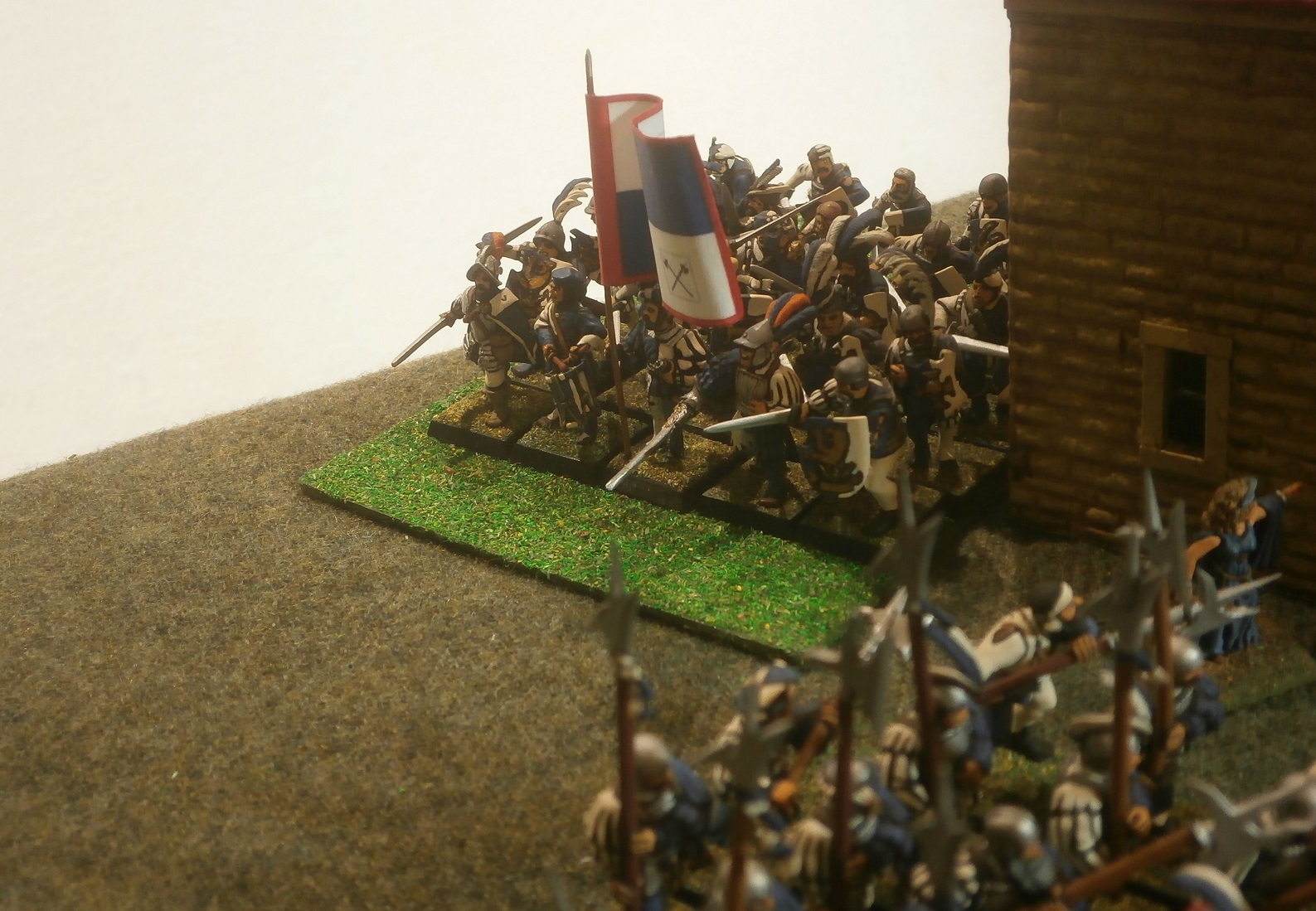
Indeed, such was their determination to amass their strength for that purpose, that even the pistoliers had pushed awkwardly between house and river to come close to the bridge’s flank. Whether they believed they could shoot at any who crossed the bridge, or charge into the flank of such, was unclear, but they were certainly keen to be close to it.

Meanwhile, two wizards made their way into the buildings by the bridge, one, being a fellow of a Cathayan appearance, entering the larger house …
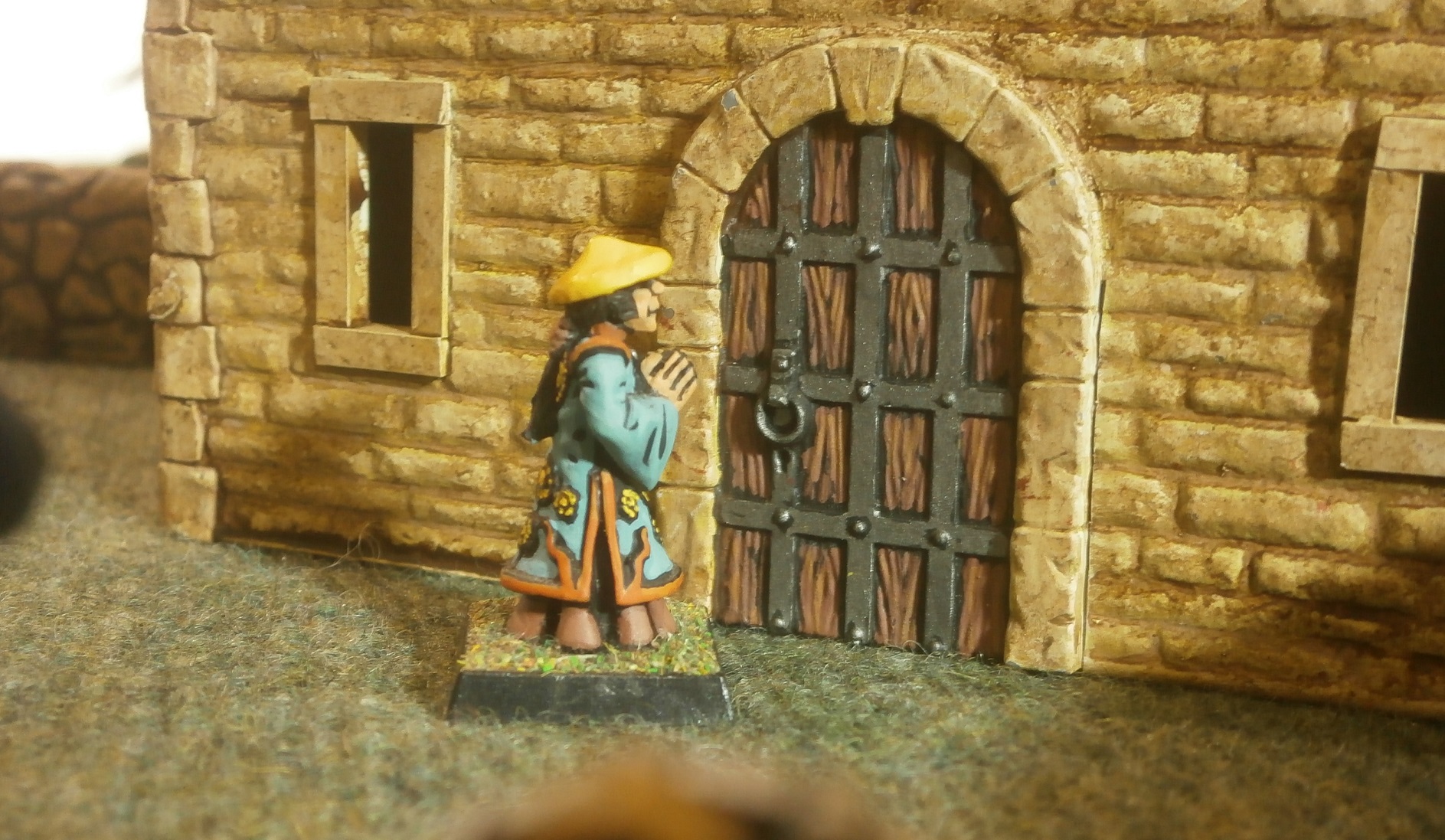
… while the other, a woman in flowing a flowing dress of blue, like an image of Myrmidia, moved carefully past the sharp halberd tips to reach the door of the smaller house currently surrounded by soldiers on three sides.

Both probably intended to find a suitable window from which to look upon the enemy and thus better target their spells.
Chapter Two, The Battle.
The Bridge at Casoli. Early Autumn, 2405.

With a wave of his hand, Barone Iacopo commanded the advance to begin. His own regiment of archers moved slowly, arrows nocked, keen to loose a volley as soon as possible. Beside them, the large bodies of pikemen and knights also moved …
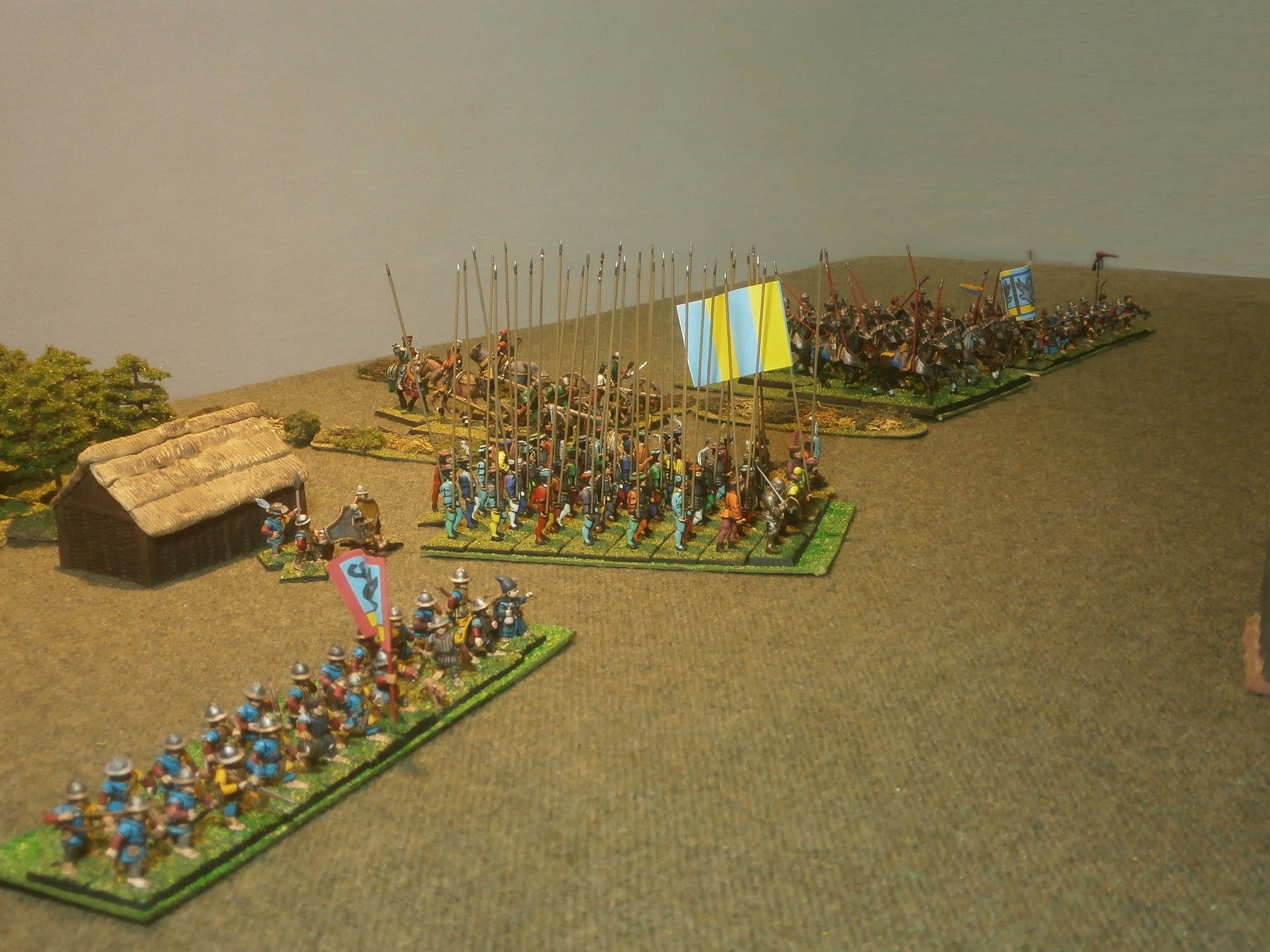
… the former aiming for the bridge, while the latter considered what role they could play if the pike were to assault first. The Pettirosso and his band ran into the fenced yard before them …

… not willing to lose the opportunity to shoot at the crossbowmen formed up on the far side of the river, and very happy to do so from behind a protectively sturdy fence.
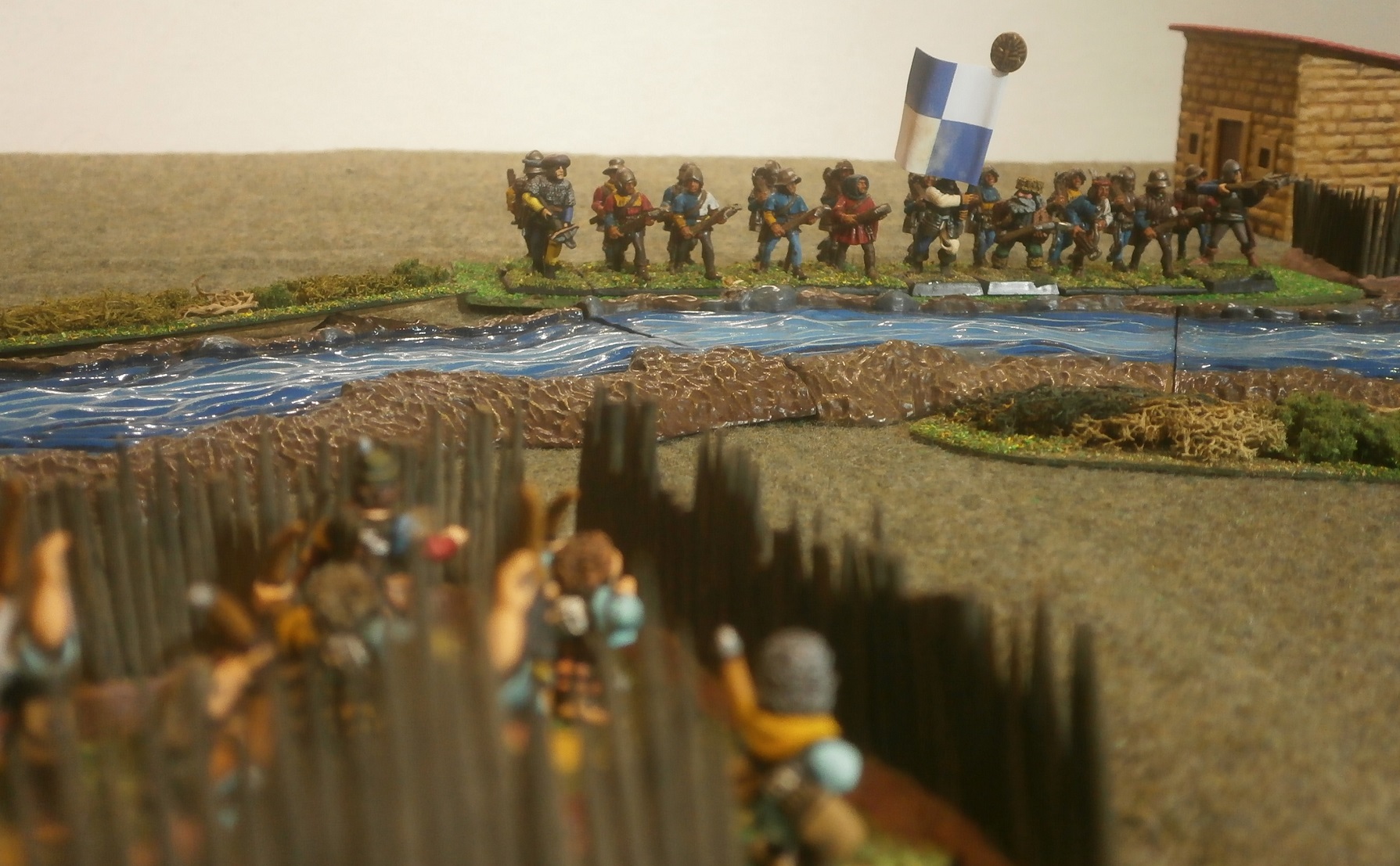
The enemy’s blue and white, quartered banner, fluttered above them as several heads turned to spy the halflings who had, until now, been hidden. The Pettirosso himself was eyeing the pistoliers by the bridge, while stroking the magical ring upon his finger, wondering if he could break and scatter them with one blast of magical fire.
Captain Pandolfo’s galloper guns had no need to move, being perfectly able to target the bridge from where they were.
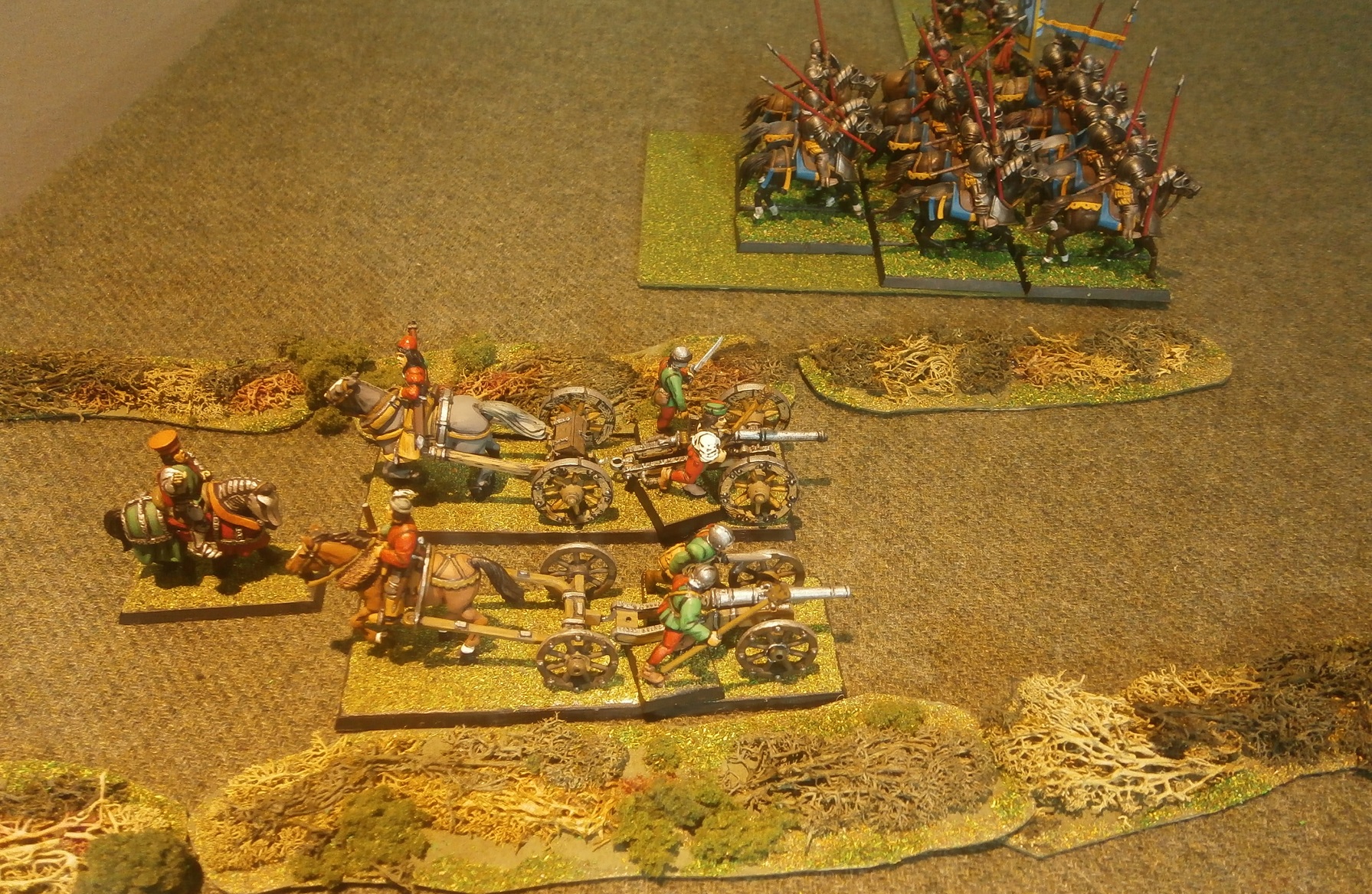
Upon the far side of the mounted men at arms, the army’s standard bearer, Captain Gildo Pecoraro, encouraged by the wizard Pellagrino by his side, commanded the light crossbows to advance at the best pace they could manage. This put a smile on Pellagrino’s face, knowing he would soon be close enough to conjure harm upon the foe.
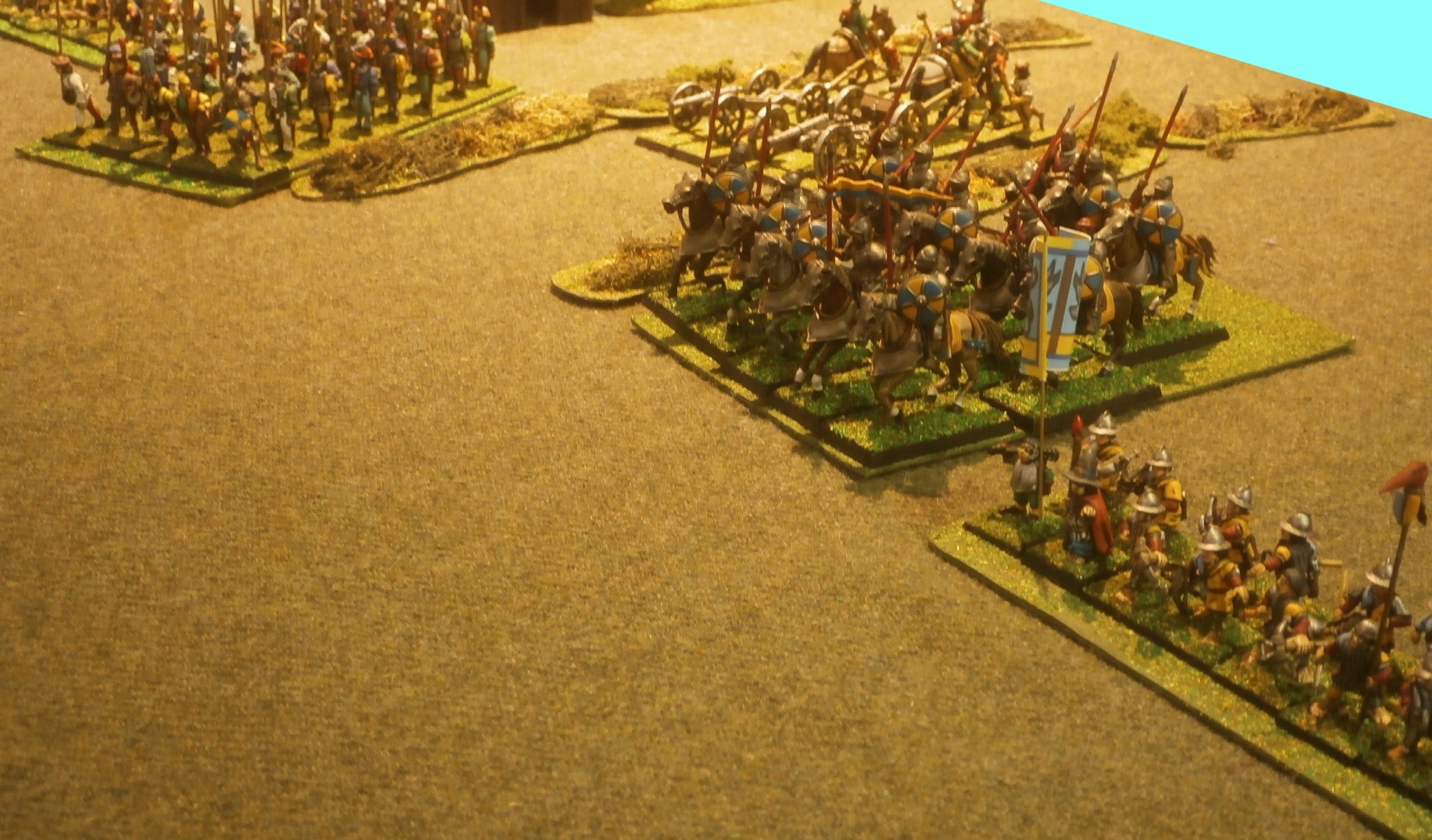
The Pettirosso’s arcane ring failed him, while Pellagrino’s attempts at magic were also disappointing. He did manage to bless the main body of archers under the barone’s command with a Harmonic Convergence spell …
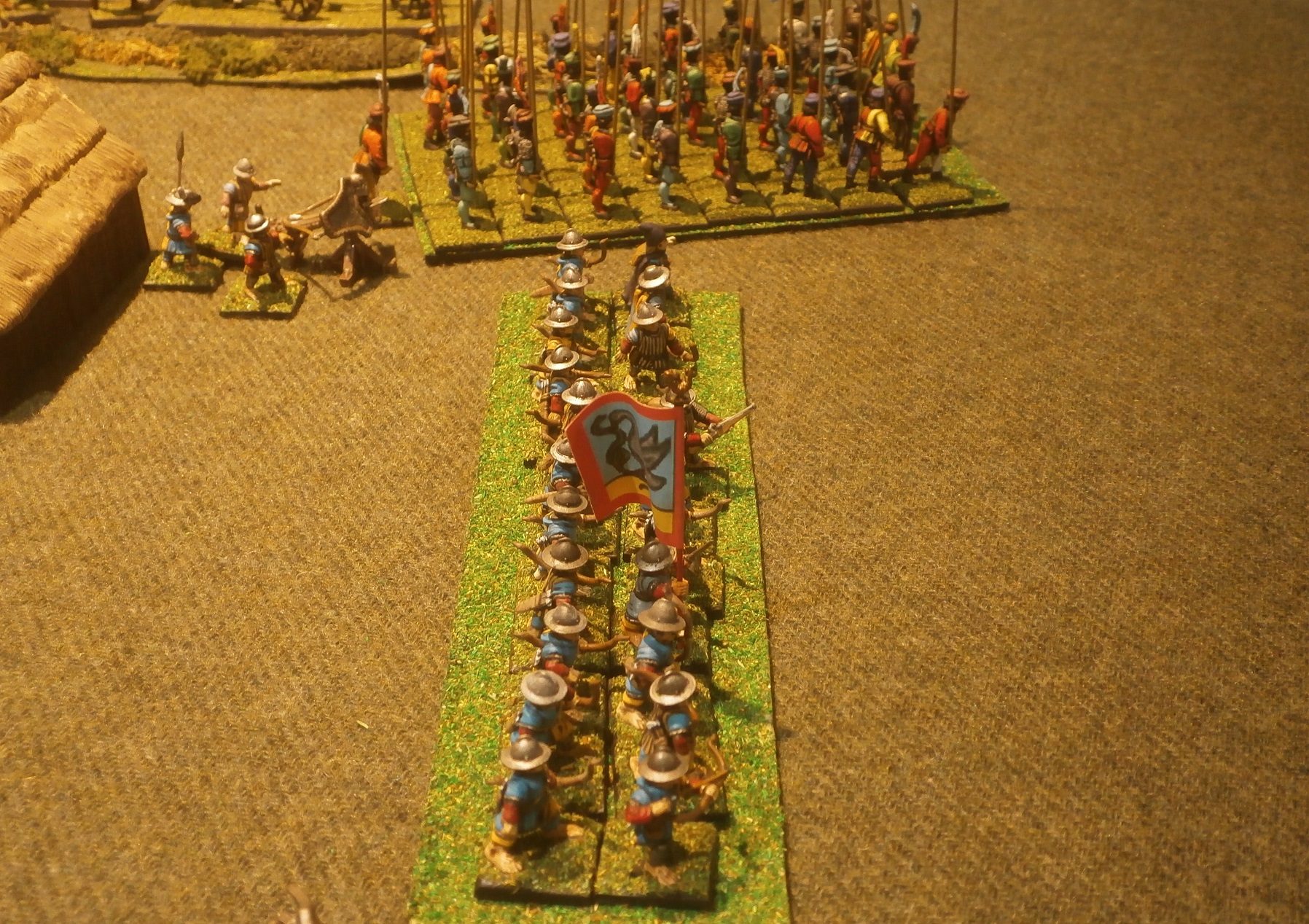
… but then the lightning he conjured to strike the cannon behind the wall fail merely struck the ground around it. Worse, in his reckless haste, he had failed to fully restrain the energies he brought into being, and a blast coursed out from him, bursting the lungs of no less than six of the crossbowmen by his side!
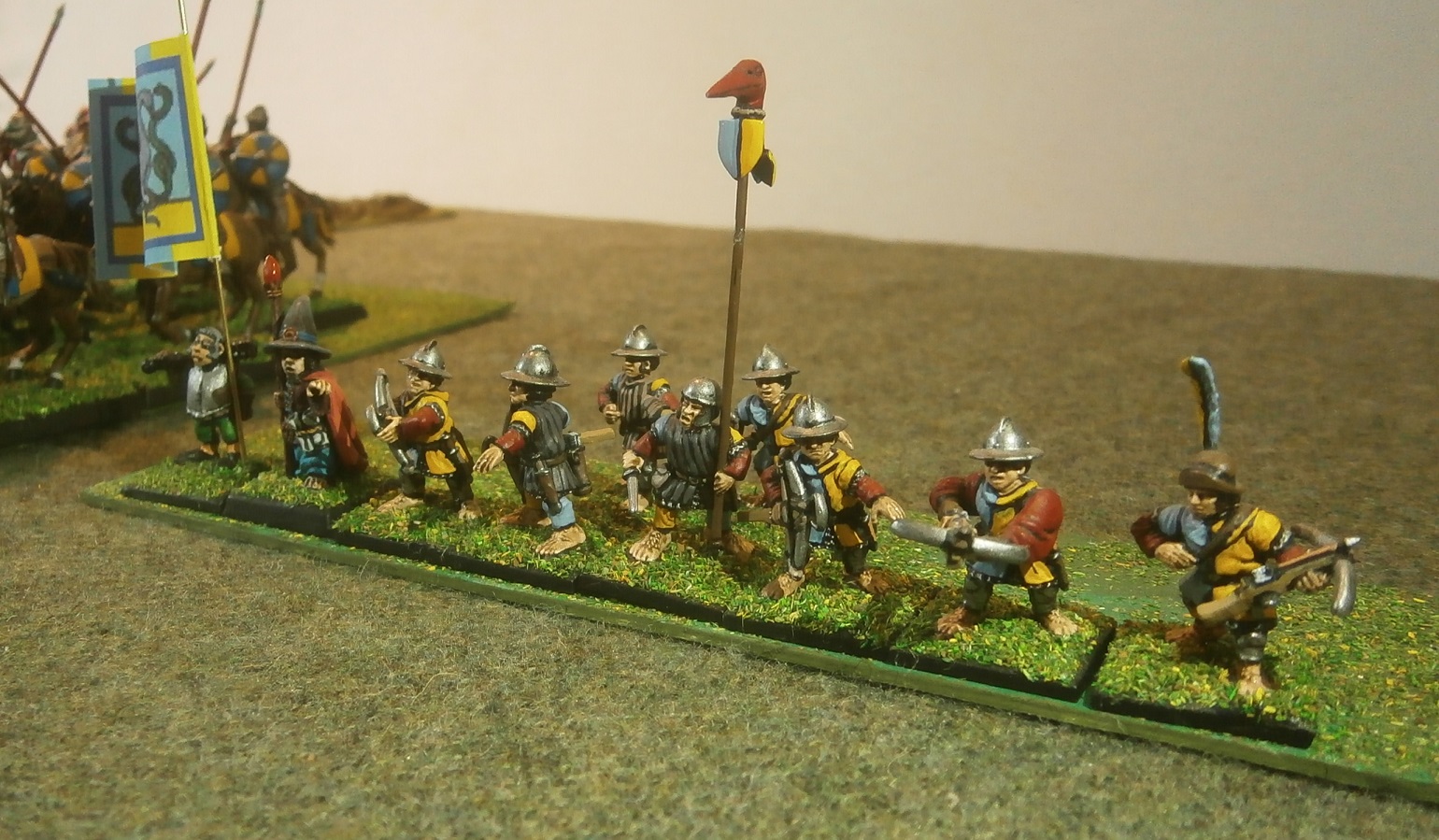
Even Captain Pecoraro stumbled as he too almost choked, but he managed to keep the standard aloft. Pellagrino had to steady the captain, who was so winded and dazed that he did not hear the wizard’s muttered apologies. He could not fail, however, to hear the two loud reports from Pandolfo’s galloper guns.
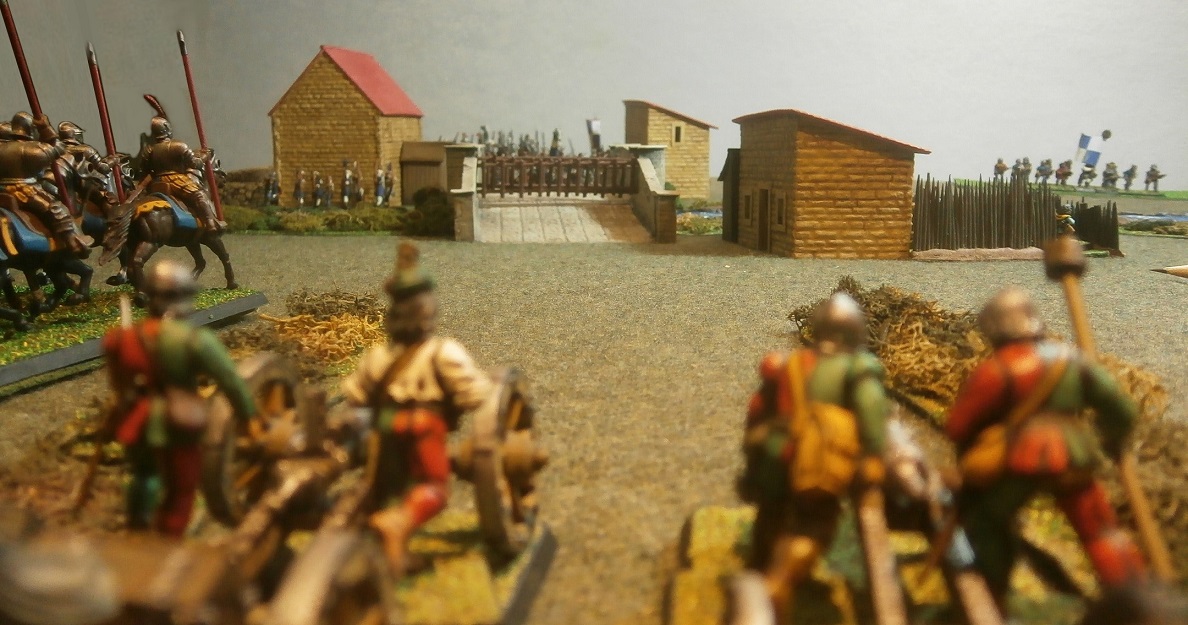
The first roundshot skipped across the field to crash into the wooden barricade upon the bridge, tearing it to pieces.
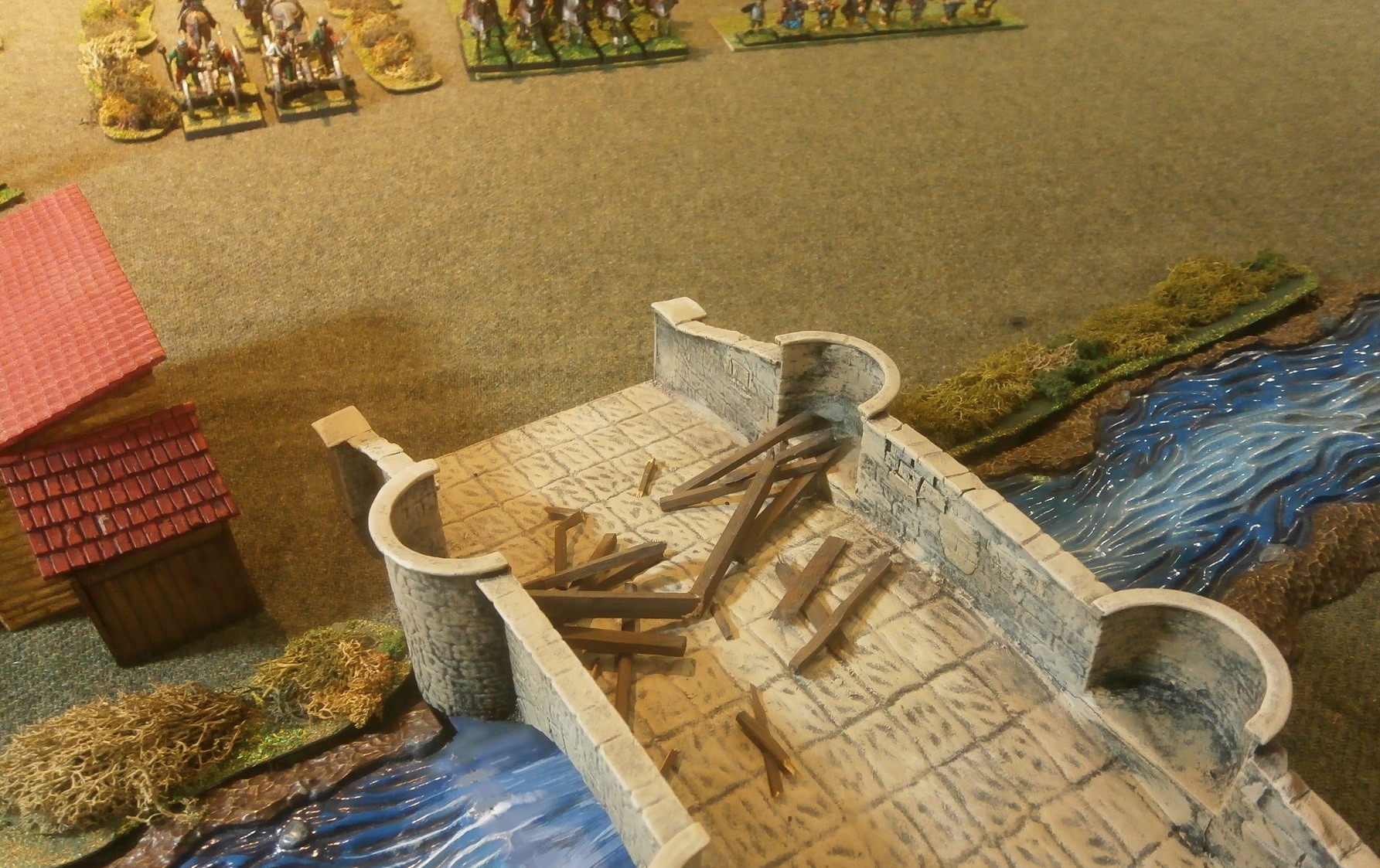
Then, after quickly shifting its aim, the second fired at the enemy pistoliers, missing them (Game Note: A roll of 1 to wound) and instead striking the building behind and (unknown to the gunners) wounding the wizard within.
(Game note: Neither the player (my son) nor I (the GM) learned from this that the enemy wizards hiding in the houses were critically vulnerable to shots from the cannons. It should have been obvious from the rules as written, but, I guess, in a roleplaying/storytelling sense, our tactical ignorance worked out well, as the crews could not yet have known that their shot had harmed anyone within the building!)
The Pettirosso and his rangers now felled five of the crossbowmen, causing the rest to flee and eliciting a cheer from the halflings.
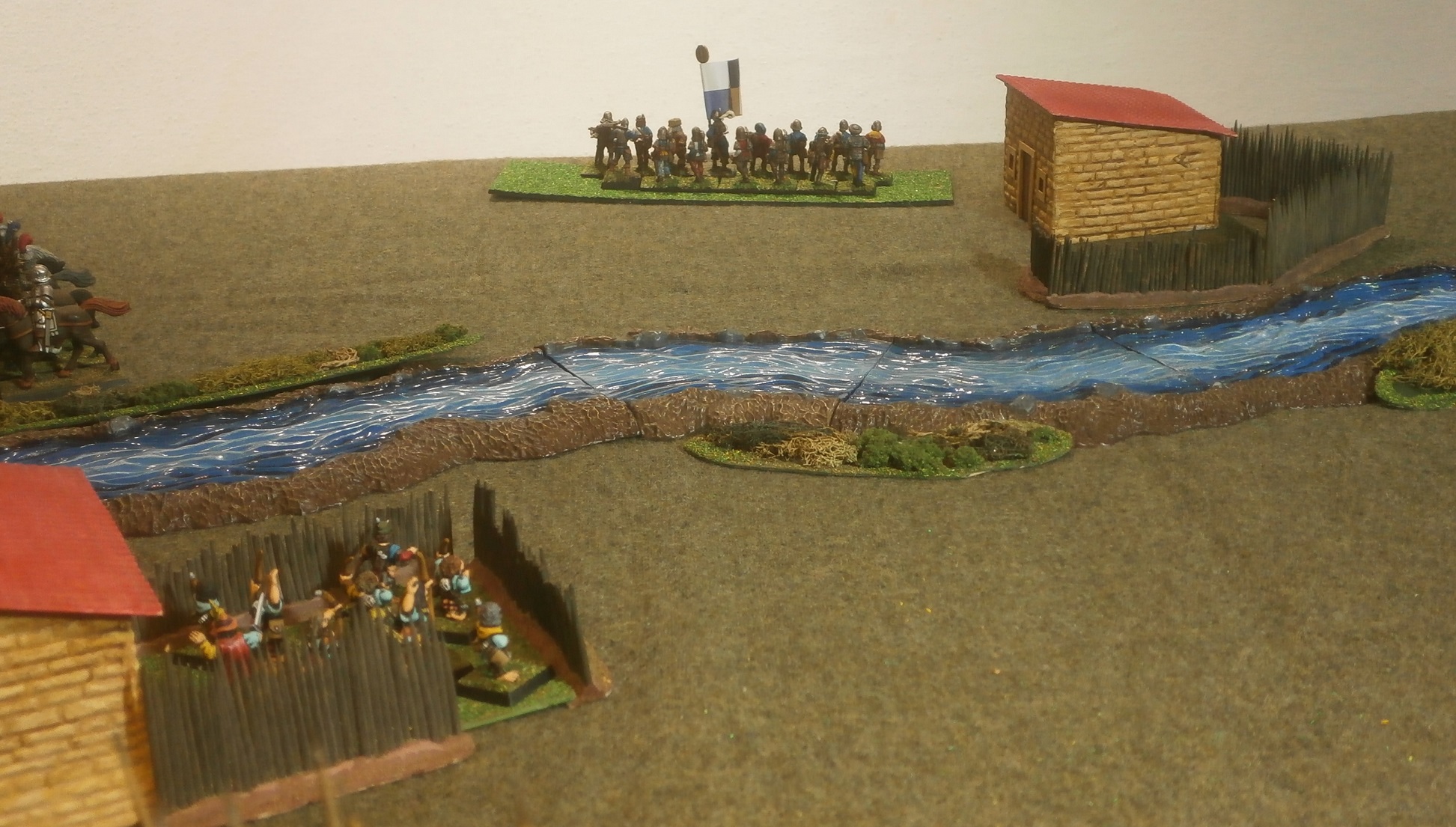
As the enemy ran, the barone silently cursed, for they were now beyond reach of his lads’ arrows, which meant the magical blessing was wasted. What with their ability to loose twice as many arrows as any other archer, he knew his lads would most likely have wiped them out the Pavonans to a man.
(Game Note: Iacopo has the campaign army list special rule, ‘Mercenary skill, Quick Shot’, which means he and any unit he joins get the rule ‘multiple shots: 2’ when shooting with non-magical short bows, bows or long bows. These guys have bows, which of course are like long bows to them!)
While one of the ballistae missed the fleeing crossbowmen …
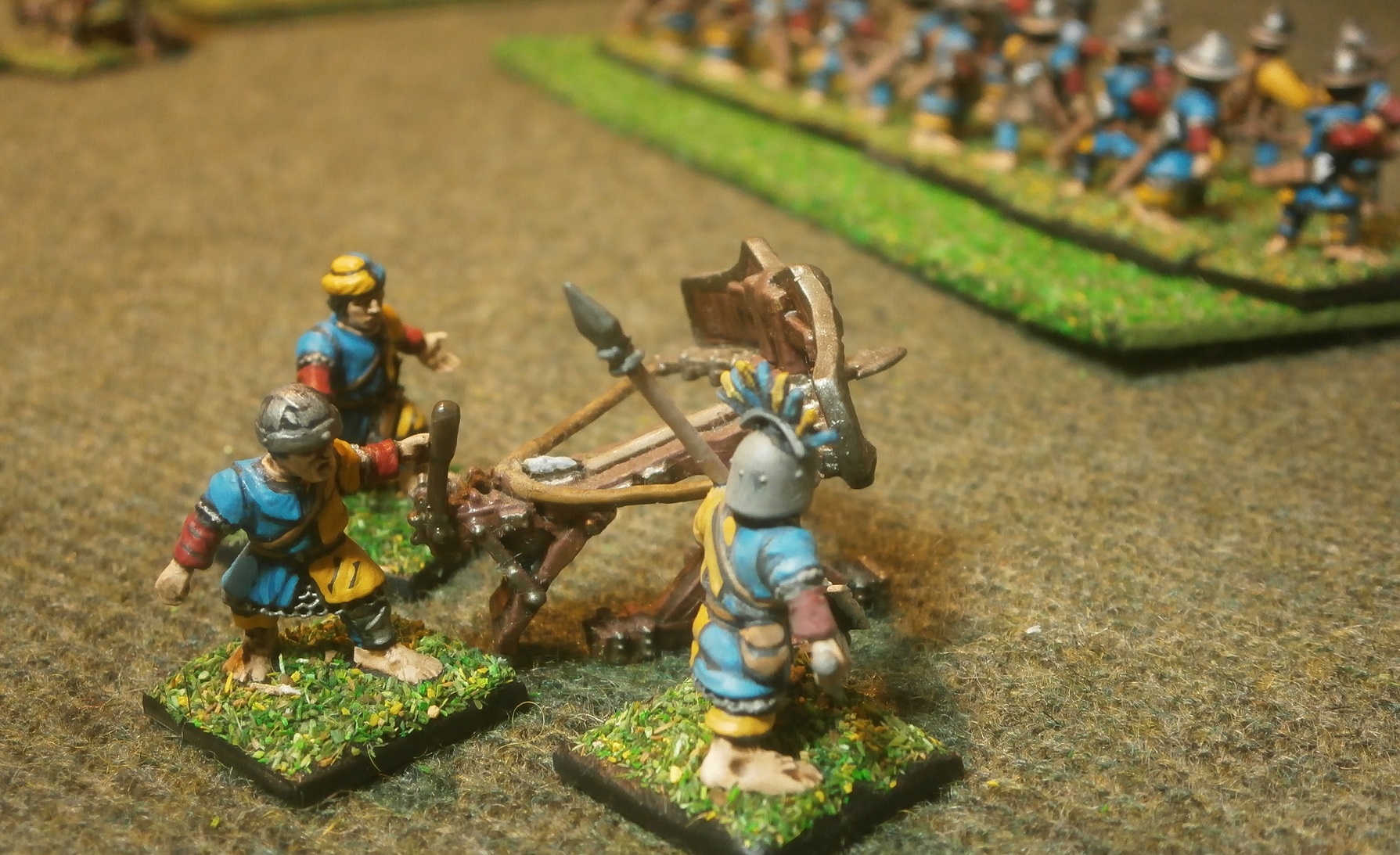
… the other slew two of them. Despite this rough treatment, the surviving Pavonans rallied and reformed themselves!
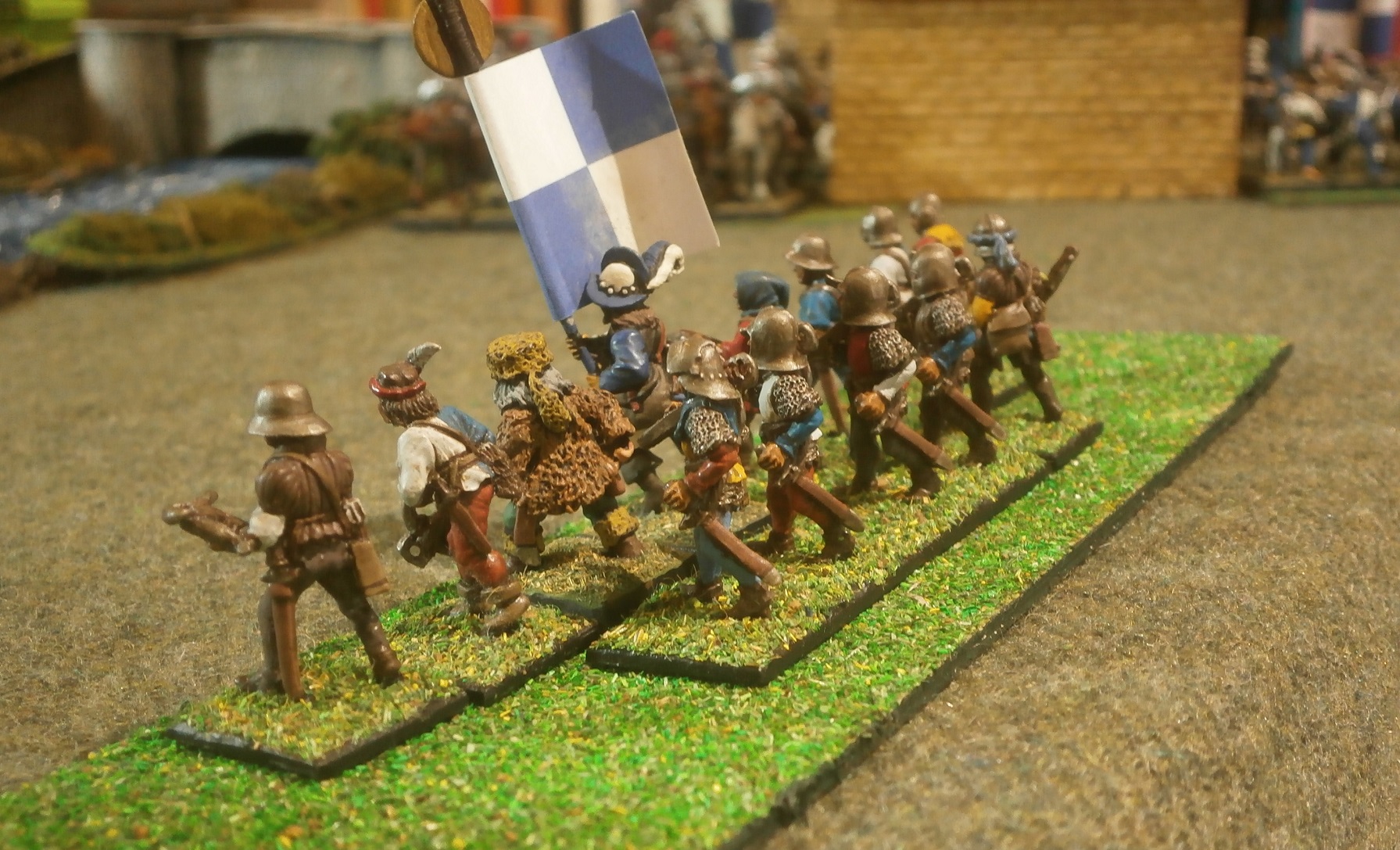
Perhaps they believed they were safe now, or maybe the thought of running before they had launched a single bolt shamed them, especially with their beloved lord present upon the field?
On the northern side of the bridge, the halberdiers fell back a little, as ordered by the duke himself, while the pistoliers manoeuvred around behind them, presumably having felt somewhat exposed beside the bridge, especially when an iron roundshot smashed into the building behind them.

So it was that the Pavonans were concentrating just about everything they had at the bridge, where they were better concealed by the houses and best placed to thwart any attempt to cross. Their confidence waxed with proximity to their miraculously recovered master, who, despite his order to fall back a little, was a most reassuring presence. Truly, they agreed, he was Morr’s most favoured, granted life so that he might defend his realm against its enemies.
(Game Note: Duke Guidobaldo was an entirely unexpected presence on the field for both friend and foe, for all had believed him to be dying for many a month, kept alive only by the skill of Pavona’s most able physicians and healers. So, as GM, I had house-ruled that he, as well as being general, adorned in his bright armour and wielding his greatsword, was now effectively an ‘army standard bearer’, although one with a range of 6″ rather than 12″, thus granting re-rolls to Leadership tests for all units within range. It seemed to me, and I think both players agreed, an entirely suitable way of incorporating the surge of hope his presence gave to his soldiers.)
The Pavonan wizards, peering through the windows of the houses either side of the bridge, failed to bring about any magical harm upon the Verezzans, their spells either too weak or dispelled by the enemy wizards. The cannon …
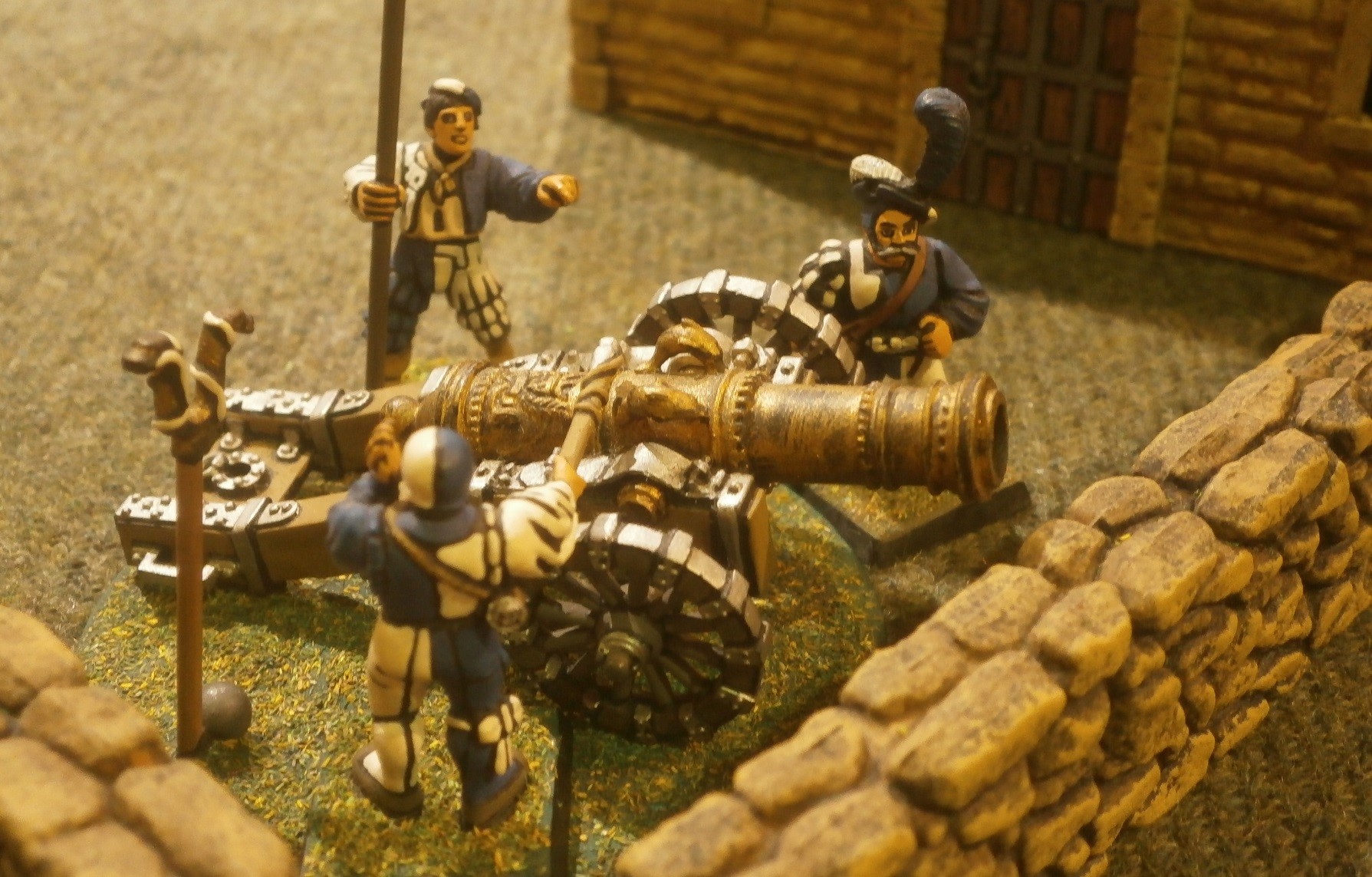
… felled but one of the mounted men at arms, while the little company of archers managed to kill only one of the halfling crossbowmen.
Such a gentle mauling was entirely insufficient to dismay the Verezzans, who continued their advance, with the galloper guns moving forward some way, and the barone’s archers marching as far as their legs could carry them.
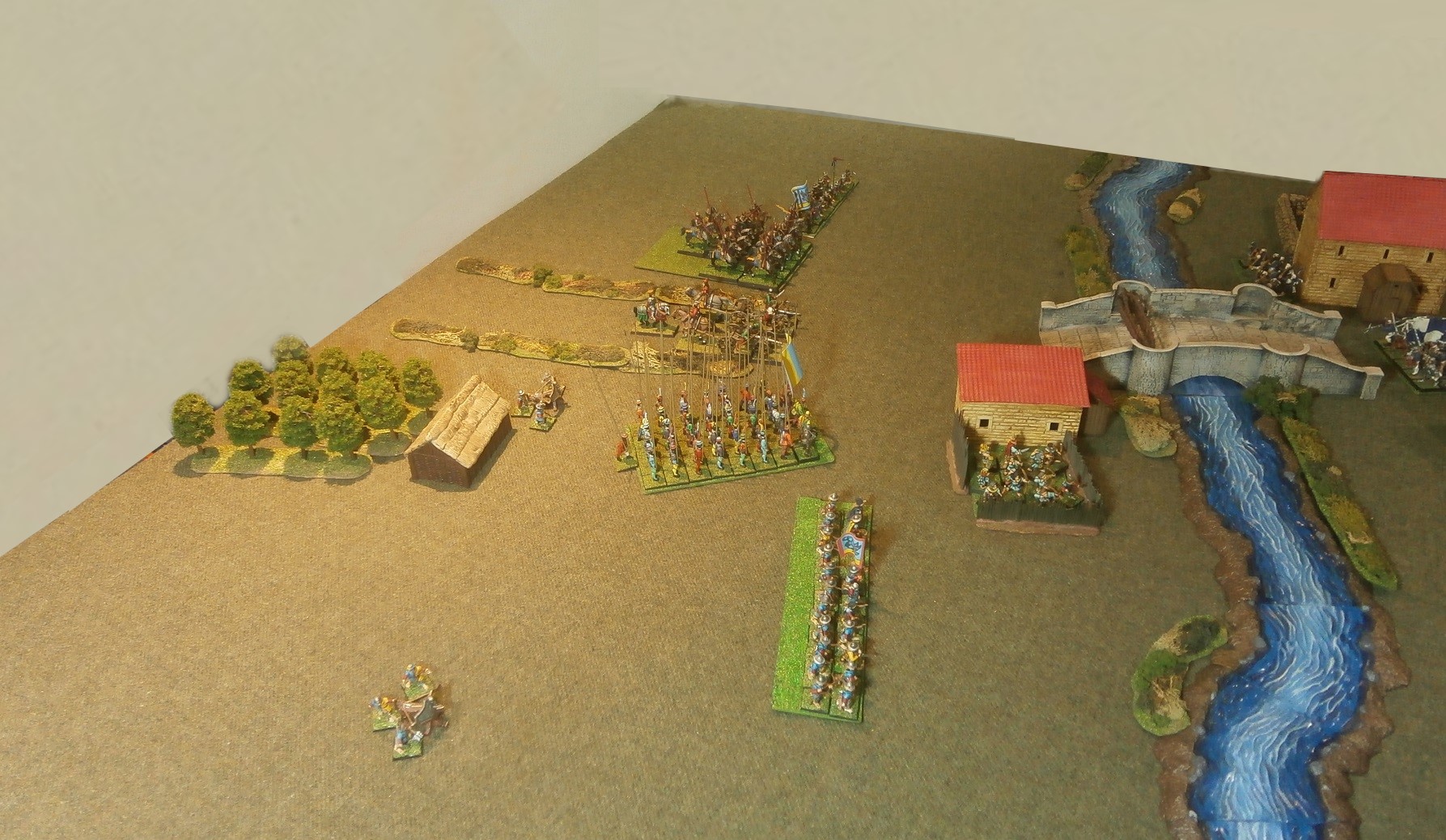
The pike regiment, however, simply shuffled a little to one side, to allow the gallopers a clear shot over the bridge.
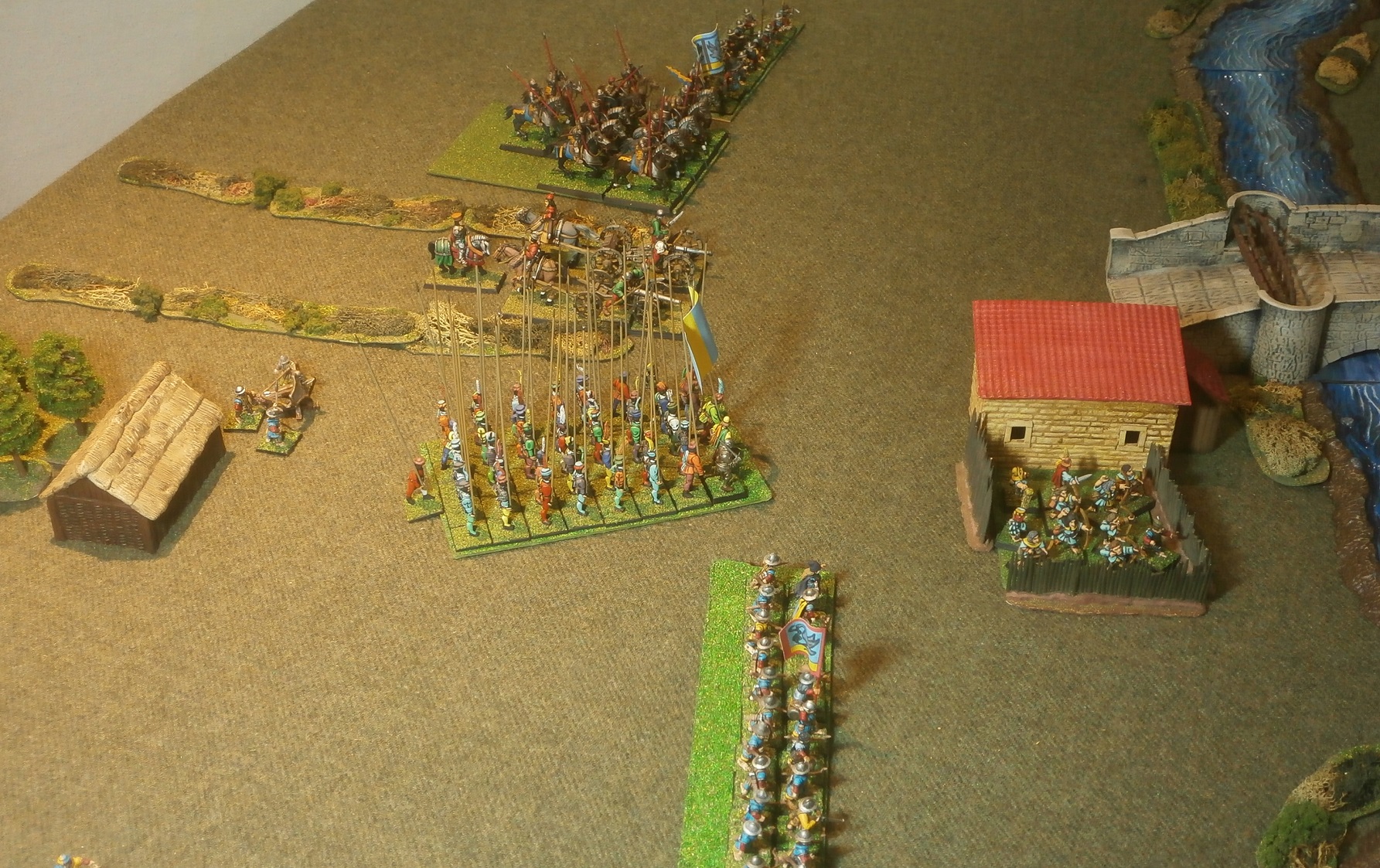
They may have been keen to assault the bridge, but having witnessed what the guns had done to the wooden defences, they were entirely happy to allow Pandolfo’s brace of ‘pocket pistols’ to play upon the halberdiers. Once the foe had been reduced in number, becoming both bloodied and shaken, then surely victory would prove more certain.
The halfing wizards were still attempting to cause as much harm on the foe as they could . While the Pettirosso’s attempt to launch a ball of fire from his magical ring at the halberdiers was again dispelled, Pellagrino thought to repeat his blessing of the barone’s archers.
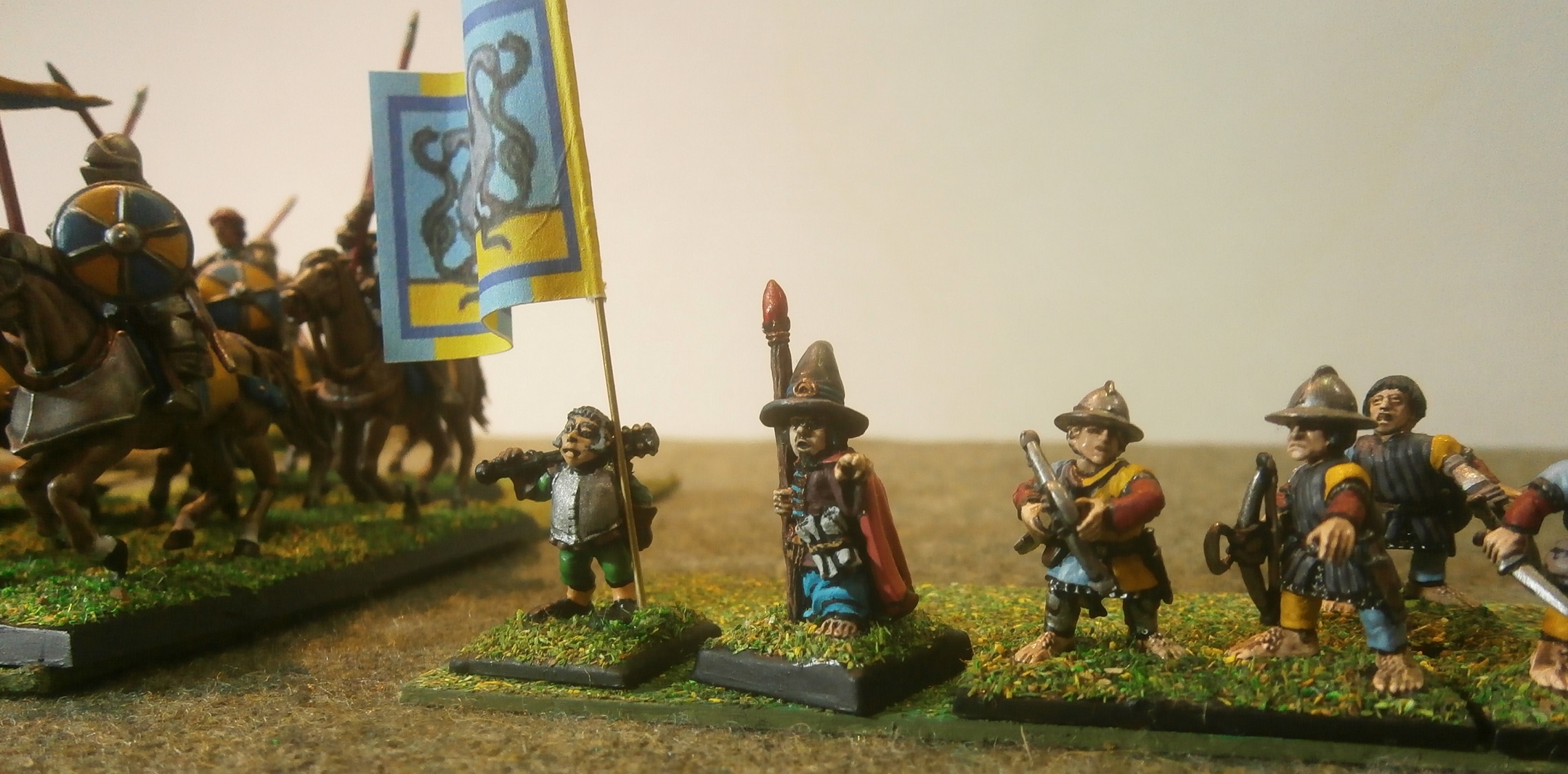
But this too was dispelled, presumably because the enemy suspected what those archers were capable of. Frustrated, and nervous considering what had happened when he had last employed the spell, he summoned a chain of lightning to strike first at the archers, killing four …
… then successfully shifted the flaming shower over to the halberdiers, killing five!
“That’ll do,” said Captain Pecoraro at his side, encouragingly. “Indeed, more of that sort of thing would be very welcome, master wizard.”
Pellagrino allowed himself a smile, which became a grin as the halfling crossbow with him brought down the last four of the enemy’s archers.
While the gallopers proved a disappointment, as their bullets only knocked one halberdier to the ground, the Pettirosso’s rangers made up for it by killing four more.
As another two of the rallied Pavonan crossbowmen were skewered by a ballista bolt, Duke Guidobaldo once more ordered the halberdiers to fall back a little further, presumably attempting to find the best spot to make a stand, perhaps where the swordsmen or pistoliers might be of some assistance in the fight.
While the lesser Pavonan wizard watched as her magical ring’s bound fireball failed to burn any of the rangers, her more powerful colleague was spoiled for choices when it came to targets. In the end decided he would go for what he presumed were the most able of the enemy’s fighters – the men at arms. He cursed, however, for although he felt the power of the spell’s bite, the enemy’s armour proved impenetrable.
Then, to his great satisfaction, a moment later, the Pavonan cannon felled three of them.
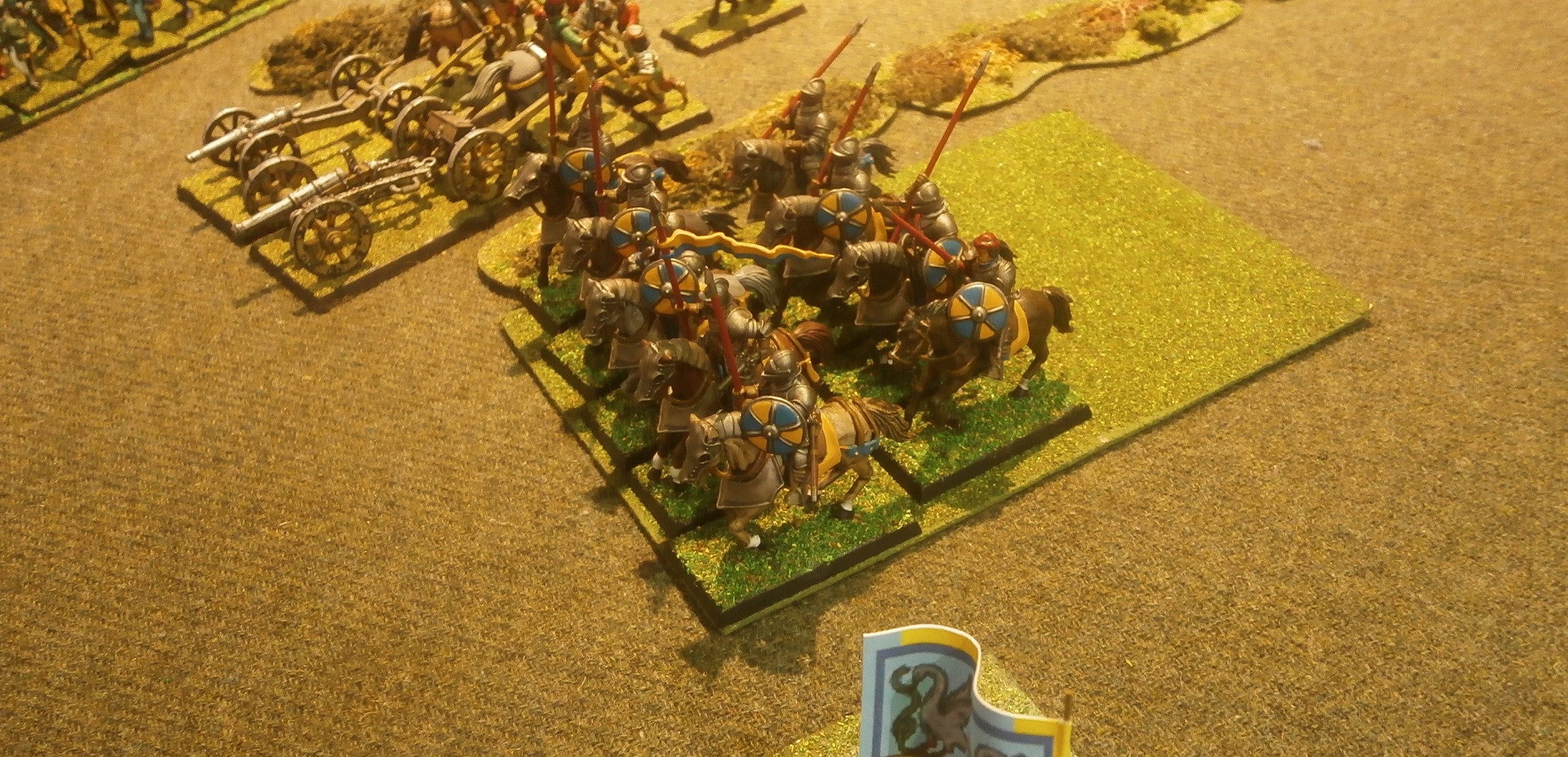
The Pavonan crossbow, despite their toing and froing of earlier, had at last managed to shoot, killing two of Pettirosso’s band. Considering how badly they themselves had been mauled, this did not at all satisfy their desire for vengeance.
The halfling crossbows, despite the gun-barrel levelled in their direction, now moved bravely up to the river’s edge …
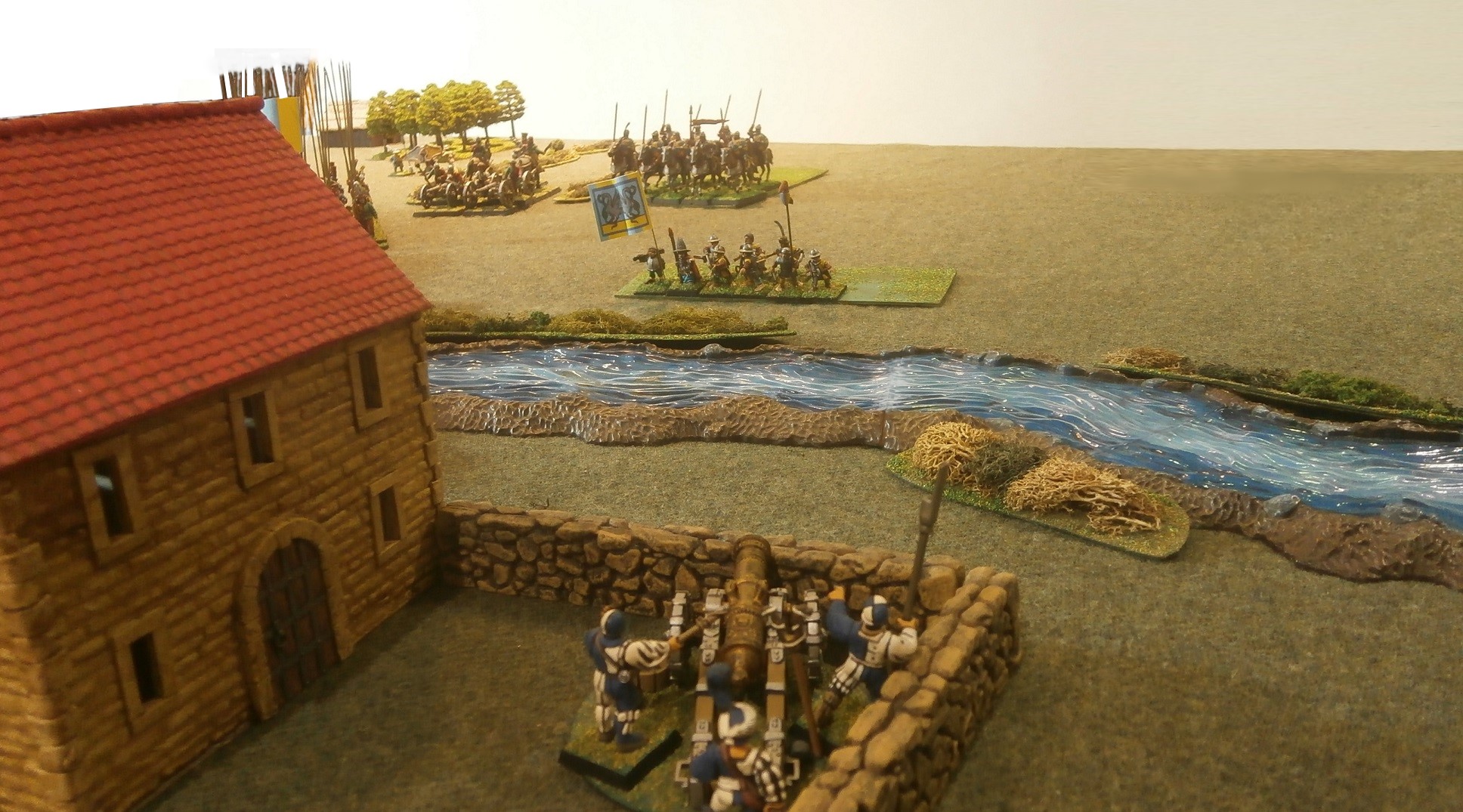
… and on the army’s other flank the barone’s archers also drew much closer to the river.
The pike, meanwhile, steeled themselves and began to march quickly to the bridge, skirting around the tollkeeper’s cottage. It was time for action.
This is it, thought Barone Iacopo. At long last, he was about to launch his mailed fist into Pavona’s face.

No more waiting, distracting, recruiting and drilling. The real fight had begun, a chance to end the threat of the Gondis and the Pavonans for good, and not just punish them for what they had done.
The wizard Zita Scadutto had a smaller battle on her mind, focusing a magical wind on the crossbowmen.
Wisps of ethereal energy coalesced at her command then transformed into an altogether more mundane wind, so strong that it blew the crossbowmen several tens of yards back, causing some to roll and tumble, others to slide as they vainly fought the power directed at them. (Game Note: She pushed them off the table edge!) This gave her much satisfaction, although she soon became aware of the continued frustration of the archers beside her. Yet again, their chances of making pin cushions of the foe had been thwarted by circumstances – specifically, her!
Pellagrino seemed to have realised that the barone’s archers had no target, and so this time blessed the Pettirosso’s rangers, then risked another conjuration of chain lightning.
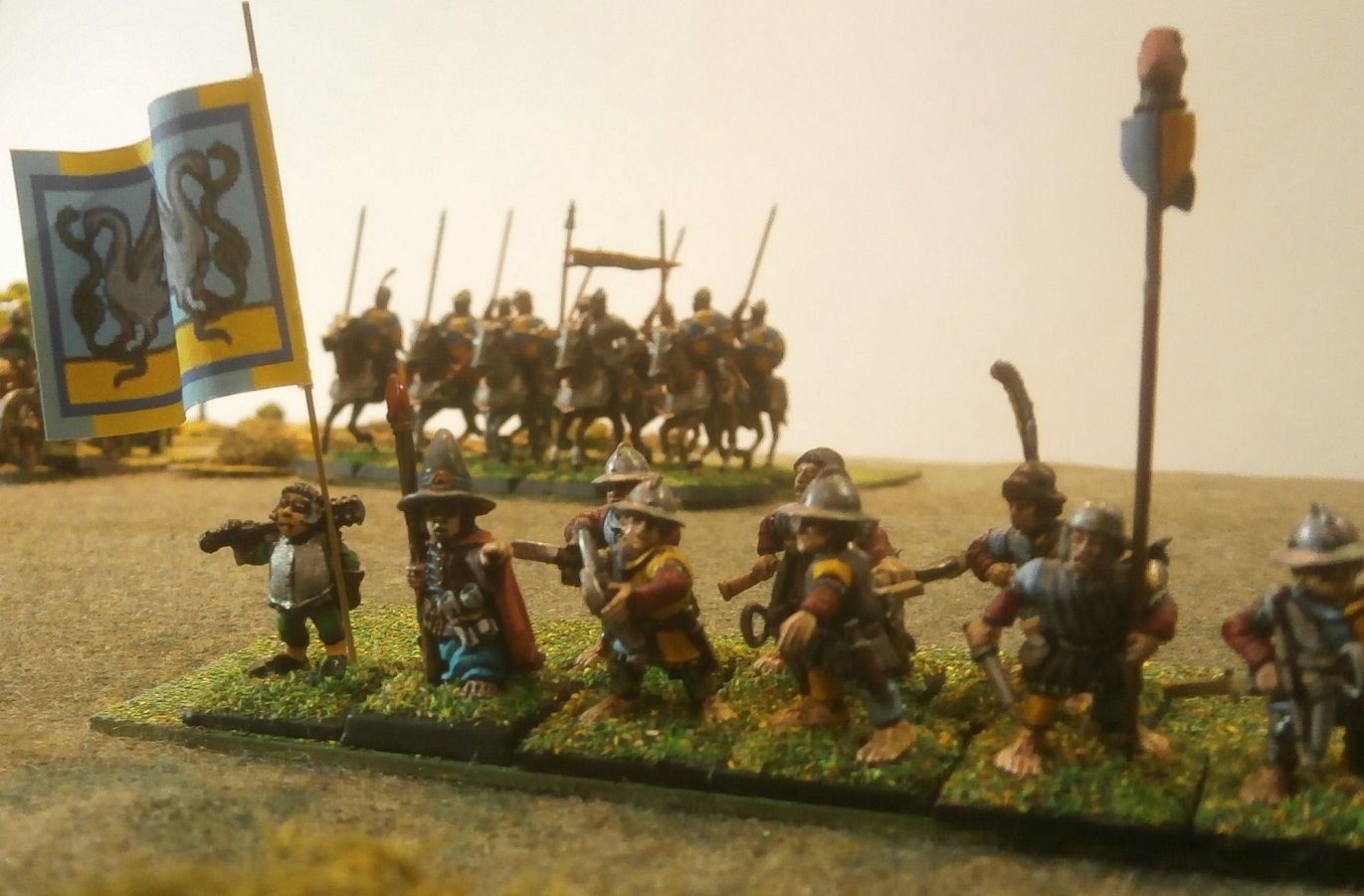
Once again, he was successful, this time striking down six of the halberdiers. And once again, he failed to keep control of the flow of energies he had conjured and a great surge coiled about him violently, then burst to kill Captain Gildo, the army standard bearer, and two more of the poor halfling crossbows with him.
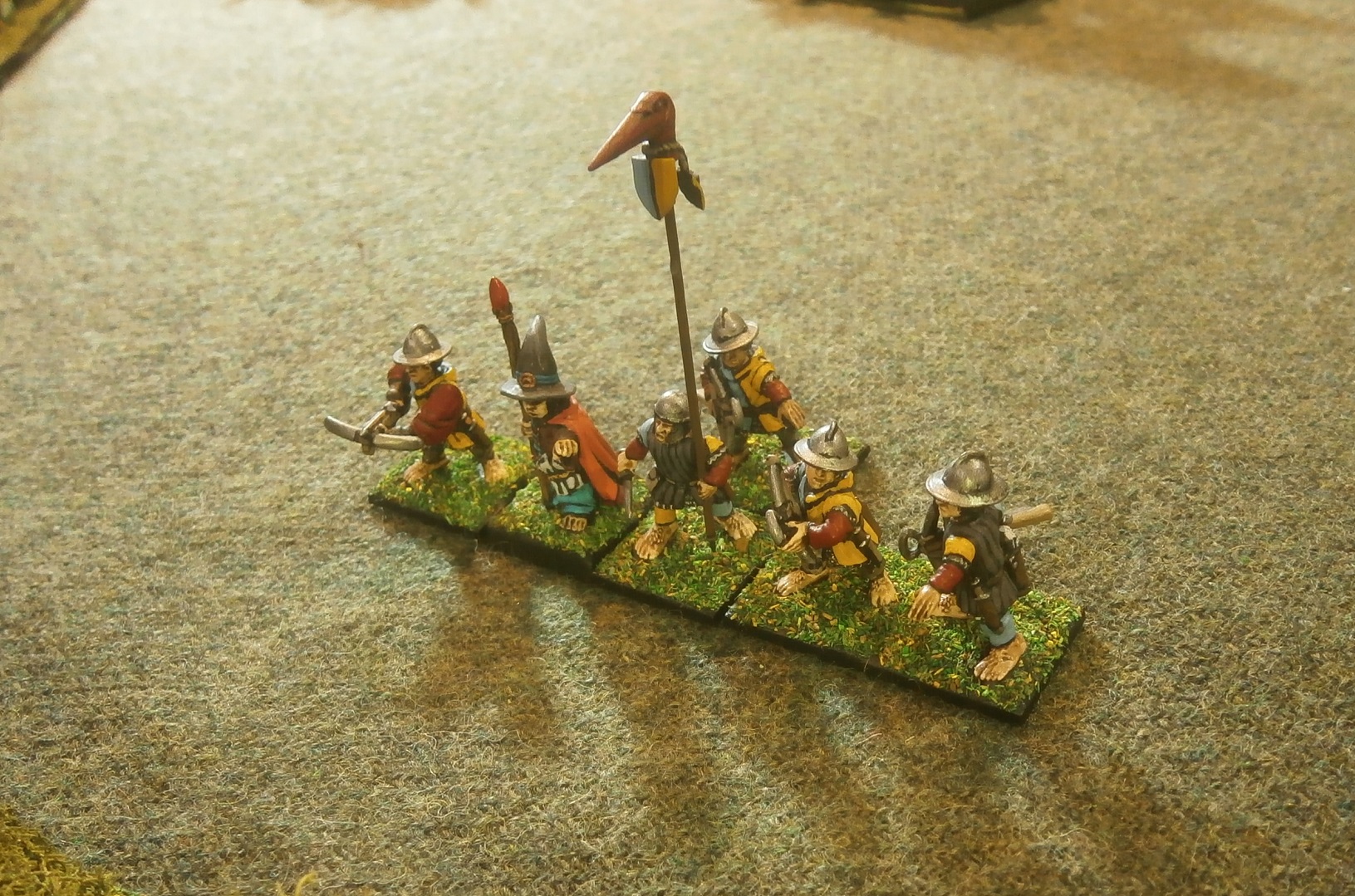
Despite reeling from shock and dizziness, yet still the survivors refused to run. The world seemed to spin around Pellagrino, who could not work out which hurt more – the guilt for what he had unleashed on his own comrades or the piercing ache his head.
The Pettirosso, however, had been blessed not cursed by Pellagrino, and commanded his surviving rangers to loose at the halberdiers.
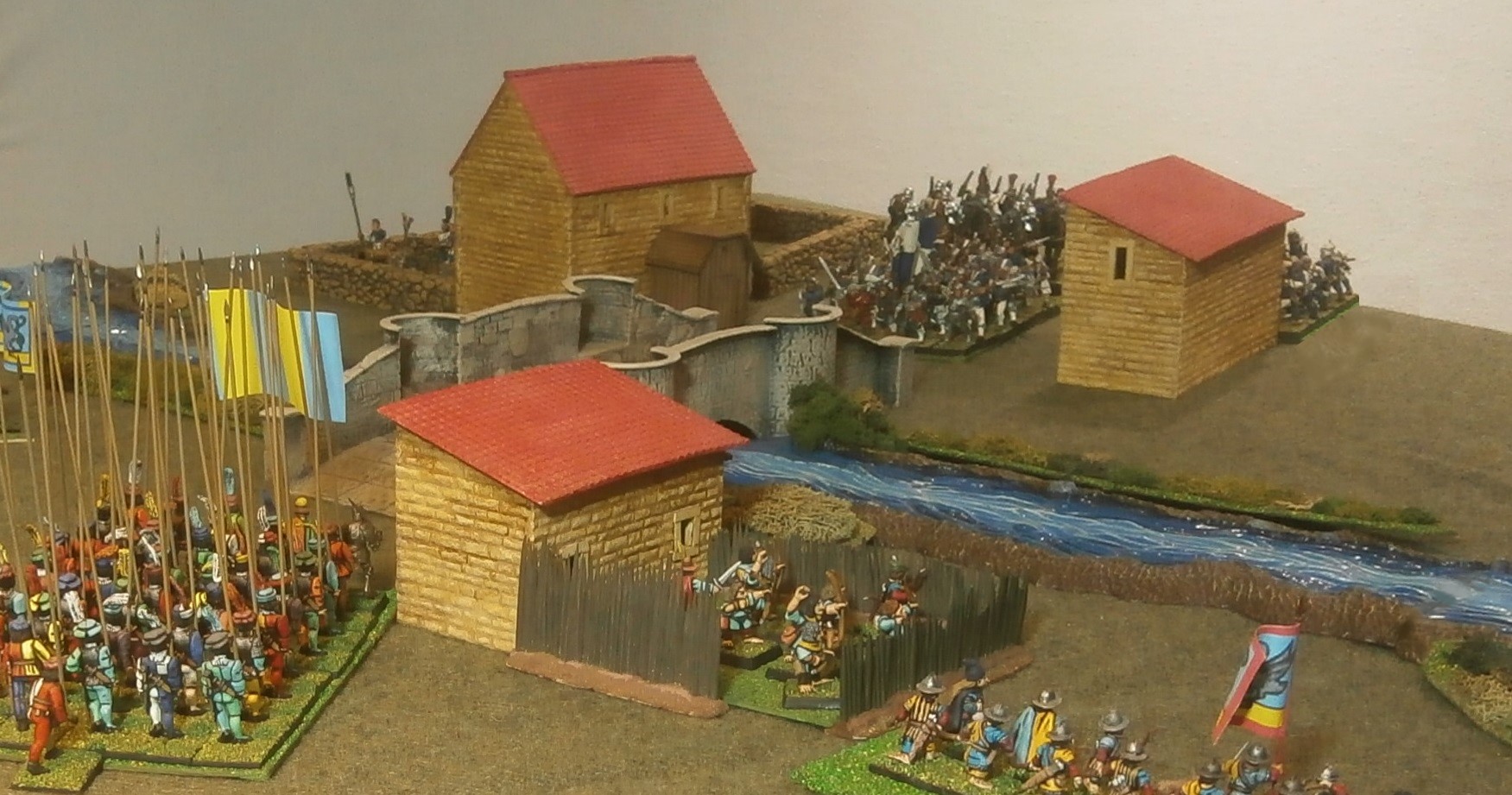
This they did, killing another five. The Pavonan’s strongest regiment had been reduced to half strength, and had yet to cross blades with the foe!
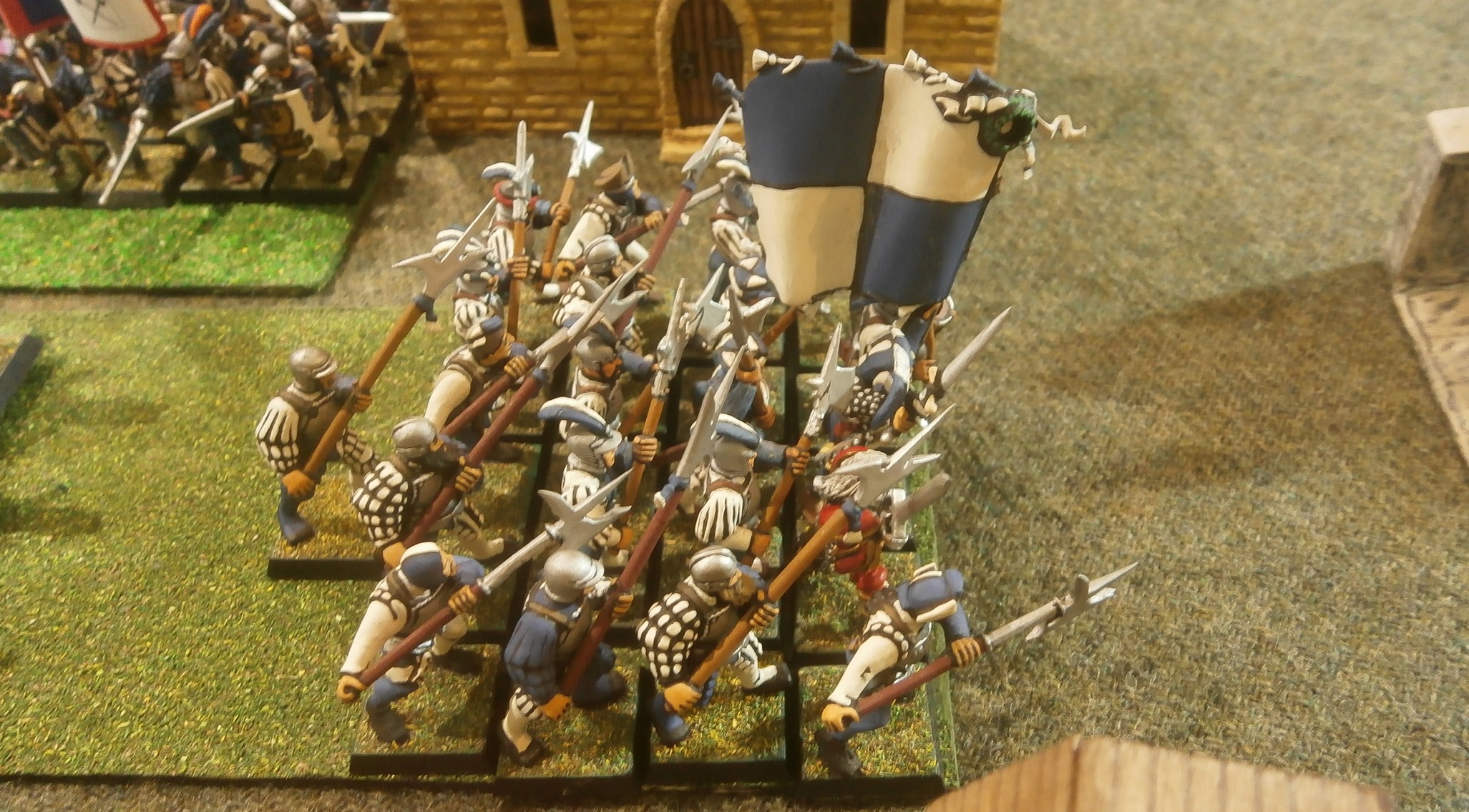
They did not complain, nor even flinch, for the duke was with them. Instead, they were silent, calm and clearly filled with righteous fury. As far as they were concerned, holy Morr was on their side and his favoured mortal servant led them. They were intent, even content, to fight to the very last. Little did they know the premonitory nature of this notion.
Just then, the galloper guns fired at the wall before the enemy cannon, breaking it down and leaving the crew exposed.
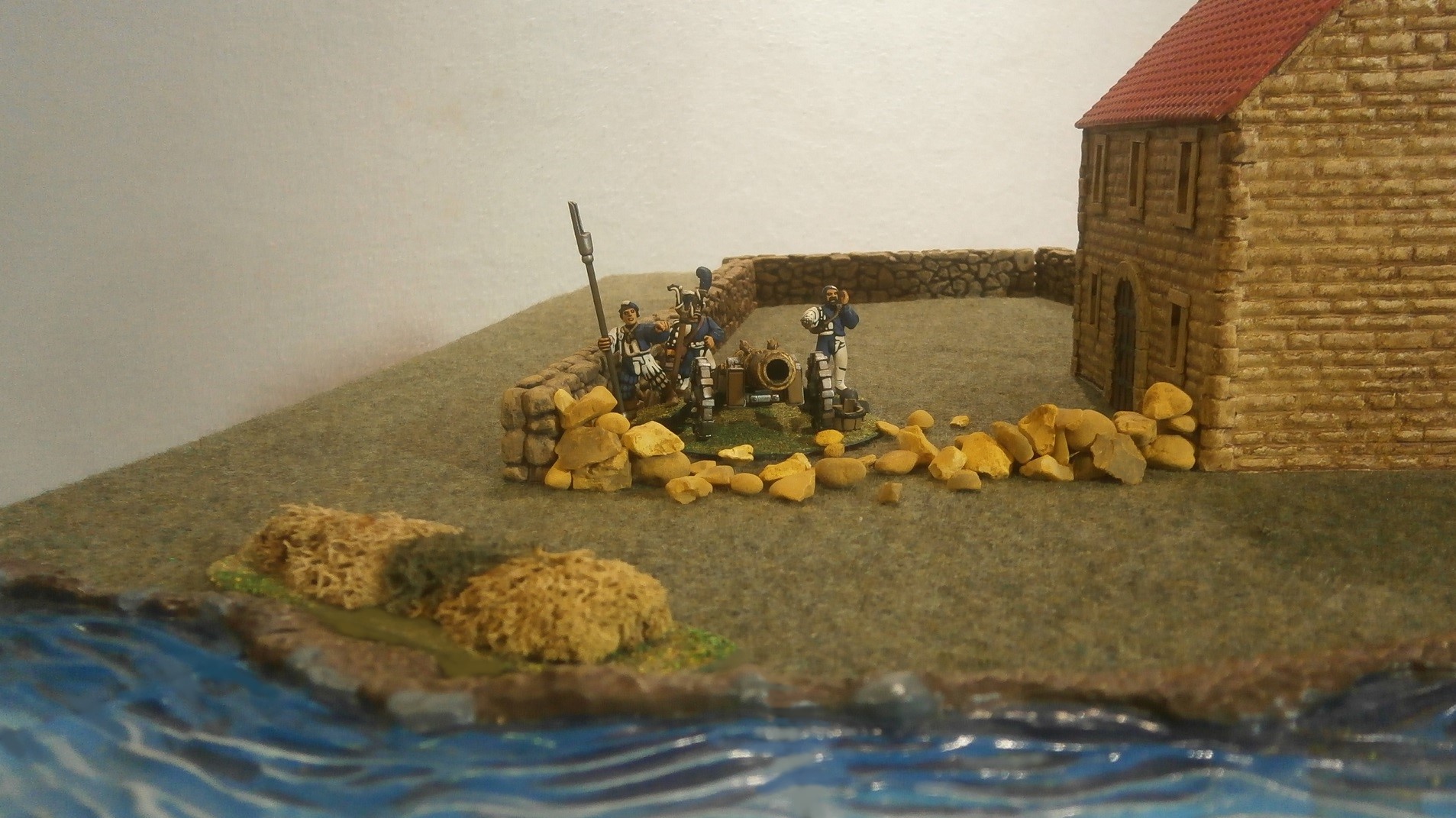
As the bedraggled crossbowmen returned to the field of battle, Duke Guidobaldo at last ordered the halberdier regiment (what was left of it) forwards, to mount the bridge.
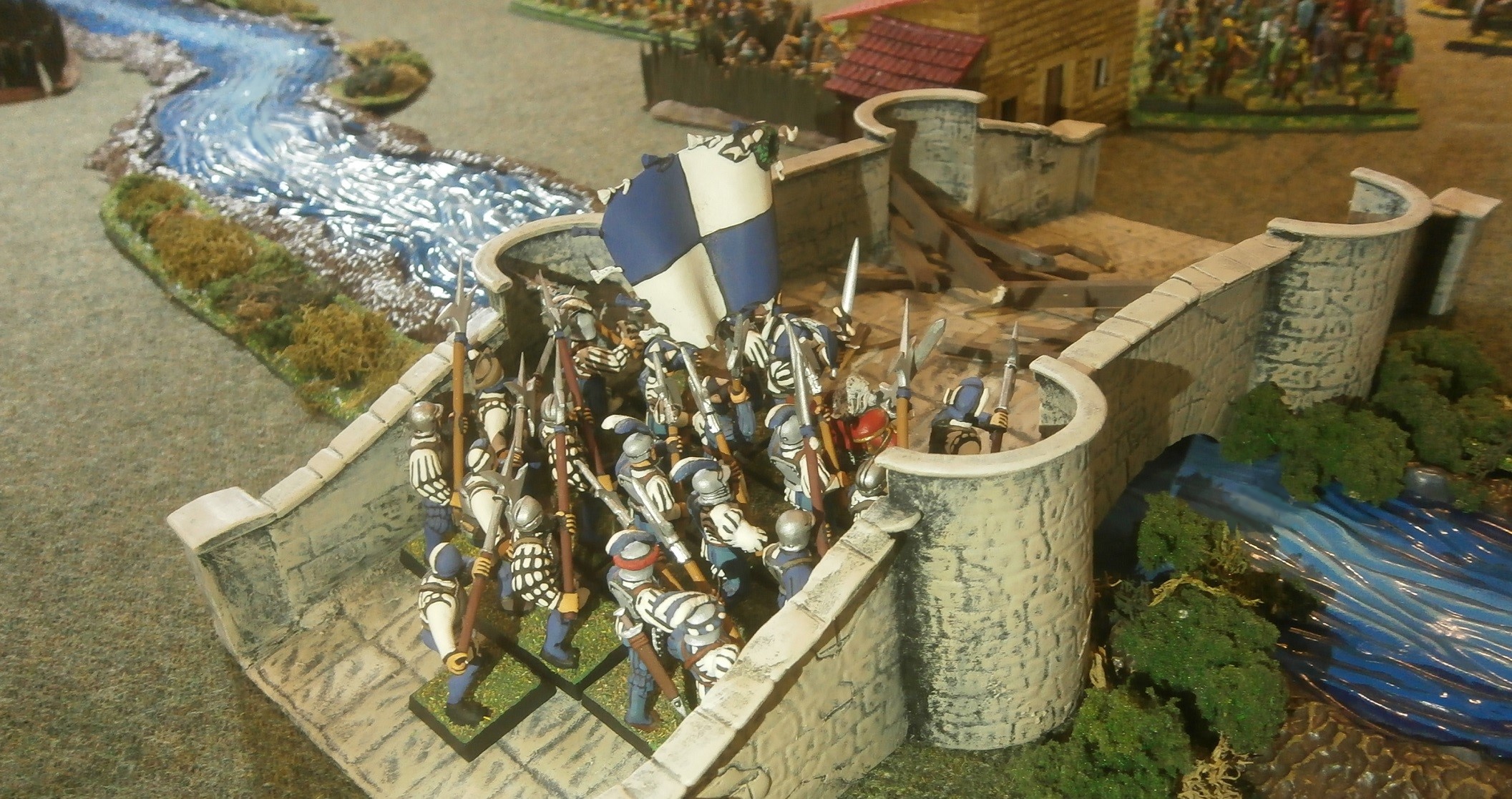
Despite their losses, they truly believed that with the duke at their head, there were none who could defeat them.

Apart from his one word command to advance, Guidobaldo said nothing – it was a reticence that seemed to prove his steadfast nature, as if he had no need for words, only deeds.
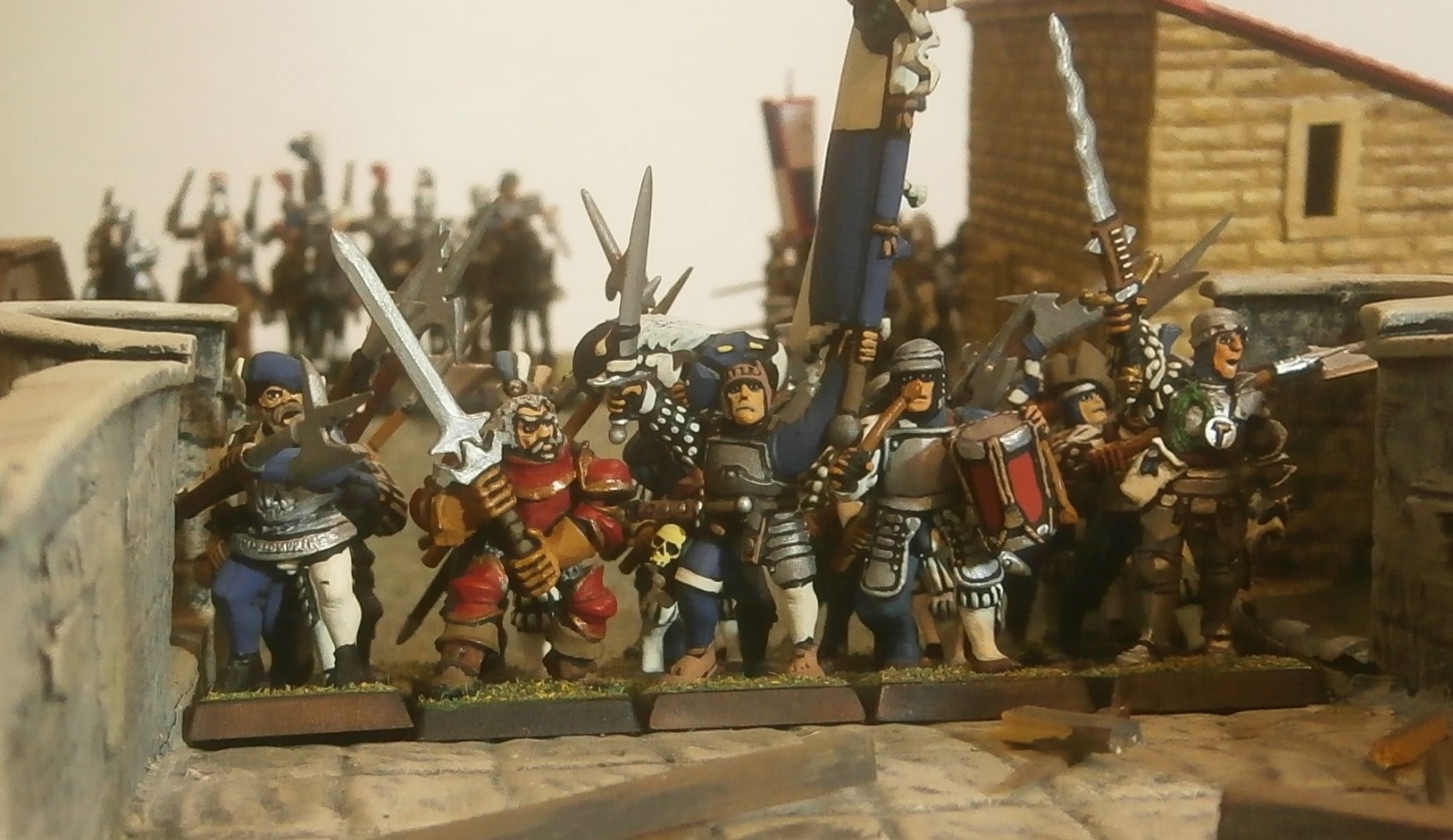
A simple gesture was all that was required for the drummer to sound the halt, just as the regiment reached the gentle crest of the bridge, before the shattered planks of the defences. Behind, the swordsmen moved up, as the pistoliers weaved their way through to regain their original position.

The battle for the bridge was about to begin.
Nothing came of the Pavonan wizards’ attempts at magical harm, for Pellagrino and Zita used various means to bat their spells away. The gunners took their last chance to shoot at the pike, killing three with a ball that no-one could bat away.

Yet the Verezzans did not falter, continuing their steady approach.
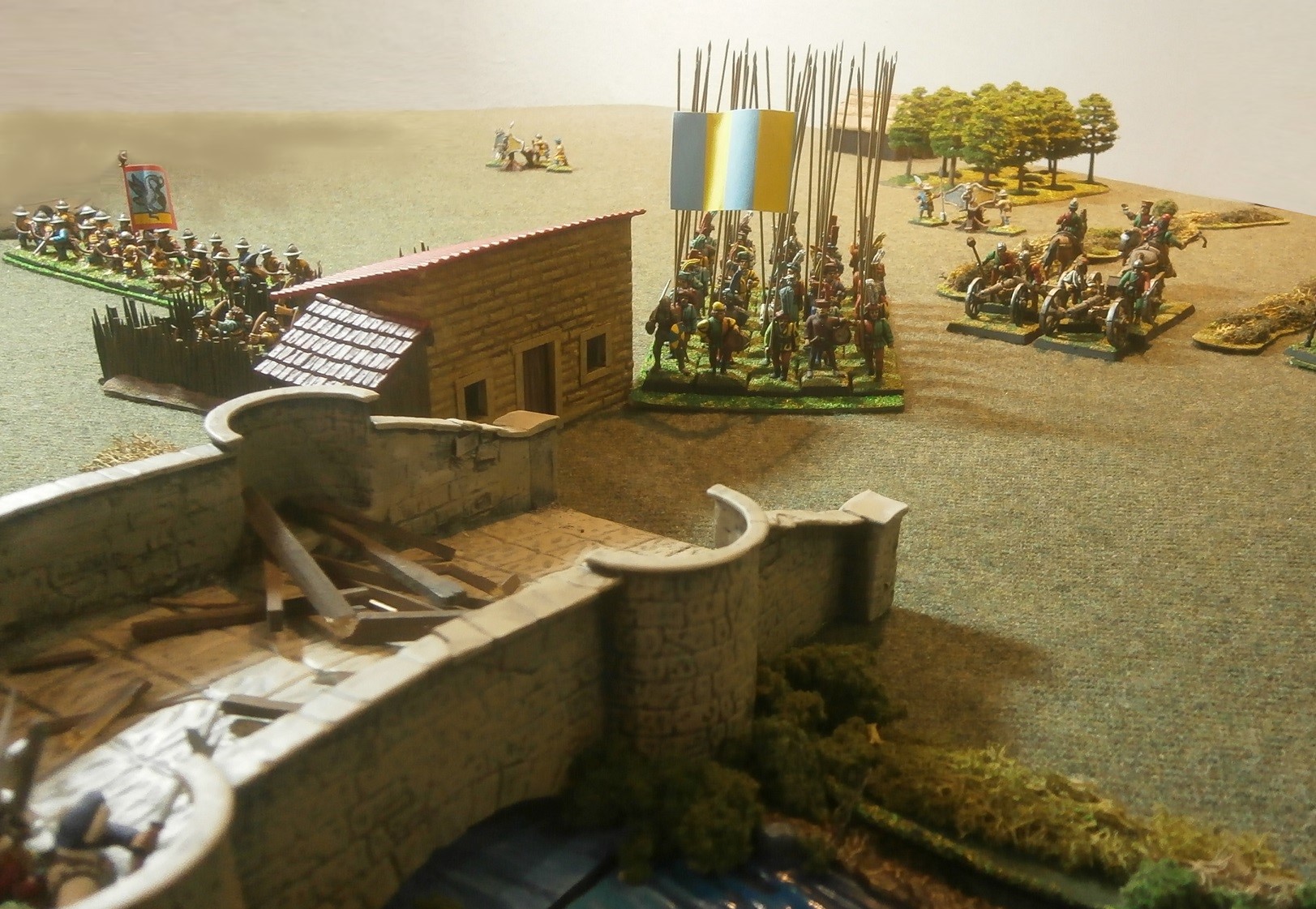
With a cry of “Vengeance for Lord Lucca“, Captain Bugni now ordered the charge …
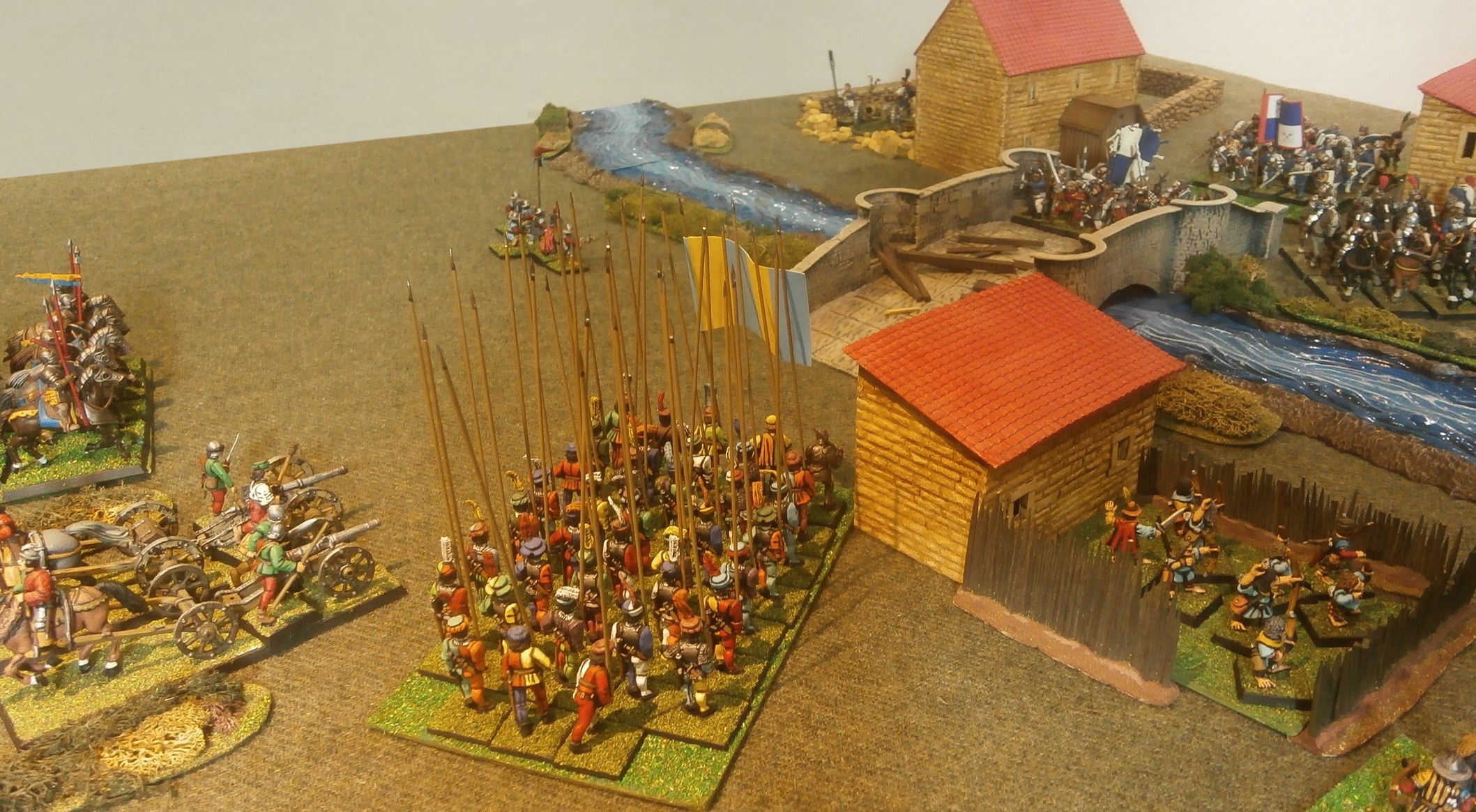
… and the pikemen crashed into the halberdiers.
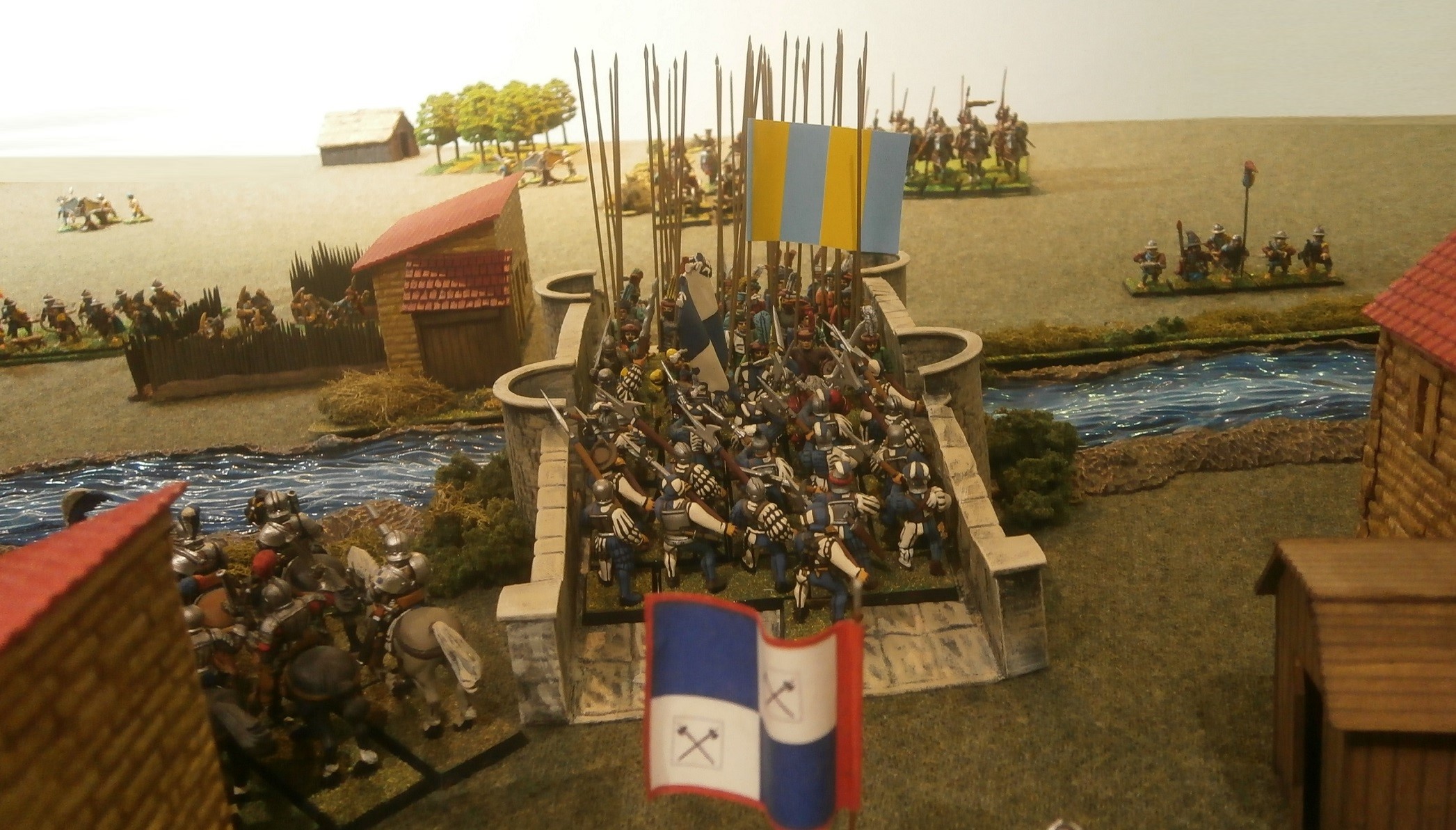
The wizard Pellagrino, despite his earlier disasters in trying to control his spell’s energies, risked casting Harmonic Convergence upon the pikemen, successfully gifting them an unnatural edge in the fight.
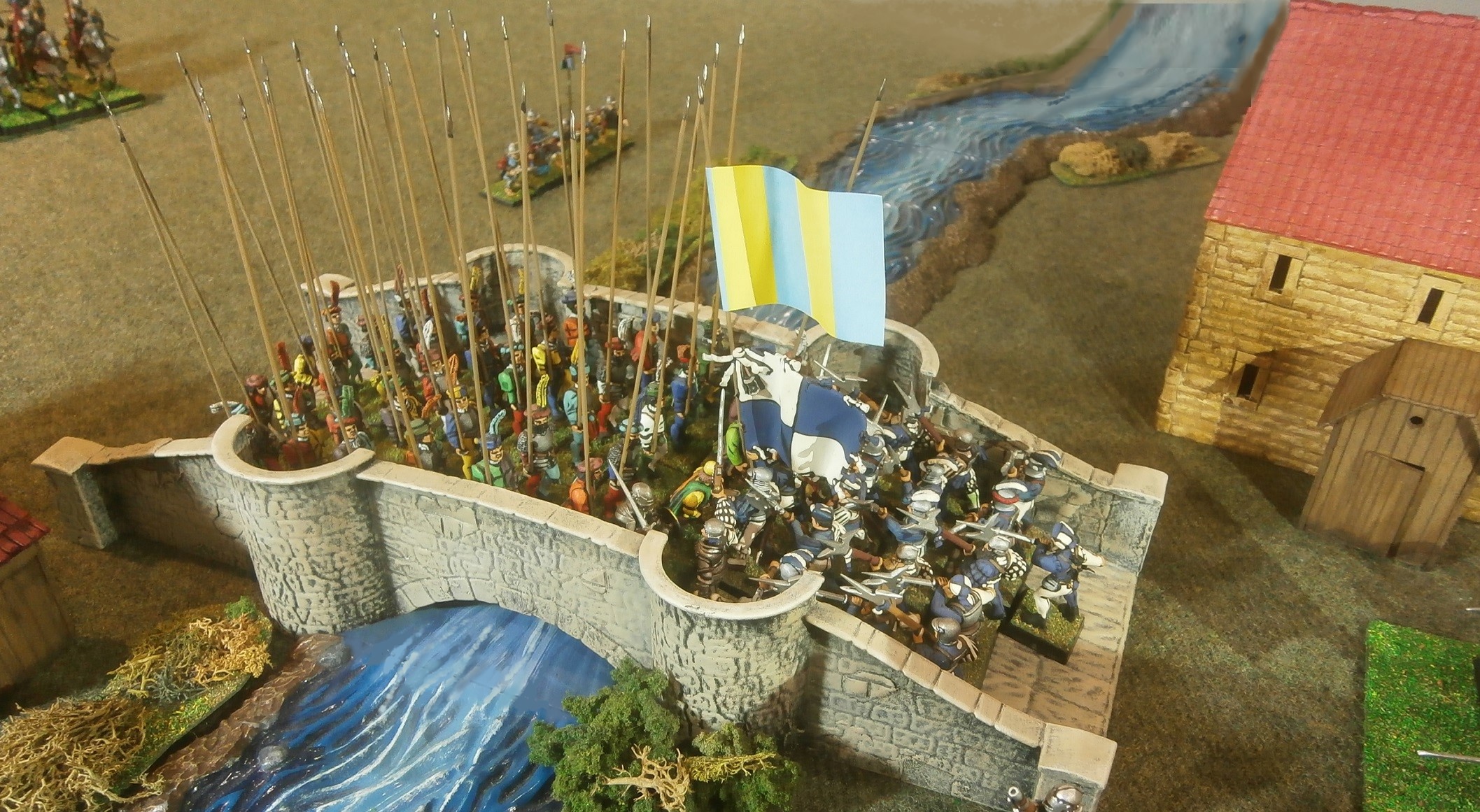
The pikemen could feel the blessing, the confidence and power flowing through them, and their battle cries took on a keener edge. This sound cheered Pellagrino, emboldening him to try one more spell, hurling lightning from the heavens to kill first five swordsmen …
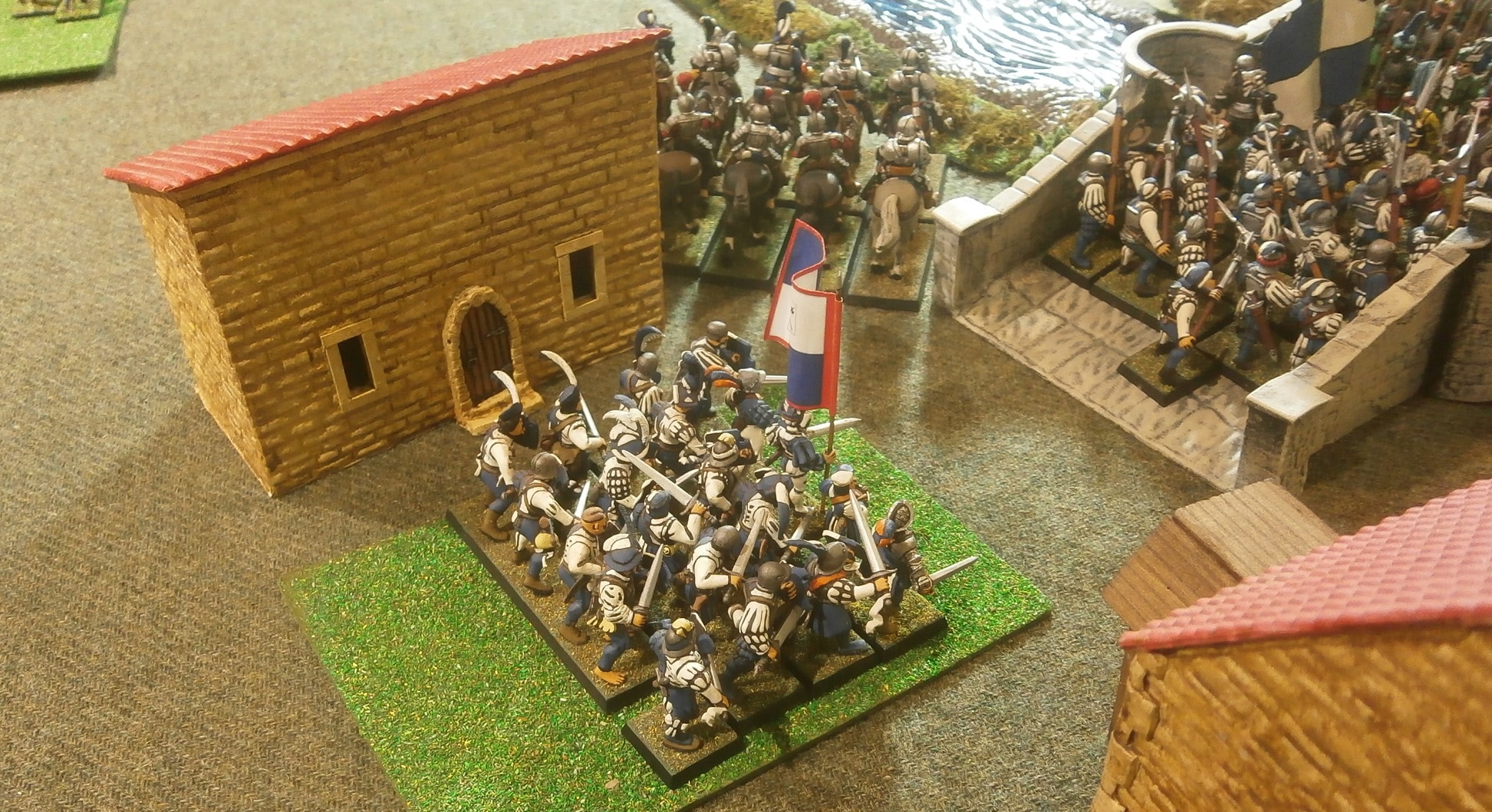
… and then four pistoliers.

Pellagrino began to grin with satisfaction – did this not balance the books somewhat, he thought. Indeed, if his previous blunderings had not killed Gildo and several companions he would have danced with joy (which he had been known to do in the past), but something nagged at him, then began to needle his already pained brain. His expression turned to horror as he realised that once more, he had failed to fully harness the energies broiled up for his spell, and that a stray shard was now swirling uncontrollably, gaining worldly power with each rapid turn. Before he could speak either a warning or an apology, the spinning, ethereal intensity spewed out into the mundane world, slaying him and all but two of those with him. The last survivors lurched in shock, then turned to run, unsteadily but with all the speed they could muster, away from the bridge.
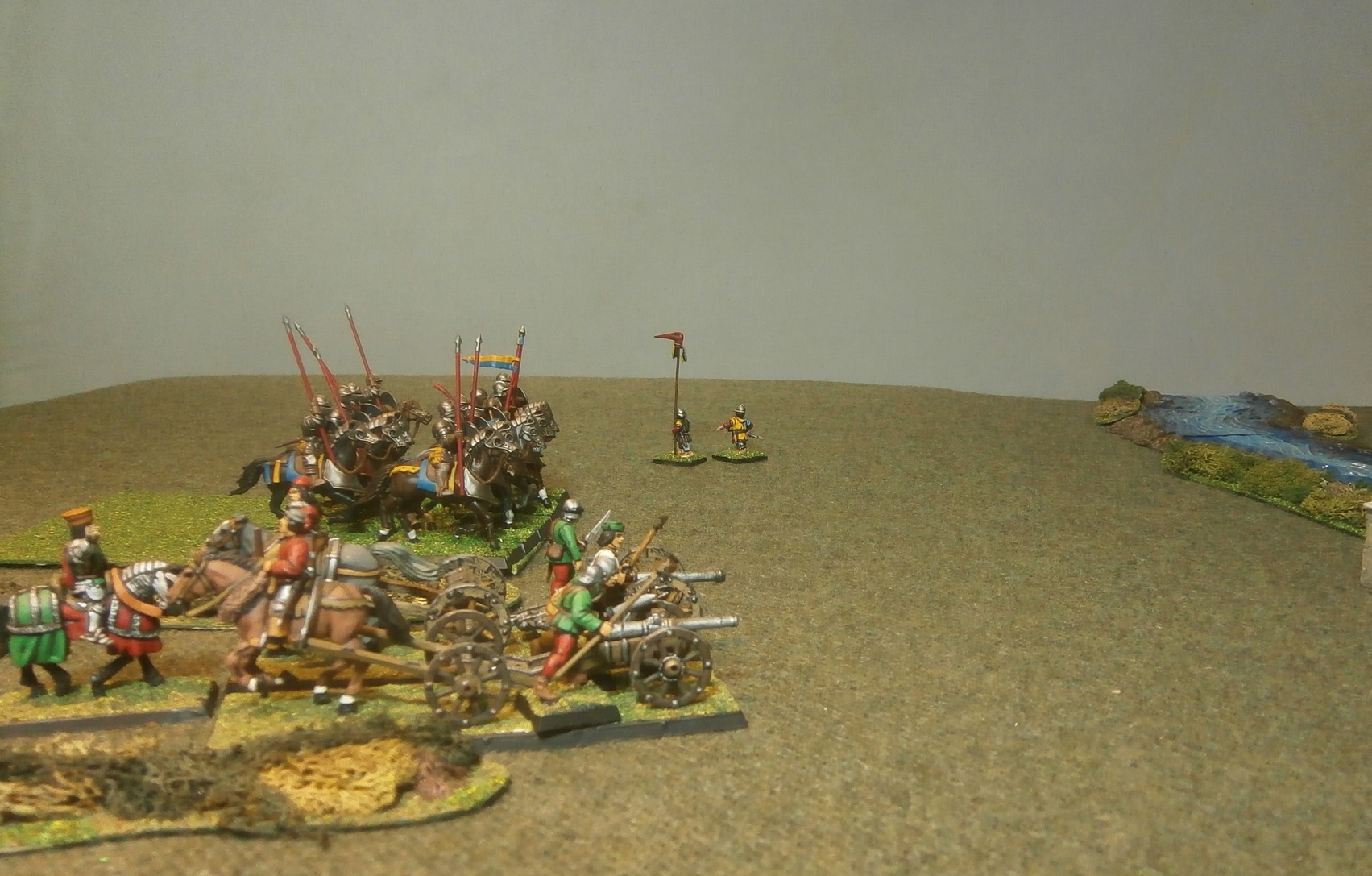
(Game Note: Turn 4, and this was his third, fatal miscast!)
Barone Iacopo failed to notice, for at last, and to his great satisfaction, he and his archers were able to loose no less than two quick volleys at the recently returned crossbowmen across the river …

… killing them to a man.
The Pettirosso and his rangers brought down another pistolier with their own somewhat less voluminous volley …
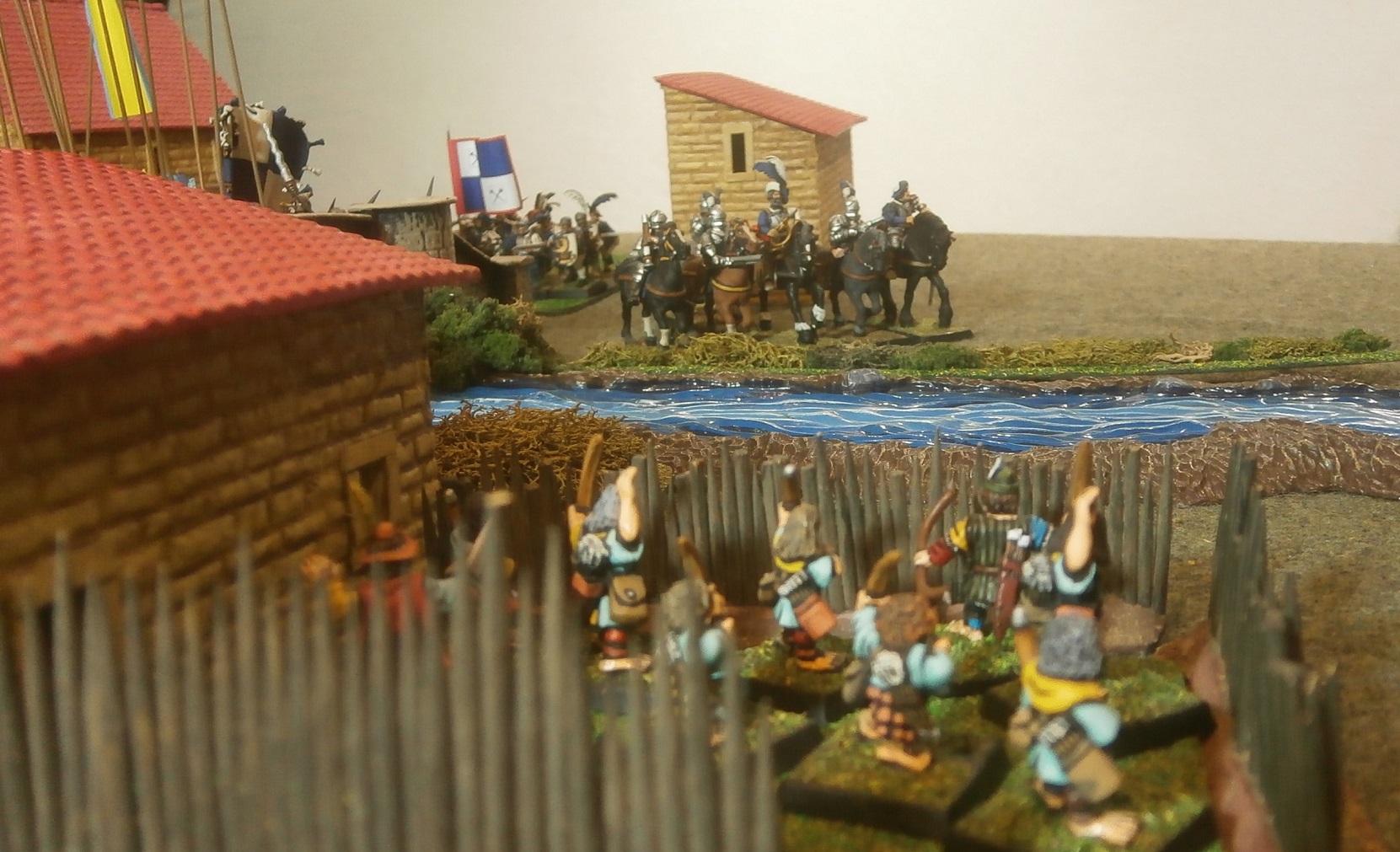
… and Pandolfo’s brace of light guns damaged the enemy’s great cannon.
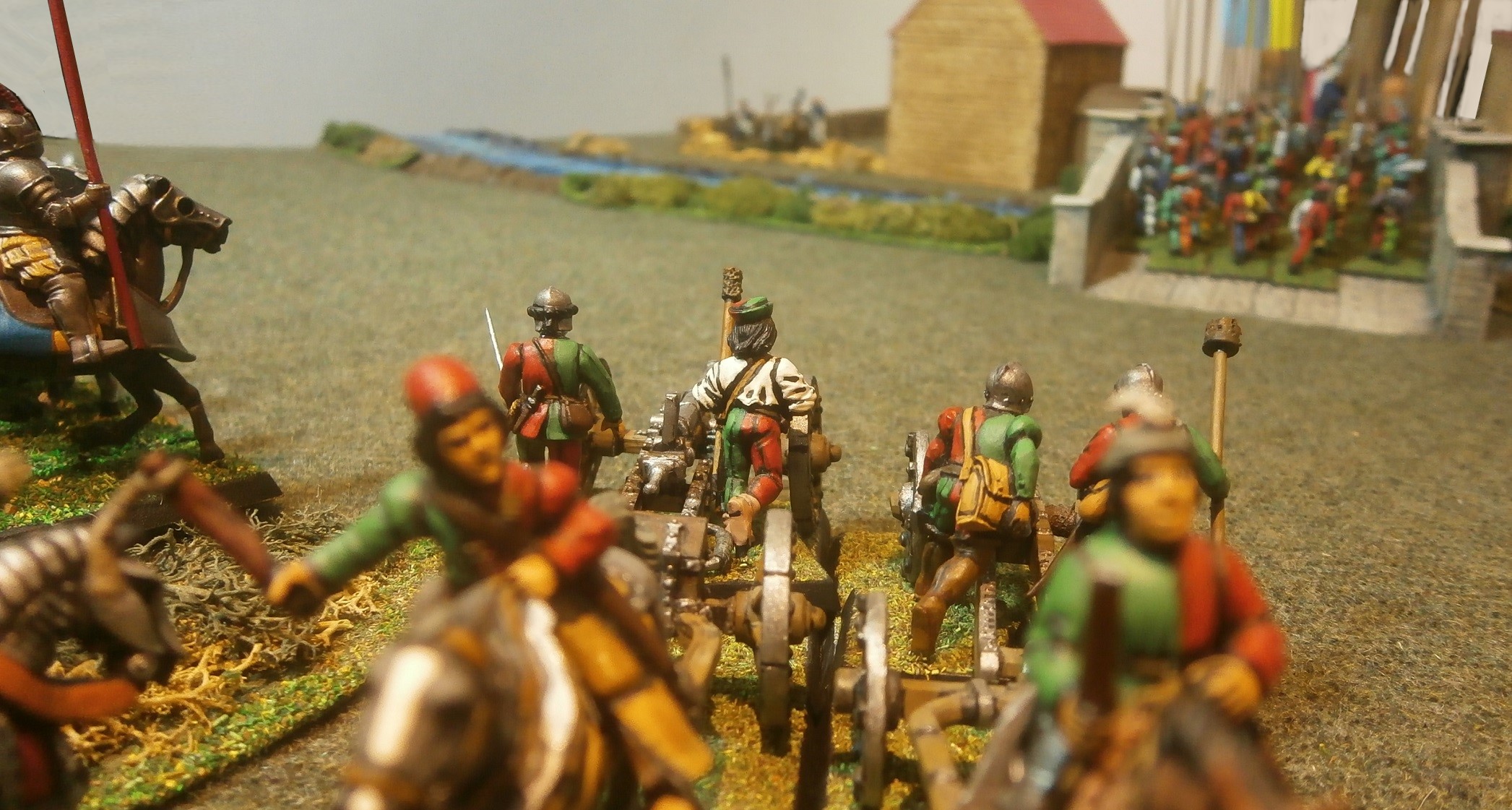
In the very centre of the field of battle, upon the bridge, the critical fight had begun. Whether the Pavonans held the bridge or the Verezzans crossed it would surely decide the day’s victor. Both sides had been battered, although the Pavonans had taken the lion’s share of harm. If the duke could deny the Verezzan’s passage, then Pavona had a fighting chance of driving off the Verezzans. The time thus bought might allow Lord Silvano to return with the realm’s marching army. Or maybe the Verezzans’ courage would fail then, and they would slink away with their tails between their legs, believing Pavona was not an enemy they could beat?

The melee was furious, as serried rows of pike points thrust through rank after rank before the halberd’s heavy blades could bring their own harm to bear. Twelve Pavonans were slain by the first force of the charge, with three more perishing on Captain Bugni’s busy blade.
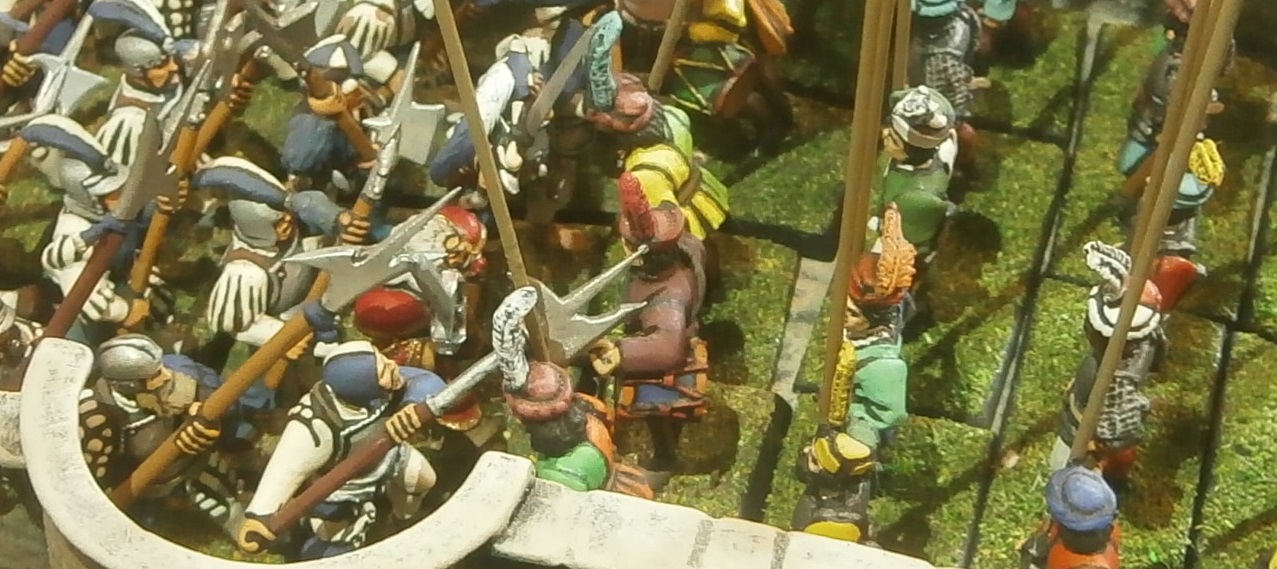
The duke lopped the head off the pikemen’s champion, his loyal captain slew another and the surviving halberdiers hacked down two more.
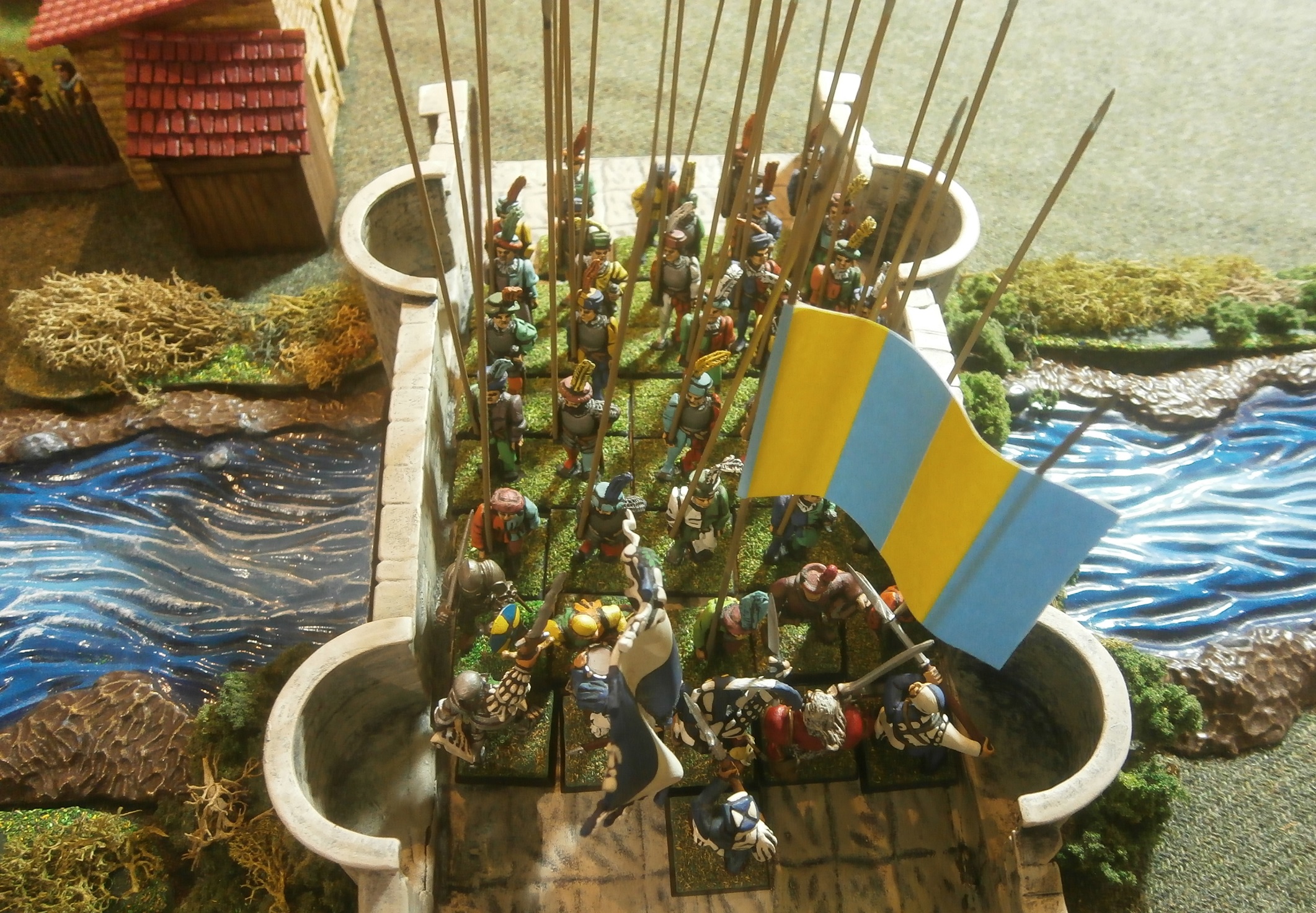
The thin, blue and white line which remained had held the Verezzan tide in check. It seemed that with their beloved, red armoured lord amongst them, nothing could make them run.
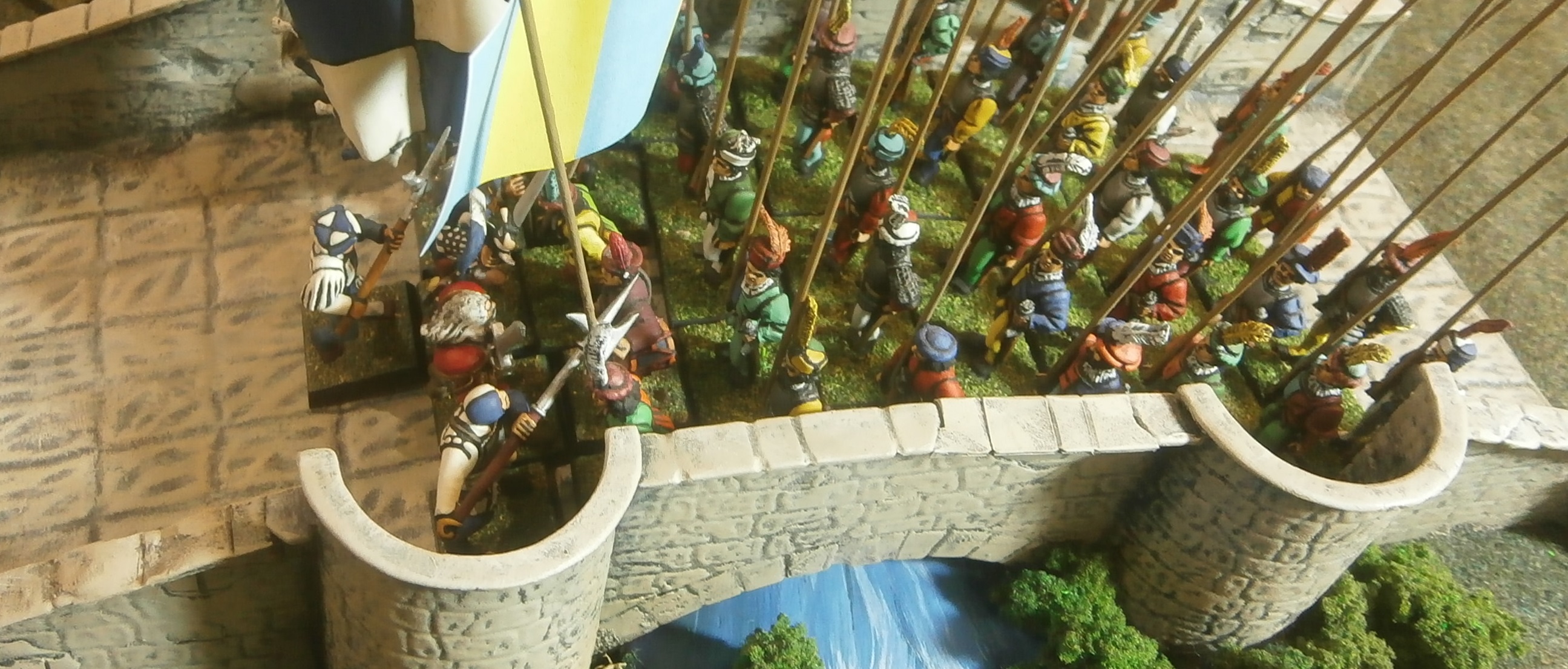
(Game Note: Crown of Command granted stubborn, and the duke’s house-ruled, counts-as army standard bearer rules applied. So, a re-rollable 9 break test.)
While the swordsmen steeled themselves behind, the Pavonan pistoliers trotted along the river’s edge to get closer to the halfling barone and his archers. It was a desperate move by desperate men. Perhaps these young gentlemen had decided that if their lord was to die then they should do so too?

Witnessing this boldness from the window of the smaller house, the lesser Pavonan wizard hurled a fireball using her enchanted gold ring …
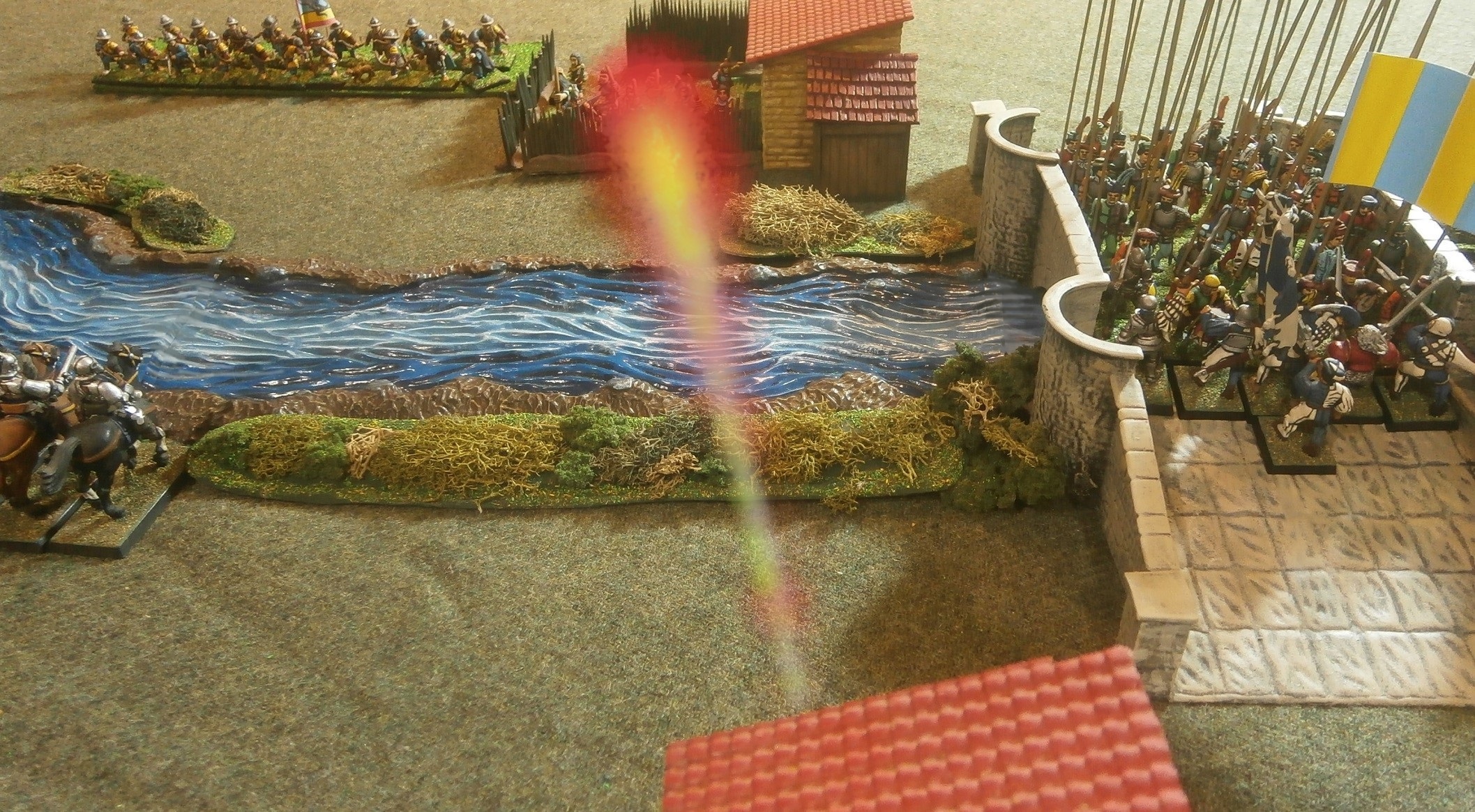
… killing three of the Pettirosso’s rangers and causing the rest to run from the little compound.
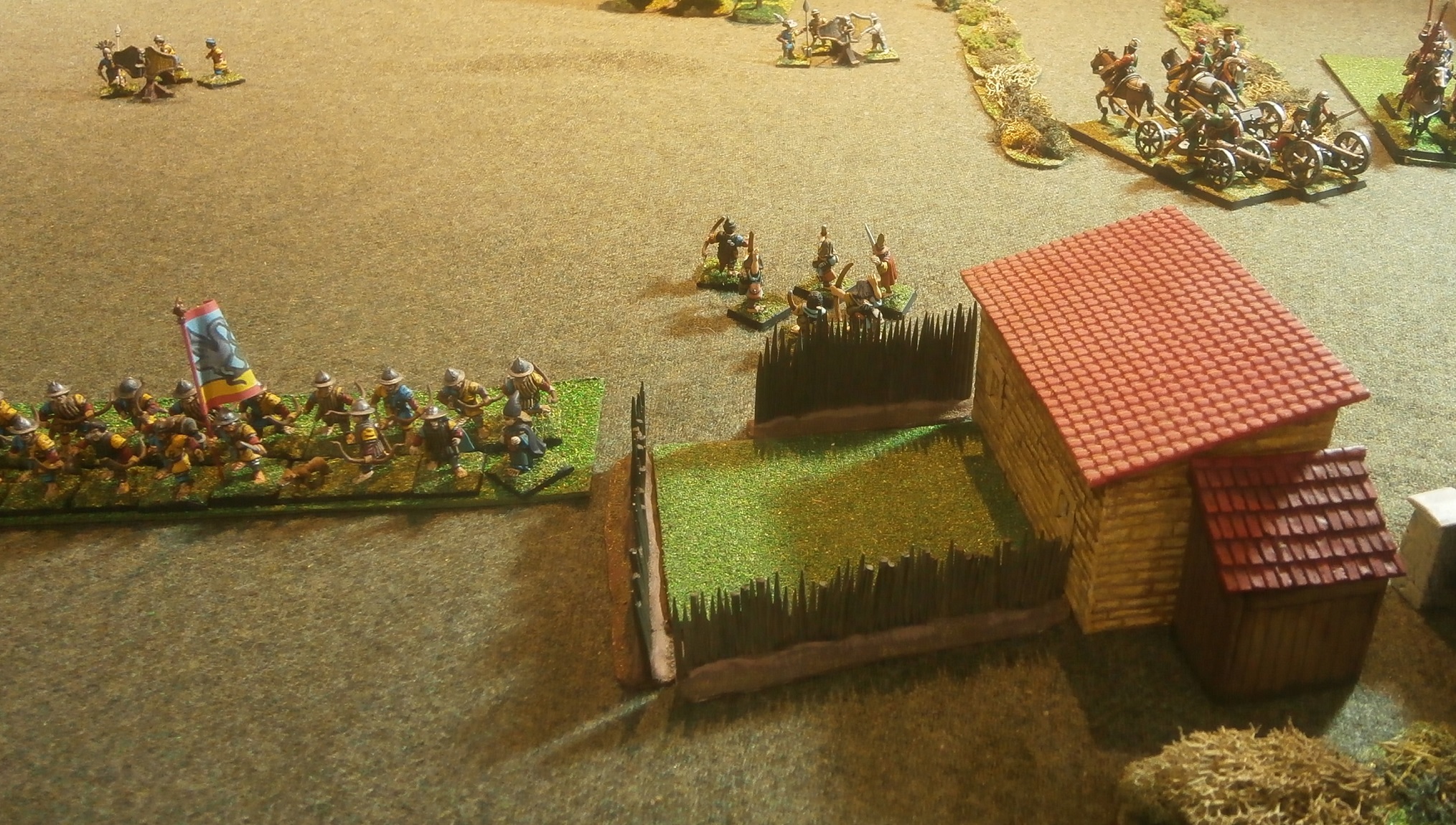
Chuckling cruelly at the sight, the other wizard summoned another fireball using his own magic and hurled it into the barone’s archers.
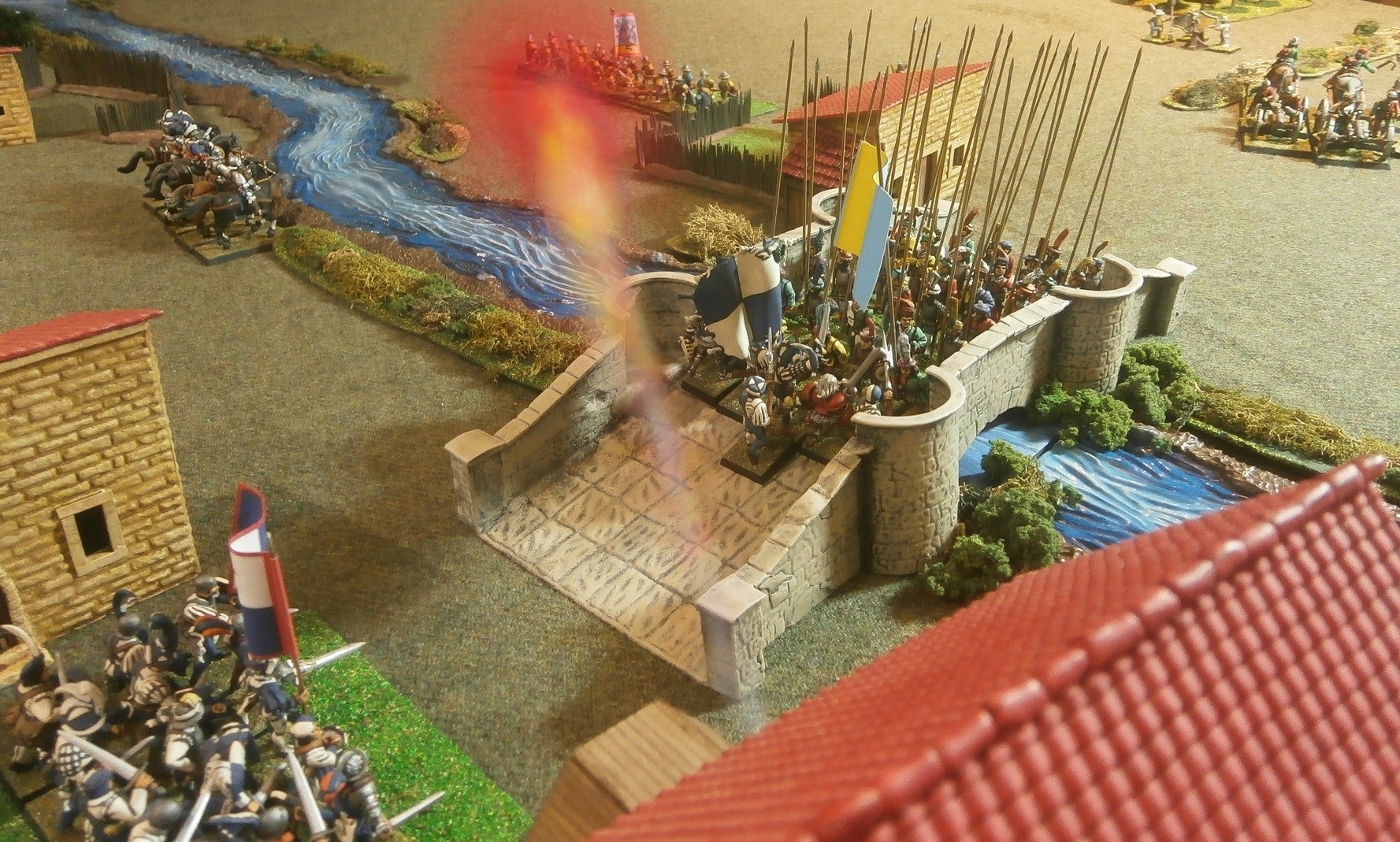
Eight of them were fatally, and most horribly, burned. In some little corner of the barone’s mind a questioning voice contemplated the cost his wards were paying to exact his revenge on the Pavonans.

But such was the hatred filling the rest of his mind, that he barely noticed the calculation.
The more powerful Pavonan wizard watched the duke’s fight from his window with concerned fascination. Hoping to assist his lord, he tried to cast a magical imprisonment of flame on the pikemen, but the enemy wizards thwarted his magic. (Game note: A double six on the dispel attempt.)
While the pistoliers killed but one of the barone’s archers, and the cannon felled a single mounted man at arms, the duke bore down upon Captain Bugni …
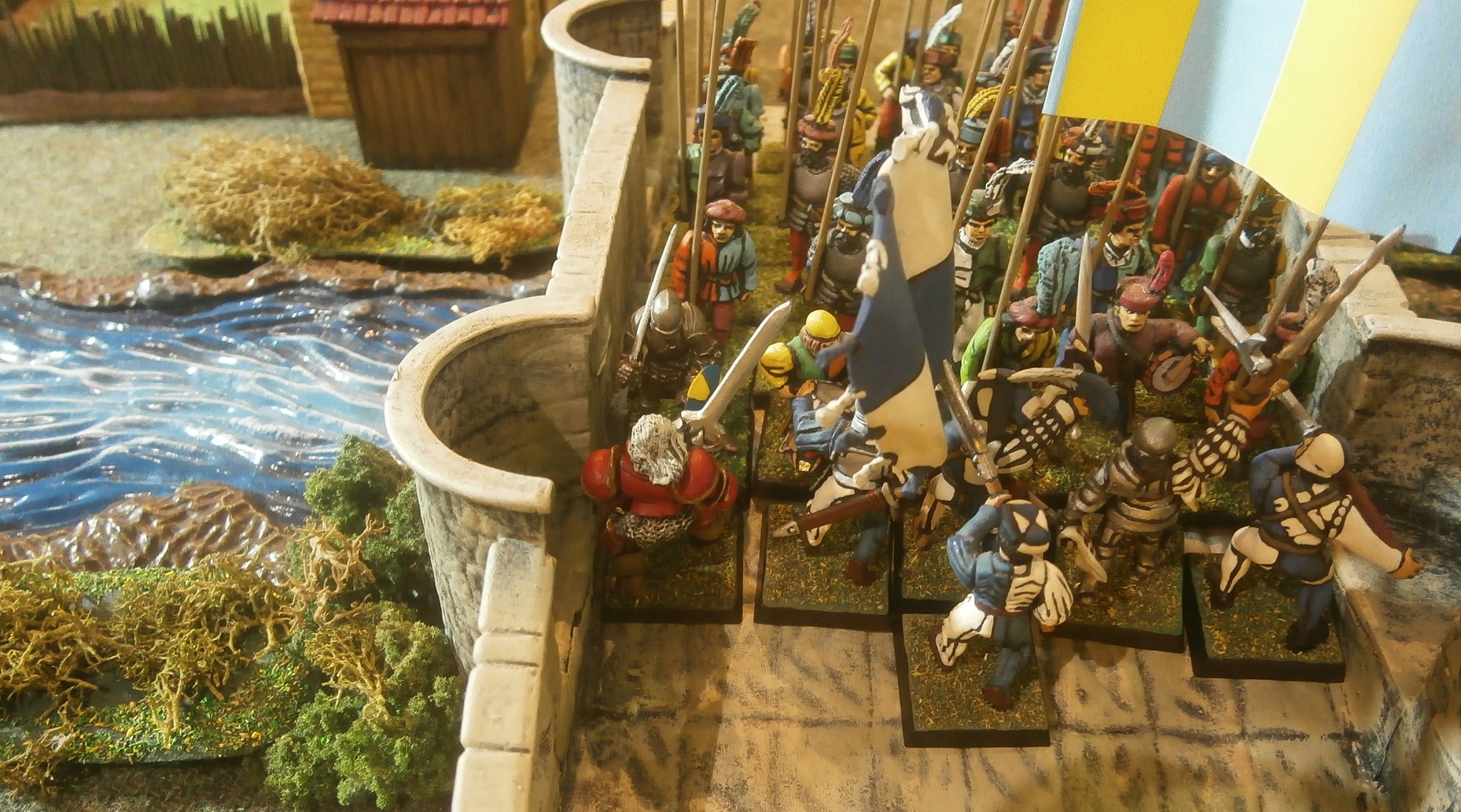
… cutting the brave fellow’s head clean from his shoulders with a single swipe of his blade!
The pikemen finished off the last of the halberdiers, so that now only Duke Guidobaldo and his own captain opposed them. And yet still, they stood their ground.
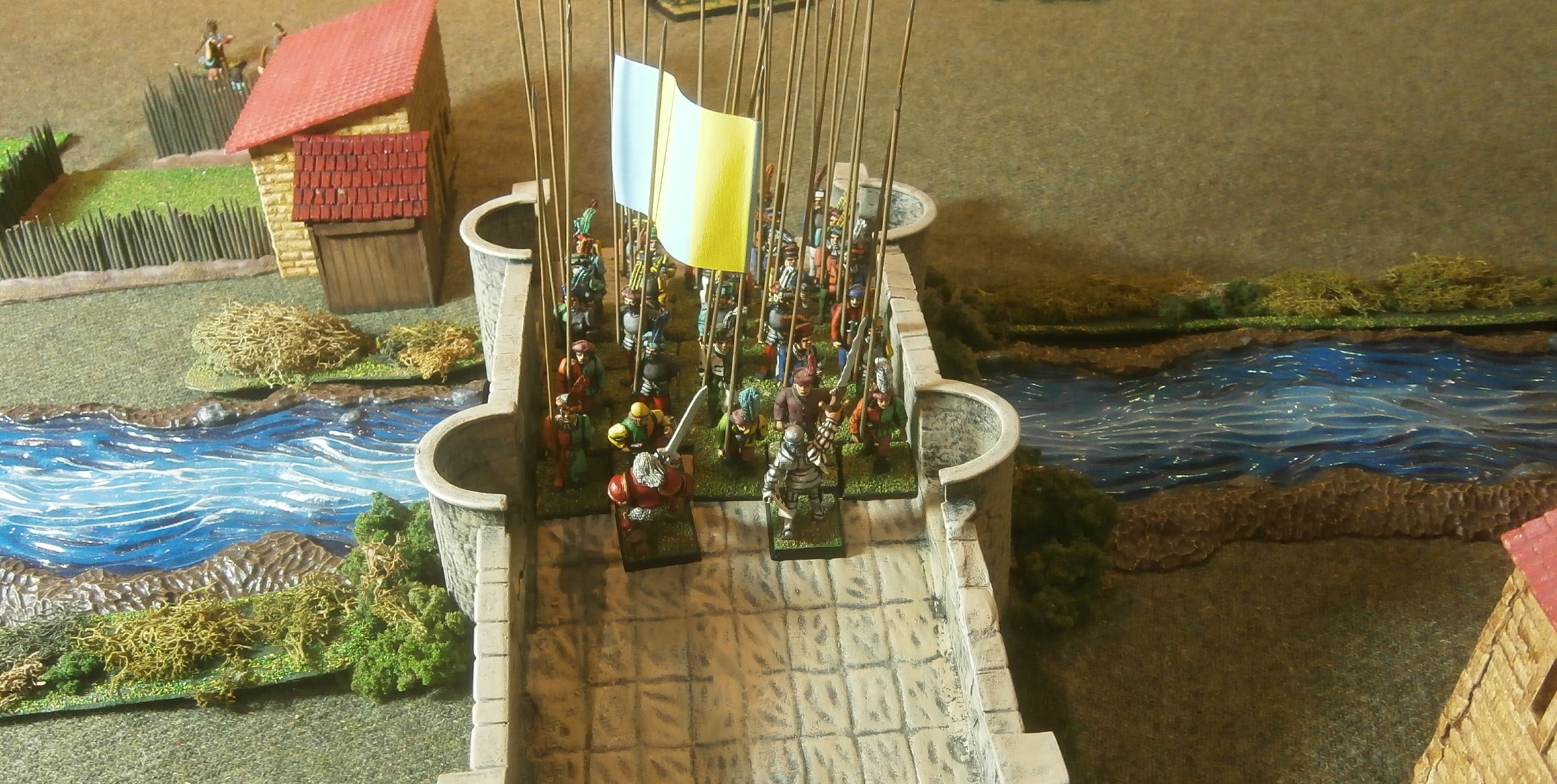
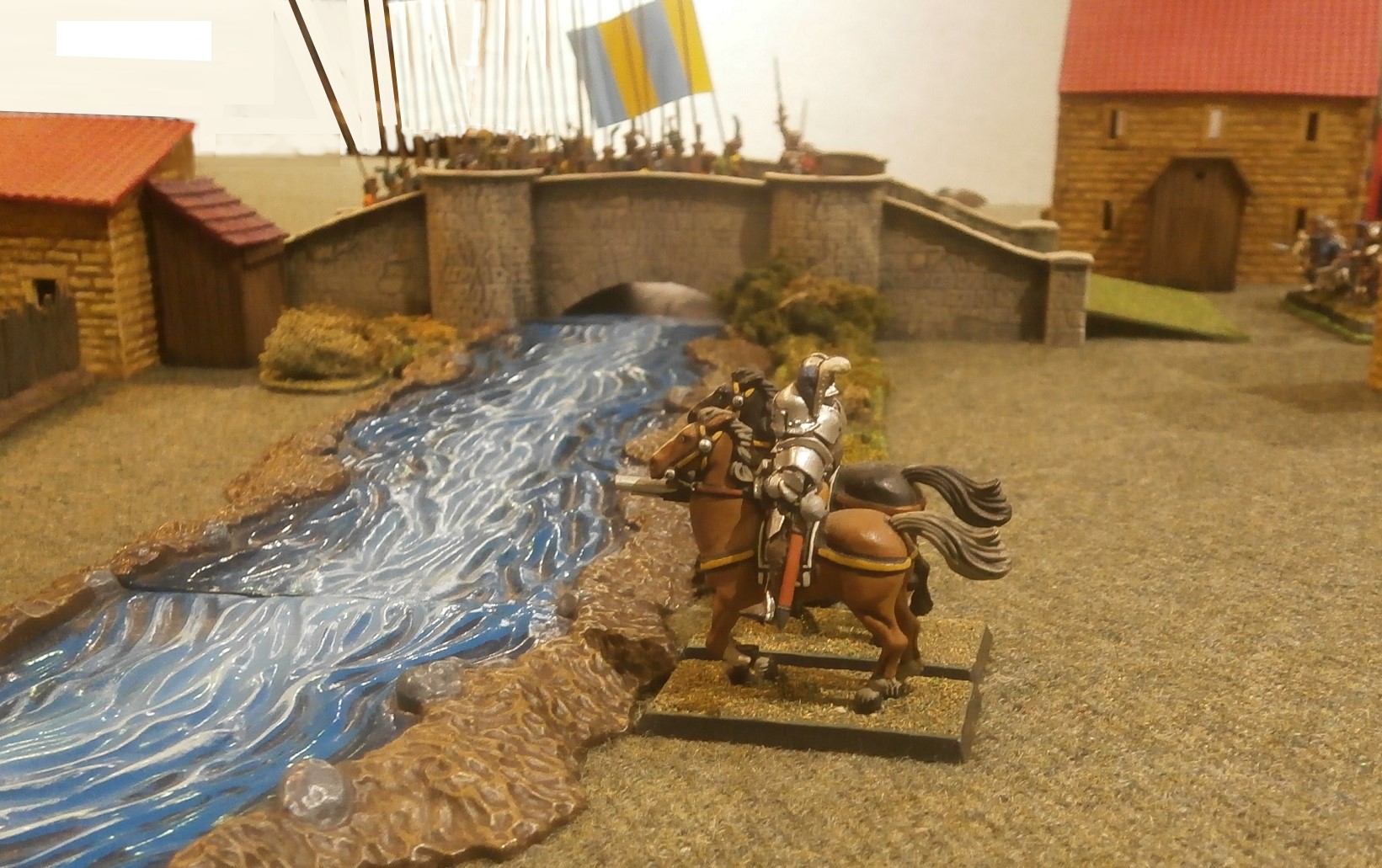
Unwilling to receive any further attention from the cannon, especially when their present task was simply to await an opportunity to join the fray, the Verezzan men-at-arms rode some way across the field, towards the now rallying rangers (one of whom waved at them as if to tell them, “Watch out!”)

The galloper guns, on the other hand, moved closer to the cannon, so that both they and the bolt thrower could target it.
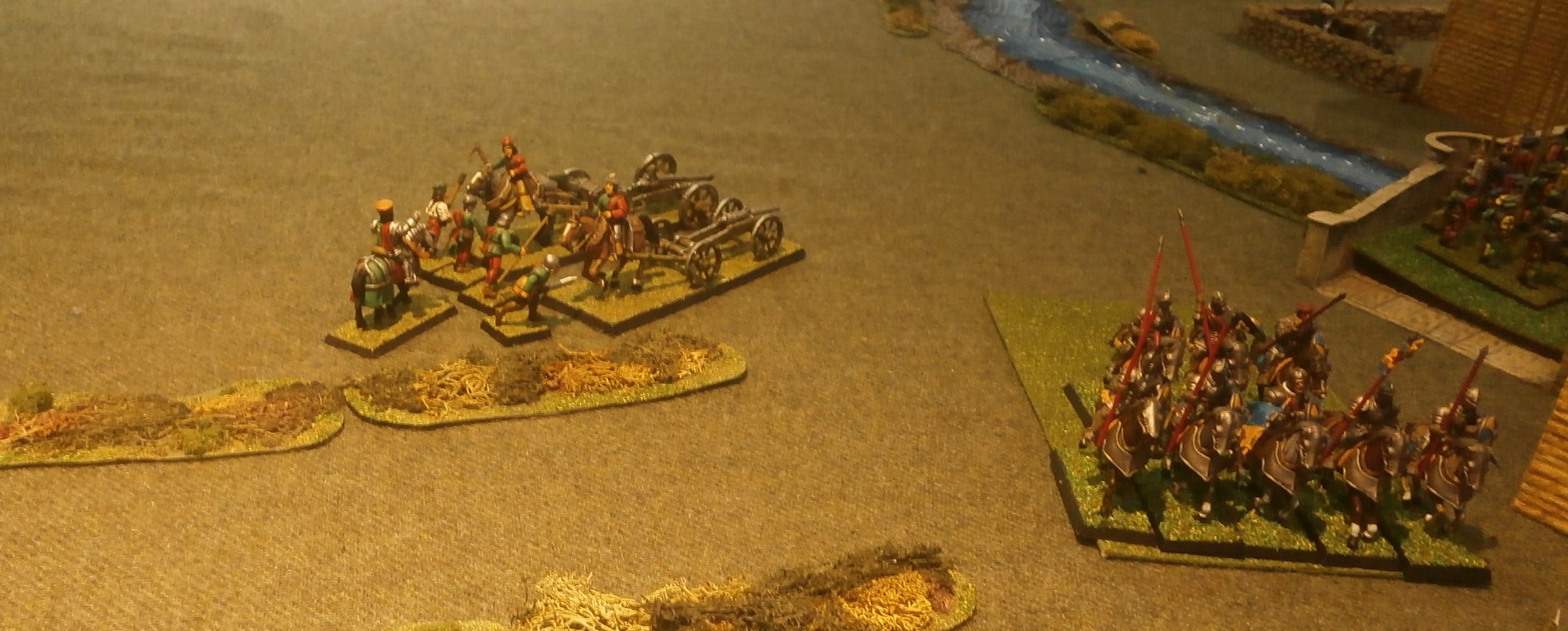
Neither the Pettirosso nor the surviving wizard, Zita Scadutto, could bring any magic to bear on the foe, for the enemy was too far removed from them. But the barone’s archers were able to reach the pistoliers with their arrows, killing another three.
As if wholly resigned to their inevitable fate, the last two refused to flee. Much to the Verezzans’ frustration neither their gallopers or ballista could harm the cannon, but on the bridge the pikemen managed to wound both the duke and his captain, but did not kill either. The price paid for this was three more of their own lives. (Game Note: The duke rolled three 1s with his four attacks.)
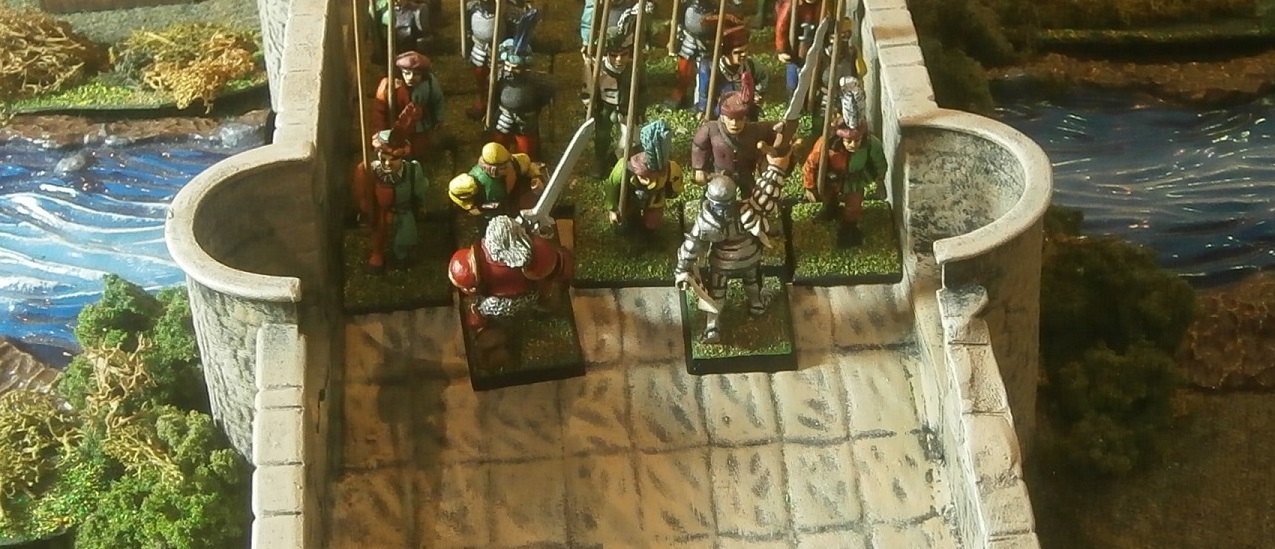
The taking of the bridge was proving to be as challenging as the Verezzans had feared, but the pikemen’s spirits were lifted by the fact that both Pavonans had now been visibly bloodied.
The Pavonan wizards chose again to hurl fireballs at the barone and his archers, this time killing seven, so disheartening those remaining that they and their lord now ran away.
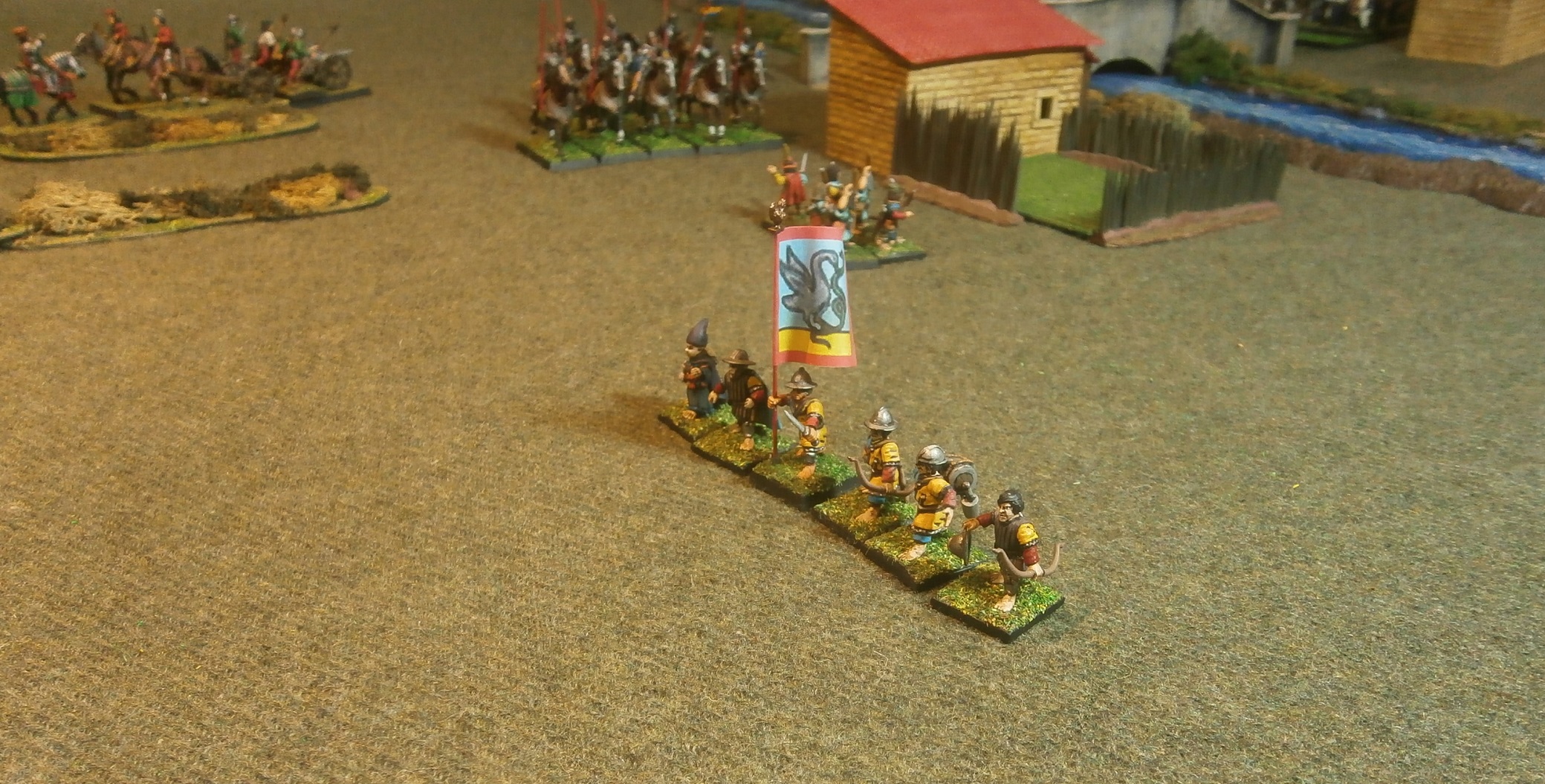
The barone still wholly intended to see this battle through, but he was damned if he was going to waste his own life and that of his archers by simply standing too close to an enemy his men could not shoot.
(Game note: I cannot believe that my boy and I had not yet realised that the galloper guns could dispatch the wizards with relative ease by targeting the buildings. Mind you, as GM, I may have felt obliged to keep said knowledge, if I had it, from the player! Usually, however, I do like to advise both players equally regarding options, without emphasising one choice as best. More usually, the players come up with their own, better ideas.)
A moment later, a cage of magical flame descended upon the pikemen, killing two of them. Nevertheless, they fought on. Two others thought they had surely skewered the duke, but were magically thwarted by some blessed artefact he carried. The Pavonan captain, however, was less well protected and finally fell, so that now Guidobaldo, alone, held the bridge against the pike. Yet still, he did not flee.
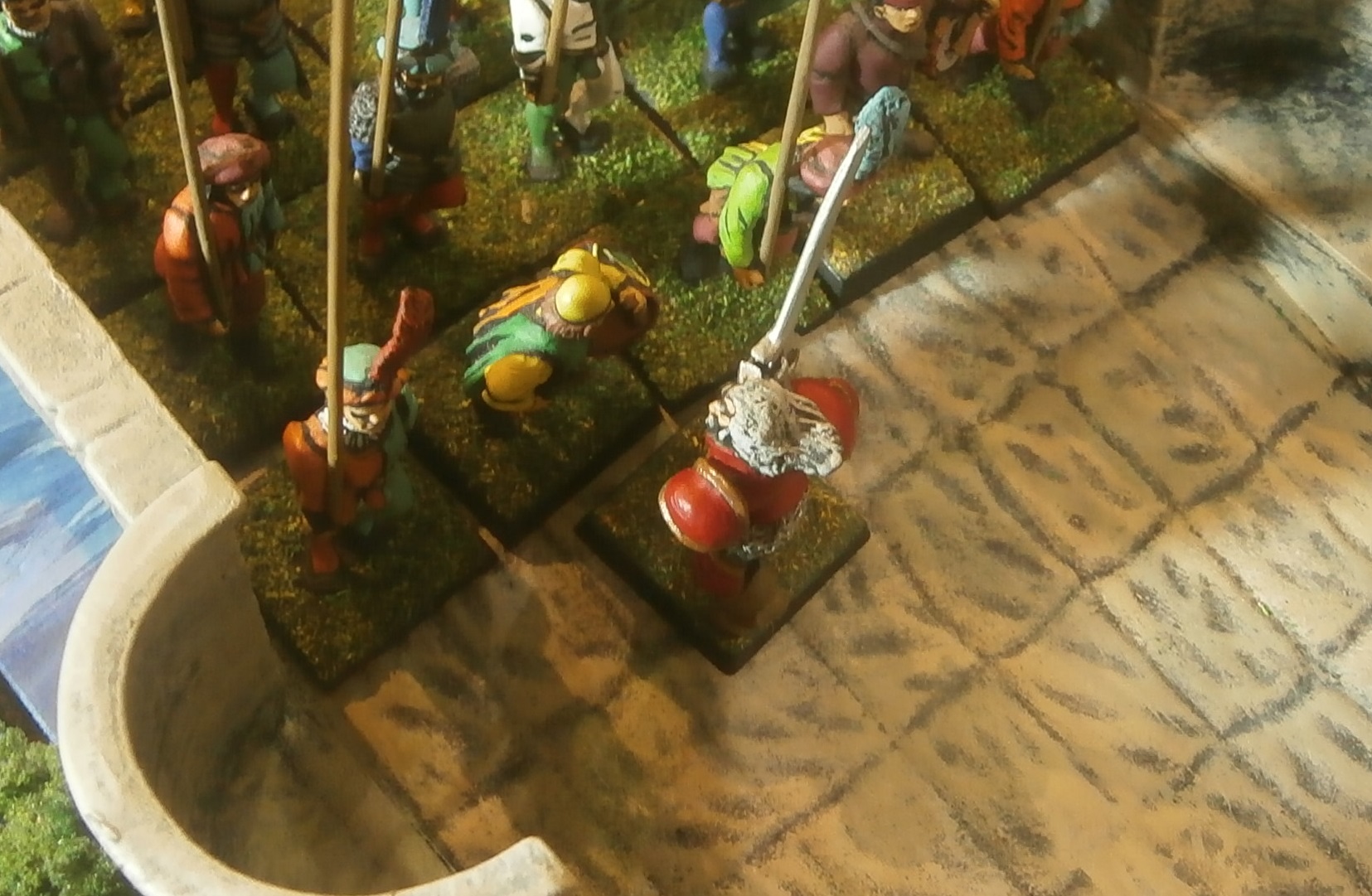
It seemed like the stuff of myth and legend: a resurrected hero facing an entire regiment of foes, unwavering as he refused to allow them to pass.
Again, the Pettirosso and his band occupied the fenced yard, trying not to look at the charred corpses of their fallen comrades …

… while Barone Iacopo chose to put more distance between himself and the enemy wizards, having ascertained that the bridge was surely about to be taken by the pikemen, and that his mounted men at arms were still intact. He halted just before the outermost ballista.

He had always known it would not be him who took the bridge, nor any of his kind. But he had commanded the army, arrayed them for battle and done what he could to help. This would have to satisfy him. It was down to the fighting men of Verezzo to carry the day.
The gallopers now shot at the larger house, from which they had witnessed fireballs being launched, and struck it.
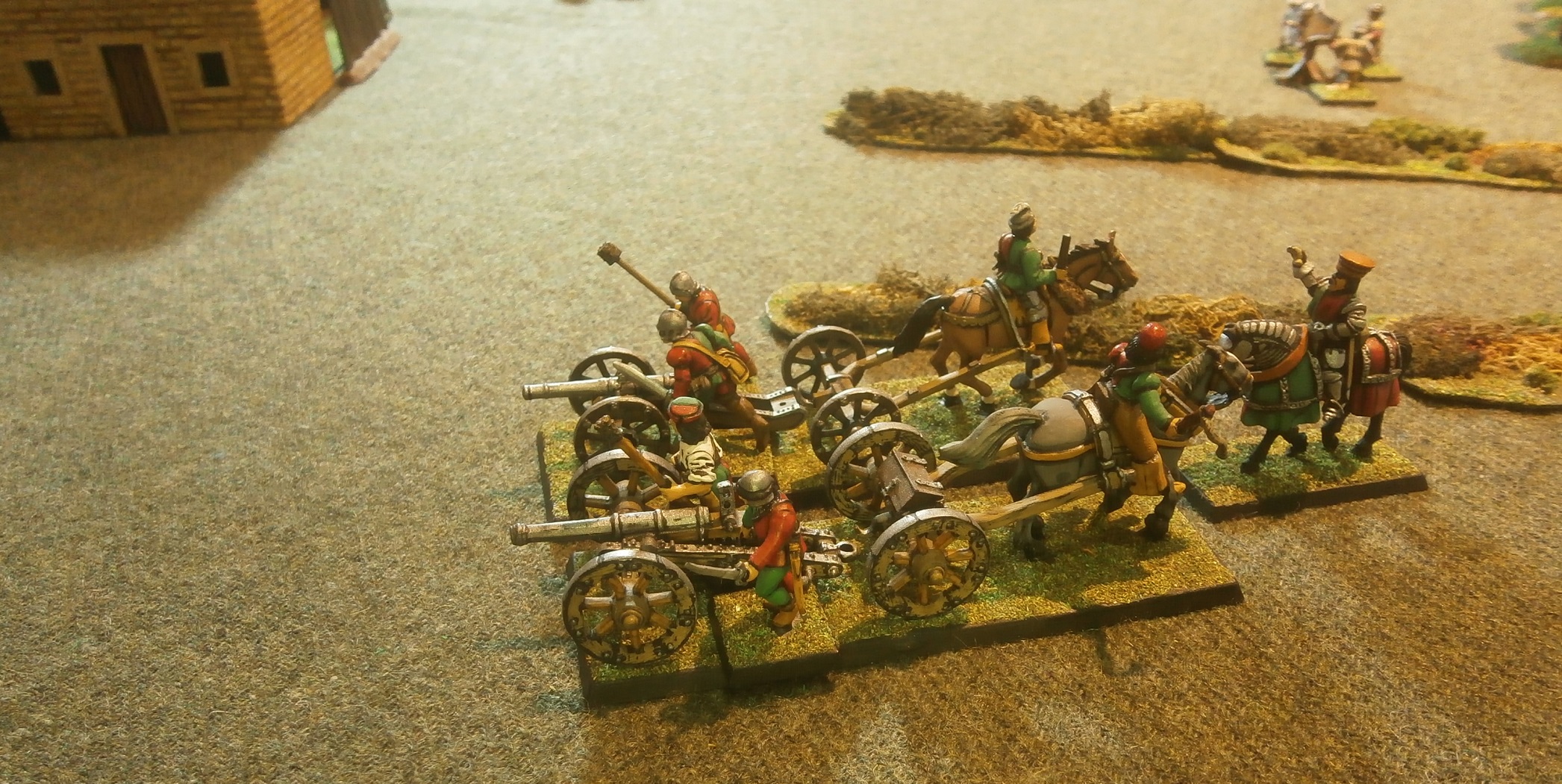
They could not know it, but they had hurt the wizard within, enough for him to make up his mind it was time to save himself and leave.
Suddenly there was a great cheer from the pikemen, and all on the field, friend and foe (apart from the gunners whose battered ears would take some time to recover before they could discern such sounds) knew that the duke had been cut down.
With an anguished cry, the Pavonan swords now charged the pikemen, for they could think of nothing else to do.
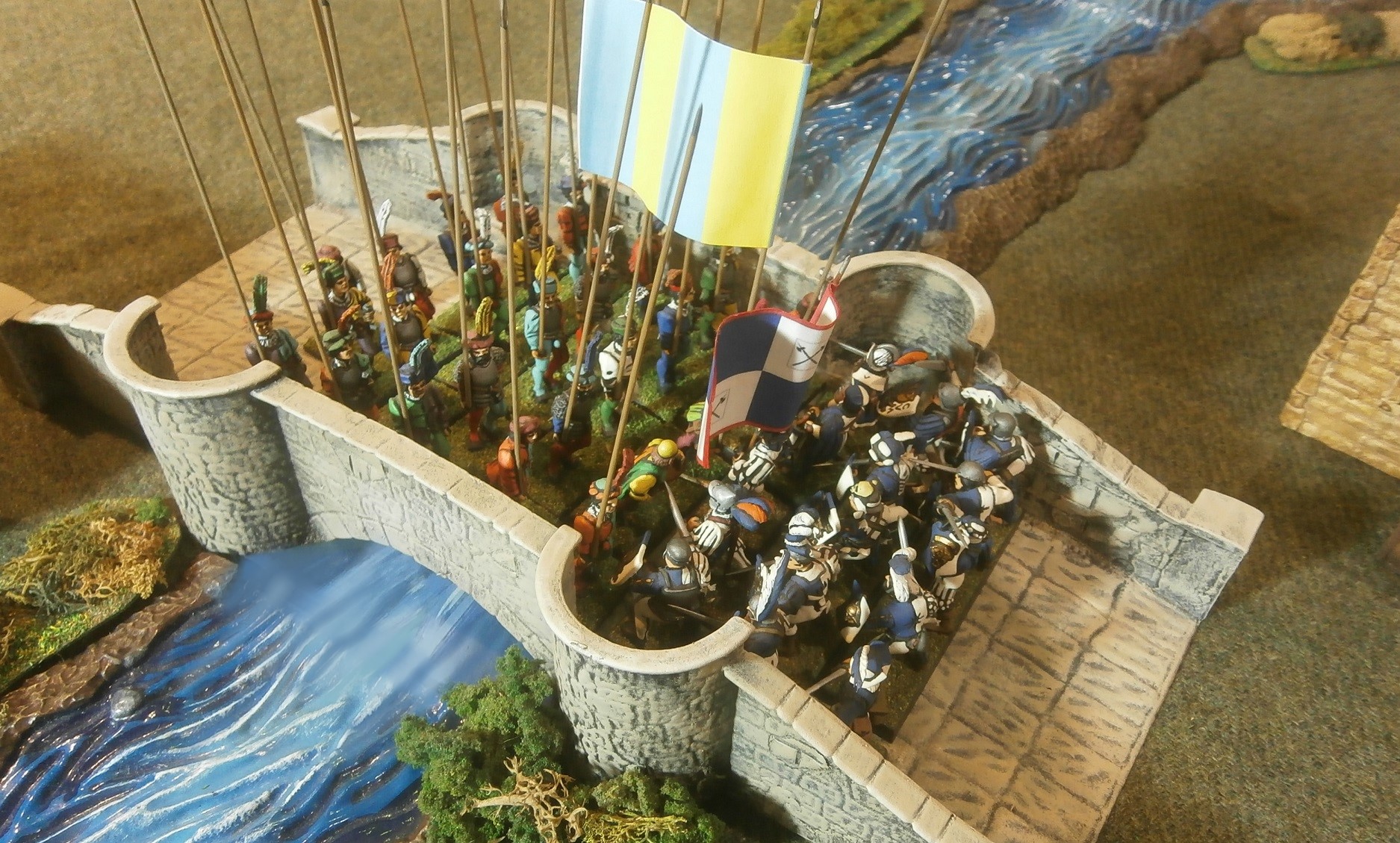
The fight was bloody, as it was bound to be.
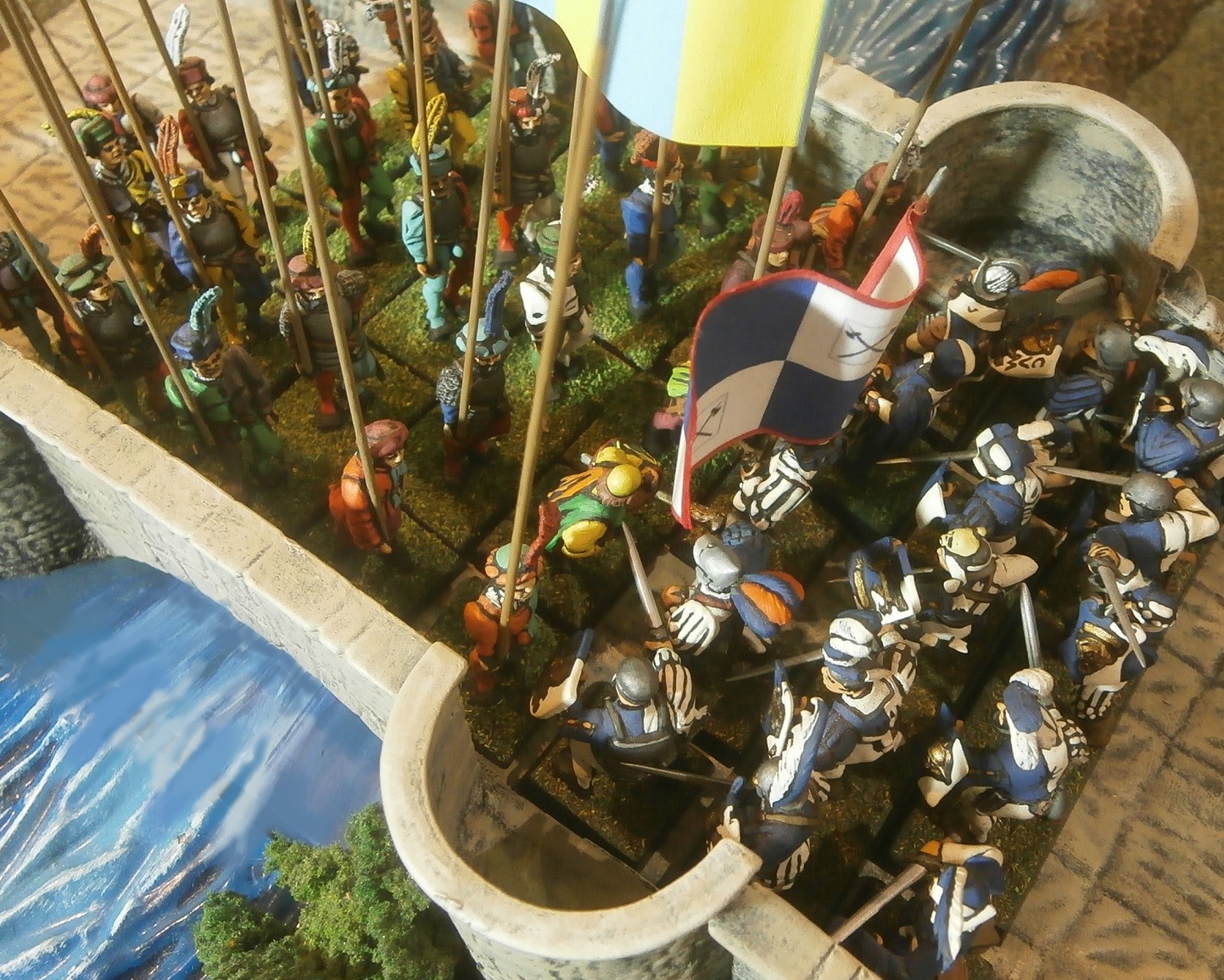
But the pike had the advantage – of ground, of morale, of every one of their serried ranks being able to thrust at the foe – and with the death of six of their own, the swordsmen’s will to fight dissipated, a process catalysed by their shock and grief at the duke’s demise. They turned and fled, and in so doing, the first of the Verezzans strode onto the far side of the river.
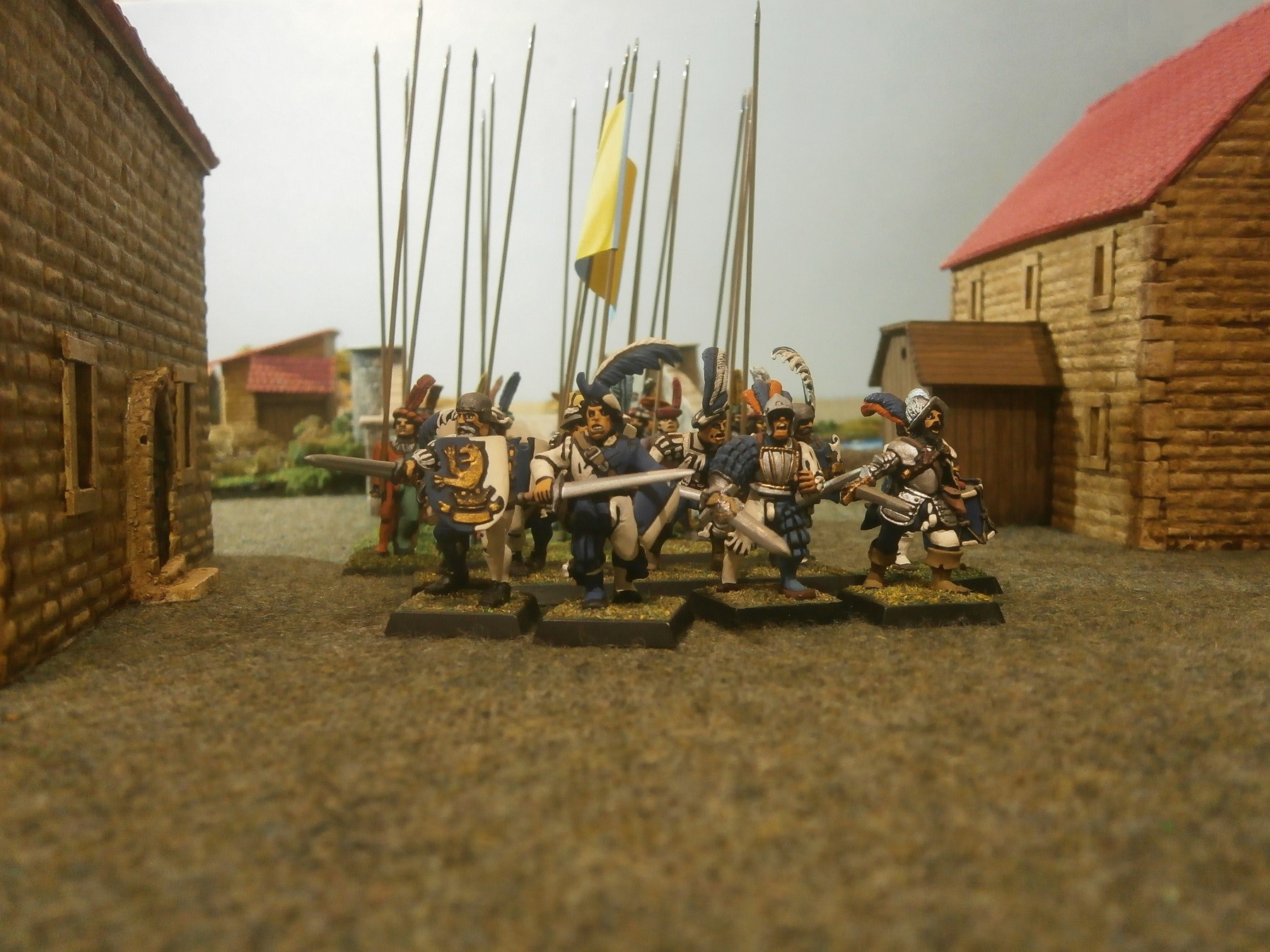
All other Pavonans now turned to run, but not before the last gunner touched a burning match to the bruised powder in the barrel’s pan to send a roundshot to smash one of the gallopers, disabling it entirely.
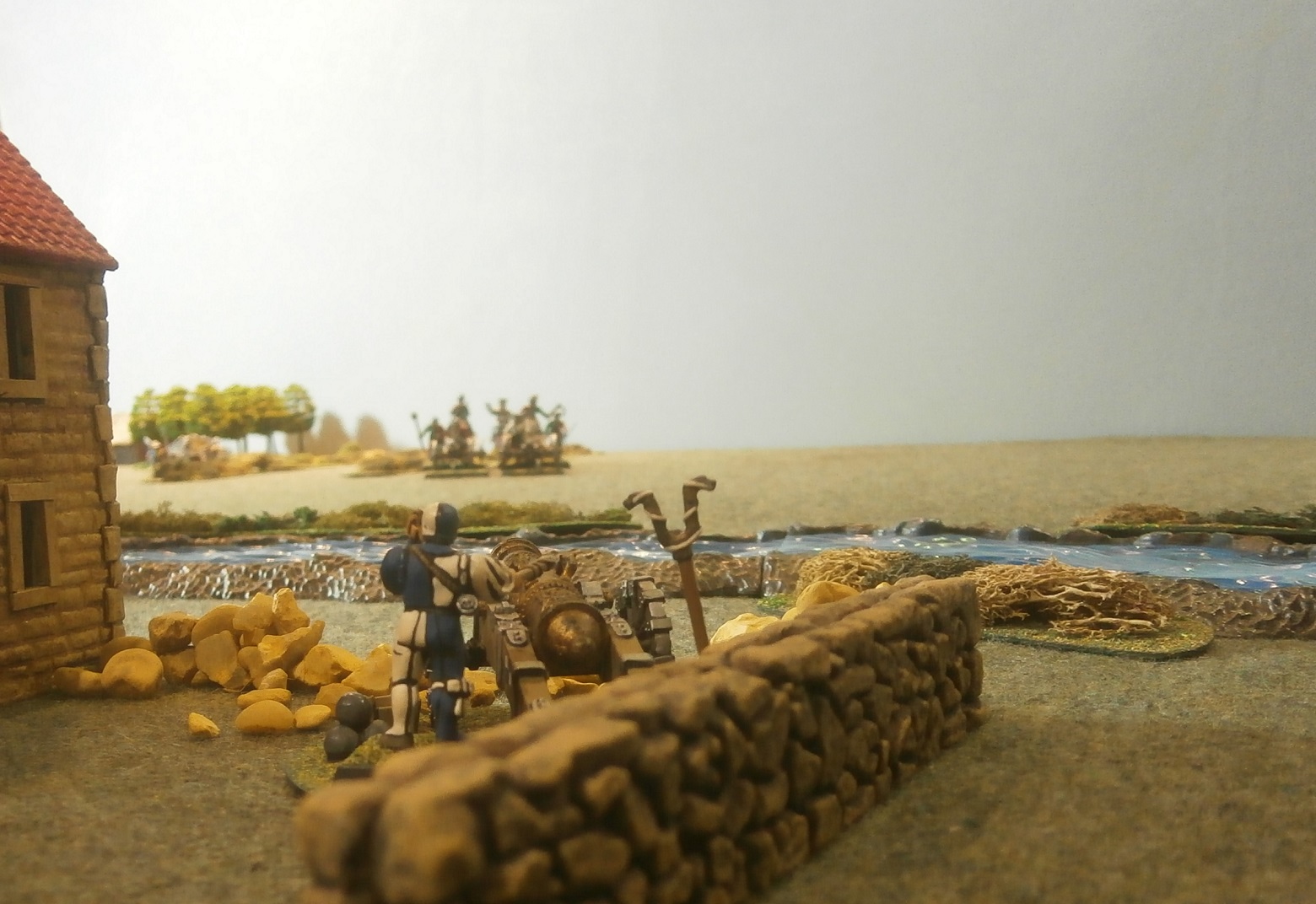
The day was won, if at considerable cost to the victors. The enemy’s army had been all but wiped out, with only a handful of survivors scrabbling away from the field.
Pavona now lay wide open, and Barone Iacope took solace from the fact that substantial reinforcements were on the way, indeed were already close, so that he would have the means to continue both his chastisement of Pavona and, if necessary, to take on Lord Silvano should he return in time to interfere.
When he reached the bridge, accompanied by the mounted men at arms – his own archers having left to tend the wounds of those fallen comrades who were yet alive – he went immediately to the red-armoured corpse, for he struggled to believe it really was Guidobaldo.
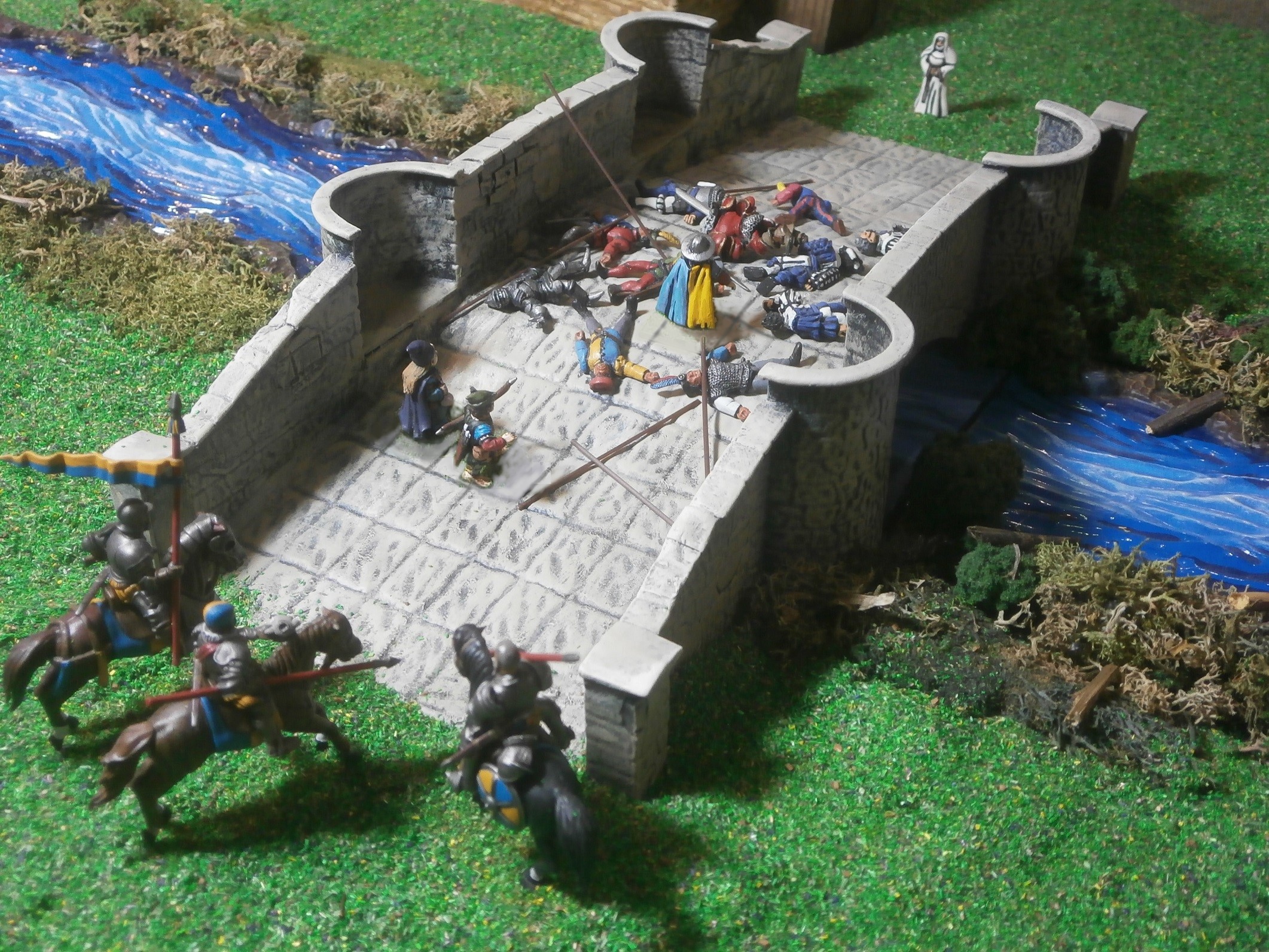
He was watched by a Shallyan sister upon the other side of the bridge (of course, despite being Pavonan, not one Verezzan thought to interfere with her business, as she tended to the fallen from both sides.)
Once he removed the duke’s helm, however, Iacopo’s doubts were almost wholly washed away. It seemed the duke’s very corpse had been reanimated to walk and fight again, and if it were not Guidobaldo, then the man had a twin brother previously unknown to the world.
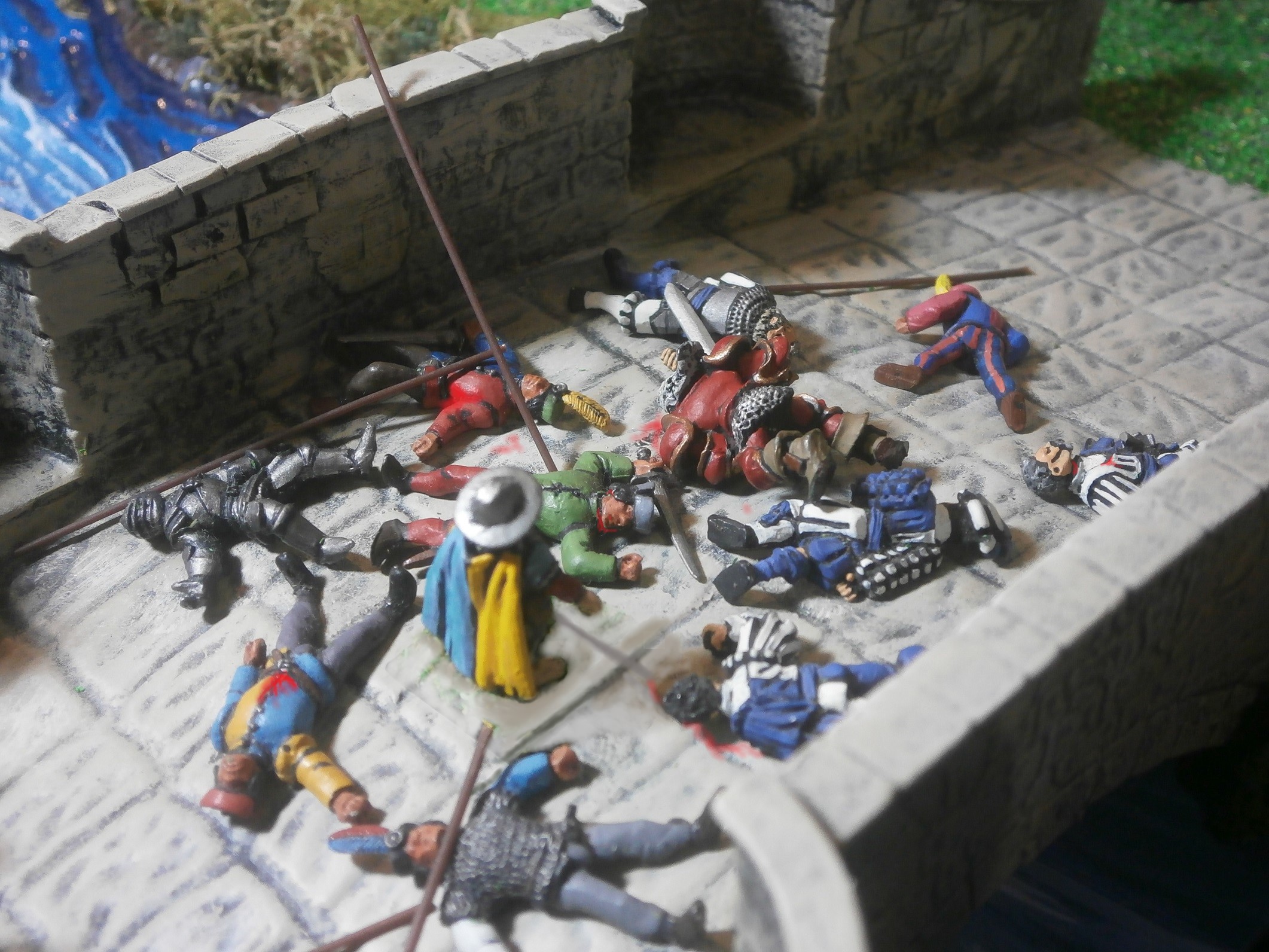
The pikemen later reported how the duke had fought ferociously, with long-honed skill, and Iacopo remembered hearing years before of the duke’s youthful victories in battle, fighting at the head of his army. It seemed, despite Guidobaldo’s age and injuries, he had not lost his ability with a sword, nor the strength to bear it well (no doubt aided by the powers of various magical trinkets).
The barone looked up to the sky. Could his greatest enemy really be dead? And if so, then why continue this war, now that the cruel but necessary justice had been achieved?
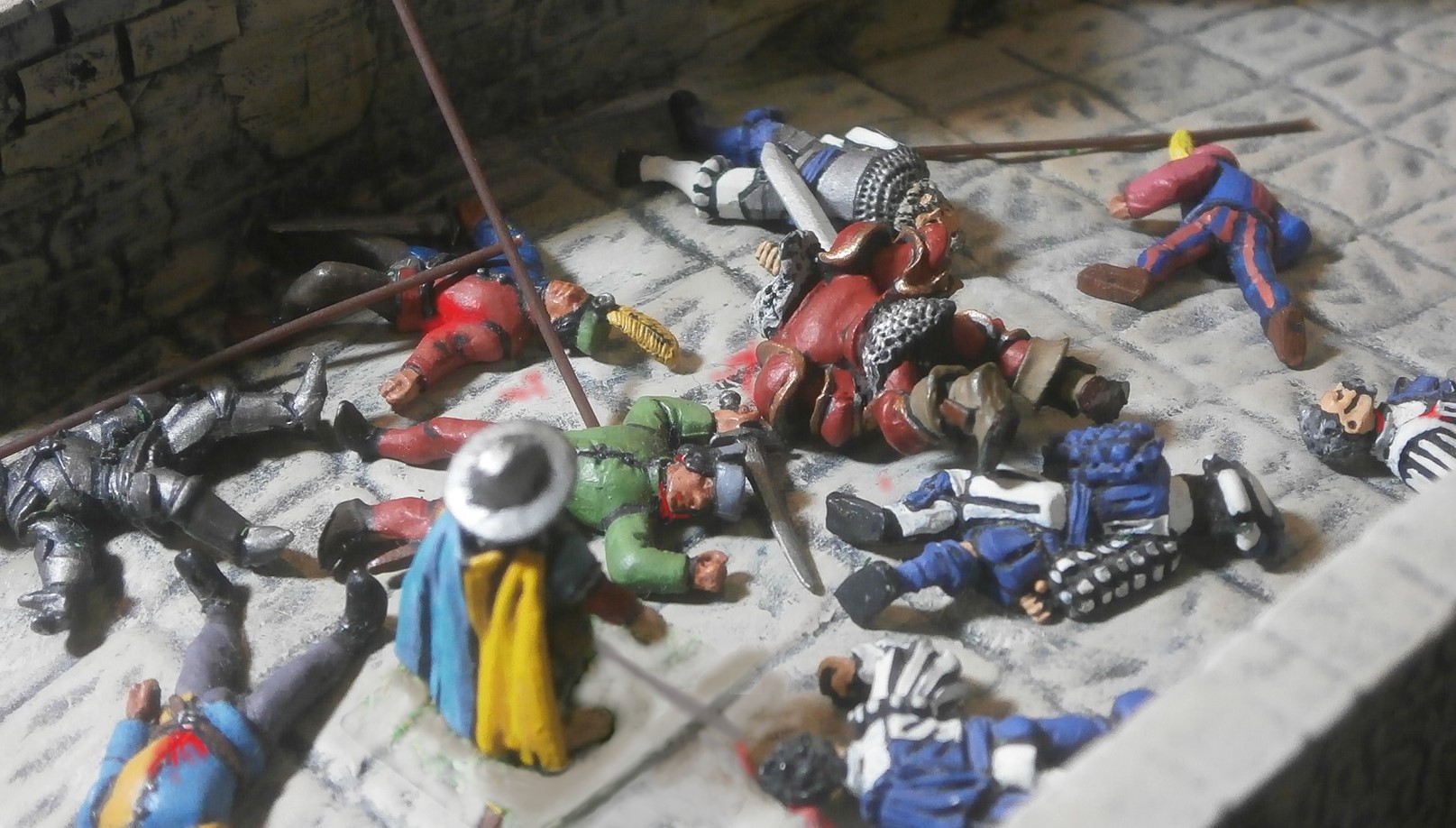
Just then, however, he wondered how young Lord Silvano would take the news – a thought that quickly led to another. Here and now, by killing the duke, he had surely made a new enemy just as implacable as he himself had been since Lord Lucca’s death. An enemy, moreover, with the hereditary right to rule Pavona, the ardent love of his people, and all the martial abilities and pride his father had ever possessed!
Despite Iacopo’s earlier optimism, he realised this moment might be the start of a long and brutal war. Perhaps the only way to avoid such would be to act decisively and assiduously; to give Pavona not a moment’s chance to recover and to strike its new duke down at the very first opportunity?
He did not think he had bitten off more than he could chew, but he did now wonder if it was more than he could stomach!

 BigSmallWorlds
It’s amazing how people who by all rights should be allies against a common enemy can instead allow old wounds and grievances to bring them to a different fight. Would that I knew less about how this worked in personal experience, but . . . woe to all of us when we fight one another at a time like this. *sigh*
Padre, your story is, as always, magnificent. And while its verisimilitude is at times frustrating, it’s also what makes it great. Bravo!
LikeLiked by 1 person