For Love of Hearth and Home
Prequel to the Fight at Sersale
City of Alcente, Spring 2404

Most folk in the city considered Captain Hector Perdigon’s soldiers to be scum, the very worst kind of mercenaries – commonly presumed to have been unwanted in whichever army they originally served, either because they refused to obey, or to fight. Unless, that is, they had simply run away. Several spoke with a Pavonan accent – presumably having left that impoverished city to seek paid service – but their other accents revealed that they hailed from every corner of the Old World, not just Tilea.

A good many had accents unidentifiable to most Tileans. Some came from the darkest corners of the Border Princes, others had fled defeat in some Empire civil war, and a good few were Estalians who, like many of their kind, had flitted from contract to contract in Tilea. It was generally believed that a good half or more had been exiled from their own lands.

Reluctantly, however, the citizens could not claim the Perdigon’s men did not know their business, or that they were ill-equipped to go about it effectively. The soldiers had been employed by the VMC, whose clerks were experts at getting their money’s worth. Had they been in rags, bearing rusty blades, then they would have been bought cheap, with particular economy in mind, but these men were clad in plate armour from head to heel, with a healthy vigour about them. The company must surely have paid dearly for them, and to equip them. They would not bear such expense if the mercenaries were not worthy of it, which should have given the lie to the common opinion of these men. VMC officers did not throw gold at a bad investment.

The truth of their origins was, of course, known to the VMC’s clerks and to the men themselves, but neither felt any compulsion to reveal it.
The citizens consoled themselves by thinking of the possible alternatives. General Valckenburgh could have left Ogbut and his brutes as a garrison force, and no-one wants ogres swaggering the streets. Or he might have left no garrison force at all. Either choice would have been far more dangerous for the people of Alcente than Perdigon’s company.
The VMC’s main army in Tilea was composed almost entirely of mercenaries. Even those recruited in Marienburg (the trading company’s far-flung home) were not pressed to serve a local lord, nor had they volunteered in their city’s militia, rather they had been hired to serve a mercantile company as part of a joint stock enterprise. In effect, they were purchased, just like the company’s ships and supplies. A good number of the soldiers had been recruited in Tilea, and as such they had every reason to serve willingly in an army fighting first against Lord Khurnag’s Waagh and now the vampires of the north, defending their homelands from such evil foes. But even they could not deny that they were serving businessmen, rather than the nobility or some city state’s elected council. Indeed, the Tilean lawyers who drew up the contracts under which they would serve had utilised a combination of Condottiere contracts and the bonds signed by caravan and warehouse guards. They themselves might have hearth, home and a noble cause in mind, but the merchant adventurers who commanded them were motivated solely by profit.
Perdigon’s regiment was not part of the company’s main army, having been raised specifically to bolster the standing militia force of Alcente while General Valckenburgh marched to the far north of the peninsula. So far, Perdigon’s men had done their job well – if simply maintaining their full strength and readiness, while nothing much happened, counted for anything. The citizens had learned that as long as they stayed out of their way, the mercenaries kept themselves to themselves. Several inns had become theirs, whether or not they were officially lodged there, and in truth the citizens, even the city’s Tilean militia guard, were glad they were there, considering the proximity of an army of Sartosan pirates ravaging the realm’s smaller settlements to the west.

This morning, however, something had changed. Perdigon’s men were frantically busy preparing to march, while the captain himself was striding through the streets with several of his lads, as if on a mission. People watched from the windows or pressed themselves back in the doorways while he passed, and everyone knew that his activity did not bode well. The city’s bells were quiet, however, which made some think it could not be a real emergency. Captain Perdigon knew the truth, of course. The bells were being kept deliberately quiet, to maintain a necessary surprise! The Sartosan pirate army was nearby, and alarm bells might encourage them to hurry!
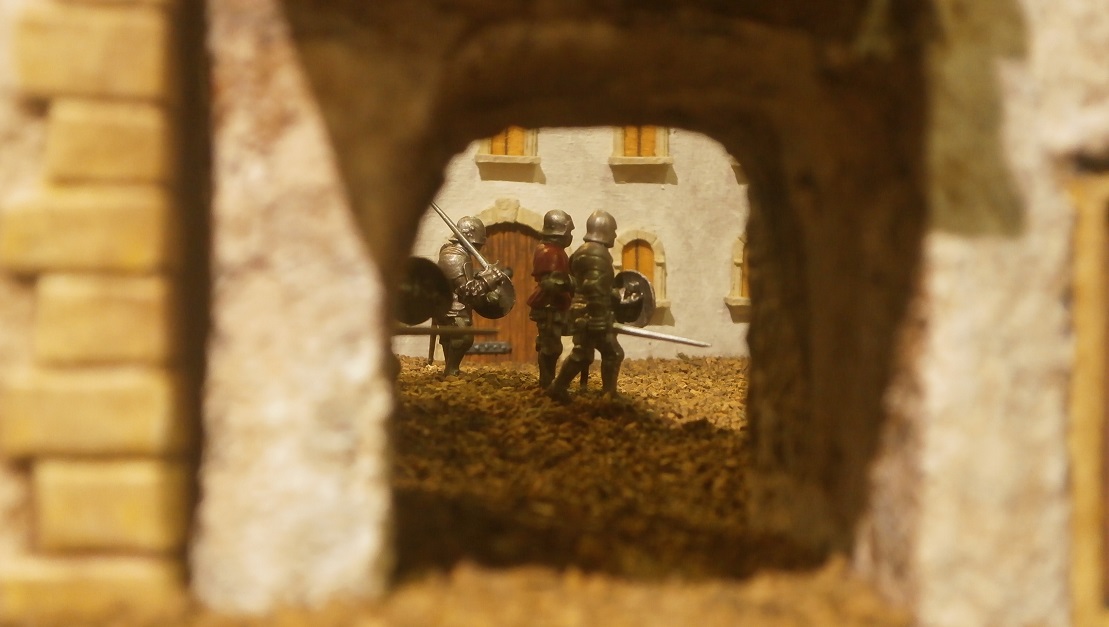
The captain knew where he was going, and before long he found exactly who he had been looking for – the militia’s watch patrol, with their current commander, being a handful of crossbowmen and halberdiers doing their rounds as the militia had done for time immemorial.
“Ho! Sergeant Ivo,” barked the captain. “Gather up your lads, you’re marching out with us at noon.”
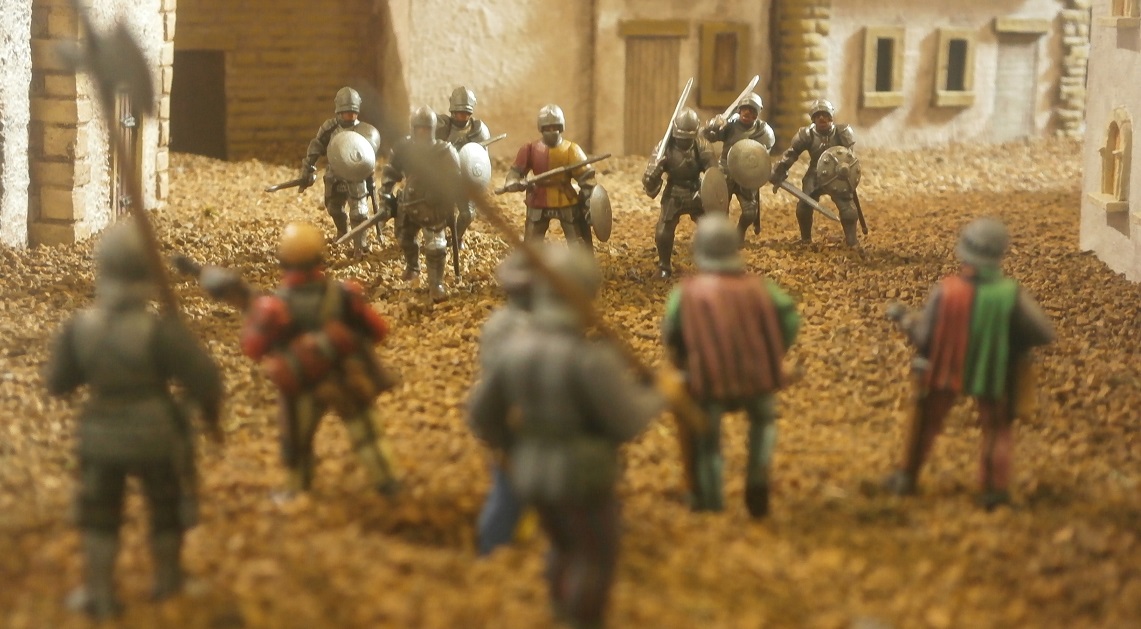
“What?” answered the sergeant. “Look you, captain, maybe you’re marching out, but our job is to stay here and defend the city. So we ain’t going anywhere.”
“You’ll be defending the city when you march out. Now, make haste.”
Sergeant Ivo snorted as if he found what Perdigon had said very funny. He looked around at his men, rolling his eyes as if to say ‘Get this fellow’, then fixed his eyes on Perdigon.
“The problem that comes to my mind, captain, is that I can’t see any way in which we can defend the city if we are not in the city to defend it.”
Perdigon narrowed his eyes, which was all the sergeant could see what with the captain’s sallet and bevor covering the rest of his face.
“You think that you and your militia can hold these walls against an army?”
“Not if we are not on the walls, no,” said the sergeant, with a mocking lilt.

Perdigon chose to ignore the tone. “You would not last an hour,” he said. “The stone is strong, but with only your petty militia to hold it, it is no defence, merely an inconvenience.”
“Look you,” said the sergeant quickly, and in a more serious manner. “We live here. Our families are here. If we leave, then there will be none but boys and old men to guard the walls. We serve the city. That’s what we all agreed to, and that’s all we agreed to.”
From behind he heard Adelchi shout, “Aye!”

The sergeant glanced back at the lad, thankful, and warmed somewhat to his theme. “We’re not soldiers, to be marched off to war. We are citizens-in-arms, ready and willing to defend our homes. We will obey any order to that end, but we cannot leave the city. And we will not leave the city.”
The sergeant glanced back again, but the lad was quiet this time. Perhaps Adelchi did not like the fact he had been the only one to shout before?
“You’ve sworn an oath to defend the city!” said the captain. “And now you must do so, by marching out! The Sartosan filth have burned Mintopua and razed Motolla. Now they march on Sersale. If they burn that then your proud city will be surrounded by wasteland on all sides.”
“Ah, but … but our city will stand!” said the sergeant, thinking quickly. “And … crops can be resown.”
Someone behind him muttered something about the vines not coming back in a hurry.
“Consider, fool,” said the captain. “The Sartosans will not stop there. You think they’ll complain at how heavy their loot has become and decide enough’s enough? Their greed only grows with the taking, and they know there’s much more to be had from the city itself. Now, they think you Alcentians are weak. And with good reason! They won’t fear assaulting the walls if they know you all to be cowards.”
“You … you take care what you say, Perdigon,” said the sergeant, his voice strained by equal measure of panic and hurt pride.
A dark cloud drifted over head as several hands clutched a little tighter to hilts. The crossbowmen suddenly regretted not having spanned their crossbows.

From behind Adelchi spoke again, and the sergeant wondered if he was the only one present who felt any sort of confidence.
“Maybe it’s you who’s afraid?” declared the youngster. “You’ve been ordered from the city I bet, and you don’t want to go alone.”
“I’m not afraid of Sartosans,” laughed the captain. “I’ve faced far worse than them – enemies that would loose your bowels on sight, boy. The truth is I like drinking wine here in Alcente and sleeping on soft beds. In fact, I’d like to do that some more. If we do not take on the Sartosans right now, then all that will be lost. Such a shame.” Then, like an afterthought, he added, “Oh, and o’course, your sisters will be raped, your homes burnt, and you will be chained in a galley for the rest o’your days.”

“Well,” said the sergeant, shaking his finger at the captain, “I say if you want to keep what you have, then you should stay and help us hold the walls.” He swung his arm to point toward the nearest city gate. “They outnumber us, yes? Well, see … I say the walls will even the odds. And General Valckenburgh could be back any day – just the sight of his army would send the Sartosans running. If we go out there now, we could end up fighting unnecessary.”
“Dying unnecessary,” someone muttered from behind.
“The general is hundreds of leagues away. Chances are he doesn’t even know what’s happening here. Look, we have orders and you have orders. This is my last offer of advice, and then there’ll be no more talking. The militiamen of Sersale have mustered and called for the city’s help. They intend to make a stand and will die to a man if we do not help them. Now, I don’t care much for them as I don’t know them. But they’re your cousins and countrymen. Do you want them to die?
“No … but see …” stuttered the sergeant uncertainly.
“And the road wardens are riding in force from Pavezzano, while we have Captain Hidink’s pistoliers here in the city. You think their skills in battle are best put to use on the walls?
“Well, no,” admitted Sergeant Ivo.
“This is your one and only chance to save the city. Do you understand? Wait any longer and that chance is gone. Right now we can muster us, you, the men of Sersale and all the horse left in the realm, and bring all to bear as one. The general isn’t coming in time, and if left to their own devices, the men of Sersale and the road wardens will all die. Altogether though, we can put on a show of force that will make the seadogs think twice about fighting.”

“Well, when you put it like that … “

………….
We Know Our Business
The Fight at Sersale, a Battle Report
Late Spring, IC 2404

As the village of Sersale came into view, Admiral Volker could see that this time the Alcentians had chosen to mount a proper defence. There had been squabbles at Mintopua and Mottola, and a handful of his scallywags had died, but for whatever reason the defenders failed to muster any real strength to oppose them. His captains were convinced this was because there was no strength to muster, which was the Sartosans’ reason for targeting this particular realm in the first place – they knew the Alcentian marching army, mainly composed of the VMC’s foreign mercenaries, had gone north to join Lord Alessio Falconi’s struggle against the vampires. Although, as they had stopped to argue with the duke of Pavona along the way, they were apparently in no hurry to reach that war.

“Maybe,” Captain Van Baas had joked, when discussing how easy the plundering had been, “they ain’t in a hurry to return either?”
Considering the wealth of the company’s newly acquired possessions in and around Alcente, Volker could only assume the VMC’s army was simply too far away to return quickly. Yet, if the company had been prepared to dispatch its army so far, surely it would have left something behind to defend its precious new possession; its Tilean milch cow?
Thus it was no real surprise to discover that here, at Sersale, there were not just hastily mustered militia-men and light horse, but regimented bodies of soldiers, one of which being well-armoured. As far as Volker could ascertain, the enemy was still too weak a force to thwart his own army, but there could be some trickery at play. Perhaps a relief force was on its way, and Alcentians were defending this place, rather than their city walls, to buy time? If so, what were they waiting for? And how soon would it arrive? Or were they simply unwilling to allow any further destruction of their property?
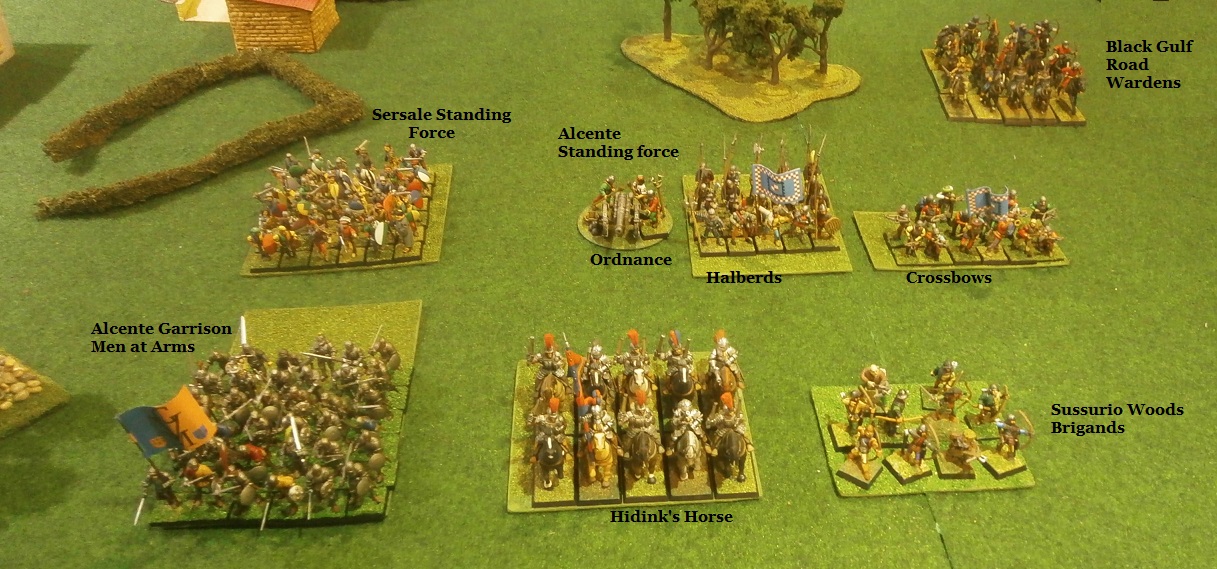
The enemy possessed only one piece of ordnance, compared to Volker’s three. (He decided he would command his own artillery to deal with it first.) Two of the regiments bore Alcente city standards: chequered red and white bands on a field of blue, with black crenelations presumably to represent the city walls. These must be the city’s drilled militia, no doubt possessing some skill in their halberds and crossbows. A large body of well-armoured soldiers bore the orange and blue colours of the VMC itself, most likely professional mercenary soldiers bought with the ample funds available to such a rich trading company. As he had suspected, their presence revealed that not every professional mercenary had marched north. These men at arms could be trouble, as could the mounted pistoliers carrying the same colours.
Then there was a large body of lightly armoured swordsmen, rivalling the men at arms in size, but lacking a standard. These were probably the local militia, but as such, they could not be discounted as a threat. Being so close to the Black Gulf, even the part-time soldiers of this region were likely to know how to handle a blade. And if this was indeed their home, then they had no need of a standard to inspire them to fight.
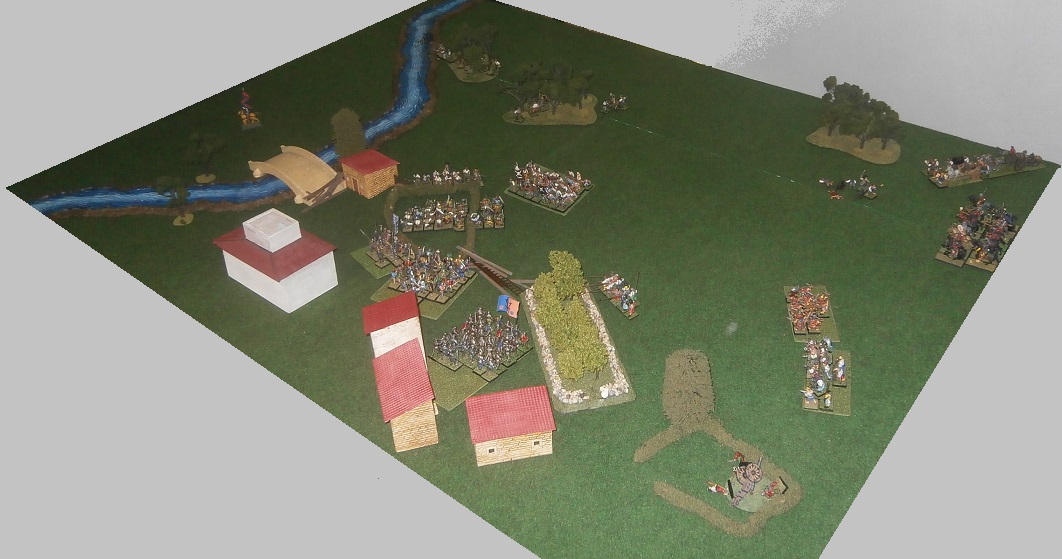
The village itself was flanked by a river, crossed by a stout, stone bridge. Several large dwellings were surrounded by small, enclosed fields and orchards, making the place fairly defensible, even without further work.
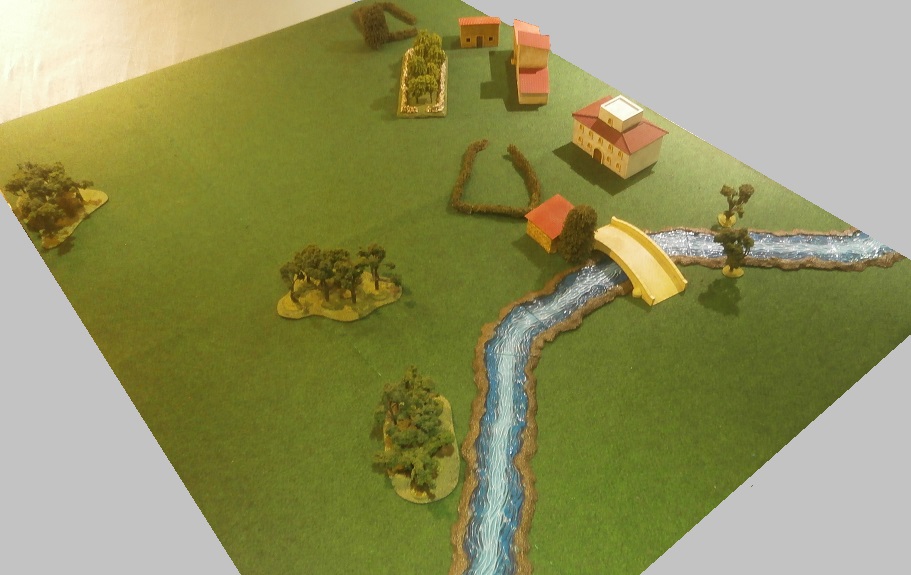
No bad thing, then, thought Volker, that this time had brought his entire strength to bear. A week or so before, at Mottola, he had sent Captain Van Baas and his crew to take and raze the village, while he and the rest of his army waited close by to lend support if required, and if necessary, to counter-attack any relief force dispatched from the city. Which was exactly what had happened, and several many VMC horsemen had perished in their abortive attempt to relieve the village. Here, today, their efforts to relieve the locals were considerably more substantial.

Volker and his three surviving captains had marshalled their crews. As both his crew and Captain Van Baas’s were badly mauled in the earlier fights, upon drawing close to the village, he commanded them to amalgamate into one body, all the better to apply strength of numbers in any fight they took on. Van Baas did not complain, indeed he seemed relieved. Maybe his crew had been mutinously grumbling about their losses, and this strengthening would reassure them?

Volker’s army was heavily reliant on black powder, for as well as the three pieces of ordnance, he had two companies of handgunners, another of blunderbusses and two armed with swivels. Captain Farq’s goblins also favoured powder, being festooned with pistols, but unlike the dwarfs (who were bereft of their captain, Brewaxe, since the battle near Luccini), their pieces were somewhat ill-kept and unreliable. Such was the way of goblins. Volker often angrily wished it was not also the way of several of his own crewmen, but it was not the place of a pirate captain to apply the lash, rather to persuade with promises of wealth gained, and inspire by example. The ship’s articles also played a role, and indeed it was stipulated in the seventh clause of his own such rules, voted for by a majority, that all the crew were to keep their weapons free of rust, well-oiled and ready for battle. Recent transgressions, however, had led to a pettifogging debate concerning whether the articles applied on land, and he had been too distracted by his duties as army commander to settle the matter in the usual manner.
His recently raised, but already weakened, pike regiment was intended to add a better defence against enemy horse soldiers, and his two wizards, Arcabar and Vedus, were there not just to dish out magical harm but to counter whatever spells the enemy might conjure. Right now, however, it seemed the only horse soldiers the enemy possessed were on the wrong side of the river, and Arcabar had mentioned that he could not sense the presence of any wizards in the village. Still, thought Volker, better to be safe than sorry. More horse could come, and any wizards might be concealed, biding their time before they struck.
The defenders had deployed mostly within the confines of the village boundary, except for the pistoliers upon the far side of the river. Volker had sent no-one that way, having failed to find a ford to cross, but he was not concerned, reckoning his lads would make short work of them, the river notwithstanding. The horsemen would surely learn the folly of prancing about within range of his pieces!
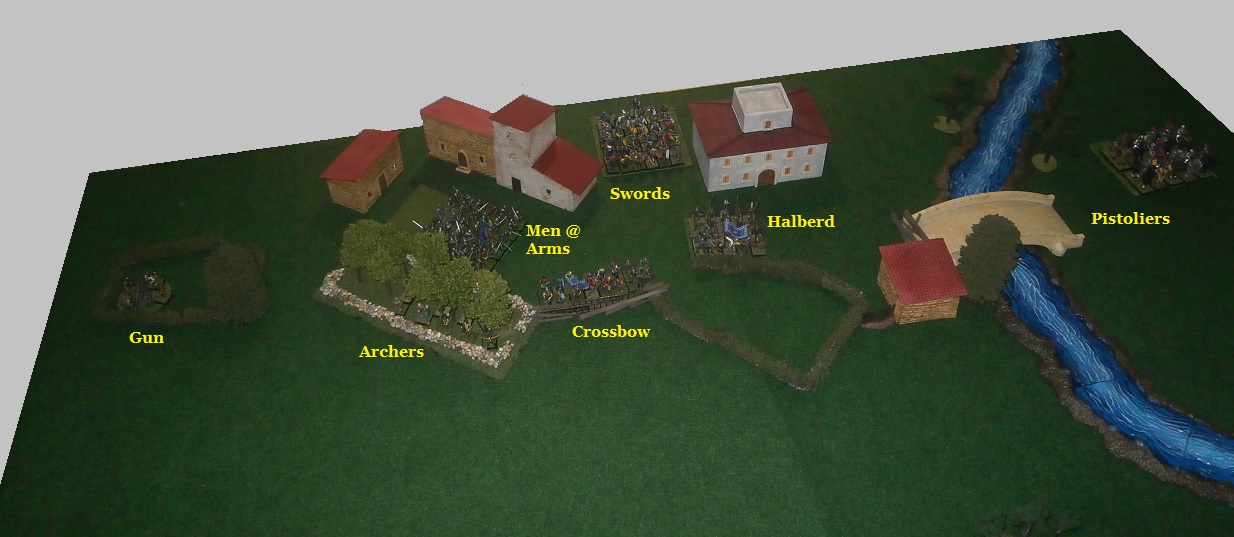
A few archers were lurking among the trees of the stone-walled orchard, like brigands awaiting the passage of prey, while the city-militia crossbows manned a hastily made barricade of ladders and planks between the orchard and the hedged field.

The enemy’s largest regiments waited behind, on the village’s street, obviously hoping to thwart his army’s advantage in numbers by fighting within a restricted space. What use was an hundred men if only those six at the front could bring their weapons to bear? Volker knew from ship to ship fighting that with such restricted access even ten men could hold back a hundred. If they were bold – or desperate – enough.
The enemy’s single gun was out on their far-right flank, concealed behind a hedge, and well sited so that it could aim its muzzle at almost any part of Volker’s army. It was heavier than his own pieces, but this was a fight for field pieces, not great guns, and so he was not too concerned.
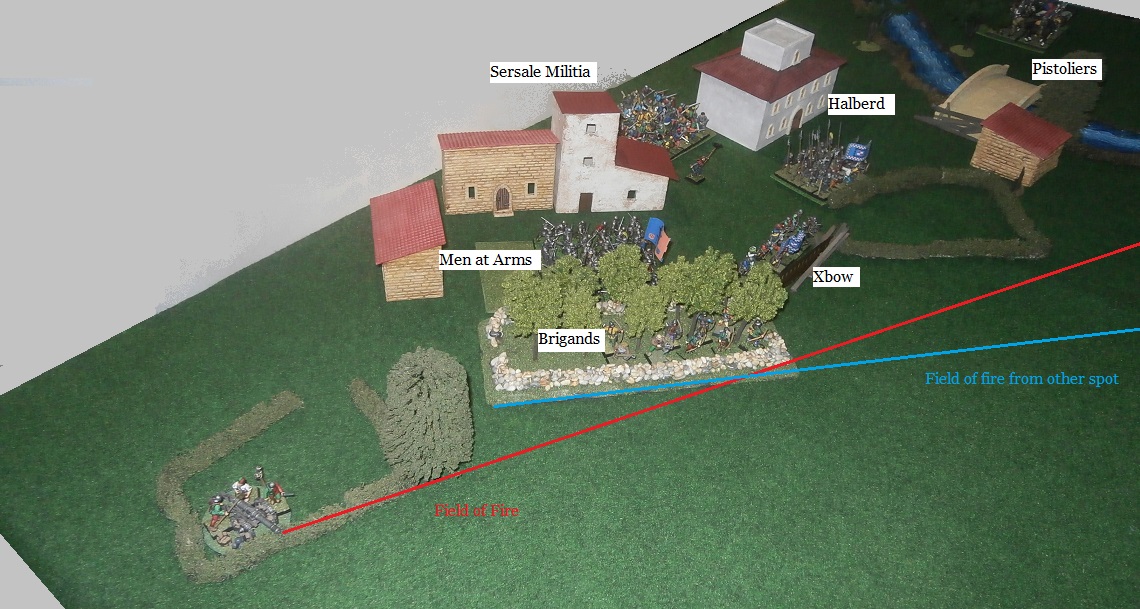
Volker intended to bring the full strength of his own army to bear and in so doing present such a sight as to strike fear into the outnumbered enemy, which is why he commanded his army to array in one long line of battle. Such a deployment would also enable his guns (both big and small) to play at the foe unhindered. So it was that he put his ordnance, swivels and handguns, upon both flanks, while his three large fighting companies, being the pike, Farq’s goblins and his and Van Baas’s conjoined crews, occupied the centre.

His dwarfs were out on the left, to ensure that flank and the baggage were protected by something that could fight hand to hand, and hard. Out on the right was the river, in full flow due to the season, so he was not so worried about that side. Only the foolish, or the desperate, would attempt to cross it. And they would fail.
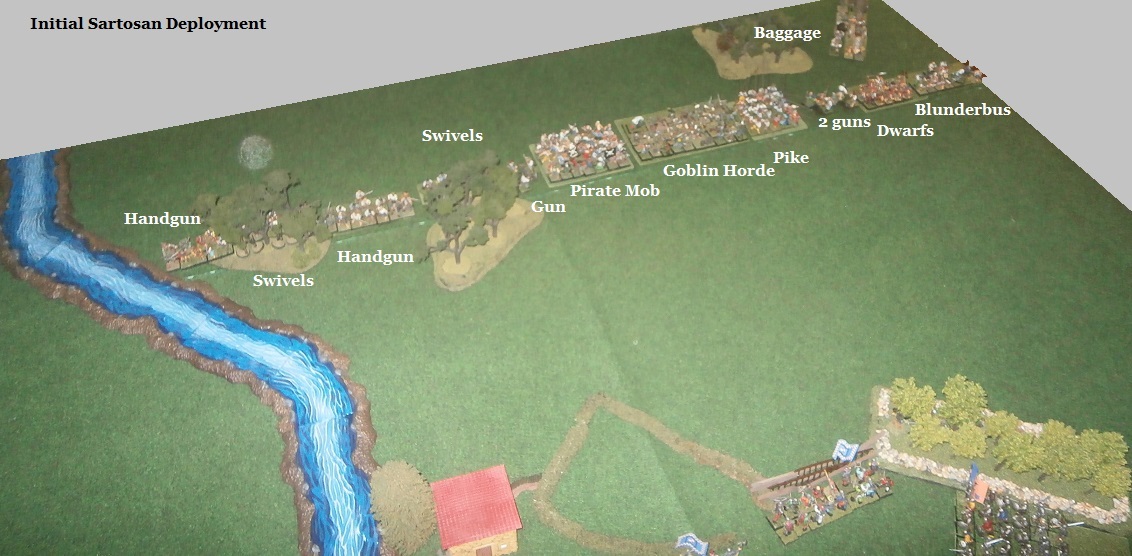
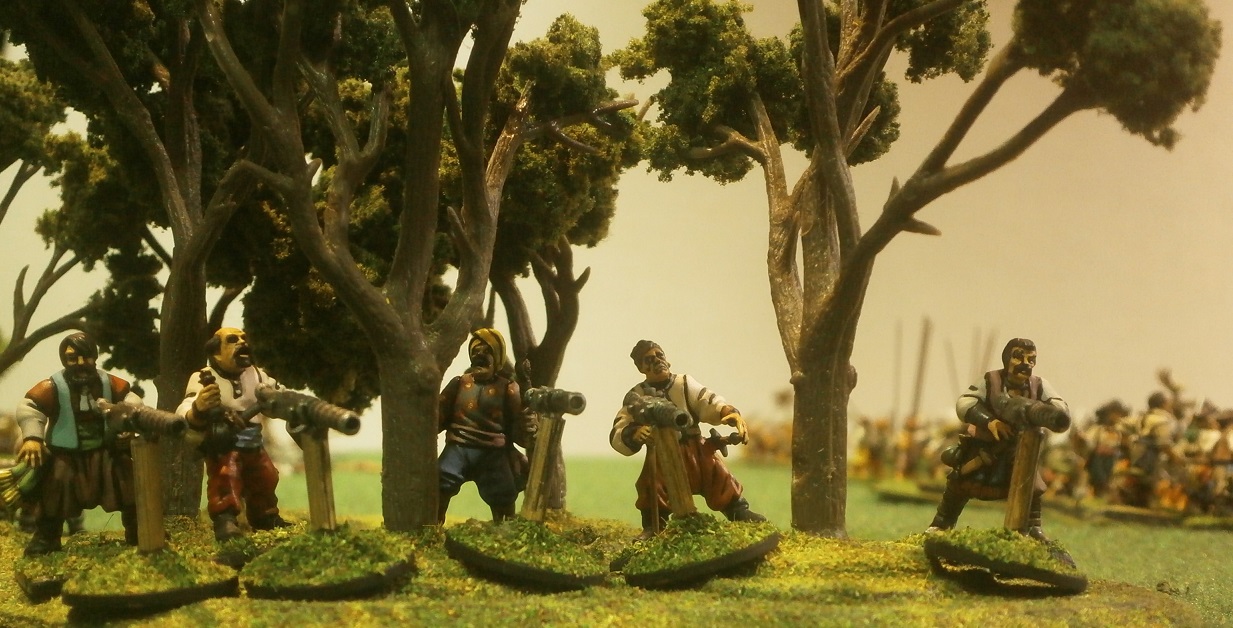
Besides, if the pistoleers thought they could harry his troops from the far side of the river, his right flank could still present quite a challenge, what with a body of swivel gunners ensconced in the trees and two companies of handgunners flanking them. It would be interesting to see how pistols fared against their larger cousins!

As well as the dwarfs on the left, he had placed two of his artillery pieces and his own blunderbuss-armed crewmen, including Draja the great orc and his mighty firearm ‘Mine’. Volker had seen what Mine could do – it was colourful, if not exactly pretty.
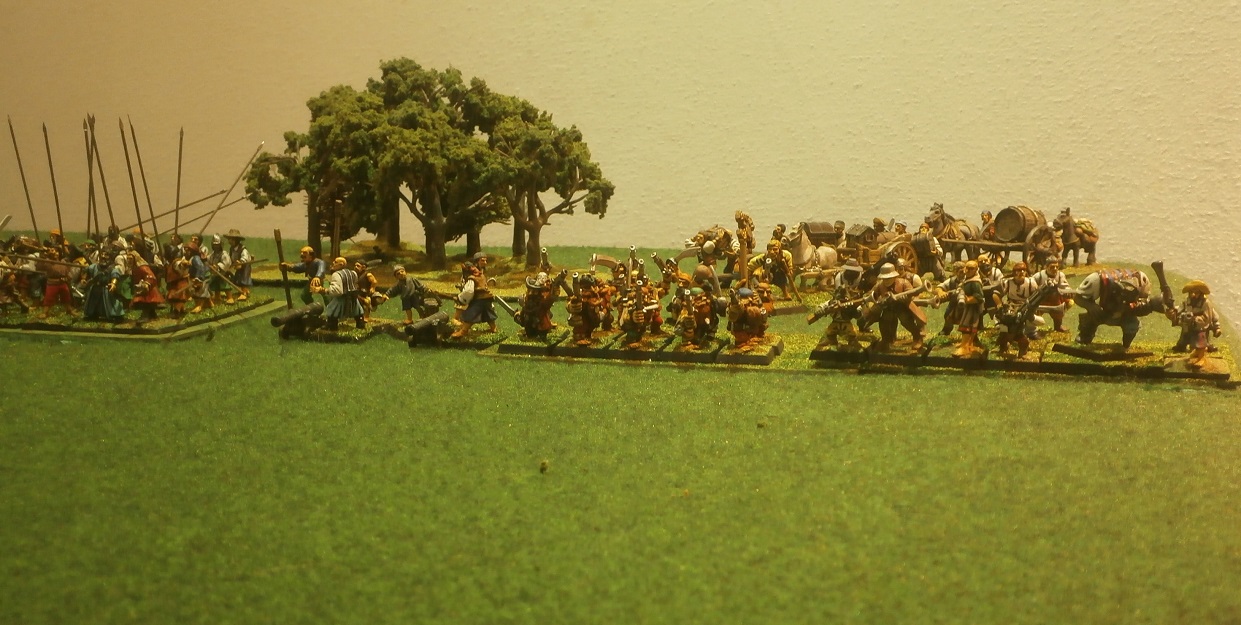
Behind them was the baggage, and although the wagons, carts and mules carried much of the loot so far stolen (a considerable fortune) Volker was not too worried about the enemy attempting its capture, for they would surely be far too busy defending what they already had to bother with trying to take more. Still, it comforted him to know that the dwarfs were close by to keep an eye on it.

He himself personally commanded the joint regiment of his own and van Baas’s mariners.

His yellow shirted navigator, Ubaida el-Noor stood to one side of him, and on the other was his standard bearer, carrying his colours of a death’s head above a cutlass.

Next stood Van Baas’ bosun, Moukib Brahimi, then the wizard Adus Arcabar …
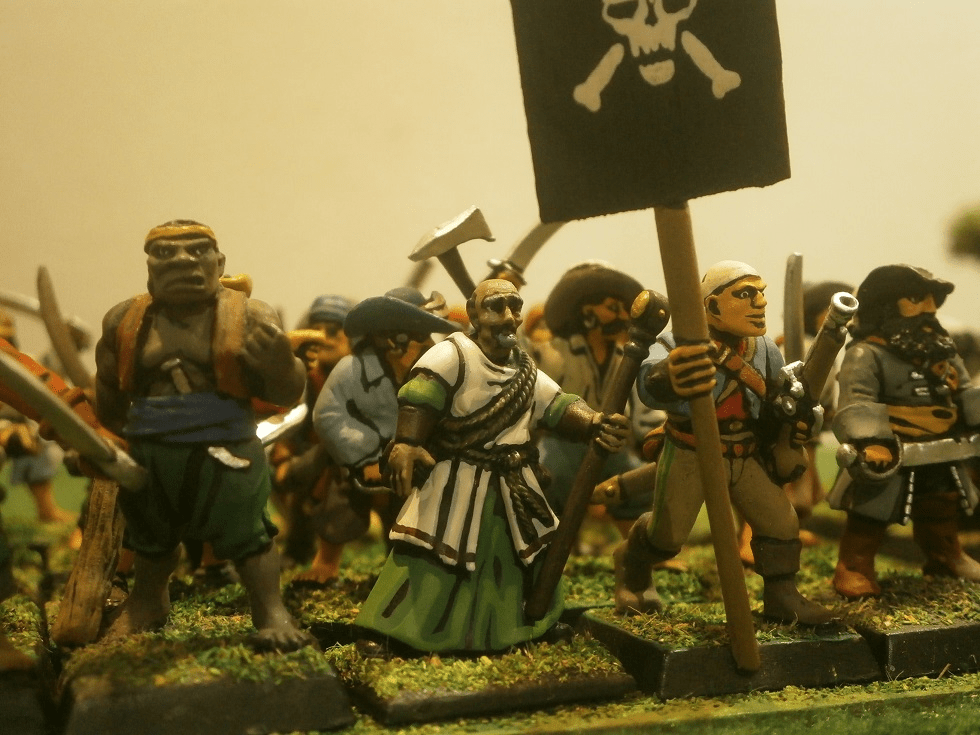
… and on the far-left Van Baas and his own standard bearer.

Crab, the young lad who carried the drum, had been relegated to the second rank for want of space amongst the officers and sea-artists at the fore. Vedus, the other wizard, was marching with the pikes, whilst Captain Jamaar Garique was commanding his handgunners on the right. Volker was glad that Jamaar was out there to keep an eye on things – the fellow had proved himself competent many times over, and a safe pair of hands.

Volker’s booming voice, a startling sound to issue from so slight a man, signalled the advance, and the Sartosans began to close upon the village. They kept in step, for now, with the dwarfs, maintaining a straight line and so ensuring plenty of unobscured targets for the artillery big and small!

The three central regiments fair bristled with steel, either sword blades, pistol barrels or pike heads, and made a sight to see as they moved as one. Volker knew full well that Captain Farq’s horde of goblins on his right were pretty much all show and little substance, but to the enemy they would still look frighteningly numerous.

Quieter, so that only the men near him could hear, Volker declared,
“That’s good lads! Steady and neat. Let’s show ‘em we know our business.”
He wondered what it must be like to be in the village looking out, to see an entire army of renowned robbers closing in; an enemy that had already devoured the western reaches of the realm and was clearly intent on continuing its feast. Would the sight sow fear or resolve?

No matter, he thought. We’ll find out soon enough.
He could hear Farq’s shrill shouting as he too ordered his mob onwards. The goblin captain had spent the previous night bragging how he and his lads would surely get to grips with the enemy before anyone else, leaving little work for the rest of the army. Farq then attempted to convince the other captains they should therefore give him and his lads a reward in advance, indeed immediately, considering how some of his lads would be dead after the battle and so, unfairly, would not able to enjoy said reward.

Volker probably spent too long trying to work out if the goblin captain was joking or in earnest. Either way could mean trouble, as goblin humour invariably involved inflicting suffering on some poor unfortunate, even one of their own, while an aggrieved goblin was as likely as any Sartosan to seek vengeance. Volker would have to keep an eye on him. Goblins were renowned for having more cunning than orcs, and such could make Farq dangerous, even to those who believed him to be their friend or follower.

Of more immediate concern to Volker was his chief wizard, Arcabar, for the man was on the wrong side of old for a battle, being toothless and wizened, despite his obvious ability to weave formidable conjurations.
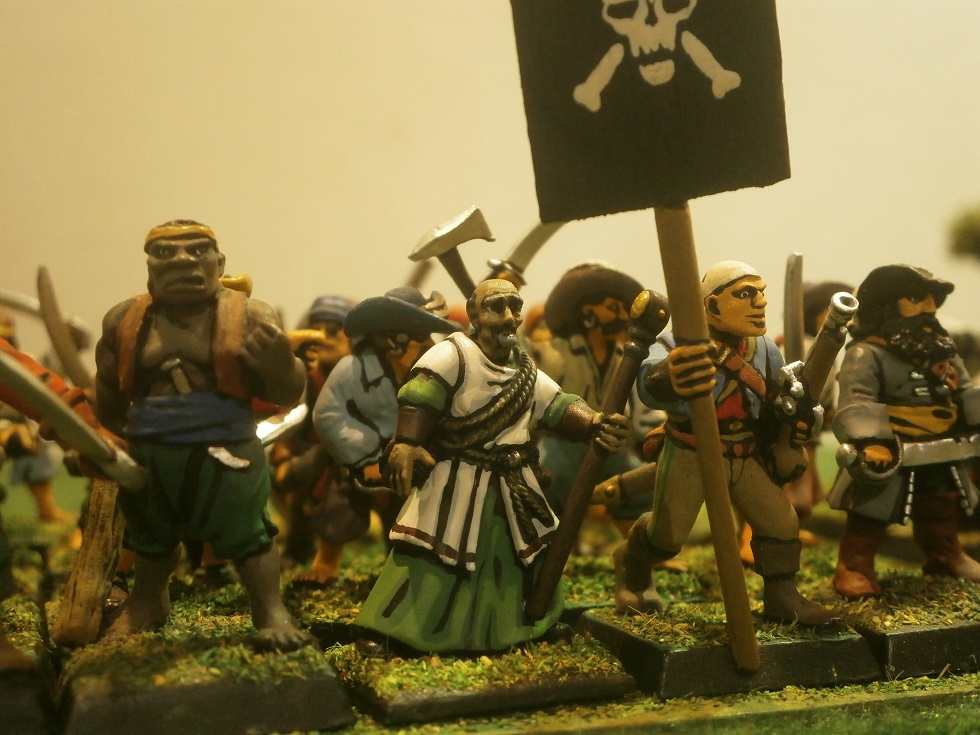
The previous night Arcabar had reassured him that if he was strong enough survive the flip they were drinking – a heady mixture of rum, beer and sugar, heated up with a red-hot poker – then he was strong enough for battle. When Volker asked the wizard if he was alive that morning, Arcabar had belched before opening his eyes, asking: “Can the dead do that?”
Now, as they advanced, Arcabar proved he was indeed strong enough to hurt the foe, for he conjured up a magical shower of lightning bolts to hurl towards the crossbowmen at the enemy’s front and centre, cowering behind their makeshift barricade.
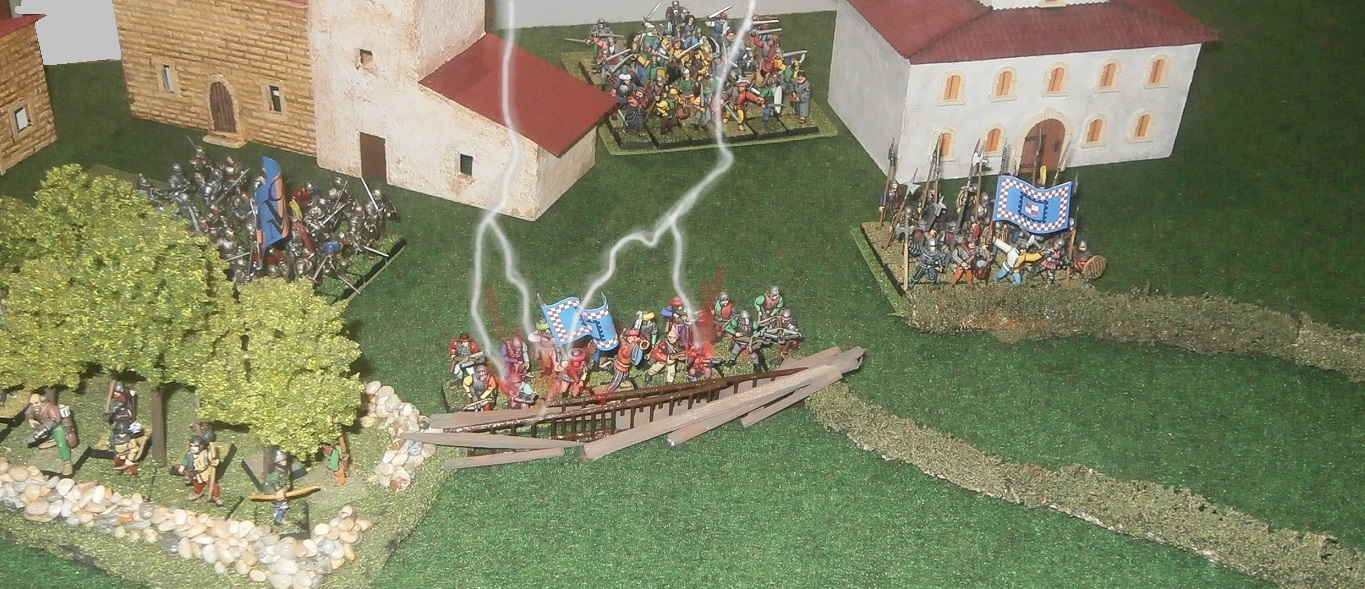
Three of the crossbowmen fell, one screaming horribly, the other two deathly silent as their blackened bodies crumpled. Volker could also see several balls of fire arcing towards the archers concealed in the orchard, undoubtedly invoked by Vedus, but unlike Arcabar’s blue bolts, they dissipated before they reached the enemy. Arcabar himself did not seem to notice his fellow wizard’s failure, busy as he was with killing two more of the crossbowmen with yet another spell, this time causing a sheet of fire to burst from the very ground they stood upon.
Just as Volker wondered what the guns were up to …

… he heard the rippling sound of shots, loud and louder, from all along the line. Impressive, he thought, as the gun on his right sent chain-shot into the already mauled crossbowmen, killing three more. The militiamen, half their number either badly charred or torn to pieces, with hardly a moment having passed since the Sartosans began their advance, could take no more and fled from the barrier.

“Fare thee well,” shouted some wit from the ranks behind.
A moment later there came another boom, this time louder, followed by the sound of shouting from his own lines. One of the brace of pieces to his left had blown up! Volker didn’t know it, but the other had failed to fire altogether. Its crew were not bitter, however, considering what they had just witnessed. They were just thankful to be alive!
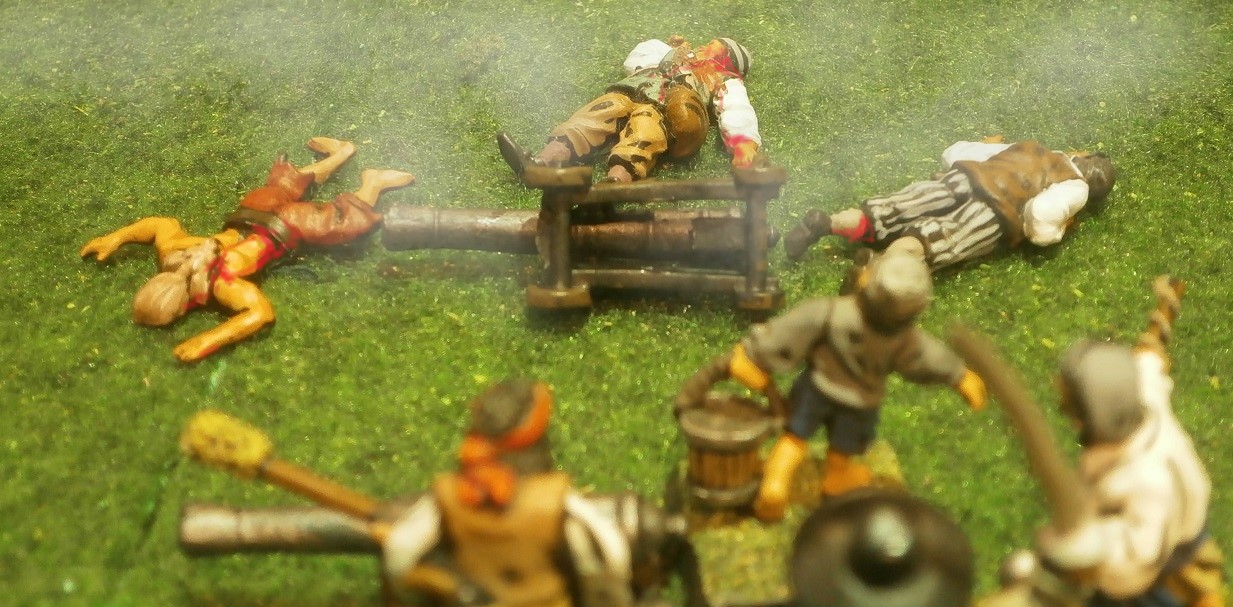
As the enemy’s mounted pistoliers cantered forwards, a swivel found its mark and tore one of them from his saddle. The rest, however, closed in on the handgunners on the far flank.
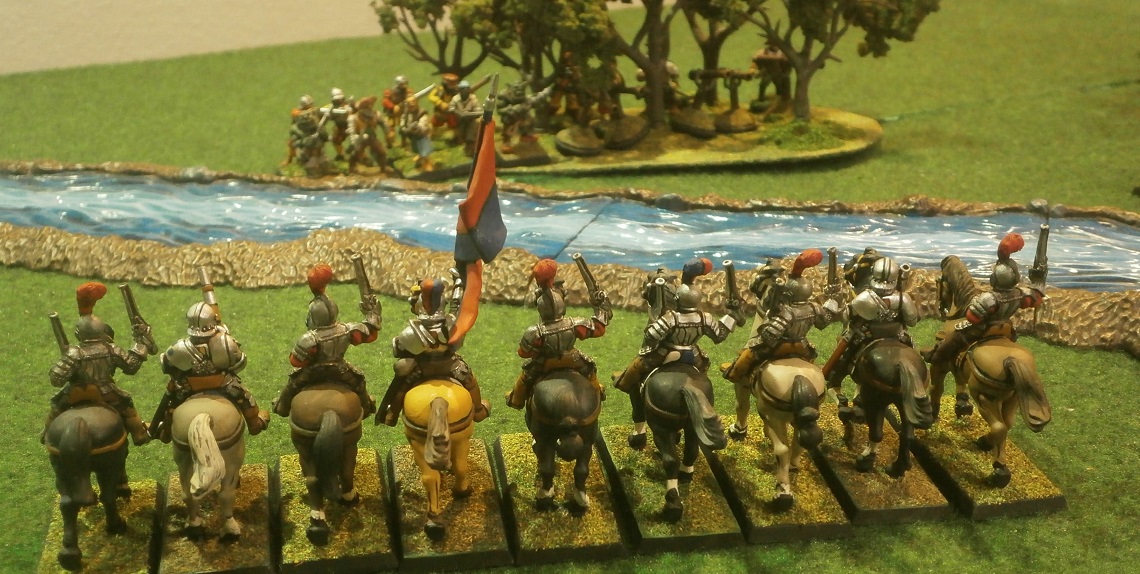
The volley of pistol fire proved surprisingly accurate as they killed five of the nine pirates. Luckily for the rest of the Sartosans, their success was not equalled by the Alcentian ordnance on the other far flank. The gunners lined their muzzle up on the surviving Sartosan gun facing them …

… but their shot merely clipped the piece as it passed harmlessly through the shaken crew.
Father Vettorio, the Morrite priest serving Sersale and several surrounding villages, seeing the militia Sergeant Ivo bravely rallying his battered crossbowmen despite their recent mauling, thought to help them with a blessing of protection, but found his prayer thwarted by the enemy wizards.

It seemed his prayers were not going to be strong enough, not with such powerful magic users in opposition. Despite the doubt he suddenly felt concerning the defence of his parish, Vettorio’s courage was not diminished. Neither he nor the Sersalian militia swordsmen he led, intended to depart the village.
Live or die, either way, they would stay.
(Turn 1 completed)
………….
The Fight at Sersale, Part 2

Admiral Volker did not need to command his army to continue the advance, as everyone knew to do so. The enemy stood their ground, apparently satisfied with their deployment. He would be too if he were one of them, thought Volker, for despite the basic and limited nature of their defences, they had used them well.

Volker shouted across to Arcabar, pointing towards the archers lurking in the orchard.
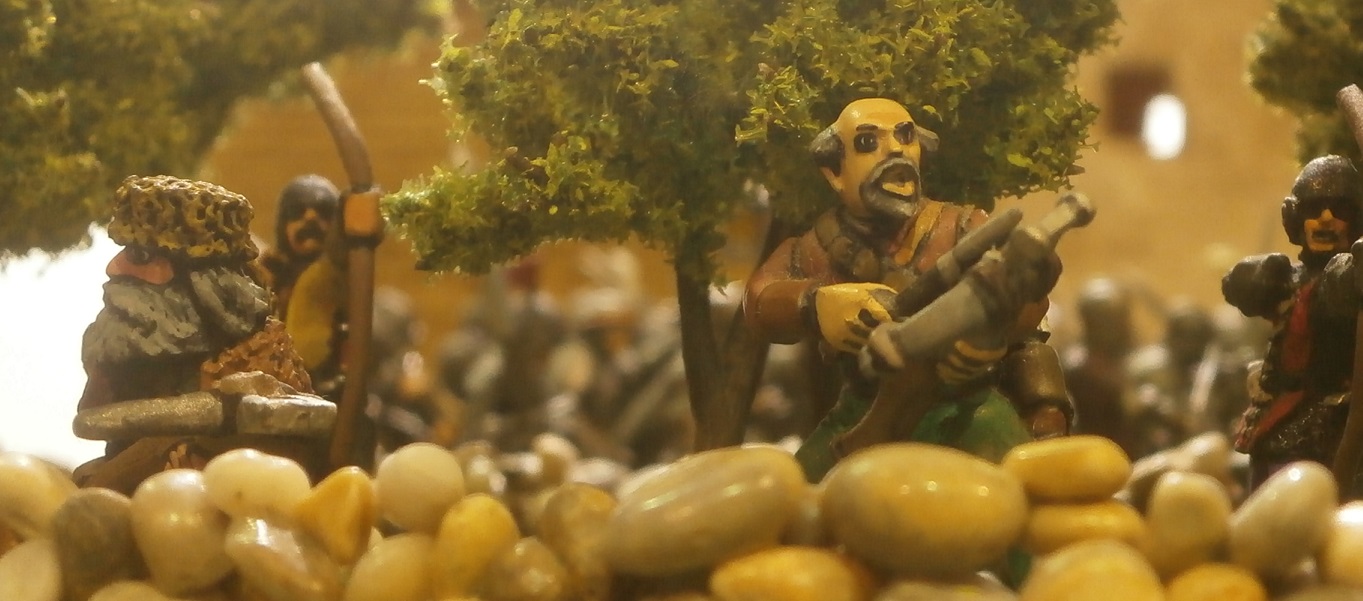
Arcabar nodded and lifted his staff to signal to Vedus further down the line, advancing with the pikemen.

Vedus did not really need the encouragement, for they had been the target of his last spell. Forcing himself to ignore the blaring horn being sounded beside him, he fixed his eyes on the archers and once again began an incantation.
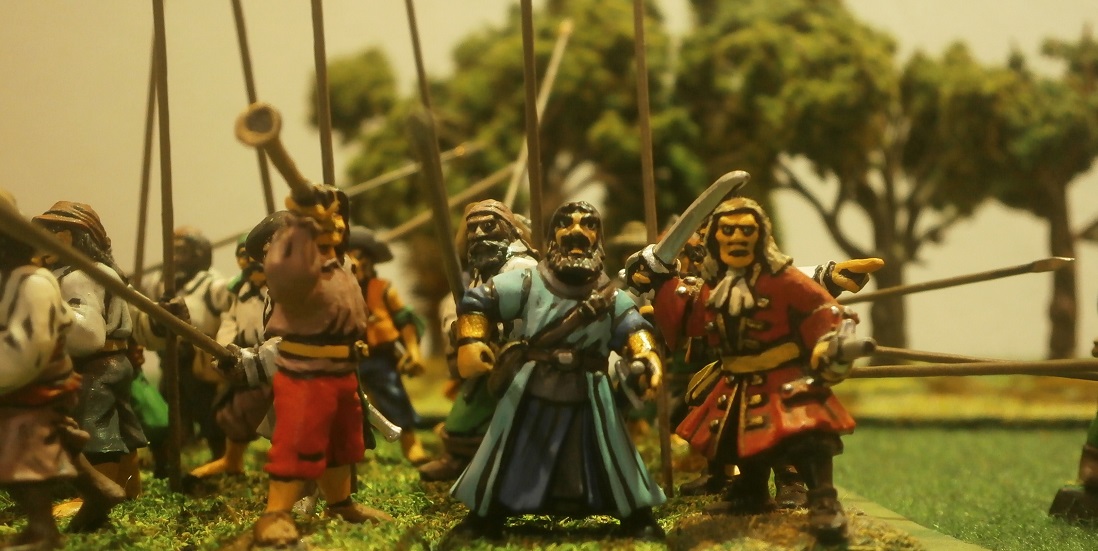
This time twice as many flaming orbs coalesced from the ether, already in motion as they rent their way into the material realm to course at speed towards the trees, trailing blue sparks. Upon hitting the branches, they spewed sheets of fizzling flames which rained down on the men cowering behind the stone wall below, incapacitating half a dozen and causing the remaining handful to leap, smoking and screaming, over the rear wall and through the men at arms on the other side. They only stopped when they reached the building over the street.
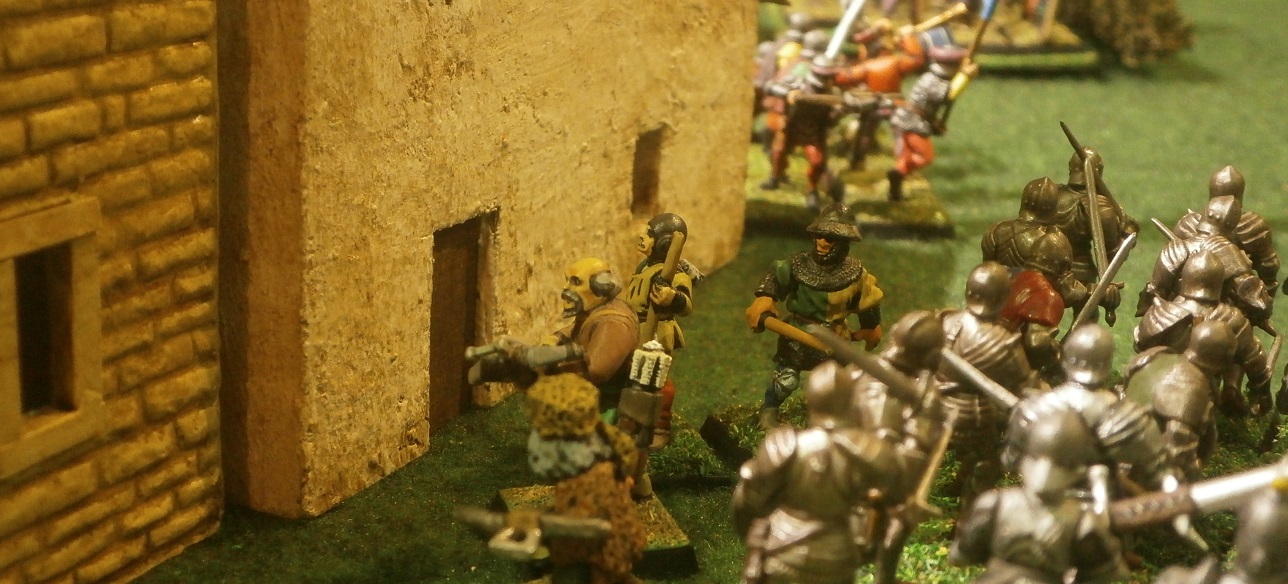
(Game Note: The men at arms, having no character to lead them, were in danger of fleeing too. But they rolled snake eyes for their Panic test!)
As he squinted to look through the smoke and ascertain how well he had done, Vedus suddenly noticed a coiling eddy of excess magical energy coalescing above him, at the very spot where the fireballs had crossed the seam dividing the realms. He had badly misjudged the etheric force drawn into his spell and clearly failed to control even half of it. His squint turned into a wince, less than a second before the broiling energy folded itself inside out to explode with an exponentially magnified power (and yet no sound at all). The blast sucked the very air from his lungs and he struggled to stay upon his feet. When he finally managed to draw a choking breath, his throat blazed with pain at the heat of it. Opening the one eye he could, he saw that many more than half the men he had been marching with had fallen to the ground, lifeless or senseless, while those few still on their feet, like himself, reeled and wheezed in shock.
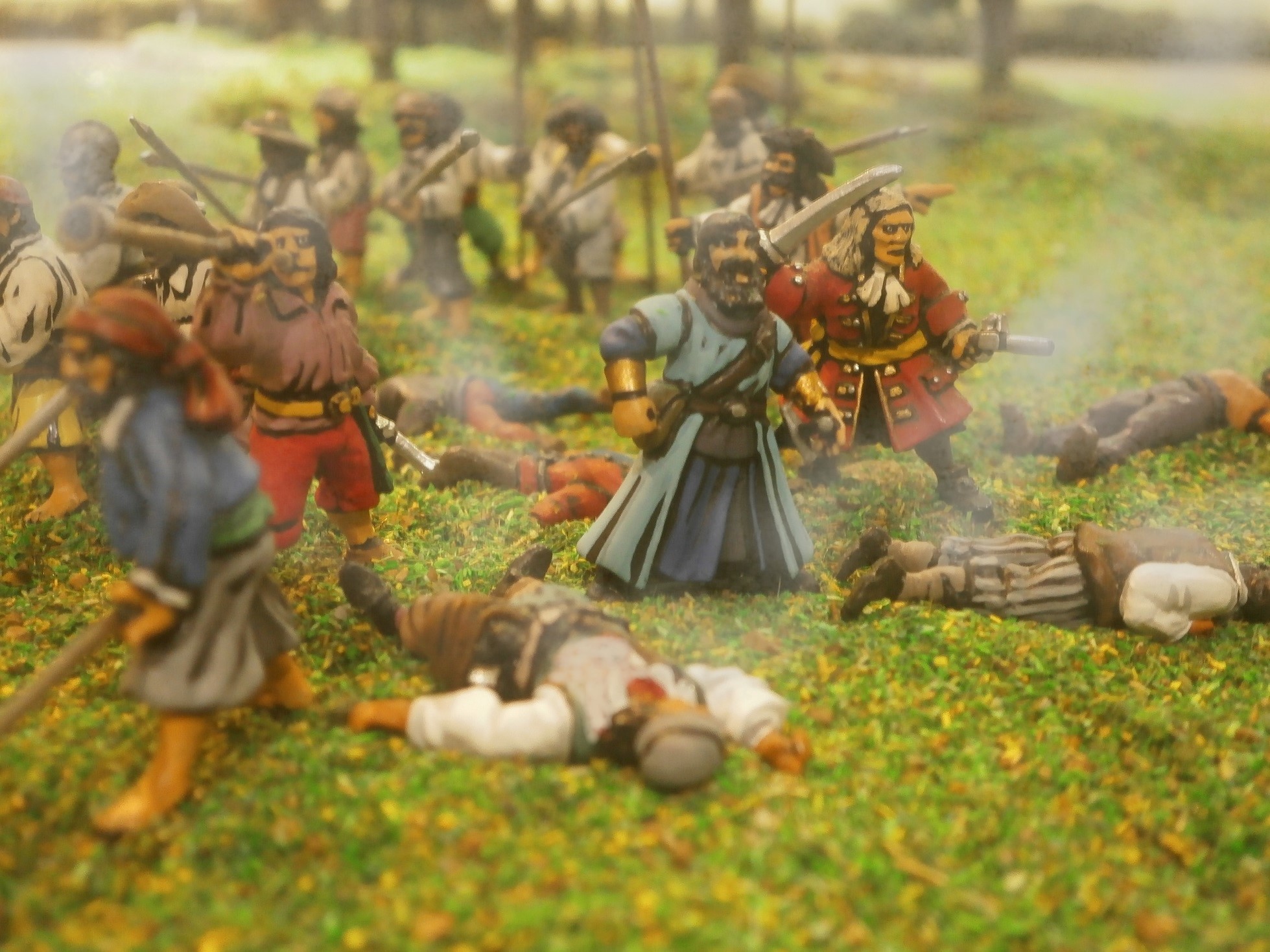
(Game note, a miscast roll of 4, Dimensional Cascade, killed 15 pikemen! Remaining casting dice lost.)
The blast’s soundlessness meant that Volker noticed the horror on Arcabar’s face before he spotted the confusion amongst the pike. Upon first glance, other than the smoke that had coalesced about them, which he presumed was from one of the guns nearby, it appeared that the company had stumbled into a patch of potholes and so taken a tumble. For a moment he entertained the thought that the enemy might have dug pit-traps around the village, but then the look on Arcabar’s face made it obvious that something much more serious had happened. When Arcabar spat out the words ‘Vedus, you Fool!’, Volker knew the other wizard was somehow to blame.
First the cannon, now Vedus. It seemed neither powder nor magic were to be relied on today! Yet the next few moments suggested that powder, with which his army was plentifully supplied, could still contribute to their success. First, an iron roundshot punched through the hedge before enemy’s gun to smash into the gun itself, disabling it and badly wounding its crew. Then the surviving four handgunners out by the river, their comrades lying dead or dying around them …

… fired their pieces to throw three more pistoliers from their saddles. The horsemen turned quickly around to gallop away somewhat quicker than they had come. Not quick enough to outrun the shots of the swivel gunner’s in the trees, though.
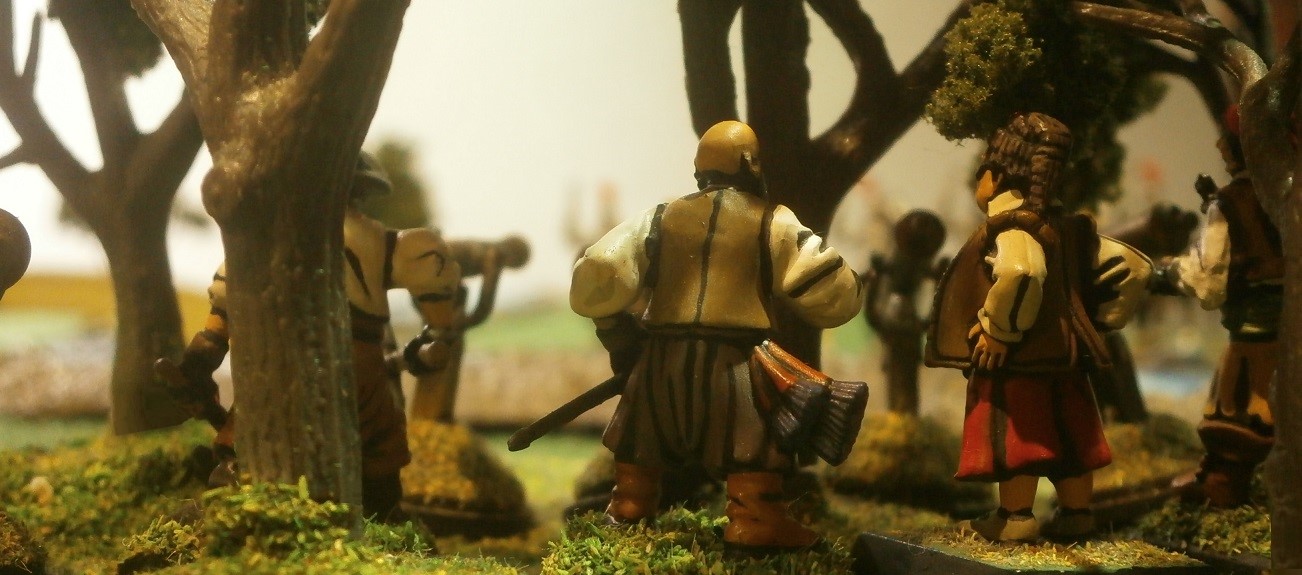
Not wanting to miss out on the sport, the swivels also fired and another three horsemen died. This only hastened the few surviving pistoliers’ frantic retreat!

The swivel gunners now found themselves somewhat at a loss, for with the only enemy they could see galloping away, it seemed there might be little else for them to do.
“Wait” shouted one of them in jest towards the last of pistoliers. “Come back! We’ve still got powder!”
The cannon on the Sartosans’ right fired chainshot into the halberdiers in the village, tearing three of them in half! Fearing that sergeant Ivo’s recently rallied crossbowmen might once again falter at the sight (and sound) of this, Father Vettorio now ran ahead to join them at the barricade.
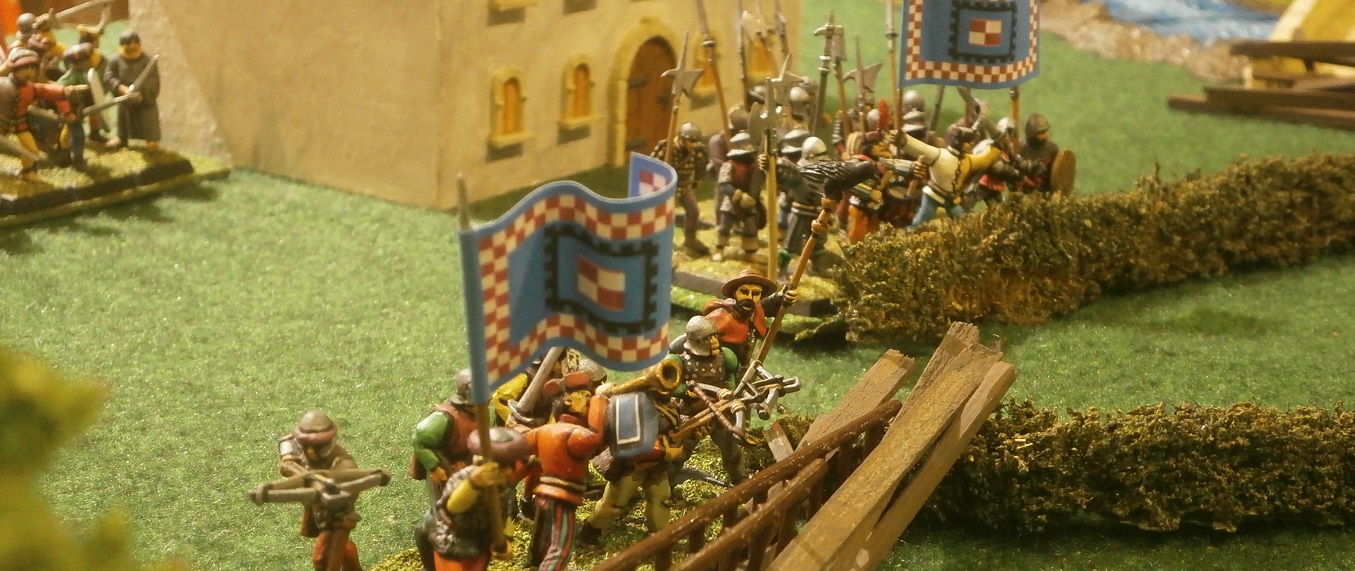
There he prayed that Morr would curse the wizard in white, and indeed could sense his god’s will manifesting though him, but this momentary hope was dashed as the enemy’s countermagic proved too strong. Disheartened he found himself surprised by the sudden snaps of the crossbows as they brought down four of the goblins now charging at him. There were so many goblins, though, that it was doubtful the rest had even noticed, and the next moment Vettorio found himself suddenly close to the greenskin mob!

Volker had begun to order his own regiment to charge the crossbows, but had faltered as Farq’s mob hurtled by, blocking the way. When he spied the four trampled goblins left in their wake, quarrels piercing their corpses, he found it quite easy to console himself at the lost opportunity. Better them than my boys, he thought. Still, knowing the goblins, his boys might yet have to do the real work. Farq’s boast of the previous night, that he and his lads would get ‘stuck in’ first, might well have proved true, but that did not mean they would stay stuck in!
Arcabar, having apparently spotted the damage done to the halberdiers by the chain shot, was obviously intent on seeing what he could do to further their misery. He conjured up a shower of burning blue bolts to equal the cannon’s tally. The halberdiers, however, were apparently made of strong stuff, for they took this as they had taken the chainshot and stood their ground.
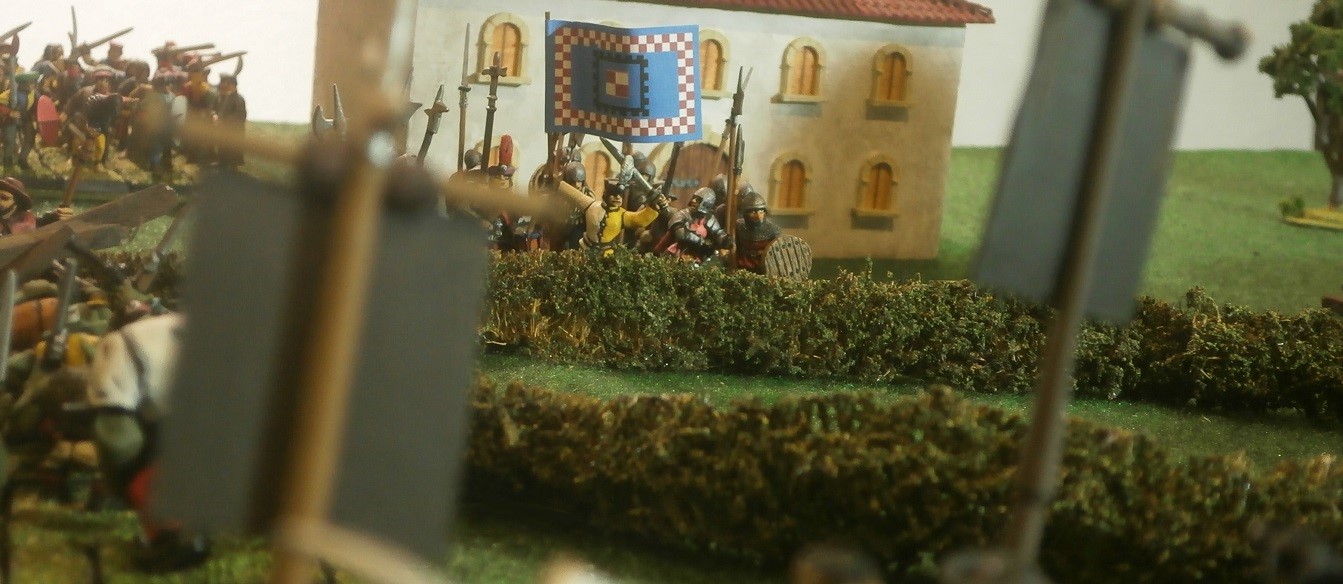
Vedus and his shattered pikemen were now very close to the men at arms, but their will had been sapped and they came to a halt. Right now, the prospect of ditching their pikes to cross two stone walls and assail the armoured professionals massed on the other side, seemed insane. Apparently, the men at arms understood the pike were no longer a threat, for not a one of them even glanced at Vedus and his comrades, intent instead on watching the crossbow fight against the goblins up ahead.
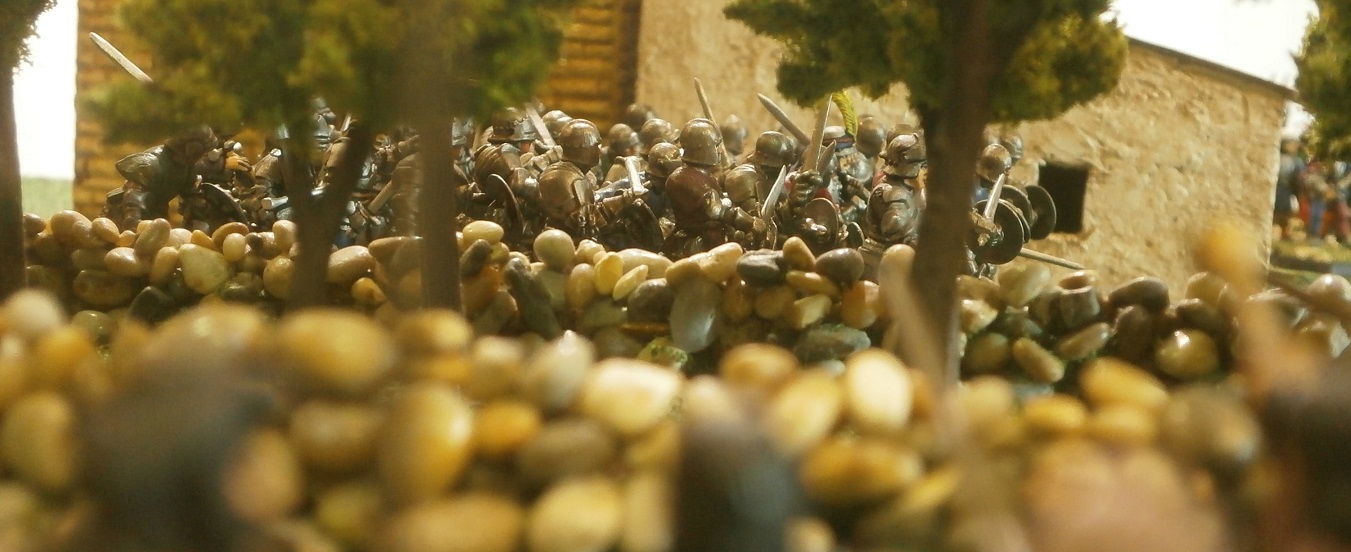
One of the pikemen was shouting something about going around the orchard, but what with the resumption of the horn’s incessant blaring and the continued confusion of his thoughts since his dreadful miscasting, Vedus failed to respond either by word or deed!

(Game Note: I know, I know, Jamie, you chose not to charge the pike attack simply because you believed they would fail and so pointlessly endanger your wizard, which is no good thing in a campaign game. That wizard might be needed for moving on to capture the city, where the real loot lay. But when a picture comes out like that, and after what the wounded wizard had been through, this ‘spun’ version of events seems utterly undeniable! Look at the guy shouting and pointing!)
While the handgunners and swivels fired yet more bullets at the broken pistoliers, killing all but one, and the two remaining pieces of ordnance shot chain to fell a handful of halberdiers as well as some of the men at arms, Captain Farq and his horde fought the crossbowmen at the barricade.
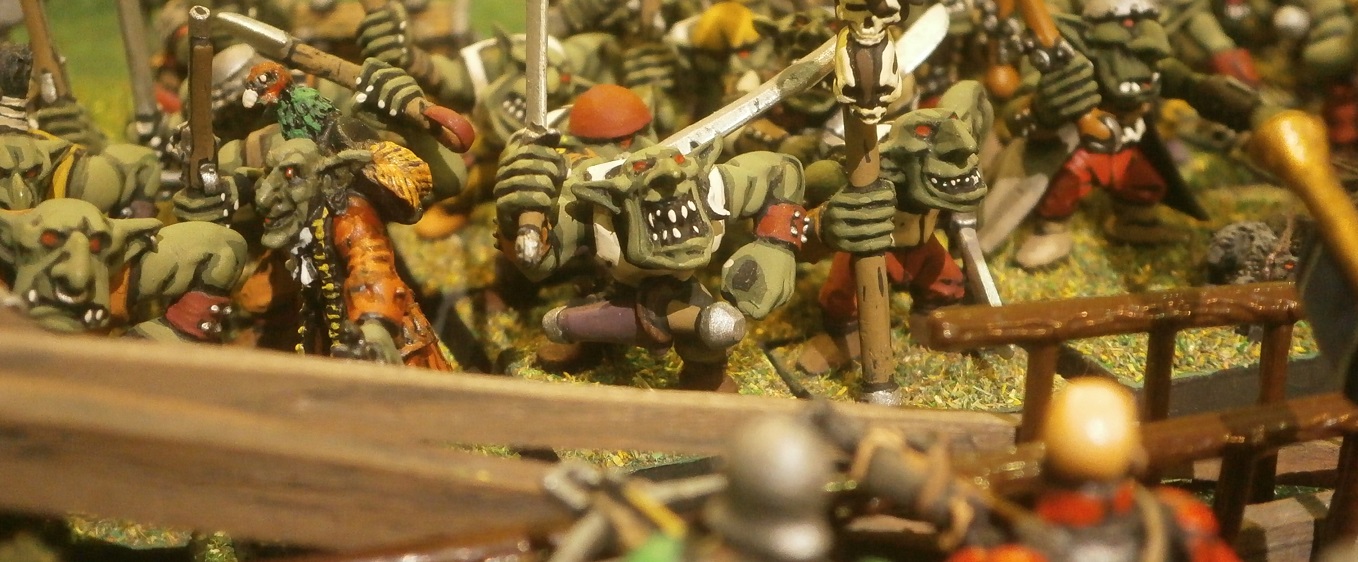
Several goblins died as their shoddily maintained pistols blew apart, while Bagnam Farq himself malingered in the second rank trying to look busy without committing himself to any real fighting.
(Game Note: The campaign list rules re: ‘Robbed Pistols’ and Farq’s ‘goblin merchant boss’ rule ‘Not the Bravest of Sorts’ came into play here. These guys truly are nearly all bluff and bluster!)
It was a bitter fight, and despite the fact that the casualties were pretty much even, the weight of numbers was on the goblins’ side.

Father Vettorio and the crossbowmen, no longer numerous enough to defend every part of the barricade, broke, to be cut down almost immediately by their whooping and baying foe. The sheer press of their numbers meant the goblins burst right over the barricade and, within a moment, had slammed into Captain Hector Perdigon’s men at arms, who were calmly awaiting their arrival.

(Game note: You can probably see from the penultimate picture above that the goblins pursuit carried them into the three leftmost men at arms. More than a mere clipping. As per the rules, or certainly as we have always played them, we then maximized the number fighting on both sides and thus the full-on clash of the last picture.)
Half way through Turn 3!
…………
The Fight at Sersale, Part 3
Turns 3.5 – 6
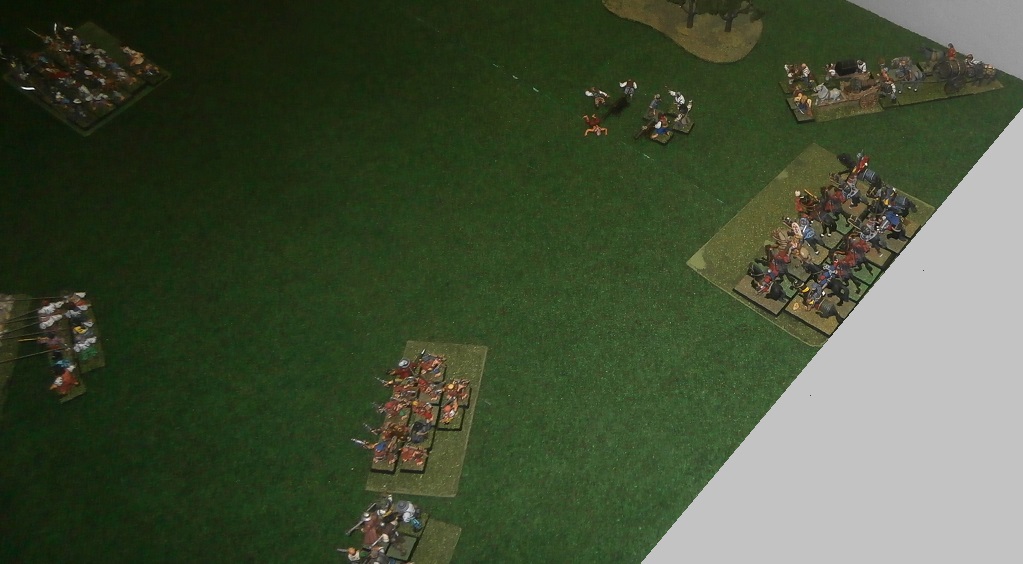
Although it was some time before he would know it, Volker’s earlier musings concerning the possibility of some sort of relief force proved to be correct. A company of light horse, the Black Gulf Road Wardens, a band of mostly Arabyan mercenaries who patrolled the VMC’s protectorate realm, now galloped onto the field of battle close to the Sartosans’ baggage and their left-most piece of ordnance. The admiral did not think there were enough of them to swing the advantage of numbers, nor realistically to increase the Alcentian’s chances of victory, but their presence near the gun, and especially the baggage, was a worrying development.
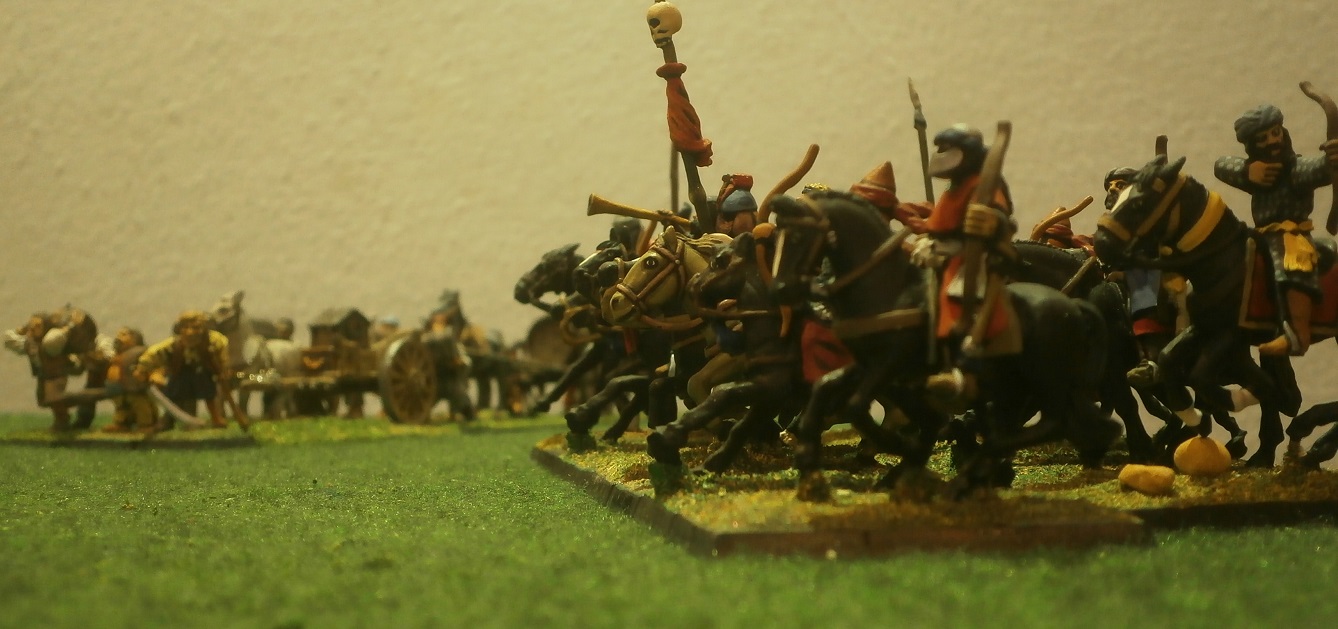
Certainly, the gunners and those men tasked with guarding the baggage were alarmed. The first made extra haste in the reloading of their piece with chain-shot, while the second commenced a heated debate concerning whether they should form a body to fight or hide amongst the baggage to better their chances against arrows.

The loudest was shouting that the enemy must have intended this all the time, and that the village’s defence was a merely ruse to draw the army into a fight while the baggage was taken. Louder still was the answer from an old, one-legged seadog,
“Aye, I reckon you’re right. Now shut up and help us do something about it!”
Being near the village and in the front rank of his marching crewmen, Volker’s attention was held by what was going on ahead of him. Farq’s goblins had already poured over the defences, hacking down the last of the crossbowmen to crash pell-mell into the armoured men at arms awaiting beyond. They would have their work cut out for them, thought Volker, as the enemy they now faced were clearly not militia, but professional mercenaries, and carapaced in steel.

The goblins might just find their rust-ridden, ill-sharpened blades would struggle to penetrate such armour. Still, Volker thought, if Farq can hold the enemy back just long enough, he and his own lads could get at the swordsmen nearby. Suddenly, as he belatedly realised they were bound to do, the swordsmen charged into Farq’s flank.
Now it would take divine help for Farq’s scurvied scallywags to stand their ground for more than a moment or two.
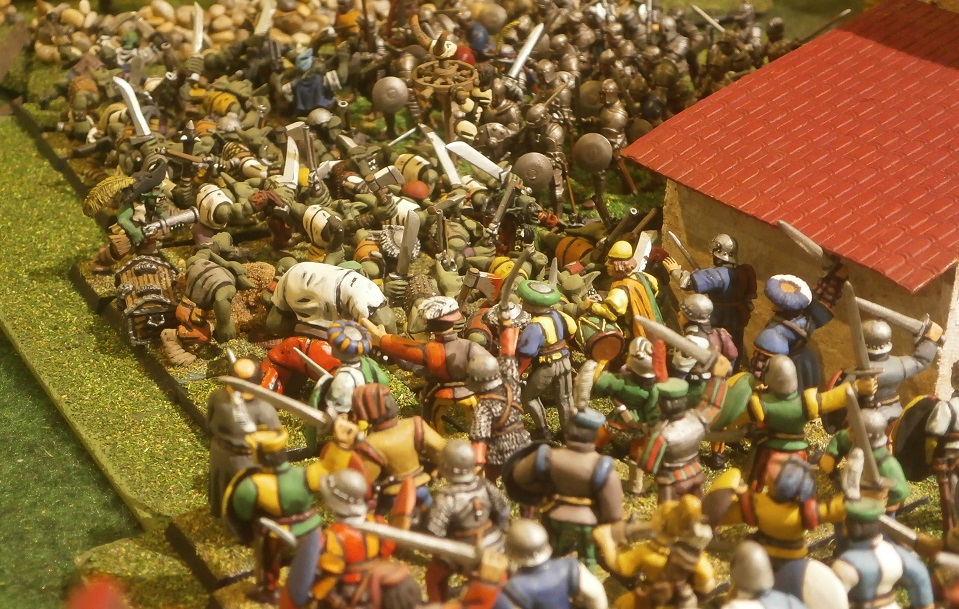
The remnant of the pike body to Volker’s left were clearly no longer in a fit state to assist anyone effectively, and even if the goblins held long enough for his own men to join the fight by charging the swordsmen, that would give the enemy halberdiers an opportunity to charge into his flank! The result would be utter mayhem, and, perhaps, exactly what the defenders had been planning all along.
He needed a moment to think.
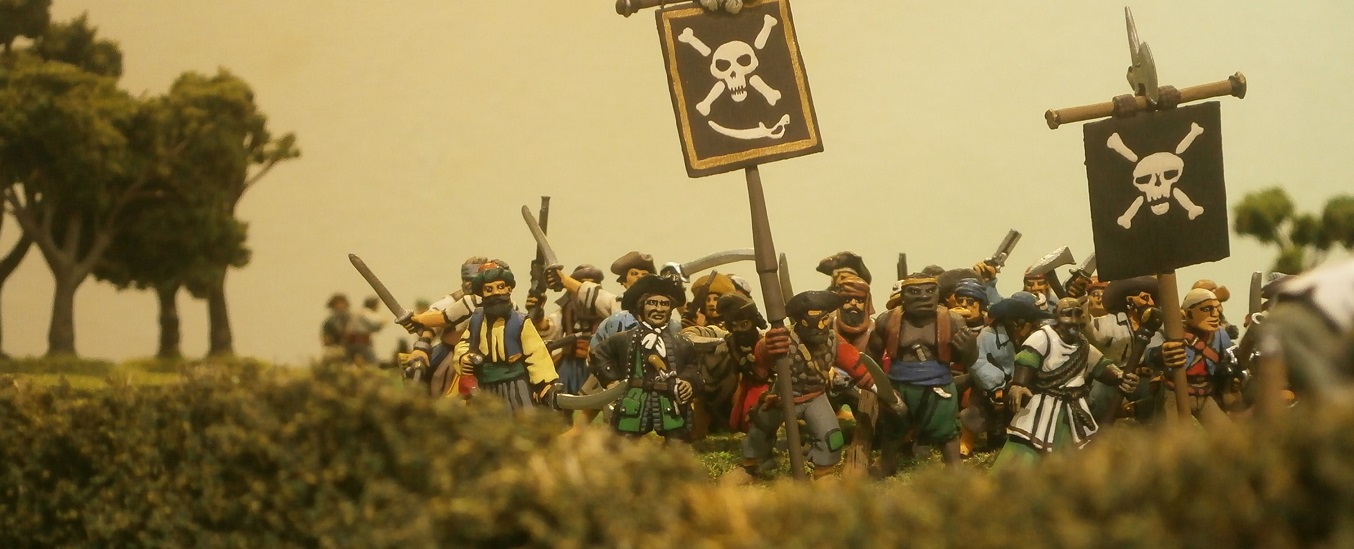
So he took that moment, while his lads watched the goblins’ fate with sick fascination.
Game Note: My campaign players are each effectively roleplaying just one character. If they die, they are out of the campaign, until we can work out who they can be and how to get them back in! Establishing their new character can be a long, hard struggle. Jamie is Admiral Volker, and commander of the Sartosans. He was once Razger Boulderguts the ogre tyrant, who left Tilea with a huge haul of loot after his chevauchee. Being a pirate is not so different to being an ogre, as he is after loot yet again. But, he has to stay be alive to enjoy it!
As the butchery began in the village, with nearly four times as many goblins falling as men, the horse archers in the rear loosed a flight of arrows at the gunners, killing one, even as the gunners hauled the piece about to face them.

Staring down the muzzle, more than one of the riders felt their stomachs knot in fear as they reached for a second arrow – they knew the gun would fire before they could shoot again.
With eleven goblins killed, and large enemy bodies assailing from two sides …

… Farq and his boys did what everyone knew they did well. They ran away. The men at arms stood their ground, but the militia swordsmen, rage momentarily getting the better of them, pushed forwards a good few steps before their captain could halt them.
The goblins hurtled through the enclosure towards Captain Garique’s handgunners, leaving an only slightly disrupted enemy line behind them.

Farq later swore that Captain Garique’s lads presented their pieces at his goblins, to which the captain answered that no such thought ever crossed his mind. Only those involved knew the truth of it, and they stuck to their stories. For whatever reason, the goblins halted and reformed to face the enemy. The consensus amongst the rest of the army was that it would have taken just such an event to stop the goblins’ flight. Farq himself claimed that he when he heard Volker’s command, he simply and obediently did what he was told. Those who heard his words had to stifle their laughs.
Volker had decided the enemy needed a touch more softening up before he committed his own boys to the fight, and so, while the blunderbusses and dwarfs continued their long march towards the orchard on the flank, he ordered his own men to move a little to the right, clearing a line of fire for the gun behind.

Vedus now headed off alone towards the horsemen. The pikemen were only too glad to see him leave. He could have commanded them to accompany him, so not to expose himself to too much to harm, but in light of his previous, dreadful mishandling of the etheric winds, he decided he had put them through quite enough and ought not endanger them anymore. It also meant he could be less concerned about any spellcasting missteps.

Fixing his eyes, indeed his whole mind, upon the riders, and happy to see they had yet to get too close to the baggage or the gun, he nervously wove what little magical breeze was available to generate and loose a flurry of fireballs.

Three horses and their riders perished in the conjured conflagration, while the rest were singed by the heat. Yet they neither faltered nor fled.
He cursed, silently, for it had seemed to him that he had missed his chance at redemption. Then watched as a fourth rider crumpled to the ground, both horse and man horribly torn by the chain-shot fired by the cannon before them. Yet the riders still did not flee! Vedus cursed once more, for as they spurred their horses and began to level their spears, he knew they were not going to try archery again. He could see from the surviving gunners’ wide eyes that they too had the measure of what was coming their way!
The other gun, a way cleared before it to reveal the recently victorious men at arms …
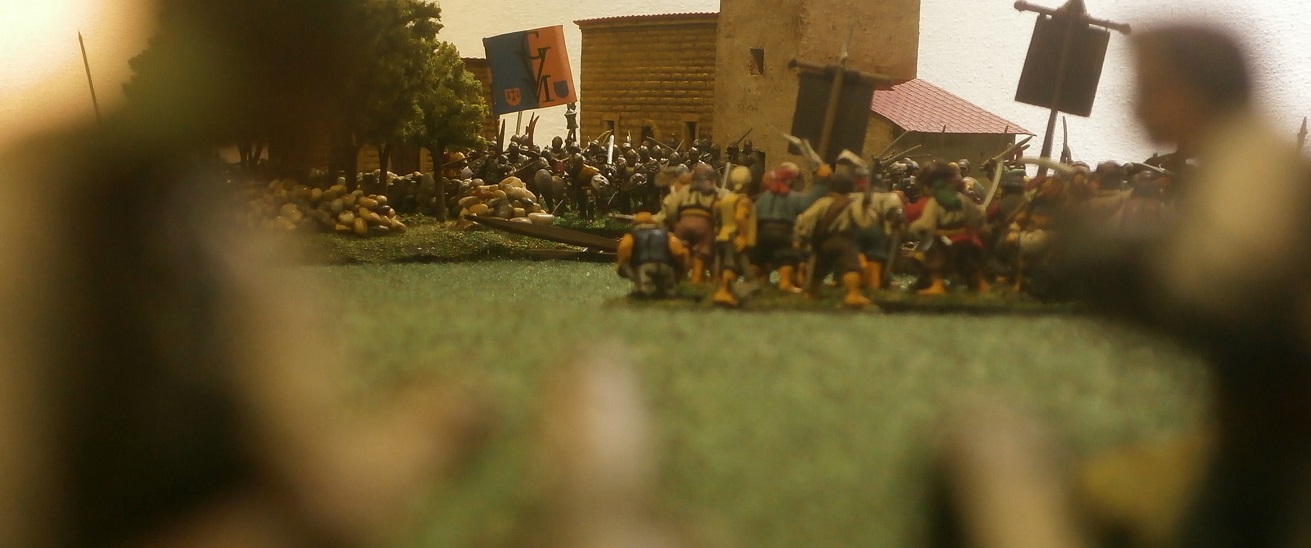
… now blasted chain-shot. Armour proved insufficient against such a missile, and five of the mercenaries perished most bloodily. Rather than panic them, the event seemed merely to act as some sort of sign. In surprisingly good order, they moved into the building behind them. Volker assumed at first that they were seeking somewhere to shelter, but then changed his mind for their calmness made that seem unlikely. They moved with precision, entirely unlike hard-pressed, panicked fellows looking for somewhere to hide. What new trickery was this?
His line of thought was broken, however, as the swordsmen charged Farq’s mob yet again. After a brief but messy fight, in which the goblins hurriedly fired a counter-shot and their famous ineptness with powder killed two of their own to add to those cut down by the foe, Farq and his boys broke and fled right through Garique’s handgunners – this time failing to notice whether any muzzles pointed their way!
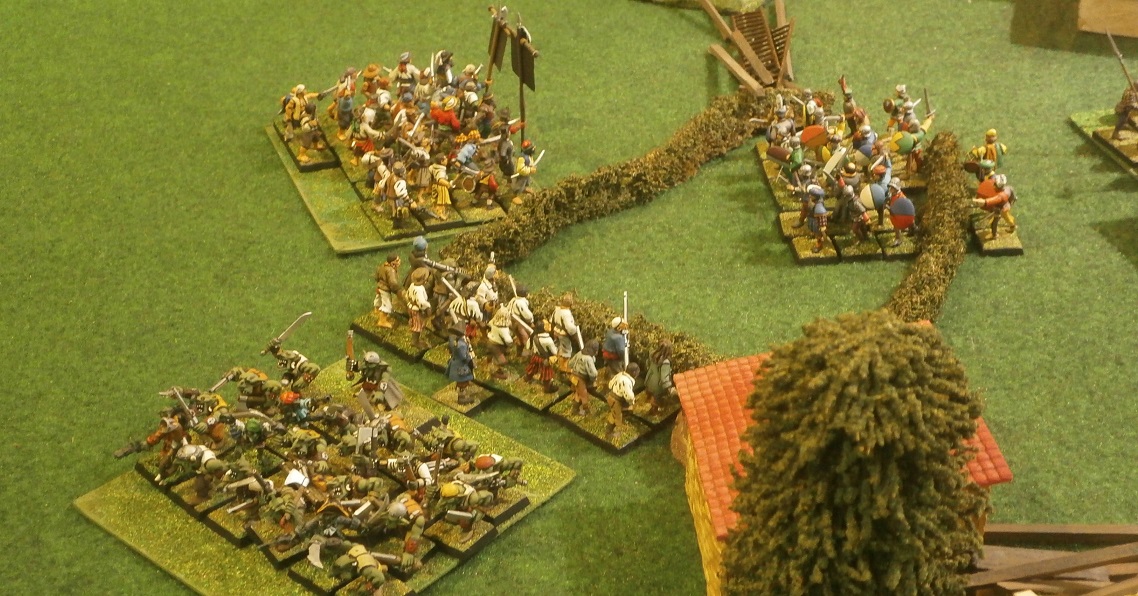
This left the swordsmen somewhat exposed, especially as the halberdiers had about faced like the men at arms and were now marching off towards the city. That settled it for Volker – he knew what the enemy had surely intended all the time. The enemy had never expected to win, but wanted only to delay and wound him, before returning to the city to man the walls, where they would face his now weakened army, perhaps bolstered by a relief force gifted just enough time to arrive?

If he had known what was happening to the rear, it would only have further proved his theory, for the horsemen cut down the gun’s remaining crew, then several of them dismounted to work out how they might disable the gun permanently. They knew a spike would be only temporary, for it could be drilled out, and so now argued whether to attempt to drag the gun away or blow it up with its own powder.
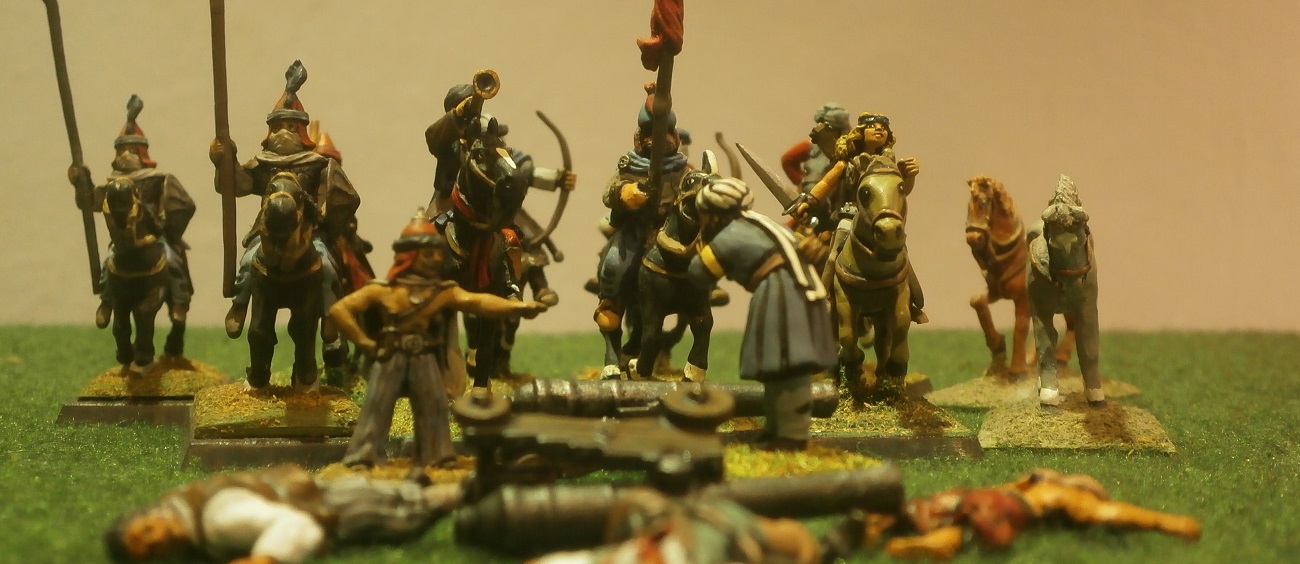
The baggage close by, heavily weighted with loot, seemed of no interest to them. They were surely operating under orders, as part of some desperate strategy and only interested in either disabling or stealing the gun.
(Game Note: My players and I have had to come up with some campaign house-rules to cover the ‘recovery’ of cannons that have not exploded but just lost their crew. It is easy enough for the BRB to say the crew models indicate the remaining number of wounds, but when it comes to campaign casualty recovery, more thought is required!)
As Farq once again managed to halt his goblins, this time from a position of safety in the rear of the fighting line, Volker gave a simple command,
“Have at them!”
And led his crews over the hedge into the swordsmen.

The fight was brutal, just as Volker knew it would be. His men might not have armour and shields, but they were festooned with blades and pistols, which he and van Baas were famously skilled in the use of . Arcabar the wizard cast the spell Flaming Sword to further improve the Sartosan’s deadliness, just before he himself was wounded. Several of the enemy had gone for him in particular, at the cost of letting down their guard to the other pirates. Here too was a sign that they were acting on orders to weaken Volker’s army – to kill wizards and disable guns – not to save the village.
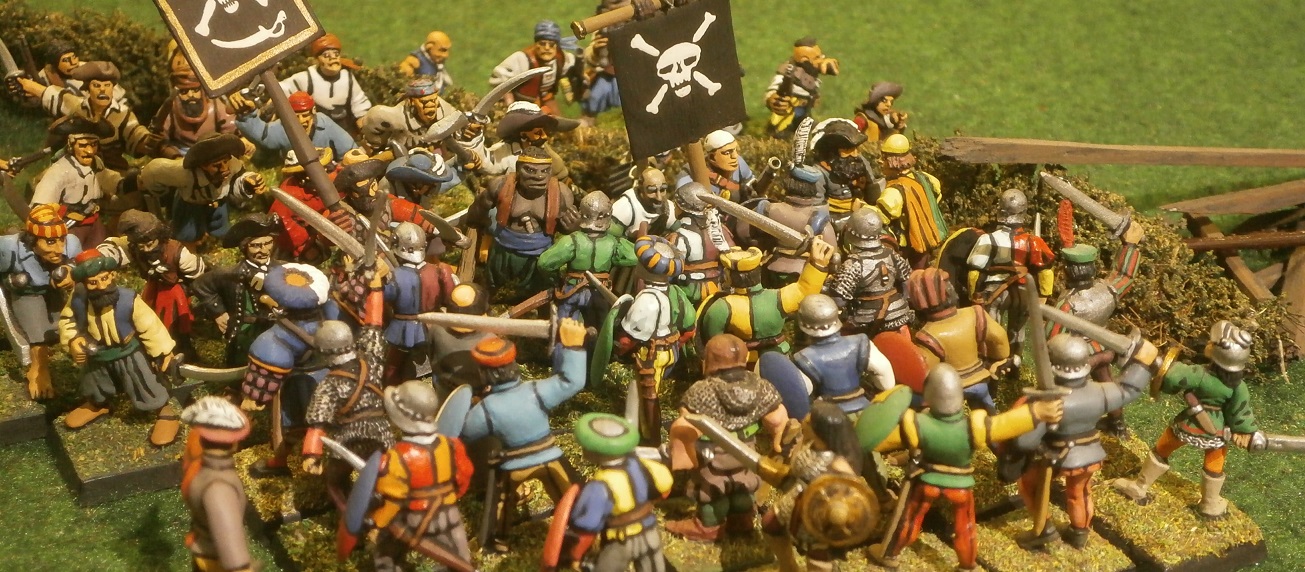
Arcabar’s pain meant he failed to notice a sudden flare in the etheric breeze. Vedus, his apprentice, had summoned up fireballs to fell another pair of horsemen, but yet again, perhaps catalysed by the continued discombobulation of his mind caused by his previous failure, he had lost control of the conjuration and the energies he had failed to bind now seared his mind.
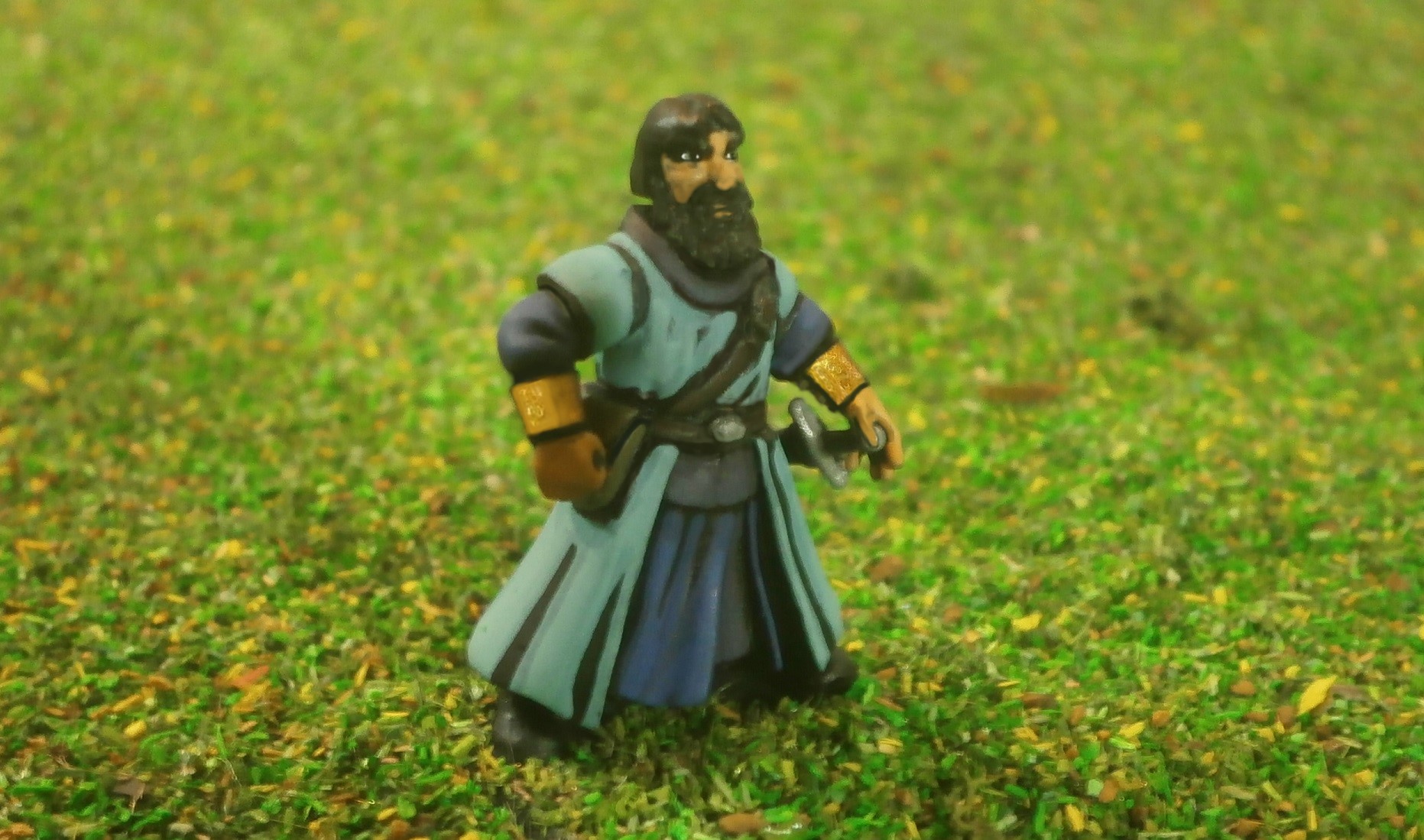
Staggering dizzily, he clutched at his temples, temporarily robbed of his senses. Moments later, as the sights and sounds of his surroundings began to reappear, he knew something was badly wrong. And part of what was wrong was that for some time he could not for the life of him work out what it was.
(Game Note: Another Miscast, ‘Power Drain’. He lost two levels and all his spells, now becoming level zero. You might have guessed this was coming, but my players and I have now had to come up with some campaign house-rules concerning the ‘recovery’ of wizard’s magic levels. It is easy enough for the BRB to say the wizard’s level is ‘permanently’ reduced, but that is in terms of the tabletop game, one battle, not an ongoing campaign. Some considerable debate ensued, and I had to do a bit of haggling. I try not to be a tyrannical GM!)
Indeed, so befuddled were Vedus’ wits in that moment, that he failed to notice that the last surviving gun and the swivels in the central trees (the latter yet to contribute to the battle at all) between them now killed four more of the riders. The last survivors, spattered by the blood of their dead and dying comrades and their horses, abandoned their struggling effort to drag the gun away, quickly spiked it instead and fled the field. They would not stop galloping until they reached the city walls, only too happy to put the fires and bullets ever further behind them!
At the little enclosure before the village, a queue was forming. The Sartosans were stacking up in a column with the goblins at the rear and Volker’s men at the front.

The main body of Sartosans had cut down a veritable swathe of the swordsmen. Unsurprisingly, the Alcentians turned and fled, running right through the halberdiers behind.

But even this did not break the defenders’ will, as the halberdiers reformed to face the foe, as did the swordsmen to their rear!

Another jump been made in this deadly game of leapfrog, with more surely yet to come. Volker knew exactly what the enemy were up to. Each time he assaulted them, his wizard Arcabar was carried into the fray. If the Sartosans halted to allow the wizard to leave, then the enemy would do the charging.

Volker had not expected such bravery and stubbornness. And Arcabar had not expected to be wounded in the melee.
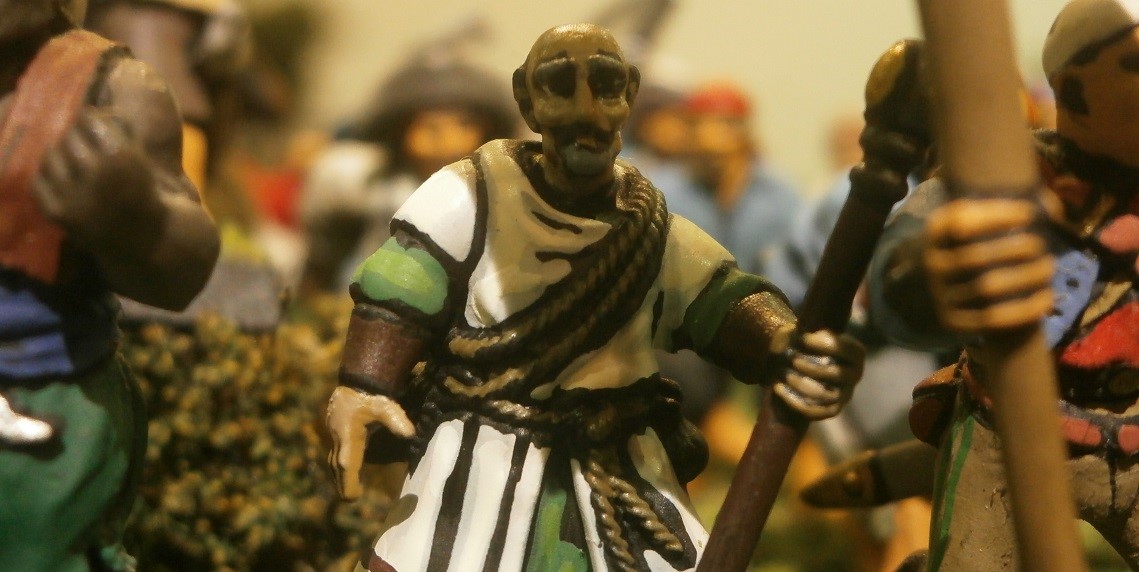
(Vedus, on the other hand, had forgotten what he had expected, along with pretty much all that he had done that day. It would take him some time to realise he had forgotten all his incantations too!)
So it was, as the sky began to darken, that Volker and his men had to fight and break the halberdiers, then fight the swordsmen yet again!

The day was won, bar the last bout of fighting. None of the swordsmen would ever leave Sersale. Volker learned later that it was their village, and thus, unlike the rest of their force, they had never intended to leave.
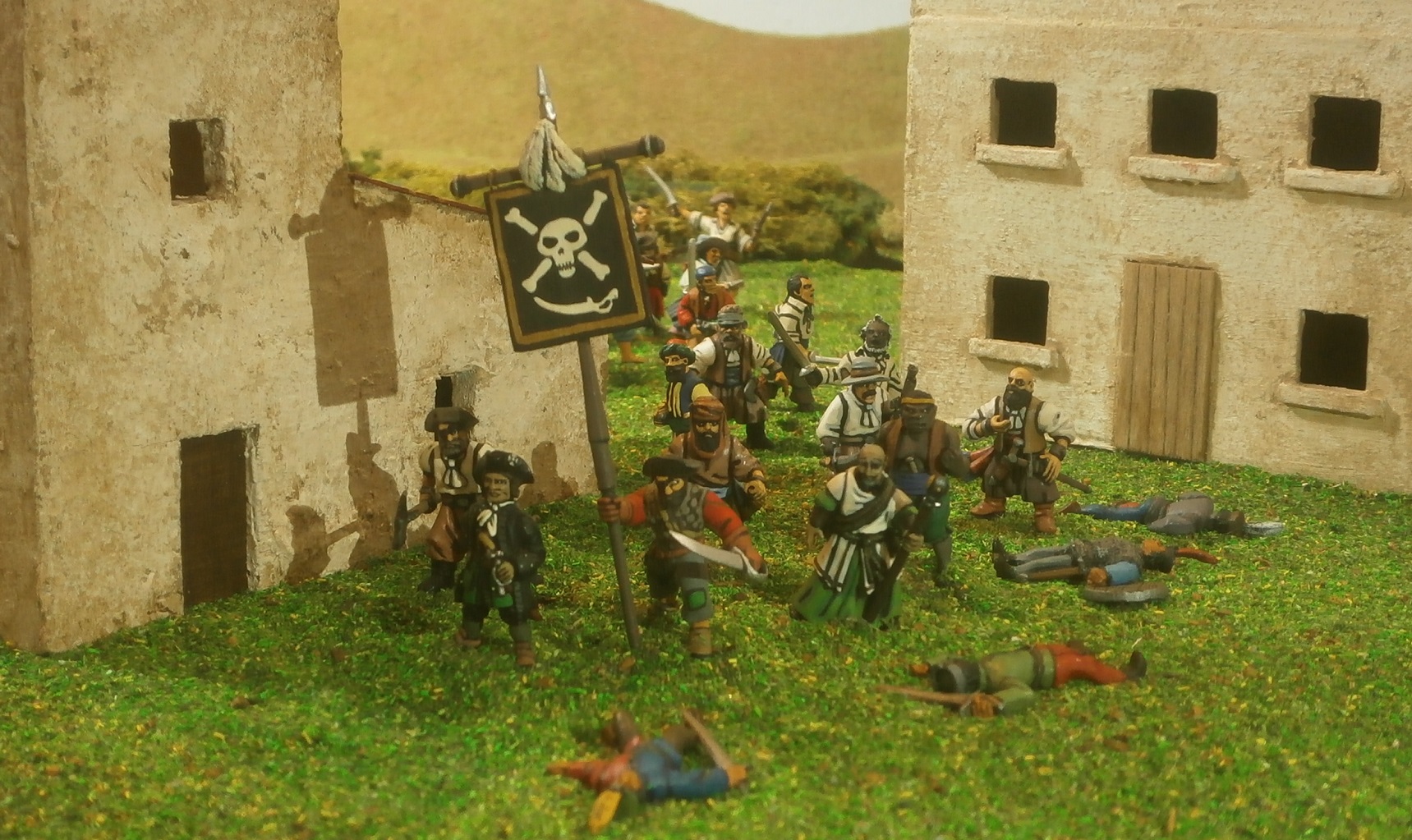
At what cost, though, this victory? Volker asked himself. The city lay before him, but it would be defended, and not only by the men at arms who so cleverly snuck away, but by whatever other forces had been obtained or raised while the battle here was fought. He had begun the day with three pieces of ordnance. Now he had only one that he could rely on. Two wizards had marched here with his army. Now one of them was a mere shell of a man, emptied of all magical powers. His mauled regiments were mostly intact, especially as his barber surgeons could now tend the wounded, but he was far from home and there would be no reinforcements for him before he attacked the city.
Meanwhile the Alcentians not only could recruit and hire from the eastern parts of their realm, or the city itself, but even by way of the sea, for lack of manpower meant Volker’s fleet was unable to blockade the city. (His ships had only skeleton crews, as most of his mariners were here with him.)
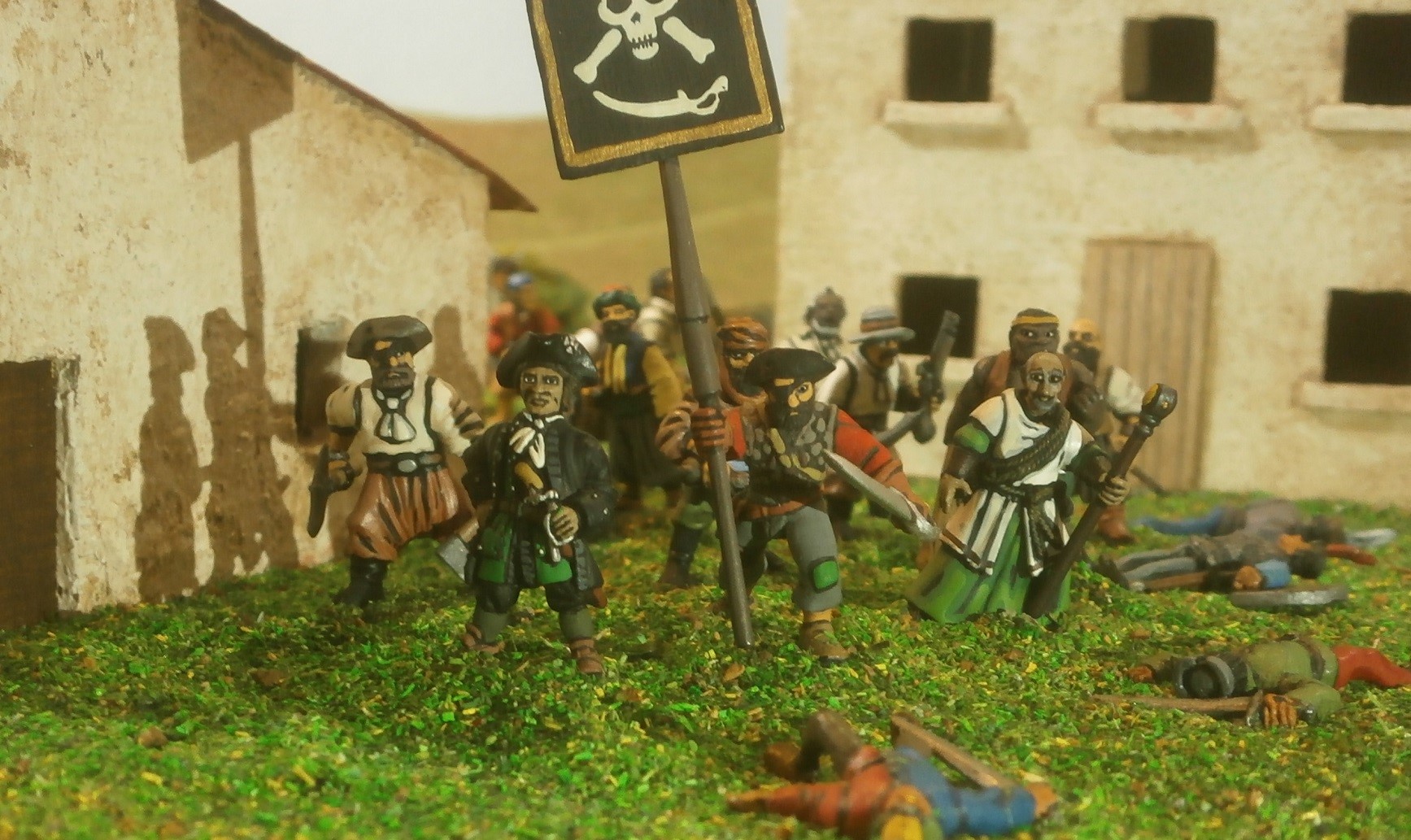
All this fighting, and he had yet to face the VMC’s actual army! Of course, the army’s absence was the very reason he had come, but he had now been in the realm of Alcente so long that it could, conceivably, arrive any day. The reports all claimed the army was far to the north, but reports could be wrong.

Perhaps, even with a famously rich city so close, it was time take what he had, plus whatever his lads could loot from Sersale, and return to Sartosa? Surely what they had already taken was enough to sate his army?
He had some thinking to do.
…
Thank you Jamie and David for your patience during this week-long pay by e-mail battle. Now I have the last campaign map moves etc of the season to make, and 6 long (private) reports to write!
Next Installment: Part 35

 BigSmallWorlds
One thought on “Tilea Campaign, Part 34”