Trappings (Prequel to The Battle for Eclano)
Scalea, in the realm of Portomaggiore. Late Autumn, IC 2404
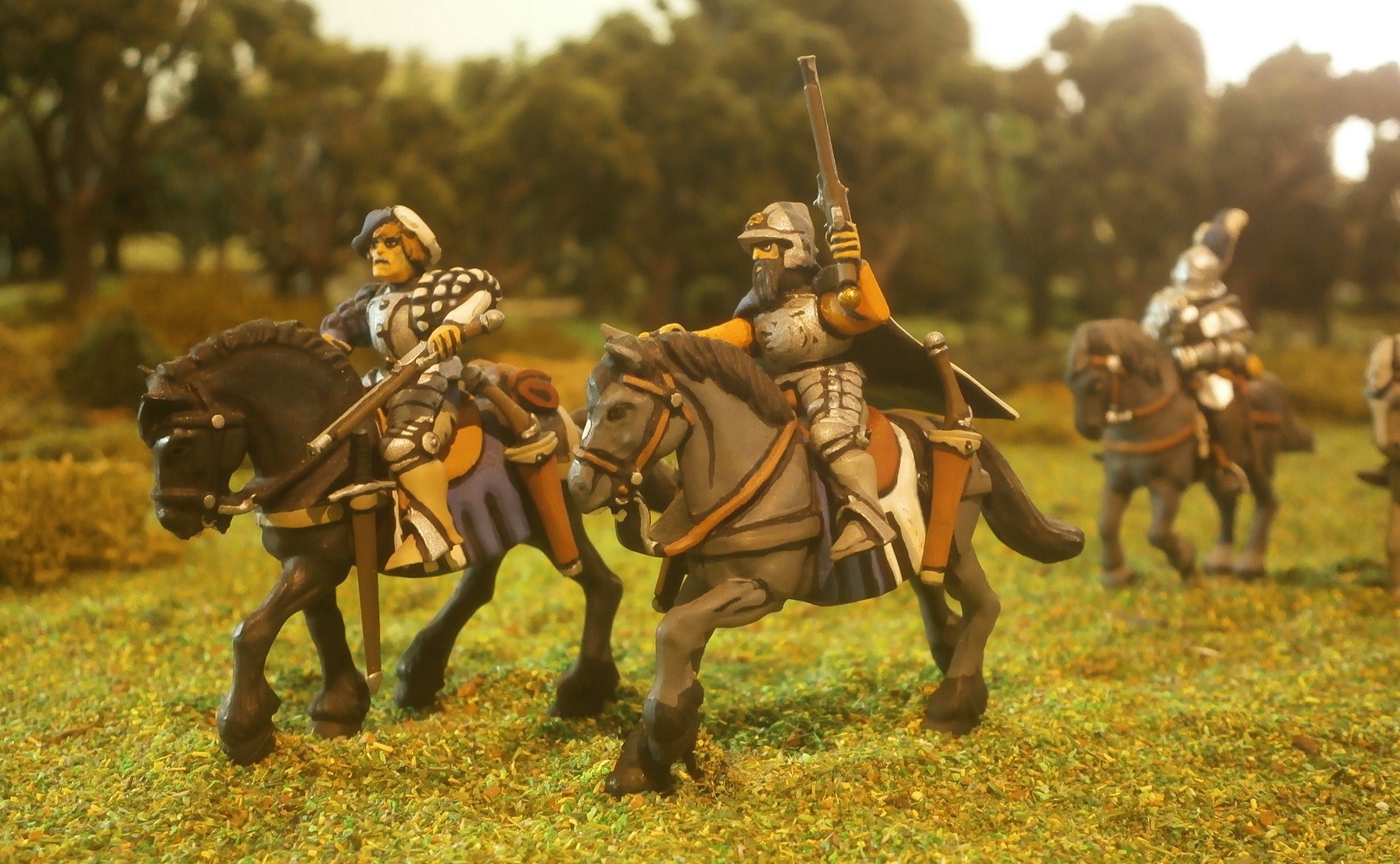
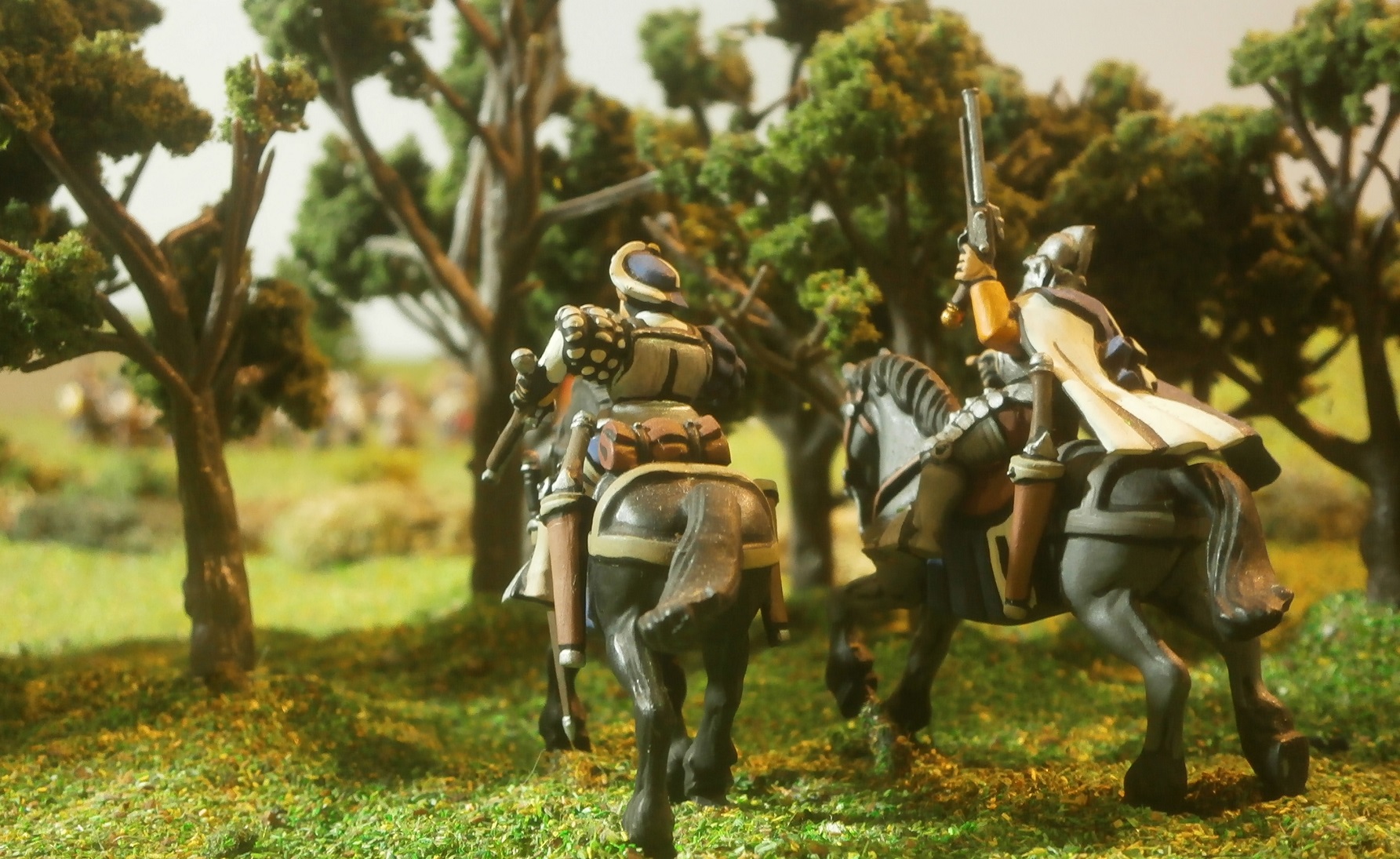
It had been hard riding for several days now, despite the fact that they had not ventured particularly far, nor had they strayed beyond the realm of Portomaggiore. But they had covered a lot of ground, attempting to ascertain exactly what was happening and where, while keeping out of trouble all the while. The enemy, an army of Sartosan pirates, had landed at Scalea, in strength far outnumbering the force garrisoned in the city of Portomaggiore. They had then divided in order to attack both Scalea and Eclano, perhaps greedy to maximise the loot they could take. Both areas were home to a good number of rich estates and prosperous villages. Obviously, the Portomaggioran garrison, a substantial force raised by Lord Alessio to defend the realm while he marched north against the vampires, could not stand idly by while this rape of the realm occurred, but nor could it expect to succeed against such superior numbers if it too divided itself. So it was, that the bulk of the garrison sallied out to defeat that portion of the enemy that had descended upon Eclano, hoping thus to save at least a part of the realm from the pirate’s depredations. Meanwhile, Filippo and his pistoleer company were among several companies of light horse ordered to keep a watch on the other enemy force at Scalea.
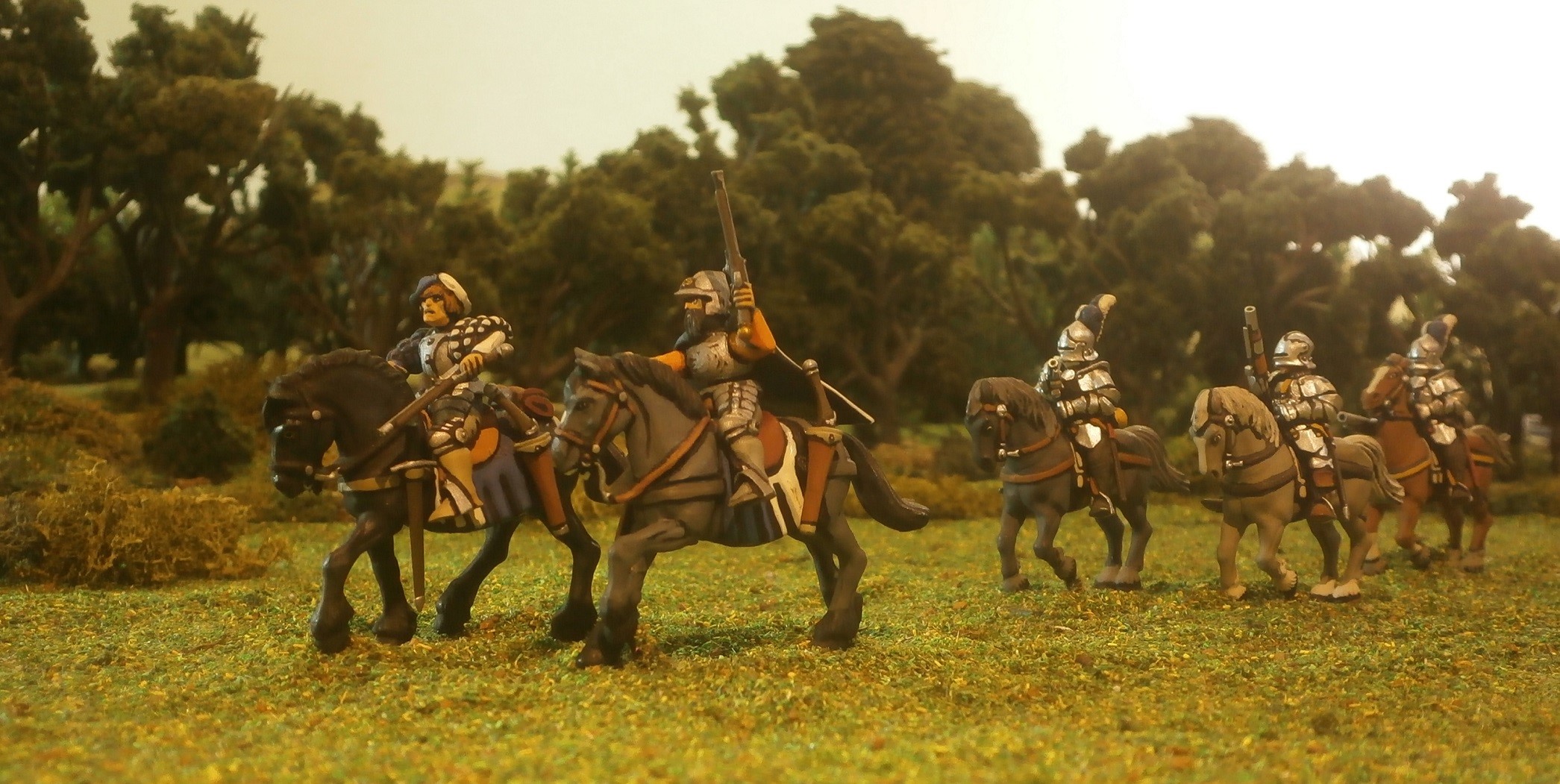
On their journey, they had stuck as best they could to wooded areas, where they might better conceal themselves, then used their native knowledge of the land to ensure that while they could survey the enemy sufficiently well to ascertain the true situation, they were less likely to be spotted. This is why sergeant Filippo was accompanied by Tino – a Scalean by birth – who knew the land like the back of his hand!
“How close do you think Lord Alessio is?” enquired Tino.
Filippo was surprised it had taken until now for Tino to ask this question. It was currently the most common query in Portomaggiore. He supposed Tino thought he, as sergeant, might have a little more insight concerning the matter than the street gossips.
“I know not,” he admitted. “But if he is close, then the Sartosans will pay dearly for their crimes.”
Everyone knew Lord Alessio’s army was marching home, and despite having fought all the way to the far north, deep into the vampire’s realms, suffering significant losses from battle and disease, it was likely still to be a substantial force, for it had begun its march far larger than the garrison. Still, whatever did return with Lord Alessio, howsoever reduced in strength, when combined with the garrison force the resultant army would surely prove more than capable of defeating even a horde of Sartosan raiders. The garrison itself had several veteran regiments – most famously the resplendent foot soldiers of the ‘Sea Guard’ …
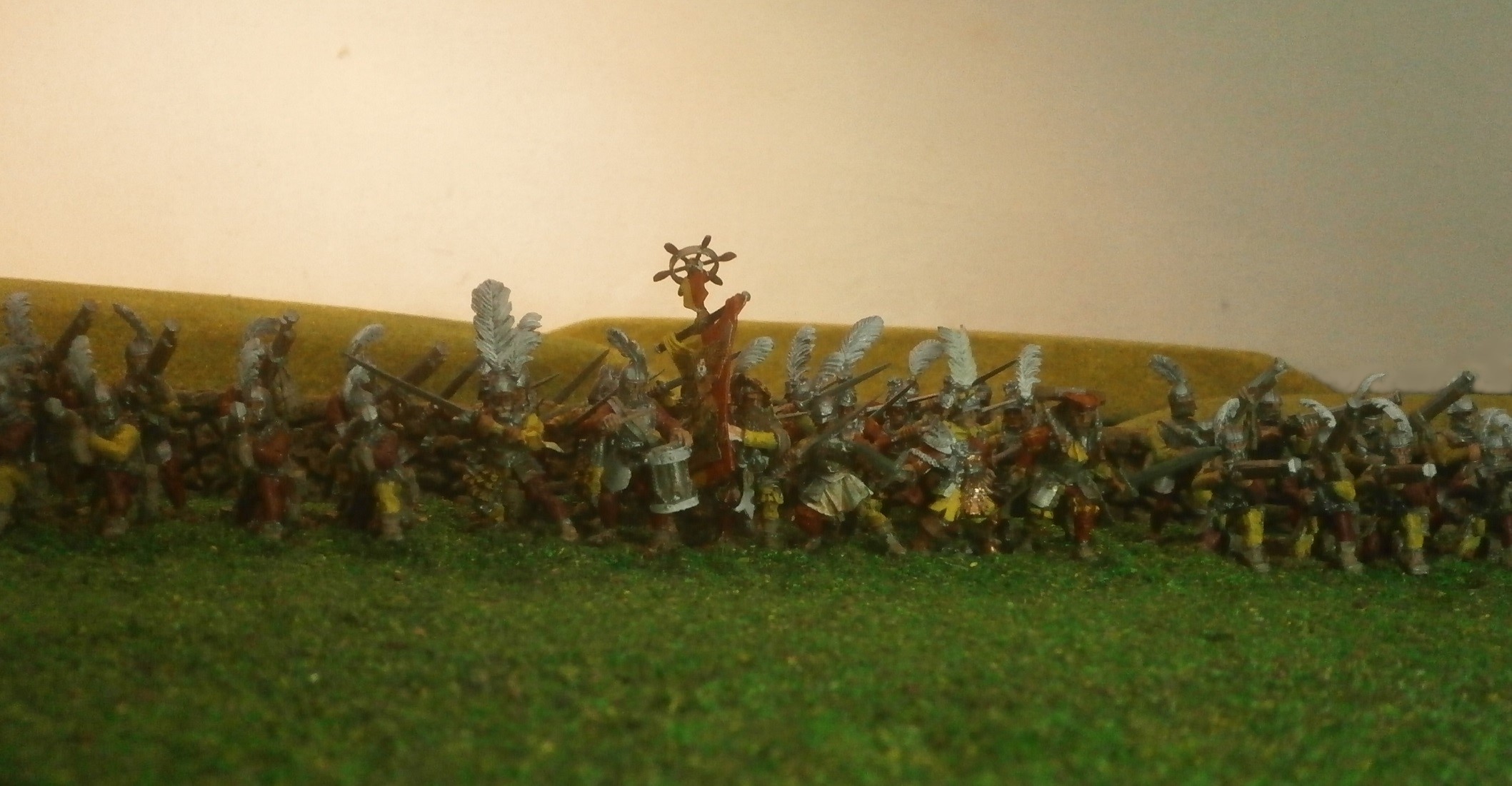
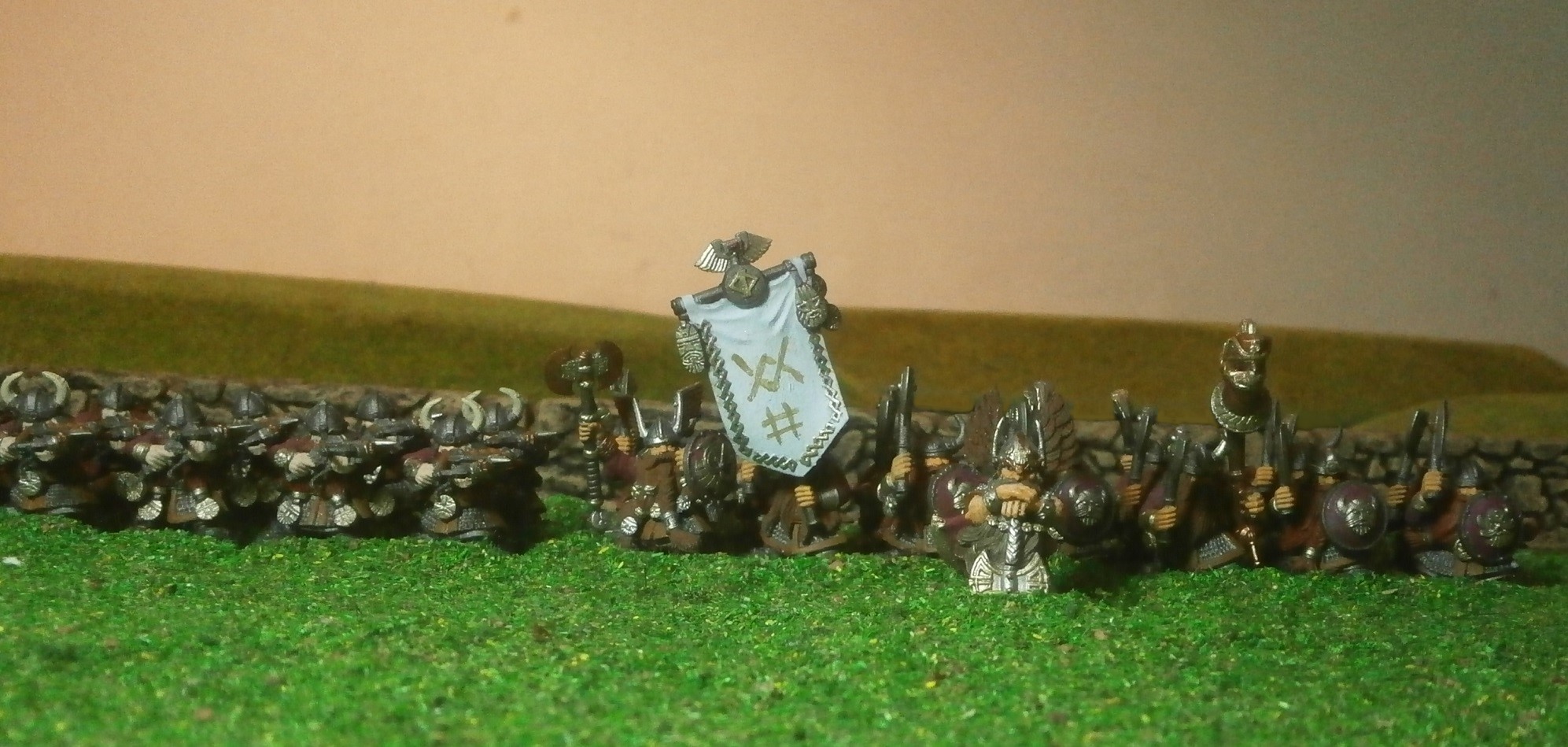
… and a sizeable mercenary dwarven company led by the renowned warlord Girseack Irongrim …
… while every man in Lord Alessio’s marching army was by now surely a hardened soldier, having gone to a very hell and back in the last year. Fighting pirates would seem to them like a holiday sport compared the horrors they had experienced.
“If you had to guess though?” pressed Tino.
“I cannot pretend to know,” Filippo said. “But I reckon the Sartosans think he’s close.”
“Why so?”
“They could have attacked city as soon as they landed,” said Filippo. “It would have been a hard fight, likely a long one too, and they would have suffered in the taking of it, but the gains would have been considerable – not only would they have gotten the golden riches of the city, but afterwards they could have plundered the entire realm at their leisure, the garrison having been destroyed. But no, instead they went immediately for easy targets, dividing their strength to do so, despite the city garrison. They’re in a rush. They want their plunder quickly, and without too much of a fight. That way they still have their full strength should they need to fight their way out of our realm.”
The riders were galloping towards the Villa Corealle, where it seemed the southern contingent of the of the enemy’s army were presently concentrated. As they drew near, they grew a little less cautious, having realised that the Sartosans’ lack of horse soldiers meant even if they were spotted, they could likely escape with little loss, perhaps even with ease, although the enemy’s long barrelled handguns remained a worry. And there was a chance that the Sartosans had looted the local stables to mount themselves.
Apparently, Tino was not convinced by the sergeant’s answer.
“All that could be true, sergeant, I grant you, but not certainly. What if the pirates know Lord Alessio is still far from home, and they’re only attacking Scalea and Eclano to lure the garrison out of the city? Or perhaps they don’t care where he is, happy to throw the dice for a chance to win a richer prize. If they can fight the garrison army in the open, then there’s no need to assault the walls, and they might gain victory quickly and easily. That done, they can loot the entire realm, the city included.”
“O’ course,” exclaimed Filippo. “And that’s why we’re here! If this lot make a move to support their mates in Eclano, we have to get word as quickly as possible to Lord Nero. He’ll then decide how best to respond before the garrison is forced to fight on the Sartosans’ terms.”
“How to respond?”
“Aye,” said Filippo.
“You mean he’ll have time to turn about and run back to the city walls, while Scalea and Eclano burn.”
“Better than the city falling.”
“Better for them in the city,” said Tino. “Not for them out here.”
Filippo had momentarily forgotten that Tino was Scalean.
“All is not lost, Tino. Lord Nero might have a trick or two of his own. And Lord Alessio could be close. Maybe we just have to spin out time a little; keep the Sartosans busy marching back and forth, until they can be defeated.”
“It’s too late for tricks now,” said Tino. “The raping and pillaging has already begun. Why didn’t Lord Nero lure them to the city?”
“And how could he do that?” asked Filippo.
“I don’t know – I’m not a general. He could have feigned surrender? Offered them a bribe? Made the city look weak? They’re all the sort of games that could spin out time, and none involve the suffering of Scaleans.”
“Look here, it ain’t mine or your place to question. We follow orders, yes?”
A flash of anger washed across Tino’s face. “Seems to me that a people’s obligation to obey a lord lasts no longer than does the lord’s power to protect them.”
Tino was wandering into dangerous political territory, voicing ideas normally restricted to the musings of radical philosophers and preaching provocateurs. It was a new side to Tino’s character that the sergeant had never glimpsed. But then, thought Filippo, Tino’s homeland (and presumably his family) had not previously been attacked while soldiers of Portomaggiore were given orders to do nothing more than watch. Nevertheless, such talk was not to be encouraged. Indeed, another sergeant might consider even its mere utterance punishable.
“And it seems to me, Tino, that you should remember it is the Sartosans who are in the wrong here, not Lord Alessio. He‘s not here to give the orders, and why? Because had he not personally driven the foul undead back north, there to annihilate them, then all of Portomaggiore, even the whole of Tilea, would have descended into hell. There’s your lord’s protection.”
“Aye,” said Tino, apparently unconcerned about his brush with treacherous sentiments. “There is that!”
They rode on in silence, neither willing to explore the matter further. After another hour, utilising Tino’s knowledge to navigate a circuitous route through a quiet valley, and having slowed to a cautious pace, Tino announced they were close to the Villa Corealle. Moments later he brought his mount to a halt.
“There!” he said quietly, but clearly. “On the other side of the trees.”
Filippo peered through the foliage, and his eye was caught not by the buildings, but by movement, in the form of a marching body of men.
“Well, that lot are not looting right now,” said Filippo. He looked up to find the sun, but cloud and canopy thwarted him. “What with our meandering path, I’ve lost my bearings, but I think they’re heading north-west.”
“That they are, sergeant,” said Tino. “On the road towards Eclano.”
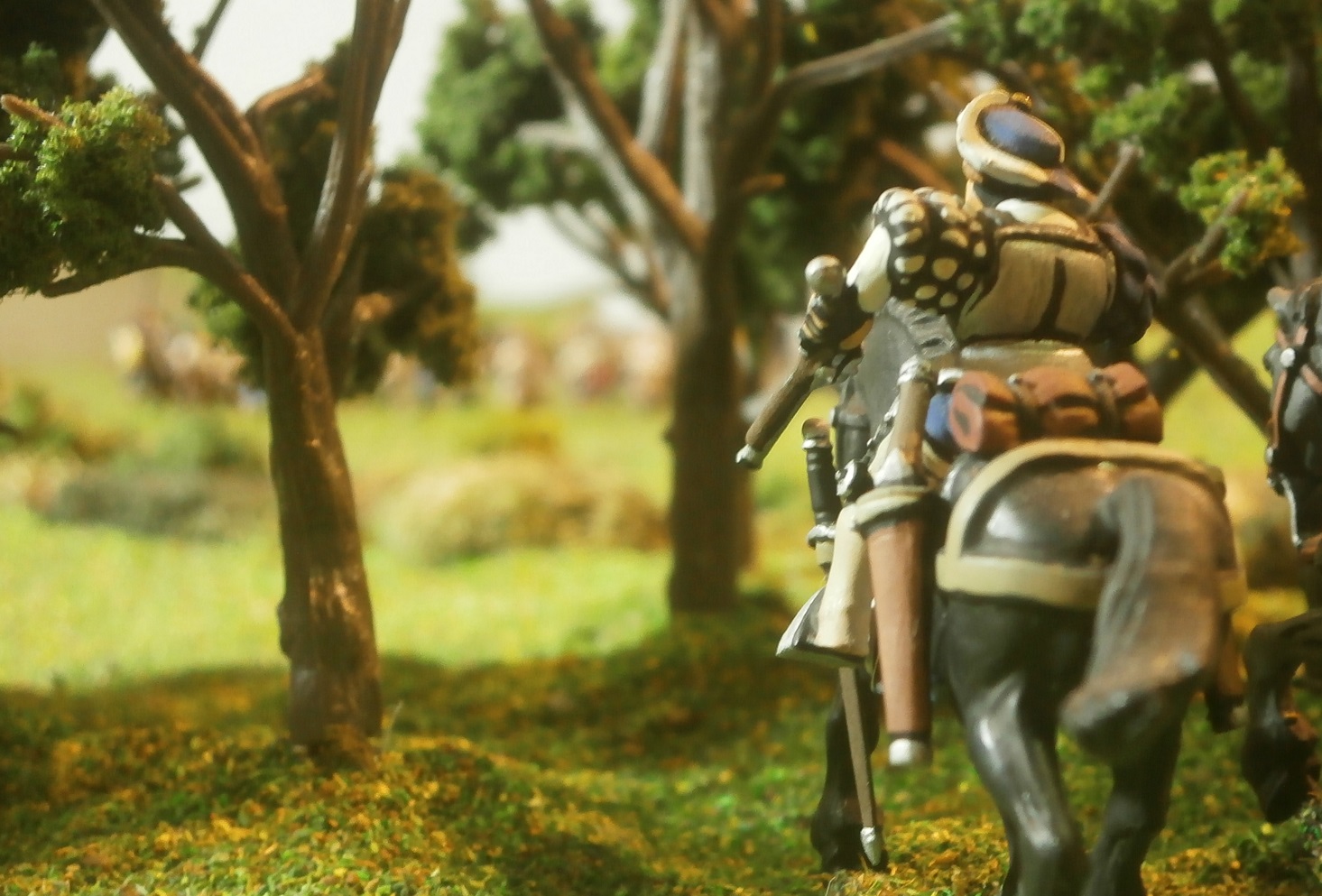
Filippo narrowed his eyes and scrutinised the enemy.

They were clearly seamen, armed with pistols both large and small, and blades of umpteen kinds, but having not one piece of armour among them. Formed in somewhat ragged ranks and files, they were obviously unconcerned about soldierly postures and dressings.
“Might just be these on the move, while the rest continue plundering,” he suggested. “And who’s to say they’re going to Eclano? They could just be looking for the next villa to loot?”
“Maybe,” said Tino, slowly pushed a branch out of the way that he might see a little better. “They’ve a banner at their fore.” he whispered. “And, there’s another company following them.”
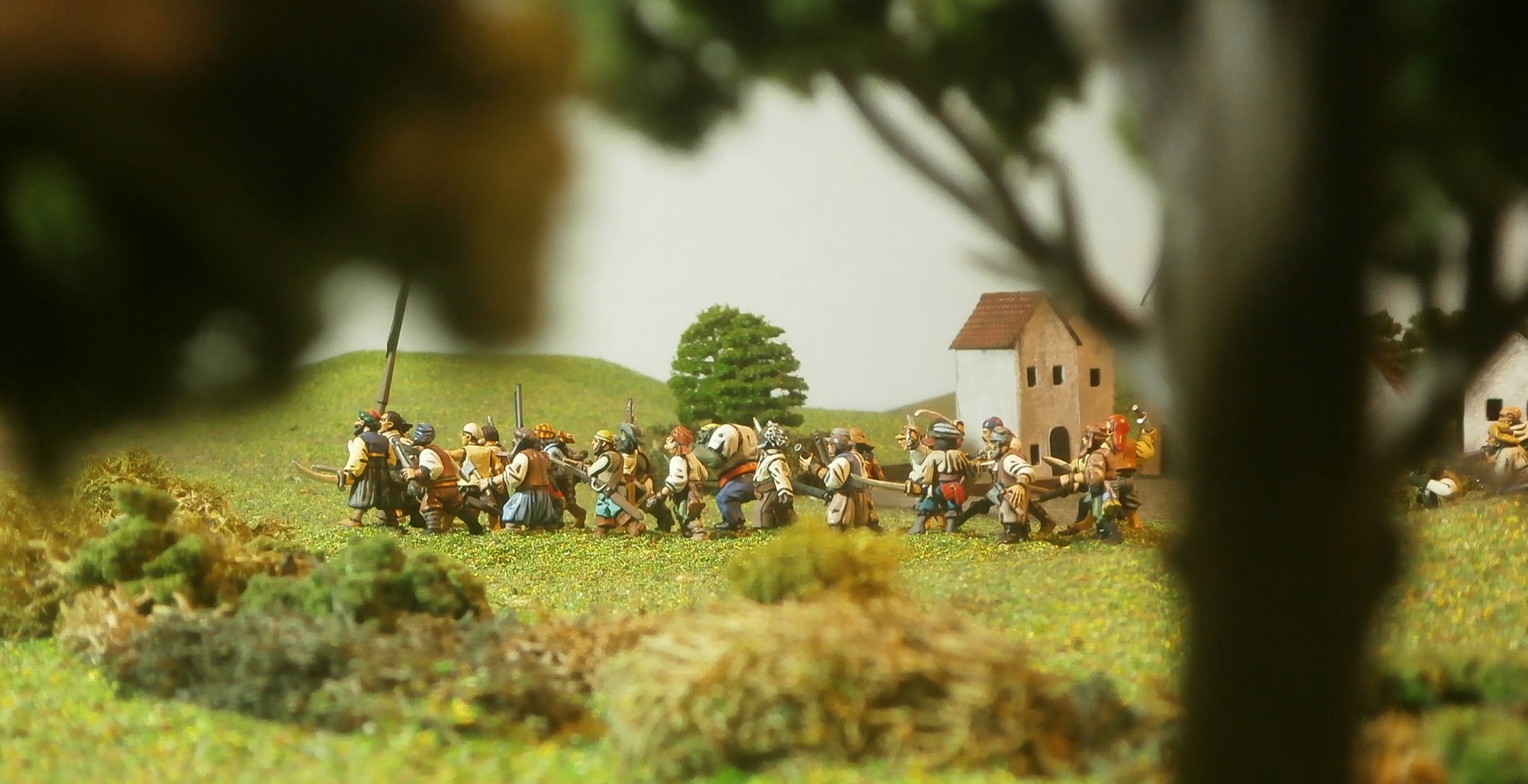
Filippo saw that they were not just men – there was a hulking orc among their ranks. As for the rest, some looked like Tileans or northerners, while others appeared to be Estalian or Arabyan. They were clearly making haste, marching faster than even light foot would normally be expected to. His companion had obviously noticed this fact too.
“If they’re looking for somewhere else to loot,” Tino said. “Then they’re in a rush to find it.”
Filippo was beginning to doubt they were simply scouting about for further opportunities. As they moved quickly by, another equally fast-paced company hove into view, of a similar composition but smaller in number and armed with blunderbusses.

They too had a large orc in their midst, striding in a somewhat ungainly manner due to his thick peg of a wooden leg, and bearing a blunderbuss that rivalled a swivel gun in size. More than that, there were smaller orcs, goblins and even a dwarf among them.
“Orcs and dwarfs!” said Filippo.

“Aye,” agreed Tino. “And men. All wrong ‘uns.”
“I mean,” said Filippo, “serving together, in the same company. I didn’t think that was possible.”
“That’s the least of their sins.”
“Wait,” said Filippo. “Now there’s another company! I think they are on the march.”

“Do they know about the garrison army’s march? Is this one of the jaws of a trap?” enquired Tino.
“I’d say that’s likely. We’ll know for certain as we ride to Eclano, for they’ll either follow us or not.”
Tino moved his branch again.
“This lot are all dwarfs!” he said. “Look at ‘em, fair bristling with blades and barrels.”

“Stop moving that branch will you,” ordered Filippo. “What’s the point of keeping to the shadows if make a tree wave at them?”
Tino was not really listening.
“I’ve heard of their kind,” he said. “Sea slayers, afeared of nothing. They’d hurl themselves into the kracken’s maw if it meant their blades could cut its flesh.”
The dwarfs were carrying a golden death’s head icon, like that of an orc’s skull, with crossed bones to bulk it up. Nearly all, to dwarf, were red-haired and bearded, if not bald.

“There’s more ‘n more – another company behind this lot! Should we be counting them?”
Filippo let out a groan. “What do you think I’m doing? Contemplating whether they follow the fashion?”

A green coated captain of a northern countenance led the next band. While Filippo strained to get a look at the company following behind, Tino pulled upon the branch again. The captain halted, then suddenly spun about to begin shouting at those behind him, while pointing at the trees concealing the riders.

“You bloody fool!” cursed Fillipo. “He’s seen us!”
“I wouldn’t worry, sergeant. We have horses and I know every path.”
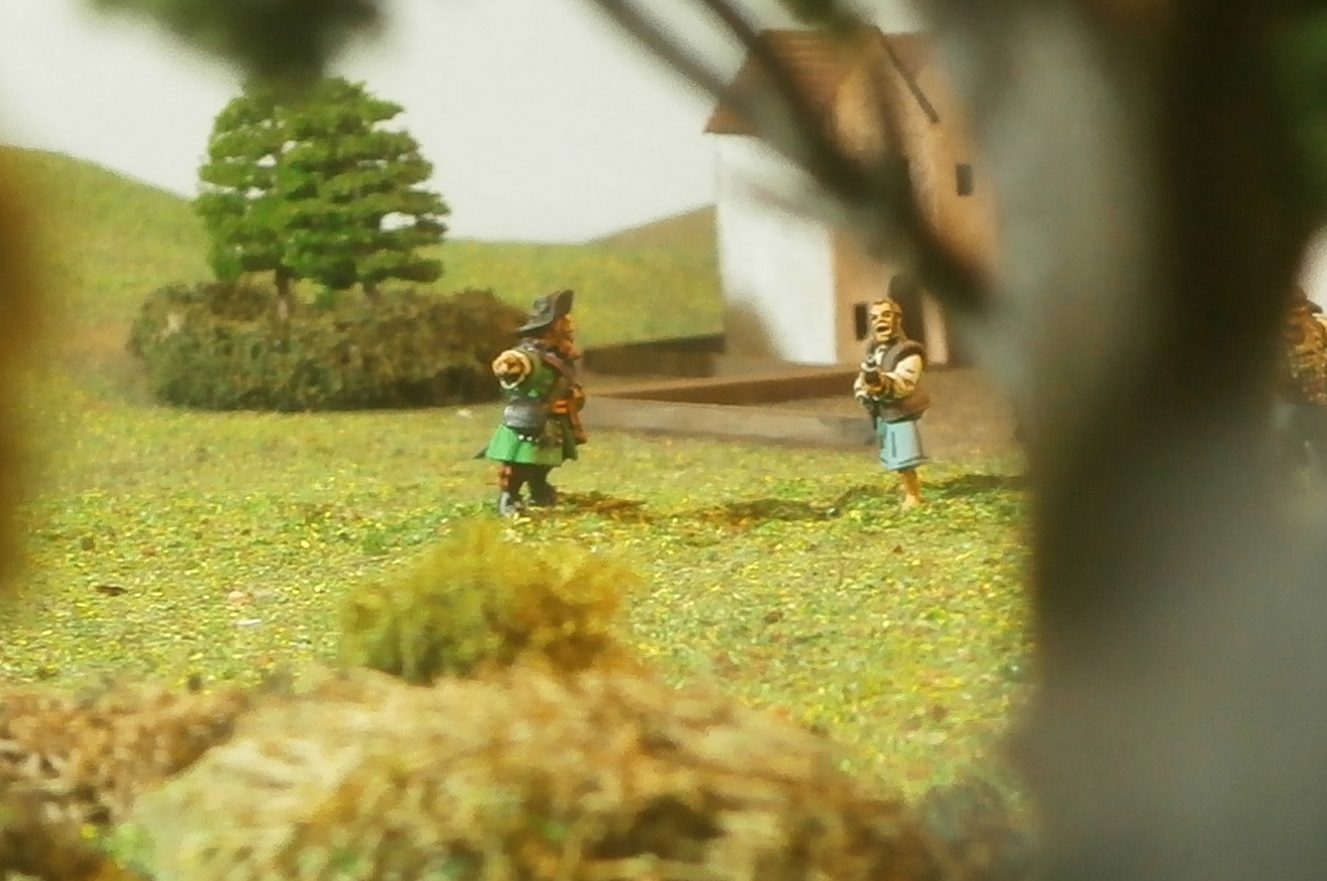
Filippo could see what this band were armed with now.
“It’s their guns I’m worried about,” he said.
Several Sartosans were already taking aim.

As the first shots rang out, the riders turned to flee.
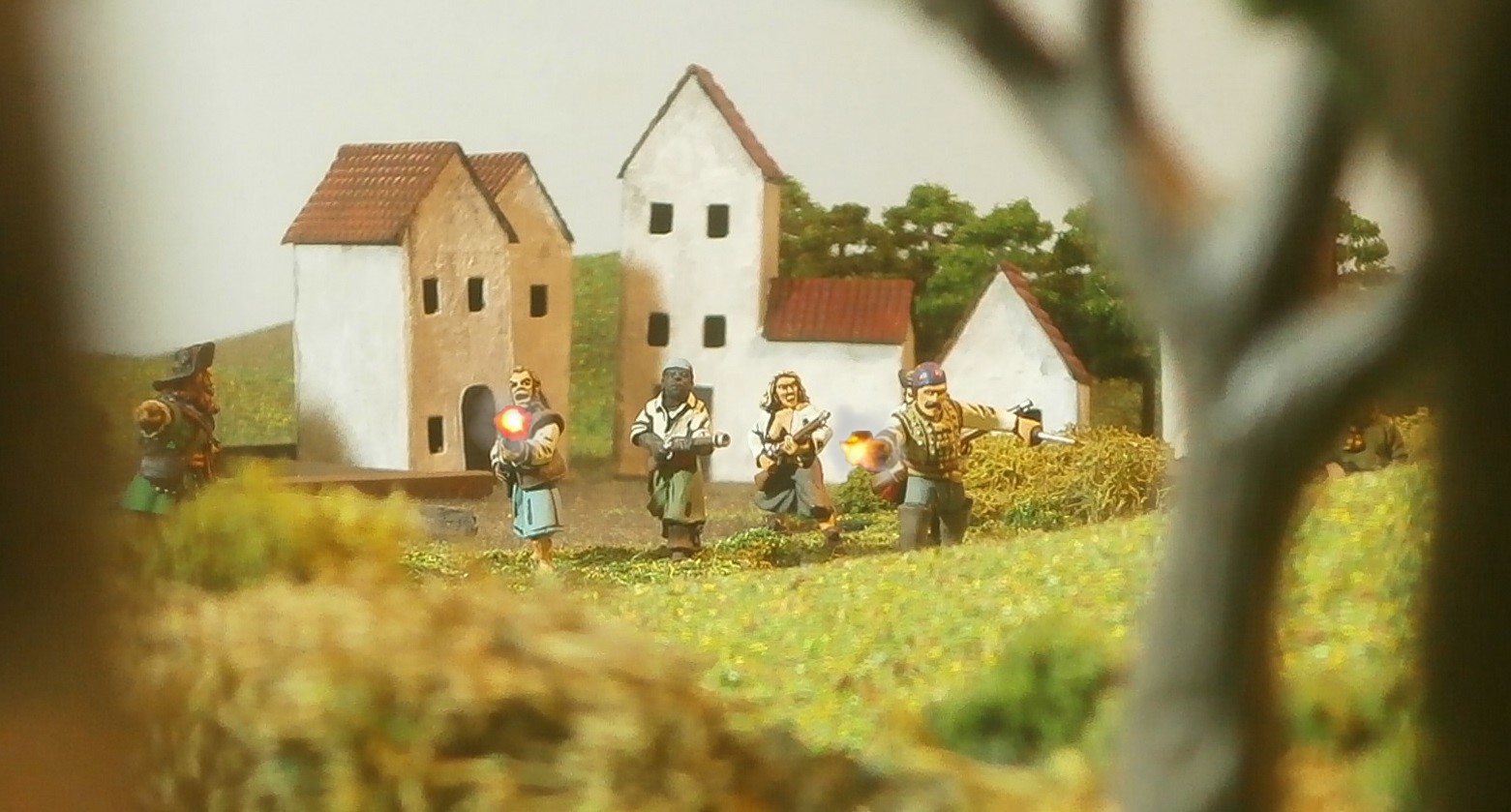
Filippo saw a branch splinter close by as a bullet tore into it, then heard Tino curse. But he knew any further shots would be wasted.

Ducking low, so as not to be knocked from his saddle, he began thinking about who he would send ahead to warn Lord Nero, and who he would keep with him to count the rest of the enemy.
The Battle For Eclano
The Realm of Portomaggiore. The end of autumn, IC2404

The Villa Bruscatta was neatly laid out. It had an ancient, sturdy temple, possessing chapel-alcoves dedicated to Morr, Myrmidia and Mercopia, and minor shrines for several other gods of note, while the house was a more modern affair. Both were incorporated into a walled yard, beside which was a well-tended orchard. Laying in a wide valley in the Savuolo Hills, in the region known as Eclano, to the east of the ancient road running south of Portomaggiore, it was normally a very haven of peace. Today was to prove an exception.

A substantial force of Sartosan pirates, a detached part of Admiral Volker’s invading army commanded by the sorcerer Adus Arcabar, had been ravaging the southern region of Scalea, but was now closing in on the villa to increase its haul of loot. As they drew close, their advance party returned to report, being Captain Kardreath Leadforge’s Sea Slayers, a dwarven crew who had continued to march in the darkest hours of the night while the rest of the force rested. Leadforge reported that the Portomaggioran city garrison was marching upon the villa too. But not to worry, he added, as he was certain that Admiral Volker was also on his way and should be there soon.
Ah, but will it be soon enough? thought Arcabar.

It could prove ruinous to attempt a retreat, for then the enemy might gain the initiative, able to pick the pirates off piecemeal as they withdrew. Besides, the Admiral, whom Arcabar considered a good friend, was not a man he wanted to disappoint, and so Arcabar ordered his force to array in line of battle behind the villa. He would see if his force could keep the enemy busy long enough for Volker to arrive.
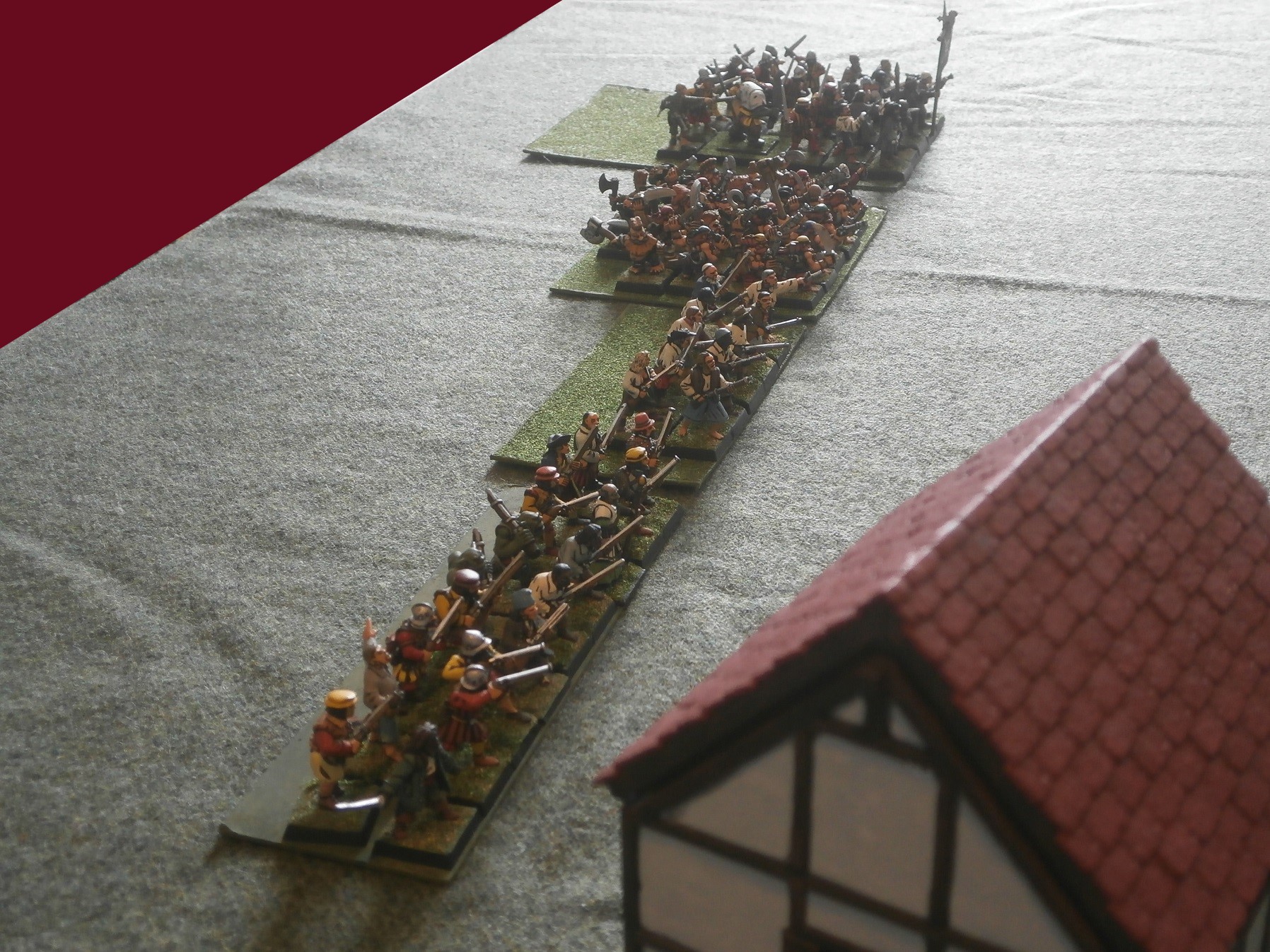
He himself joined Captain Garique’s crew, a body of handgunners, on the right of the line nearest to the villa.

Another smaller company of handgunners stood to their immediate left, being part of Captain Van Baas’s crew, while the newly arrived dwarfs were beyond, with the rest of Van Baas’s crew on the battle-line’s far flank.

Captain Leadforge led the cheering from his regiment, while Van Baas brooded in his usual manner, employing his hook-hand to give rest to his cutlass blade.

The Sartosan artillery pieces, big and small, were placed to the far left of the line, with the sakers higher than the swivels and thus able to shoot over them.
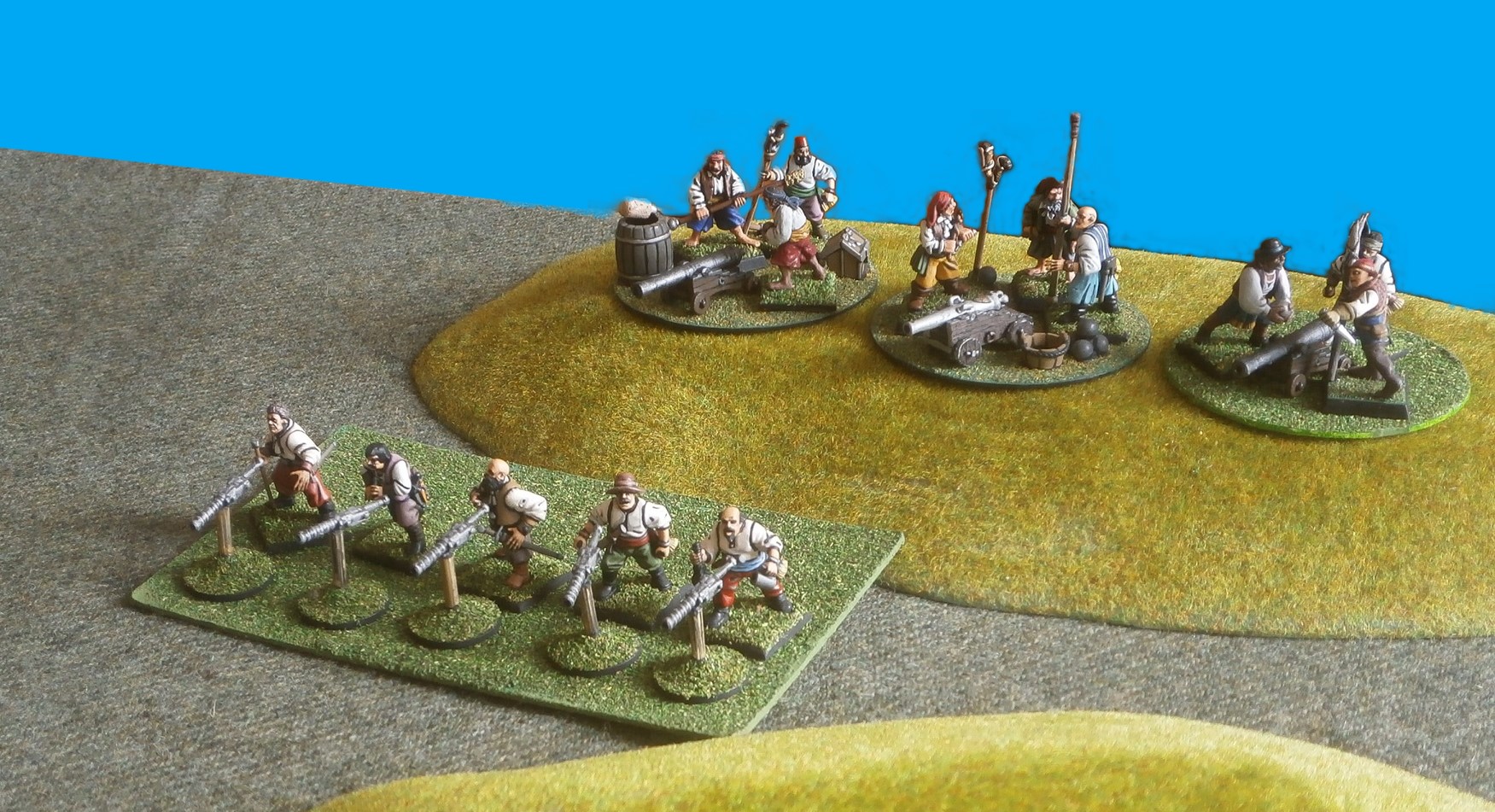
These were entirely unprotected, perhaps because the Sartosans presumed that anything attempting to close on them would be torn to pieces by the sheer weight of firepower they could bring to bear? And yet, a body of enemy light horse was indeed riding upon that flank …
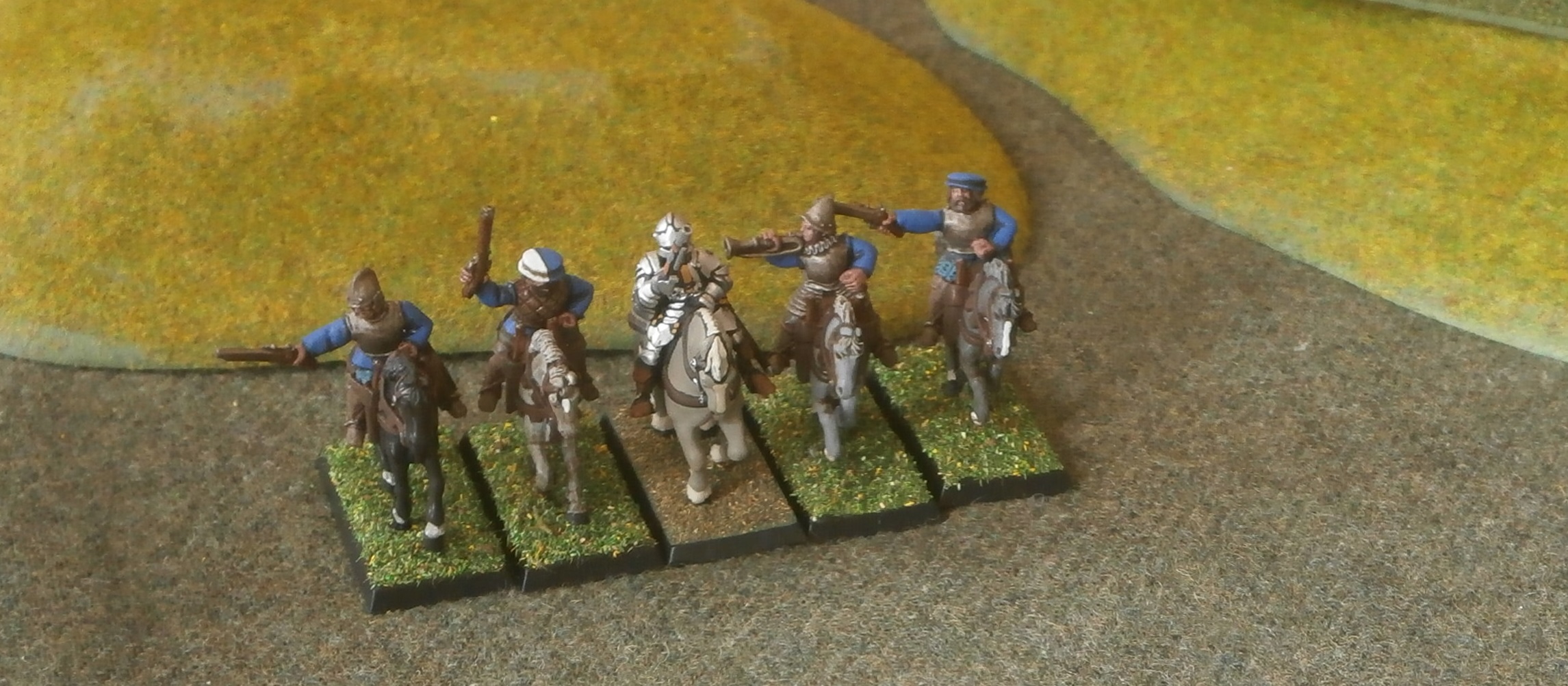
… and boldly crested a hill to stare right at the serried muzzles.
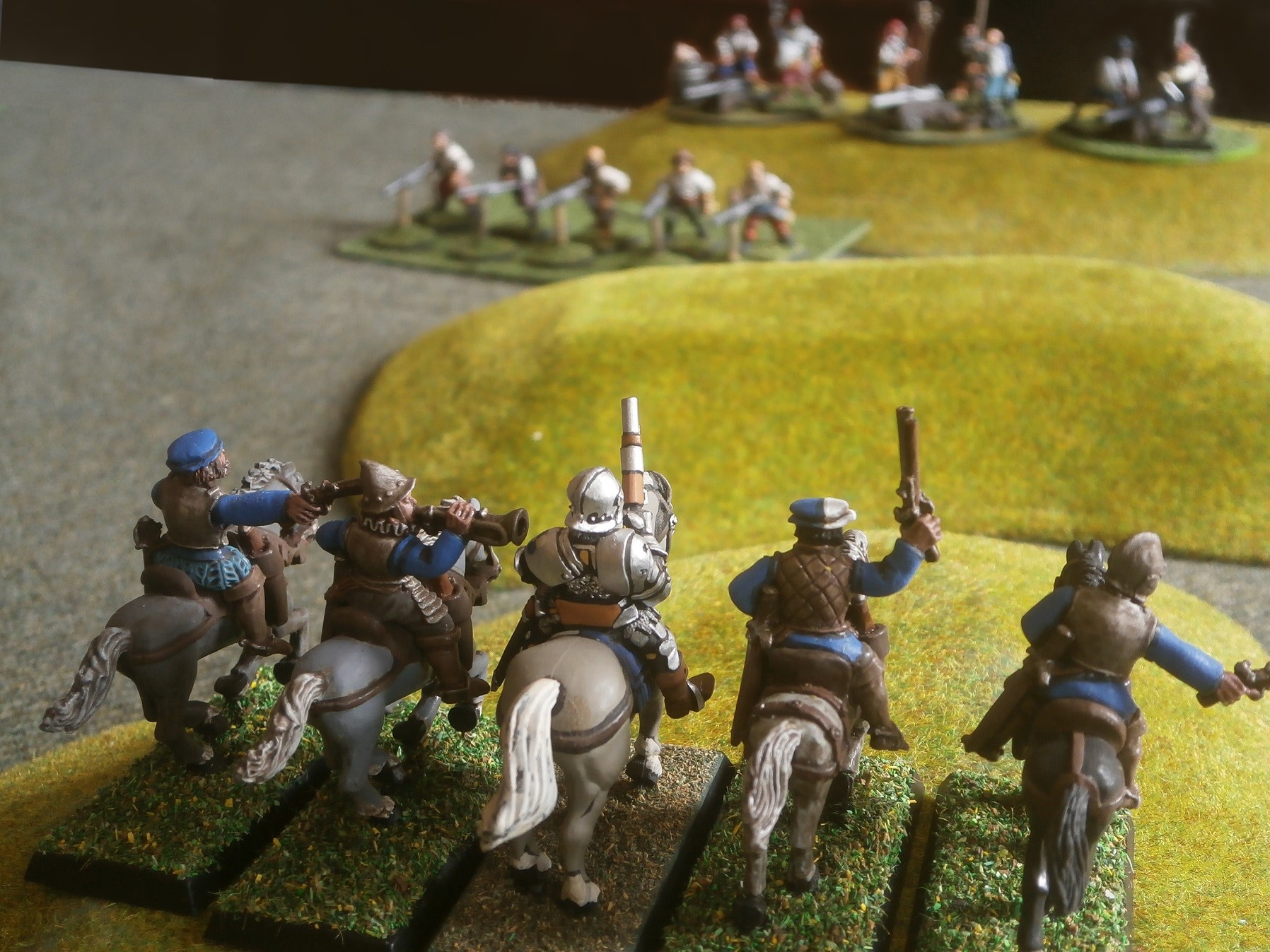
Upon the enemy’s other flank there were more pistoliers – two companies – beside a ribaudequin with shiny-brass barrels.

These riders also promptly advanced – more cautiously than their counterparts on the far left of the line – riding through the orchard and thus concealing their movement.

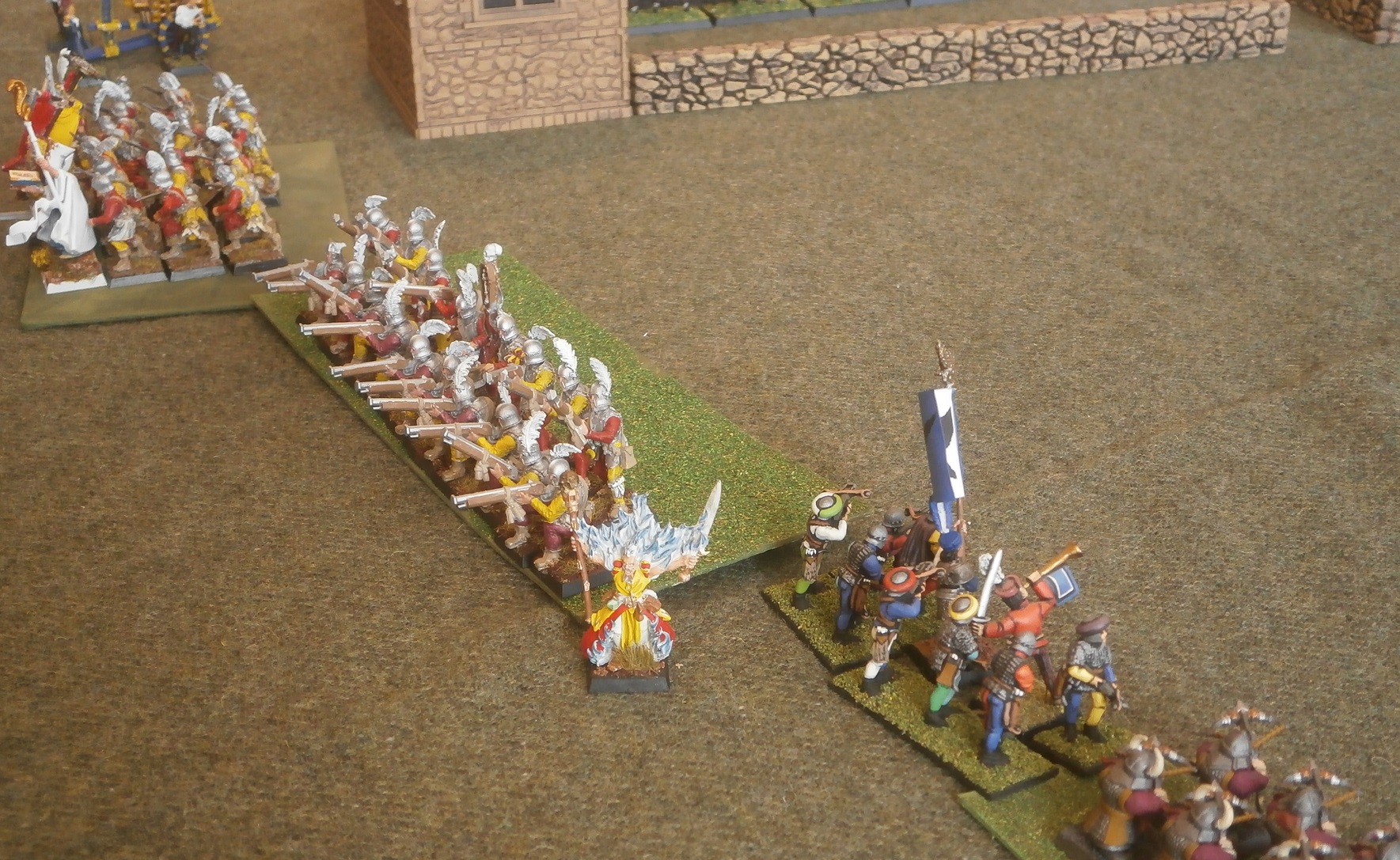
This pincer-movement of light horse seemed to prove that the Portomaggiorans had come here to fight. The force massed in the centre of the Portomaggioran’ line was clearly intended to be a defensive garrison, for the vast majority were missile troops, with a large regiment of Sea Guard handgunners, a body of mercenary dwarven crossbows and the local Eclanian militia crossbowmen, the latter mustered under an impressive Portomaggioran standard bearing a Falconi emblem (revealing that much of Eclano was Lord Alessio’s family estates).

The main fighting regiment was beside the handgunners, being the Sea Guard swordsmen, an elite body under the command of Lord Nero Acciaio, military governor of the city state in Lord Alessio’s absence. One of the garrison’s two wizards was also among their ranks, the other having joined the handgunners.
Even more crossbowmen had taken position on the higher ground to the right of their line, ordered to keep an eye out for the enemy relief force known to be on its way.

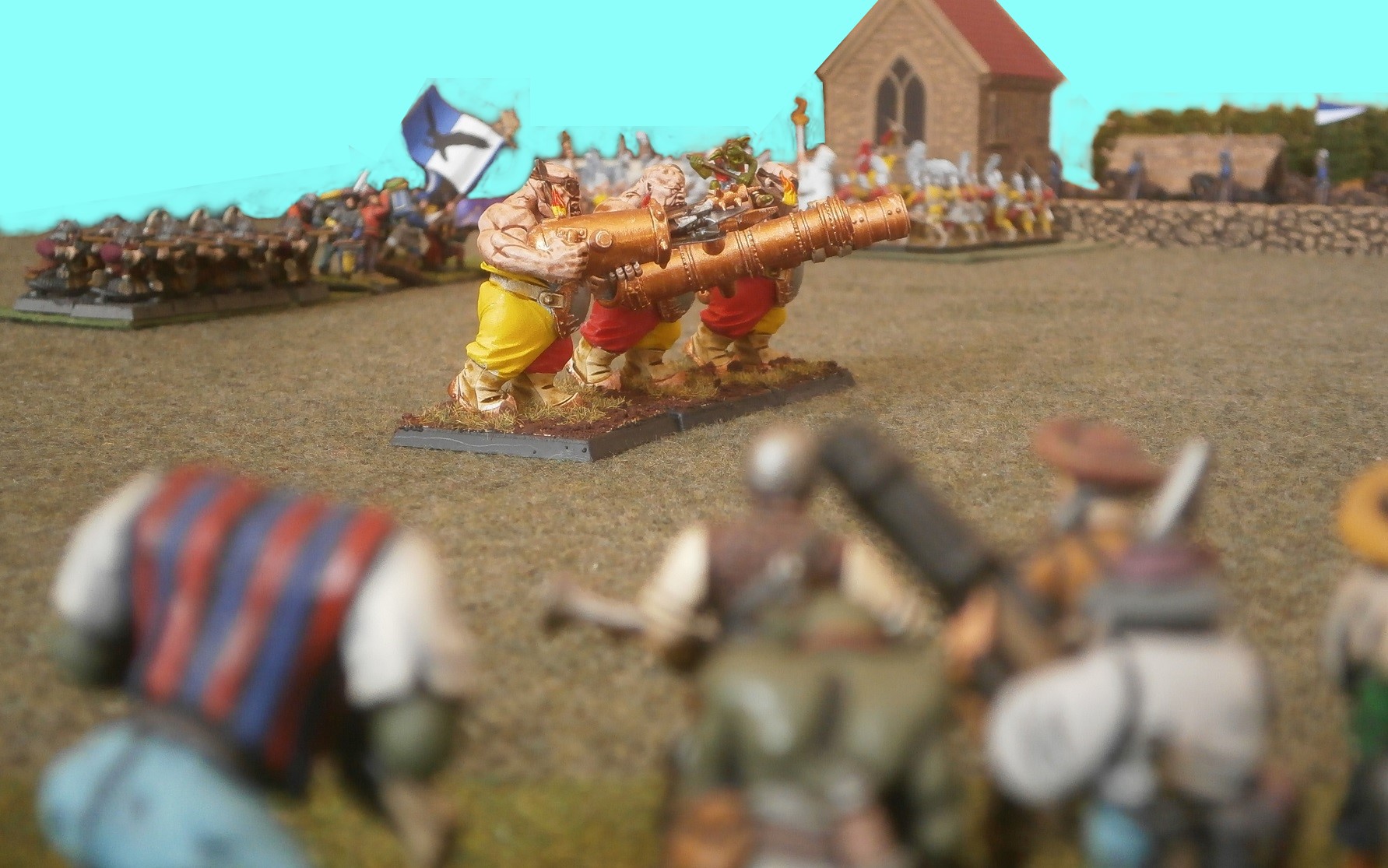
Behind these was the garrison’s second fighting regiment, the mercenary dwarfs under Girseak Irongrim, being mostly his own clan warriors. And behind them were four brutes carrying cannons (or ‘leadbelchers’ as they themselves called them). These had the potential to be incredibly destructive both when shooting and when fighting.
While the Sartosans in the main line shuffled a little to better align themselves to the foe, with Captain Garique’s personally commanded handgunners wheeling about …
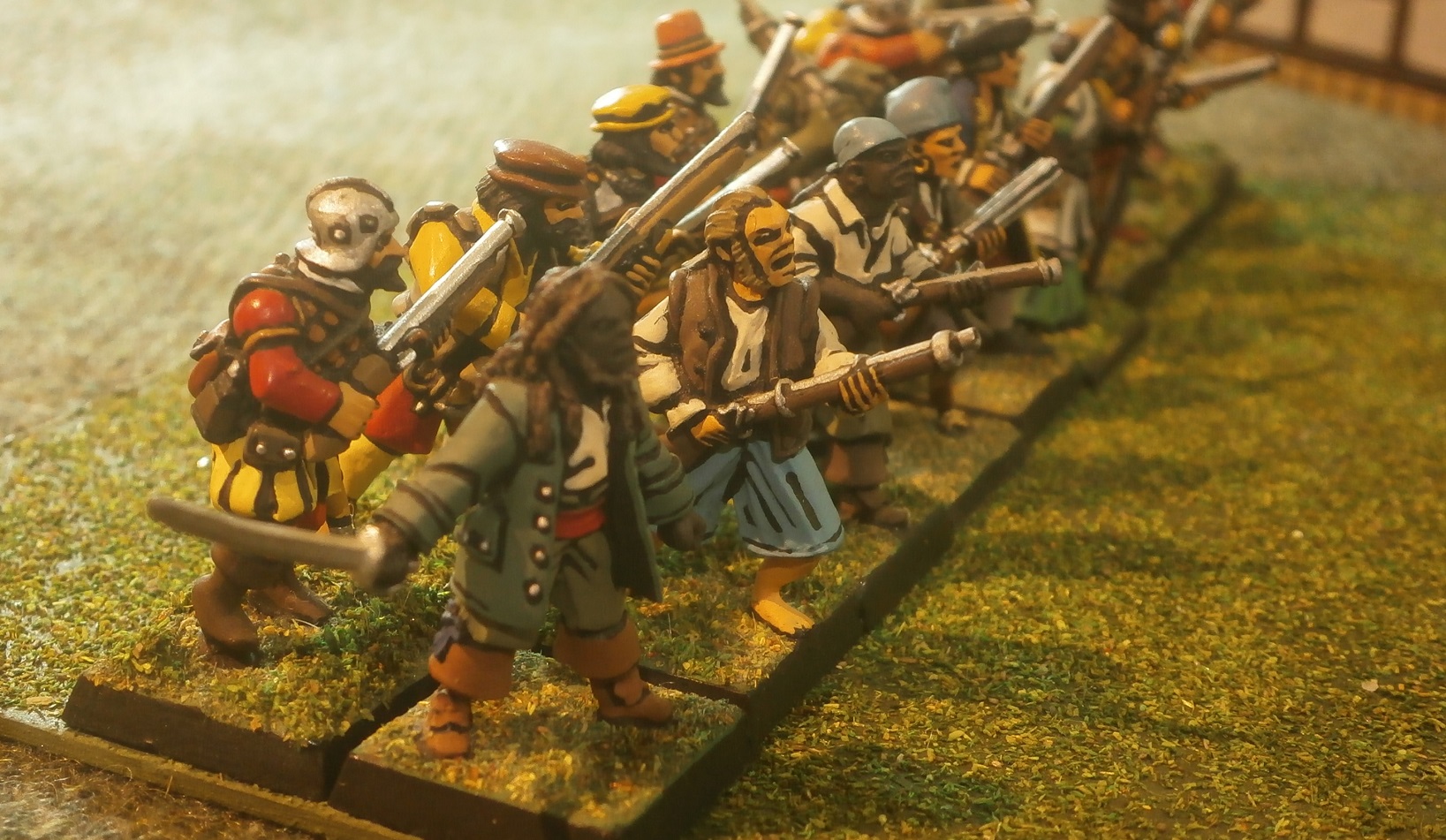
… to get a better line of sight on whatever was disturbing the trees of the orchard …

… the swivel gunners turned their attention upon the little company of horse up ahead …
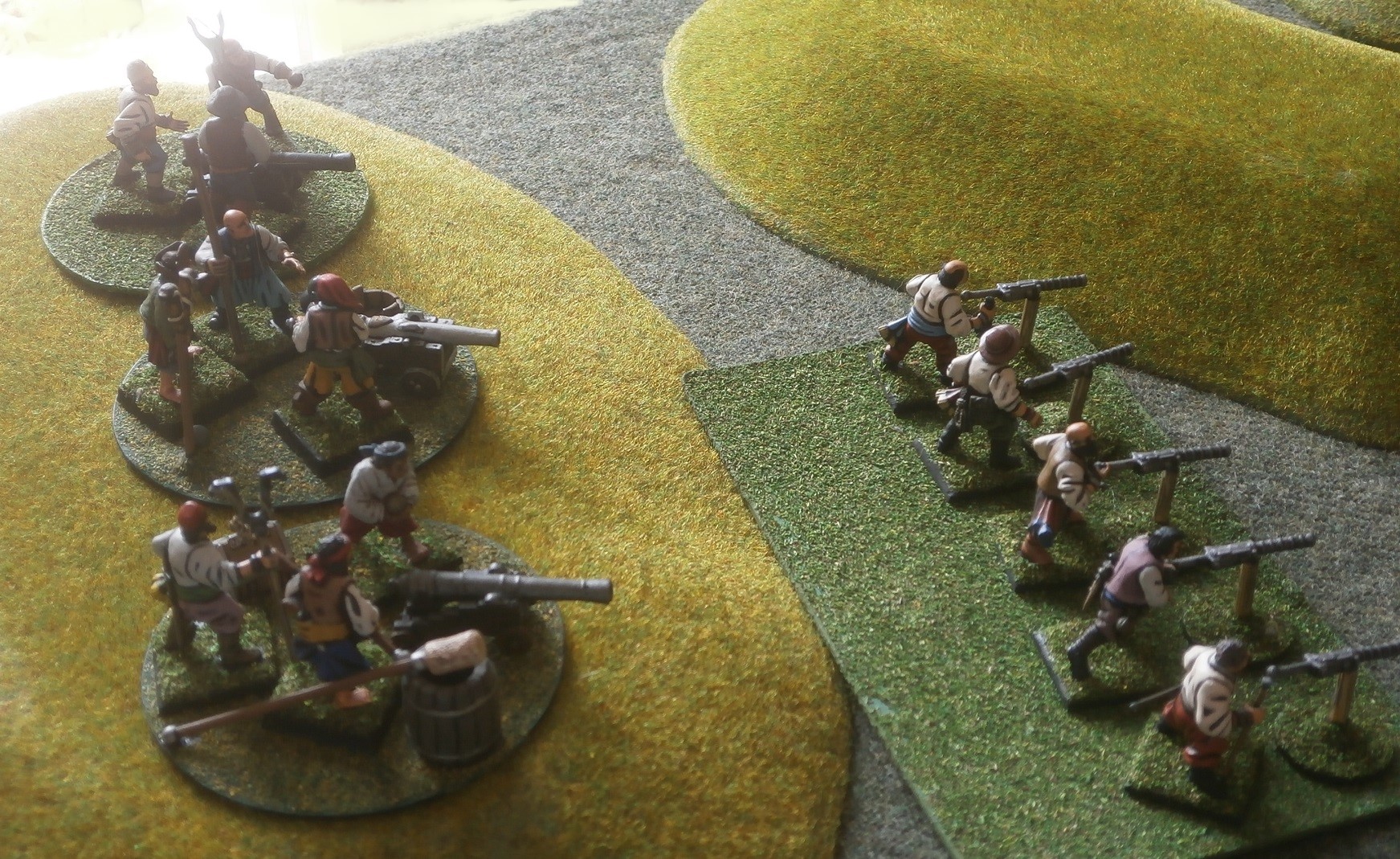
… bringing two of them down. The survivors were not dismayed by their comrades’ demise and continued their ride.
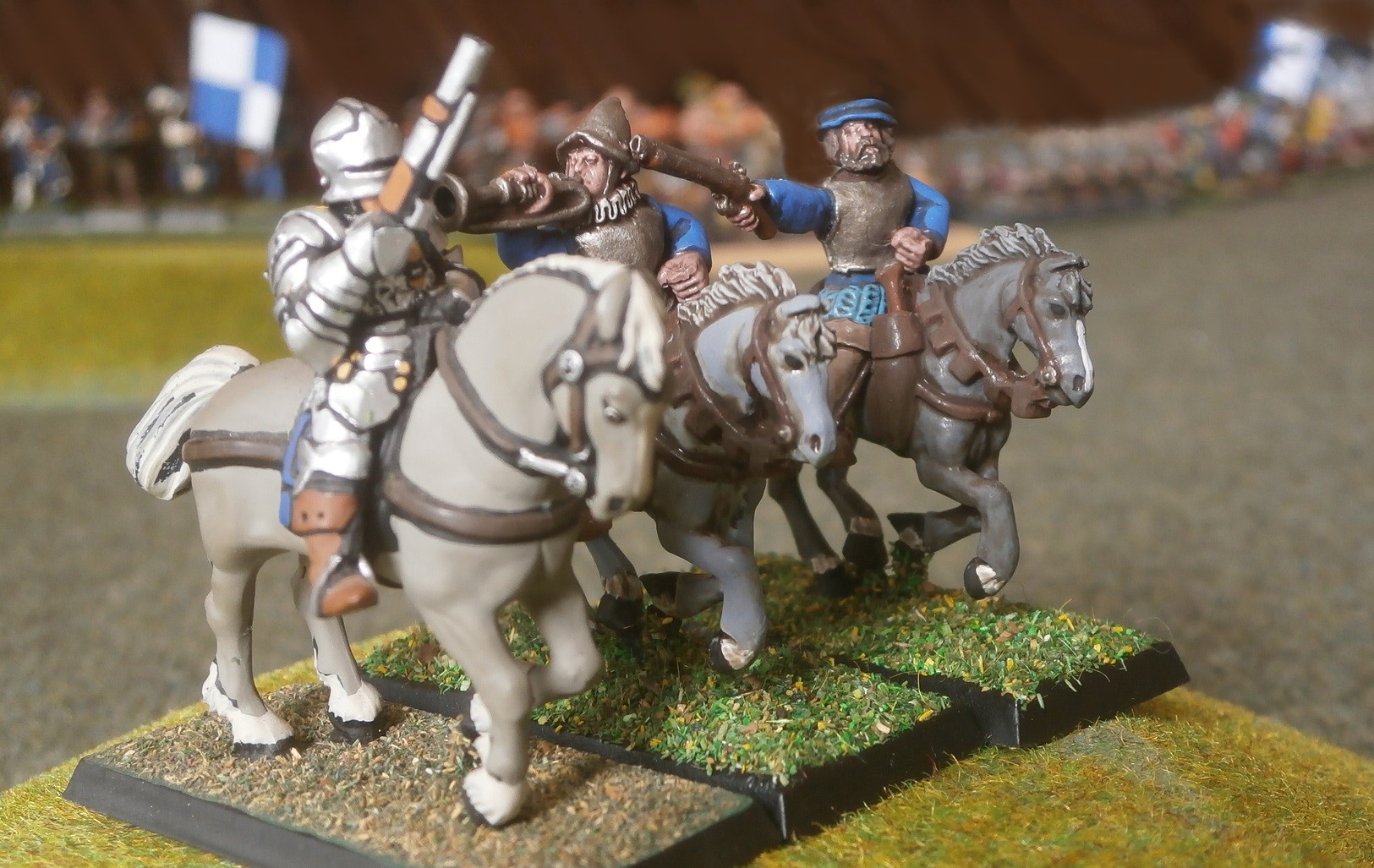
Arcabar intended, now that he could see what was moving through the trees, to conjure a fireball at the pistoliers in the orchard …
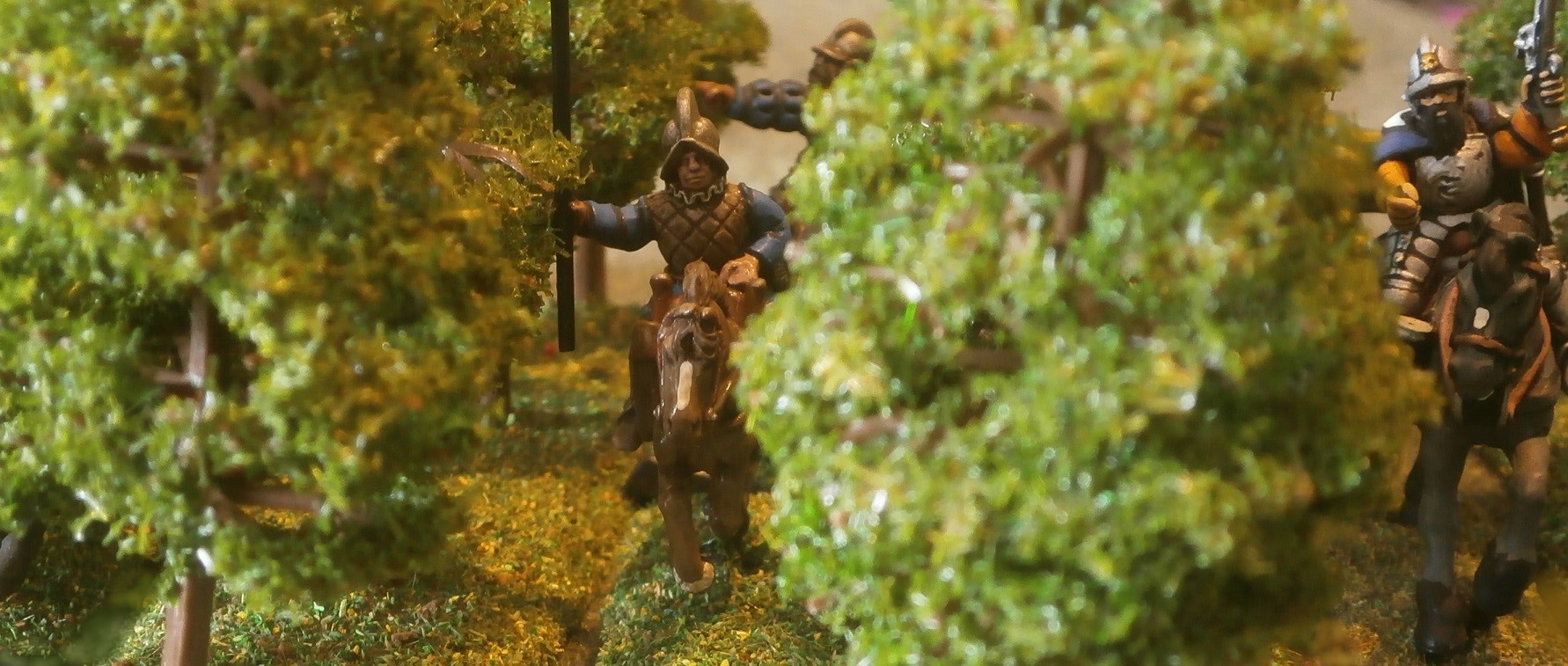
… but his efforts were thwarted by the enemy’s wizards, who unwound the etheric vapours he was coiling to form a fiery flash.
The three cannons all targeted the main dwarf regiment, two employing chain-shot, but only one was to prove successful, killing five.
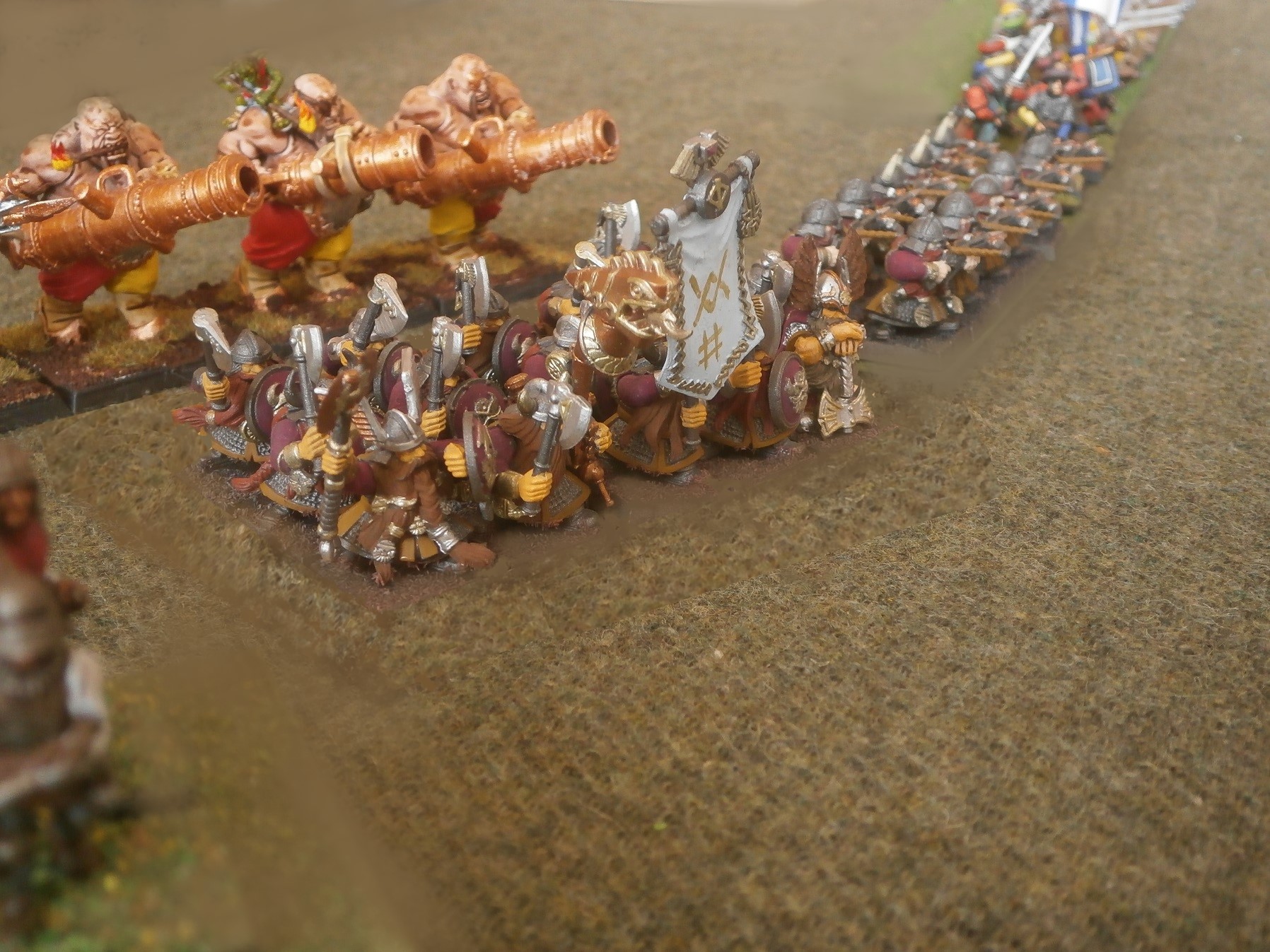
Irongrim’s warriors were battle hardened veterans however, and despite not one being unspattered by the blood of their fallen comrades, they began their advance, the ogres following behind, matching the dwarfs’ slow pace.
The last of the pistoliers on the pirate’s left, keen both to avoid further harm and to contribute to the struggle, rode quickly to flank the enemy’s artillery …

… but perhaps due to being somewhat shaken, their shots all missed.

Near the villa, the Harbour Guard swordsmen marched up beside the chapel …

… while the wizard with them attempted to summon a magical burning gaze on Garique’s handgunners.

Arcabar sensed the impending danger and used his precious scroll to dispel the attack. The wizard with the Sea Guard handgunners, however, had also conjured fire magic …

… hurling a fireball at the smallest of the two enemy handgunner companies. This killed more than half of them. Despite the harm, those remaining stayed put.

While the crossbowmen on the hill managed to bring down one of the swivel gunners, two of the ogres could aim their muzzles at Van Baas’s regiment. Their blast killed two, then the dwarfs put down another three and the Eclanian standing force crossbows added another casualty. Van Baas and his men barely flinched. The grey coated captain simply stared intently at the foe, as if he knew something they did not.

(End of Turn 1)
It was then that Volker and his large relief force began to arrive. Their sudden appearance, so soon in the struggle, made it immediately obvious that the Portomaggiorans were very unlikely to prevail, being both outflanked and vastly outnumbered (despite the fact that the admiral had left several regiments and his second wizard elsewhere to continue their plunder). It was not entirely impossible that Lord Alessio might appear with his own army, returning from the ‘holy war’ against the vampires in the north, for he had a reputation one of the best generals in Tilea, with many victories under his belt. But everyone, on both sides, knew this was unlikely, as he was reported to be many, many leagues from home. For reasons known only to himself, he had not embarked his force, or even a portion of it, onto ships in Remas to make the last part of the journey home by sea (as many in the city expected), but had taken the longer route over land.
Admiral Volker himself led the largest regiment consisting of his own crew, now outnumbering the goblins who had lost much of their number during earlier squabbling.

His trusted navigator, Ubaida el-Noor was by his side in the front rank, the pair of them alone showing the eclectic nature of the Sartosan army: the admiral, clean shaven, in a black coat, hat, linen neckcloth and dull green waistcoat, being a northern fashion; while the big-bearded arabyan wore a turban, loose sleeved yellow shirt and baggy breeches fastened at his ankles.

Topping the rise on their left flank, and matching their advance, came the newest reinforcements in the Sartosan fleet – the ogre Captain Kroll’s crew of axemen.
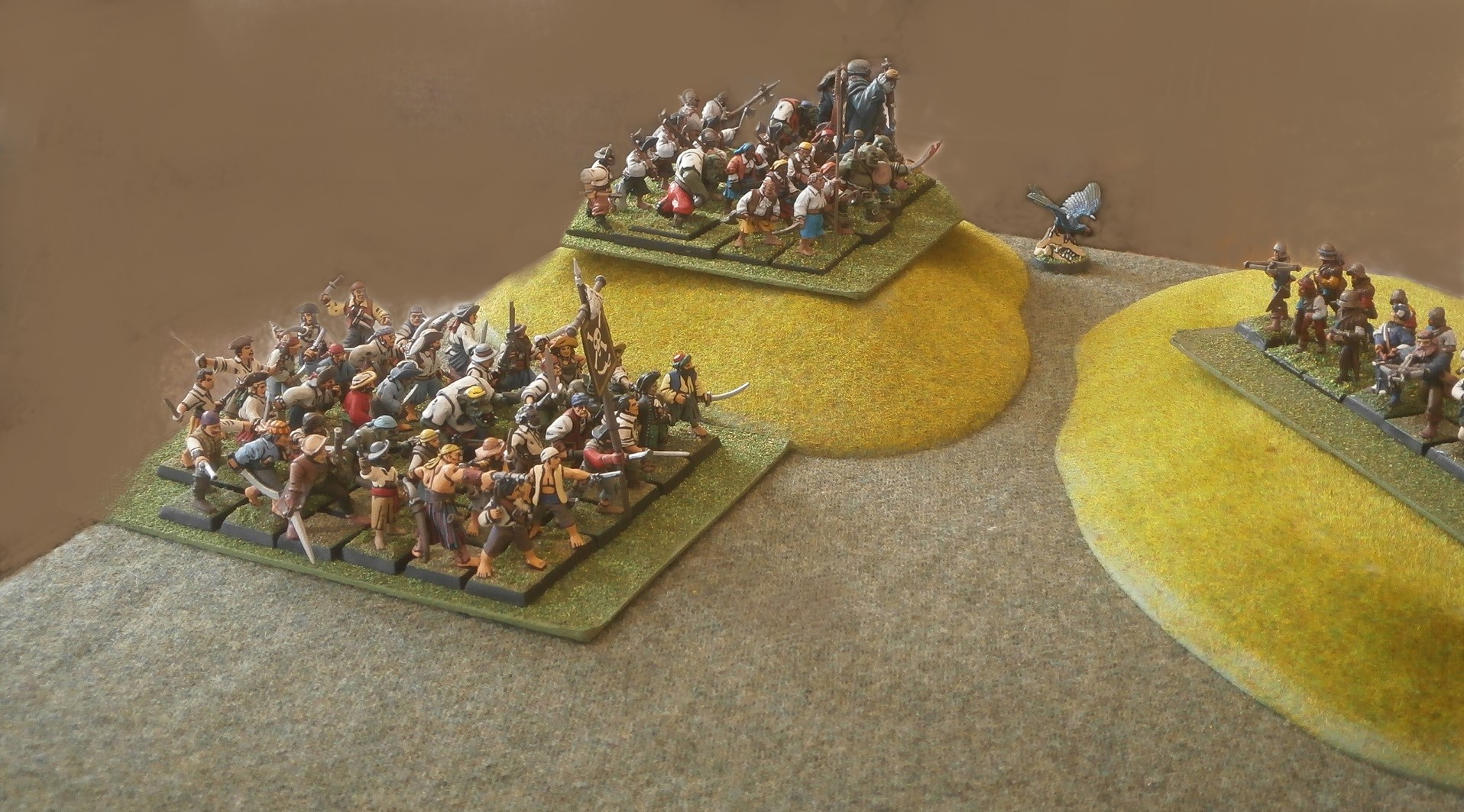
Kroll’s pet parrot, a giant amongst its kind, as befitted such a hulk as Kroll, flapped down a few yards ahead, while he himself surveyed the enemy to decide what exactly to do.

A moment later these two regimented crews were joined to their right by the rest of the force.

Close enough to Volker that he could smell them, came the sand trolls, each of whom, were it not for the bent and bowed nature of their spindly limbs, would have stood taller than Kroll.
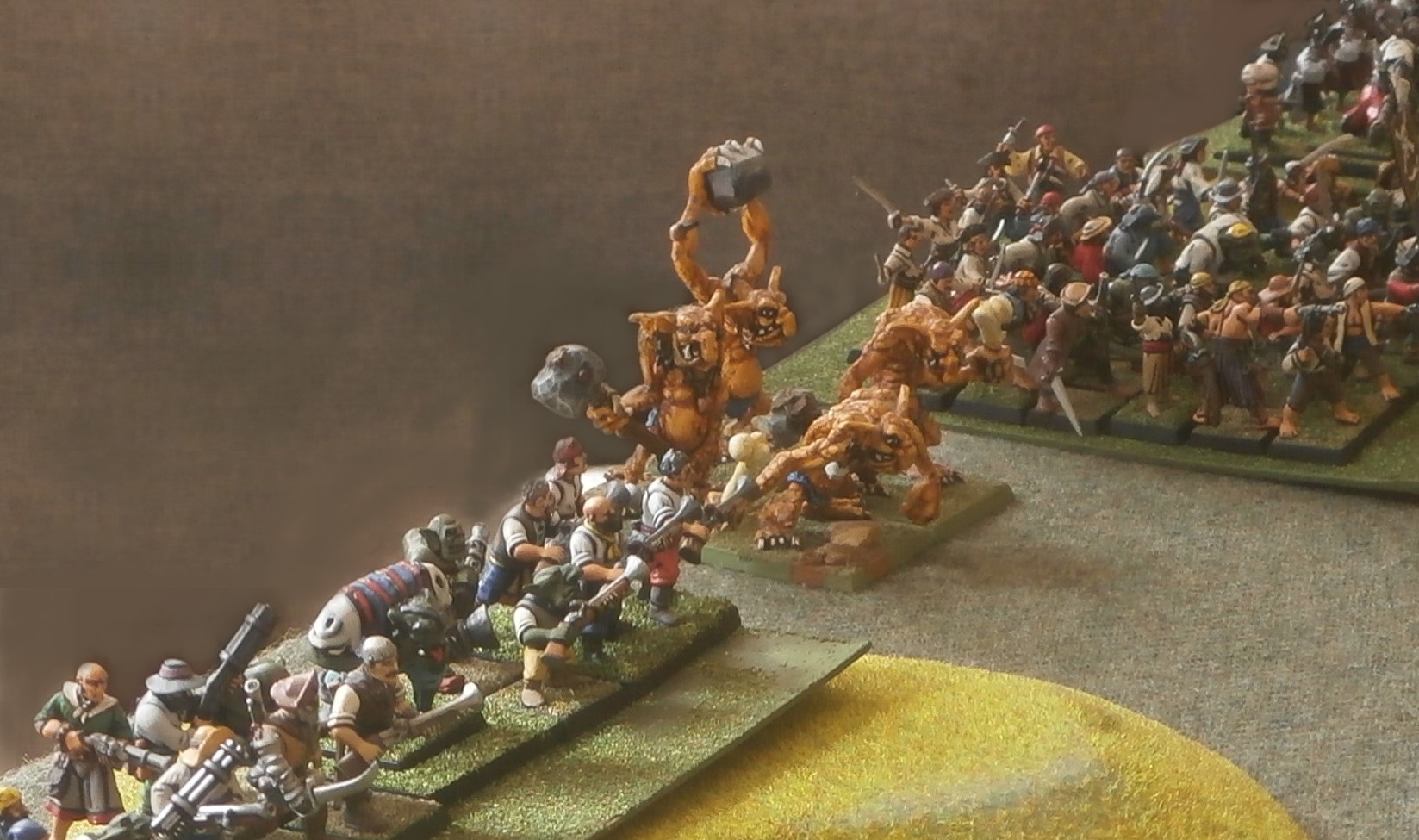
Beside them came the rest of Volker’s crew, a large company armed with blunderbusses. Out on the far right of the relief force advanced Captain Fark’s goblins, ordered to that position by Volker, who wanted to avoid any further outbreak of greenskin squabbling hindering his victory today.
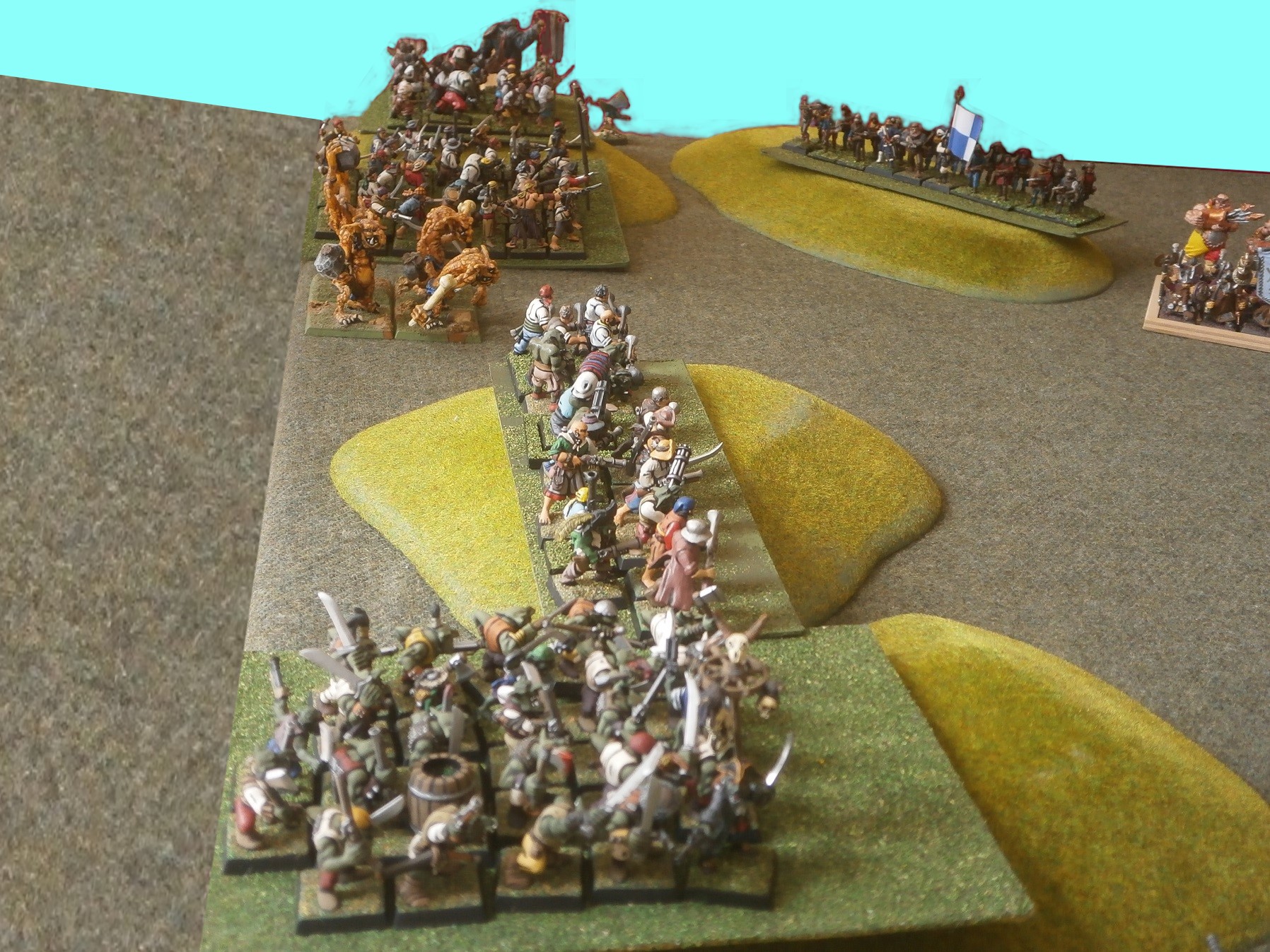
Losing no time, the Sartosans moved on, the trolls outstripping the rest to close on the dwarfs, while Kroll’s axe-wielding warriors came very close to the crossbow regiment’s flank.
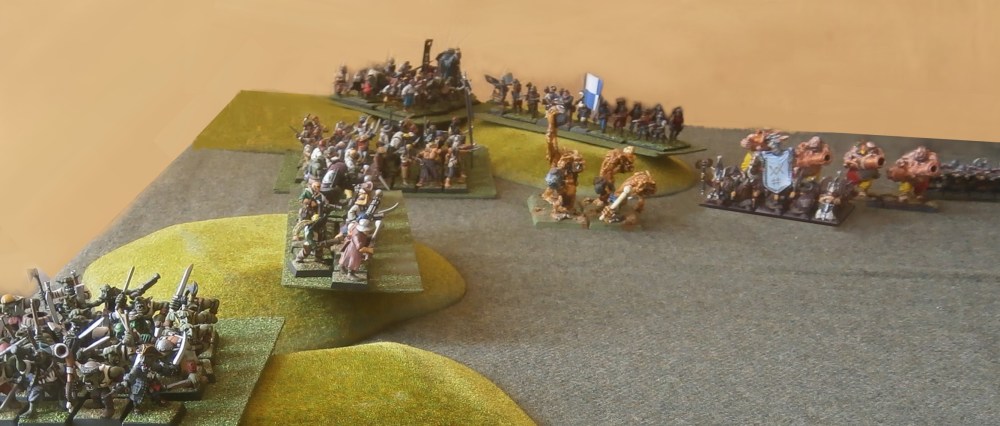
Captain Fark, however, ordered his regimented crew of greenskins to turn to face the three pistoliers …

… which might seem a waste of his crew’s fighting strength, but he had been looking for every chance to prove he really could shoot his pistol well since fighting the Luccinans ten months before, and had got it into his head that with a well-placed shot he might dispatch not one but two of the riders.
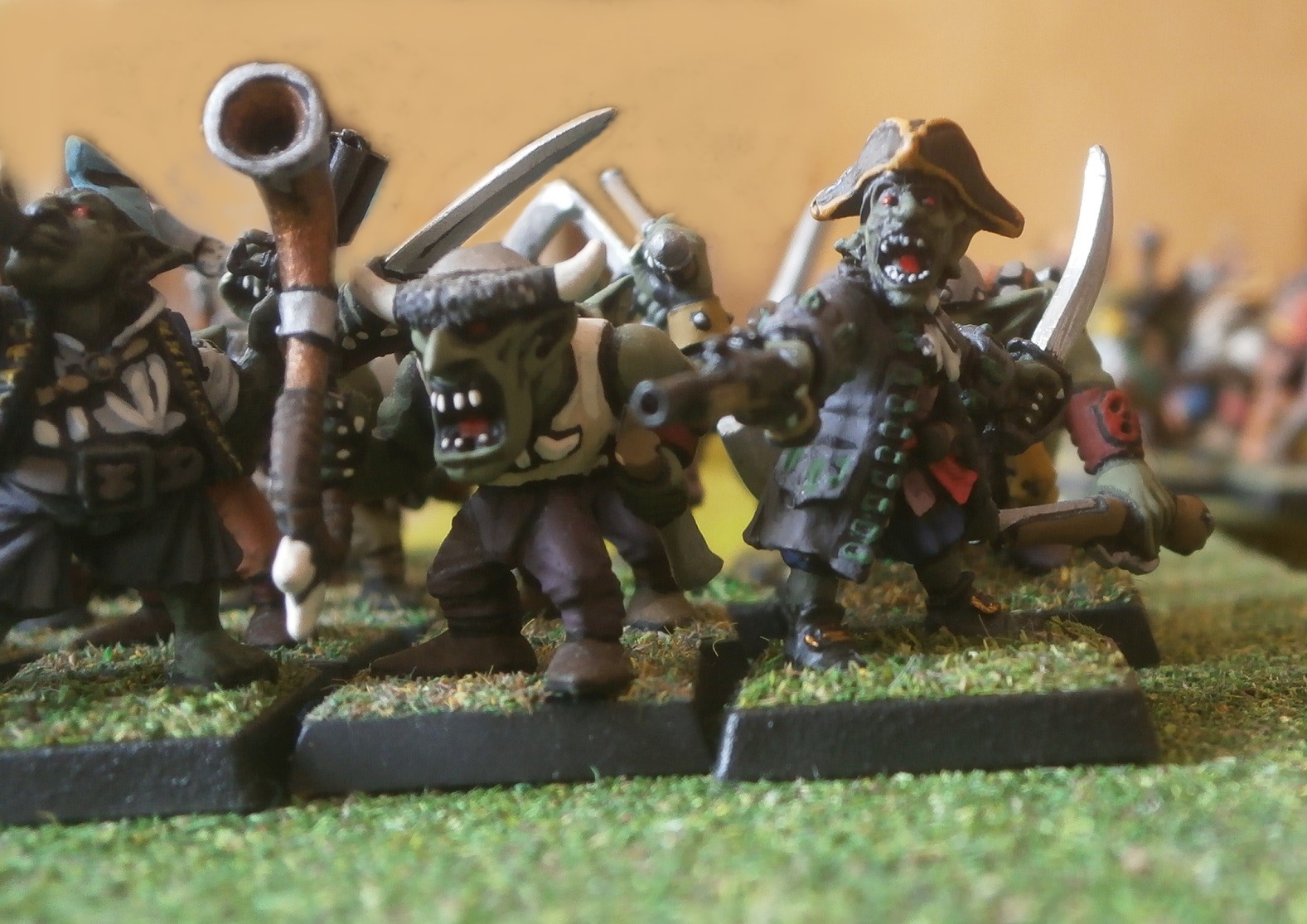
As he brought the enchanted pistol to bear, delaying just enough to shout out “Watch dis, lads!” once again, he was thwarted, as the swivel gunners blasted and killed all three riders befoe he could even pull the trigger. Behind him a goblin laughed, so he turned and shot him instead!
Volker’s force advanced …

… while the sorcerer Adus Arcabar hurled a fireball at the pistoliers in the orchard, which was again dispelled by the enemy’s magic users.
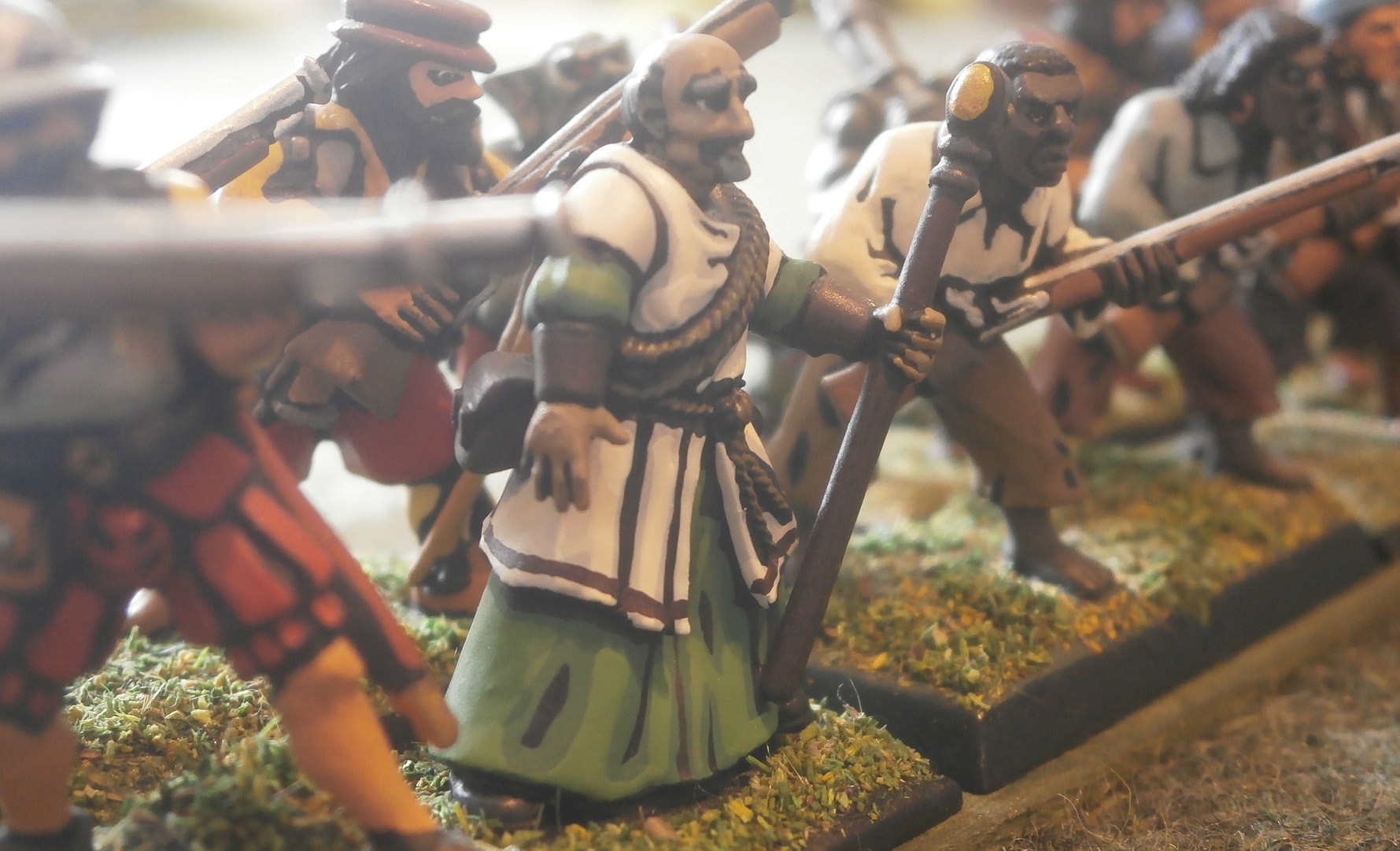
In fury, he instead wove a magically flaming cage around the riders, killing two, then two more when the survivors attempted to flee through the flames. Moments later there were explosions as the flames heated the riders’ powder flasks! This pleased the old wizard, but he cared not if anyone else had noticed.
Taking a chance before their line of sight might be obscured, the two sakers that were able to fire (the crew of the third struggling to make ready after a misfire) took aim again on the dwarfs.

Their chain shots tore four dwarfs apart, then felled one of the brute ogres behind. The dwarfs, nevertheless, and no doubt unwilling to perish before they caused some harm to the foe, charged the trolls.
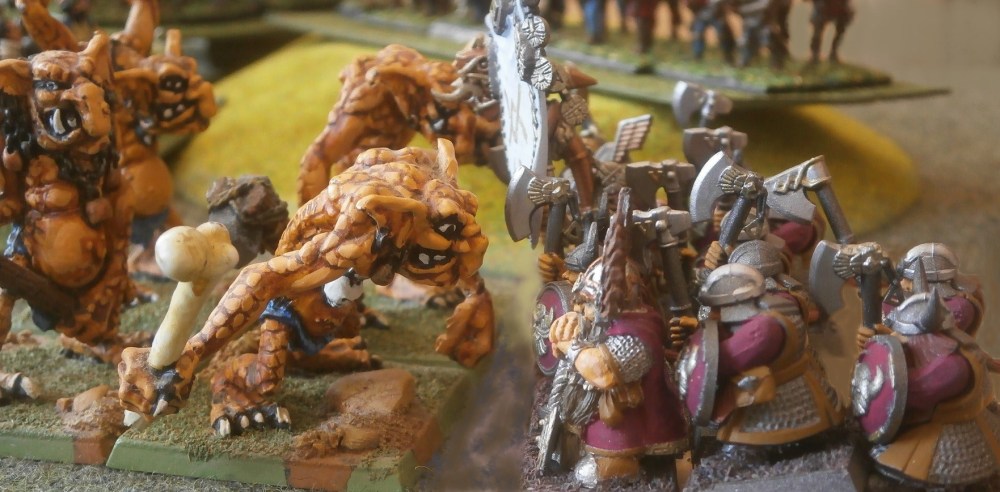
Volker watched with fascination, having never before seen two such opponents embroiled together.
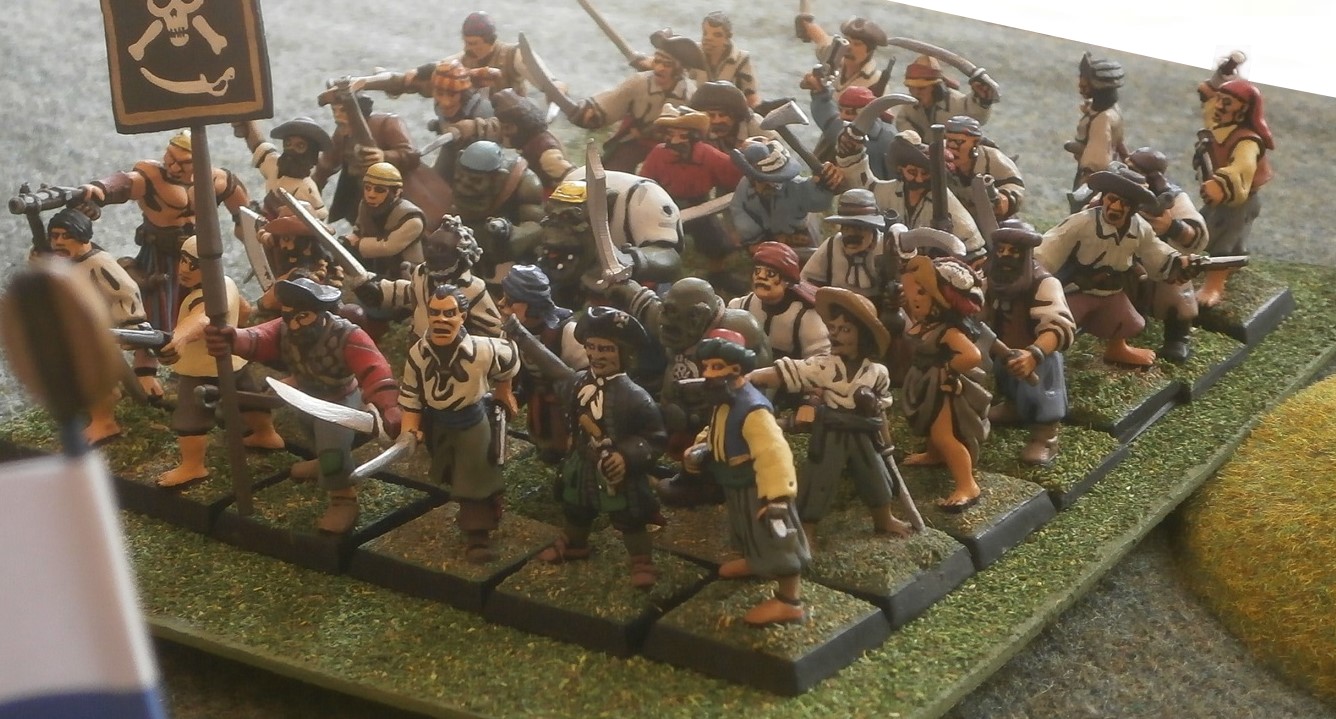
Even Kroll found himself momentarily distracted by the sight!

Out in the centre of the field, the Sartosan dwarfs and Van Baas’s crew now saw where things were going, as they watched the enemy’s large regiment of elite swordsmen face about and begin marching away.

They were unsurprised to see that the enemy’s missile troops did not do the same – presumably they had been commanded to linger a little longer, to wreak some harm from a distance, delaying the pirates, before departing themselves. Perhaps dismayed at the thought that the battle was already lost, the Portomaggiorans’ magic users failed to conjure any successful spells, although it could not have helped that one of them had his back turned as he left with the Sea Guard.

The ogre leadbelchers …

… joined with the dwarven crossbows, the Eclanian crossbows and the handgunners to pour a veritable storm of lead and bolts into Van Baas’s crew, killing ten of them.

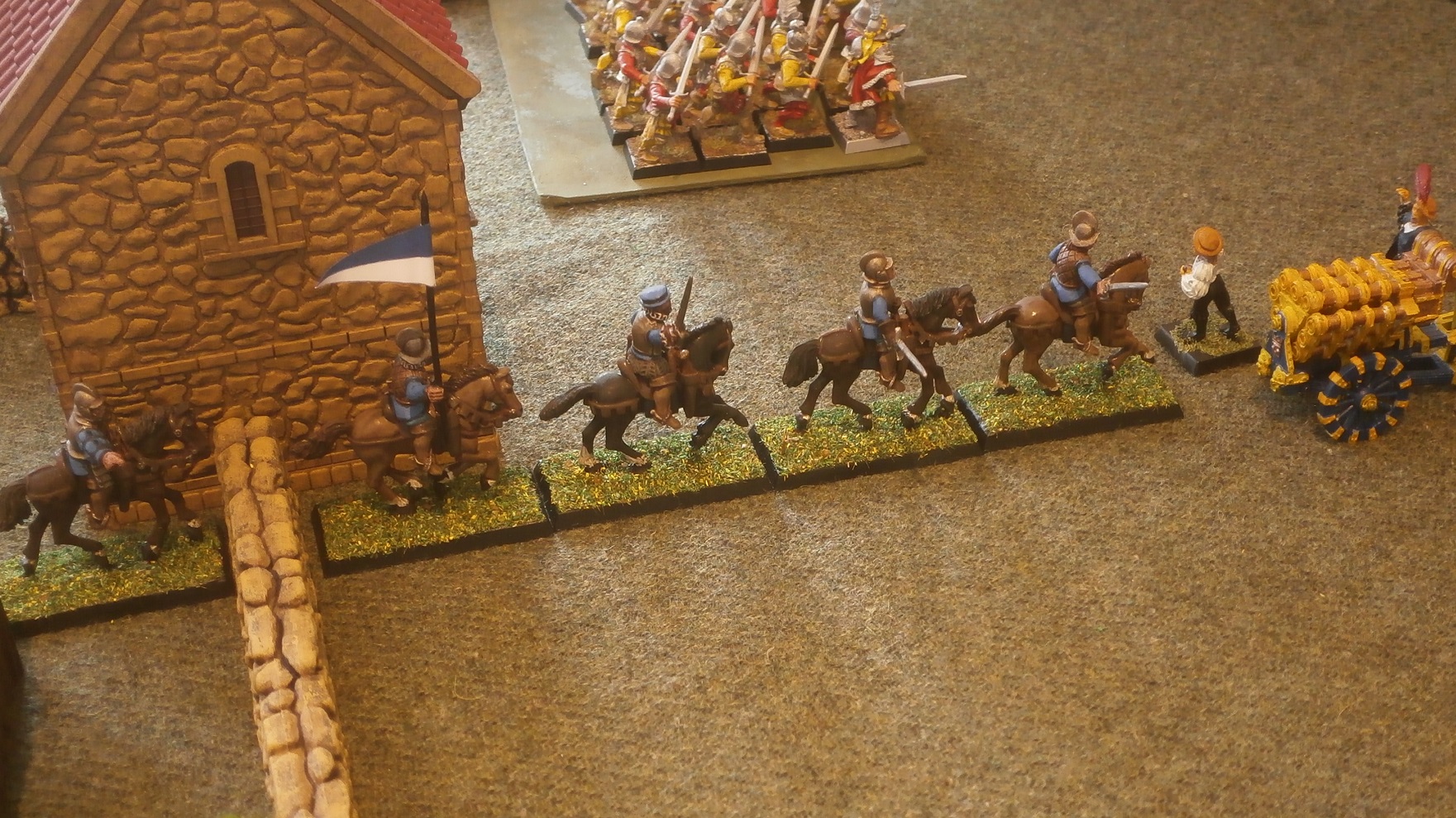
While somewhat concealed by the walls and buildings of the villa, the last company of pistoliers, who had been making heavy work of crossing into the yard, began to file away from the field. The crew of the organ gun up were also dragging their burden away, giving thanks to Myrmidia that the pirates could not see them.
The Portomaggioran crossbowmen on the far right, somewhat desperately considering how close Kroll and his crew were, loosed their bolts to kill five of Volker’s men massed down below.

Then they were surprised to see Irongrim’s dwarfs cut down one of the trolls, wounding another …
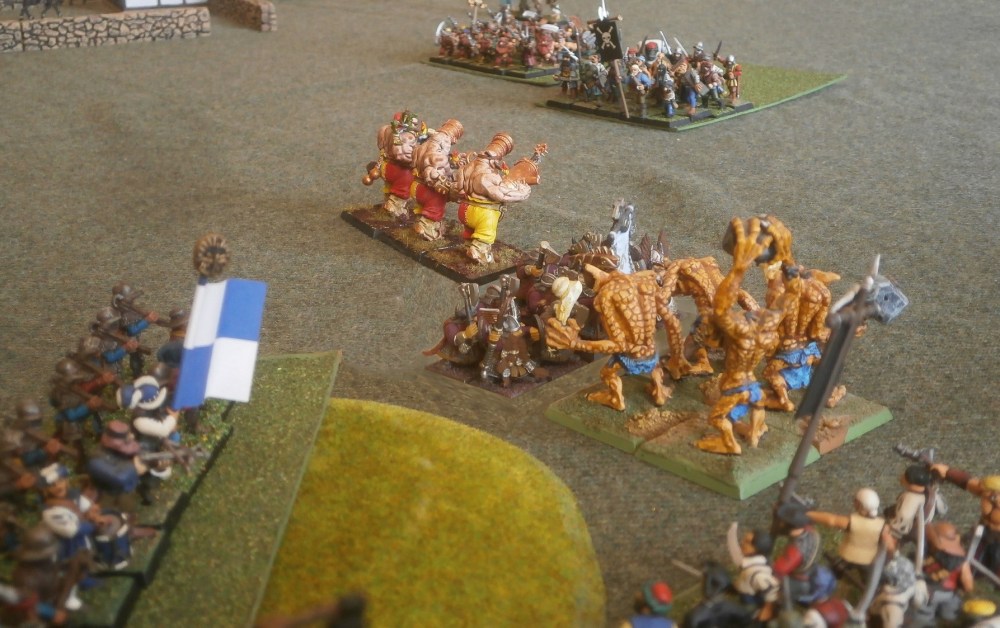
… and breaking them. When the trolls lumbered away, the dwarfs hurtled forwards into Admiral Volker’s regiment.

So it was, and somewhat unexpectedly, Volker found himself in personal combat with Thane Girseak Irongrim, the two quickly drawing blood from each other as the warriors around them hacked and hewed with swords and cutlasses.
(End of turn 2)

Unwilling to miss out on the slaughter, Captain Kroll shouted, “Right lads! Let’s get ‘em!” And led his axemen into the flank of the desperately isolated crossbowmen on the hill.

The fight was short and bloody, so much that it was over before Kroll felt it had really begun. It was observed from a distance by the goblins, who had turned around to see how the real battle was faring.

As the last of the crossbowmen was cut down, Kroll and his crew found themselves at the crest of the hill, looking down on the enemy’s ogres below.
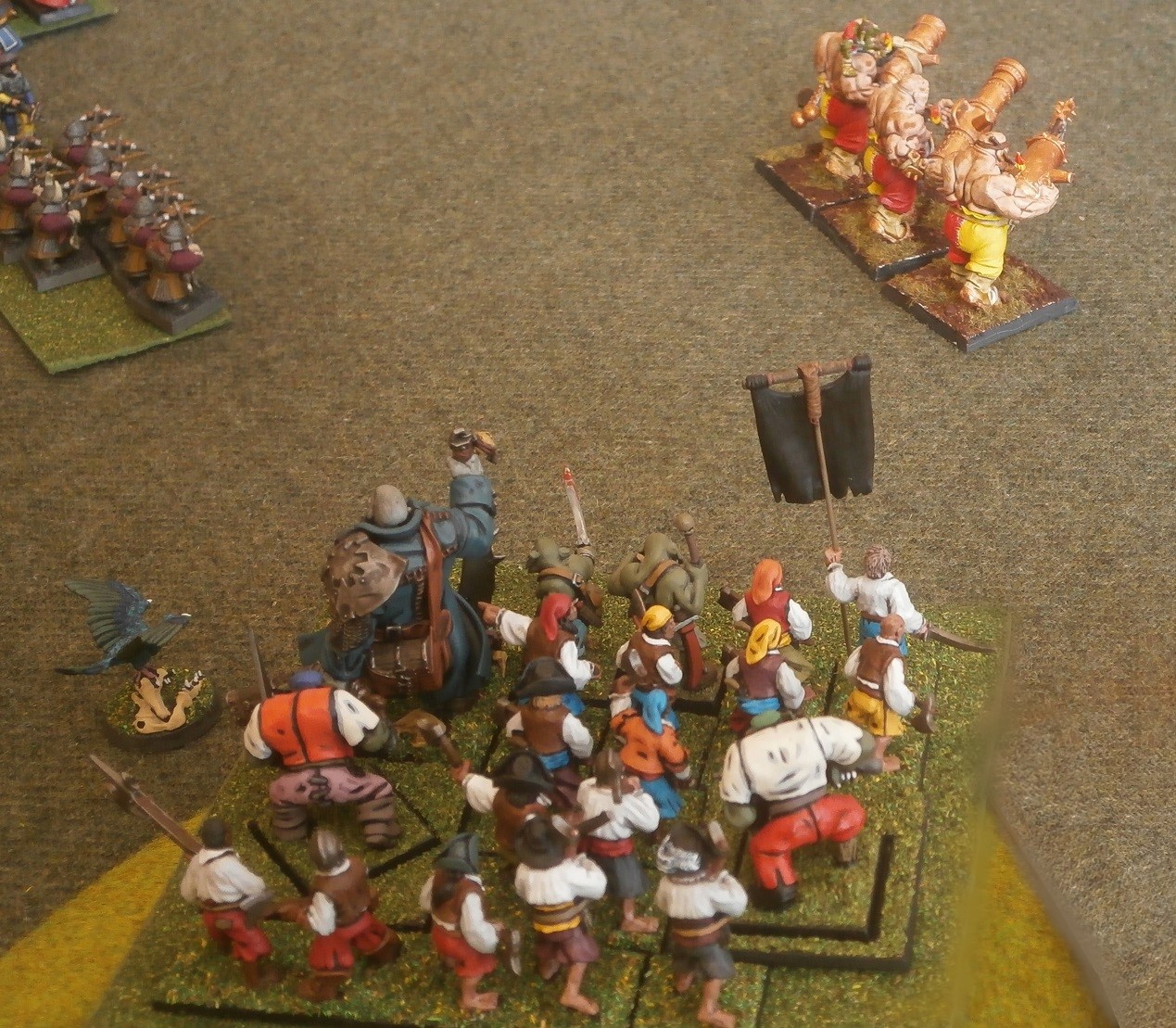
Kroll, though he did not show any sign of it to his men, felt disgust, even embarrassment, that fellow ogres would demean themselves so much as to serve as mercenaries for a human lord, receiving pay and eating salted beef and bread instead of taking plunder and eating raw and bloody flesh.
As the last of the sand trolls left the battlefield (by the time they halted they had forgotten they had been fighting) Volker’s blunderbuss company had also noticed the leadbelchers, but despite the urge to do so, neither they nor Van Baas’s dwindling regiment managed to charge the brutes.
This time, the sakers targeted the ogres with their chain shot, both overshooting, and one reaching the dwarf crossbows behind to kill two. Meanwhile, Admiral Volker remained locked in combat with the mercenary Lord Girseack, discovering just how difficult it could be to find a chink in dwarven armour! He was thankful of his own protection, in the form of a magical talisman he always carried with him, for there was a moment when without its charming influence he was sure he would have been grievously injured, if not killed. The pirates and warriors around these two fared little better, and despite the Sartosans’ greater numbers, the dwarfs stood their ground.
Deciding that Kroll and his crew were the greater danger, the leadbelchers turned to present the muzzles of their pieces at them.

Kroll let out a laugh, for he was not scared of their carried cannons, and despite knowing many of his crew would undoubtedly perish should they charge, he fully intended to do so.
Upon the other side of the field of battle, the Harbour Guard handgunners joined the swordsmen in moving back towards the city, although the wizard with them stepped away intending some more mischief before he too retired.
The last surviving company of pistoliers, concealed by the yard and the church, where also in the process of exiting the battlefield, as were the crew of the organ gun up ahead.
But the crossbowmen in the middle of the field, both the local standing force and the mercenary dwarfs, lingered, slaying another six of Captain Van Baas’s crew. The captain was beginning to lose his patience, for his crew’s role in the battle had so far been nothing more than a magnet for missiles, which meant there were hardly any left standing!
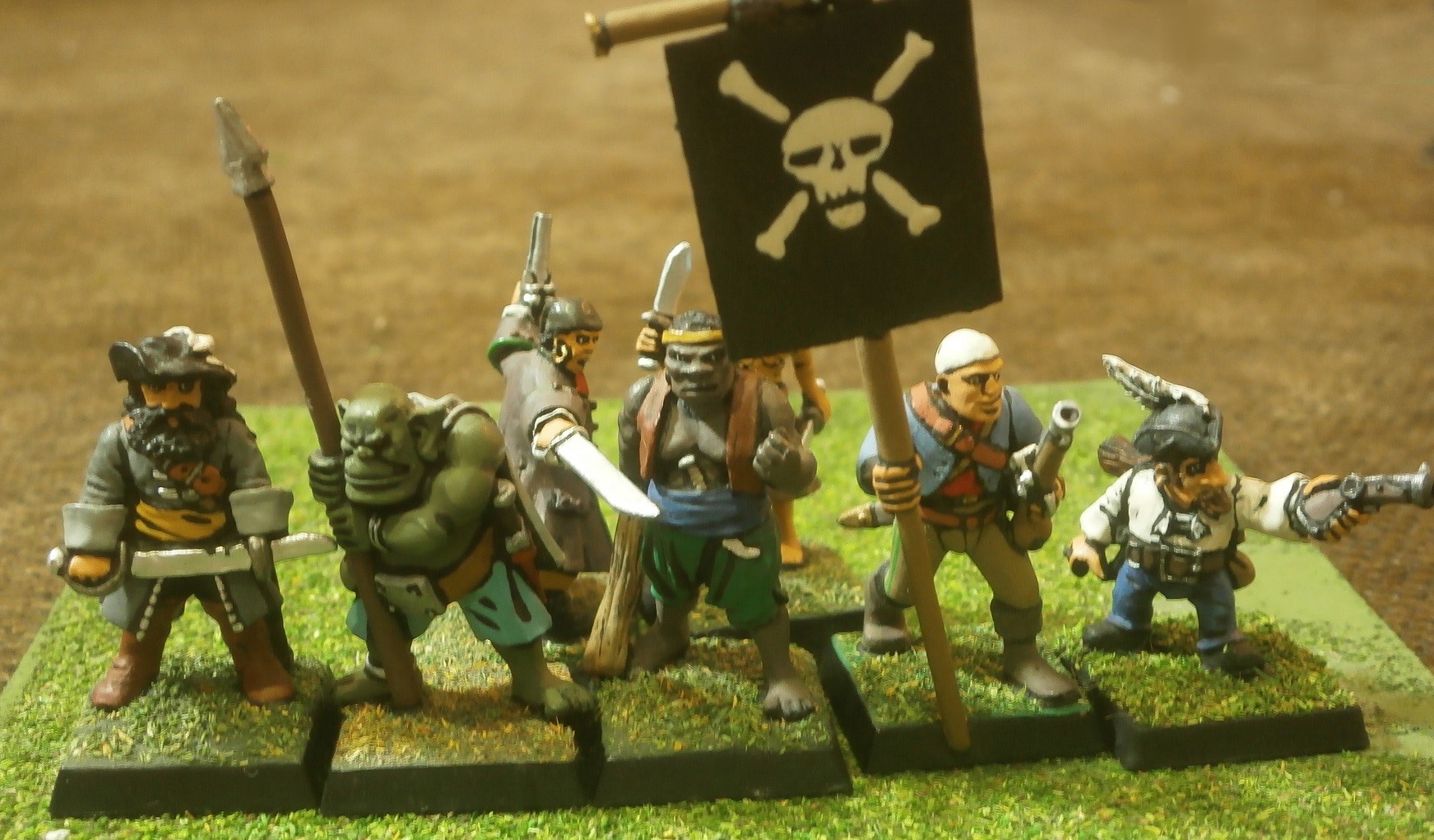
“Captain,” shouted his bosun, Moukib Brahimi. “Let’s get to fighting before there’s none of us left, eh?”
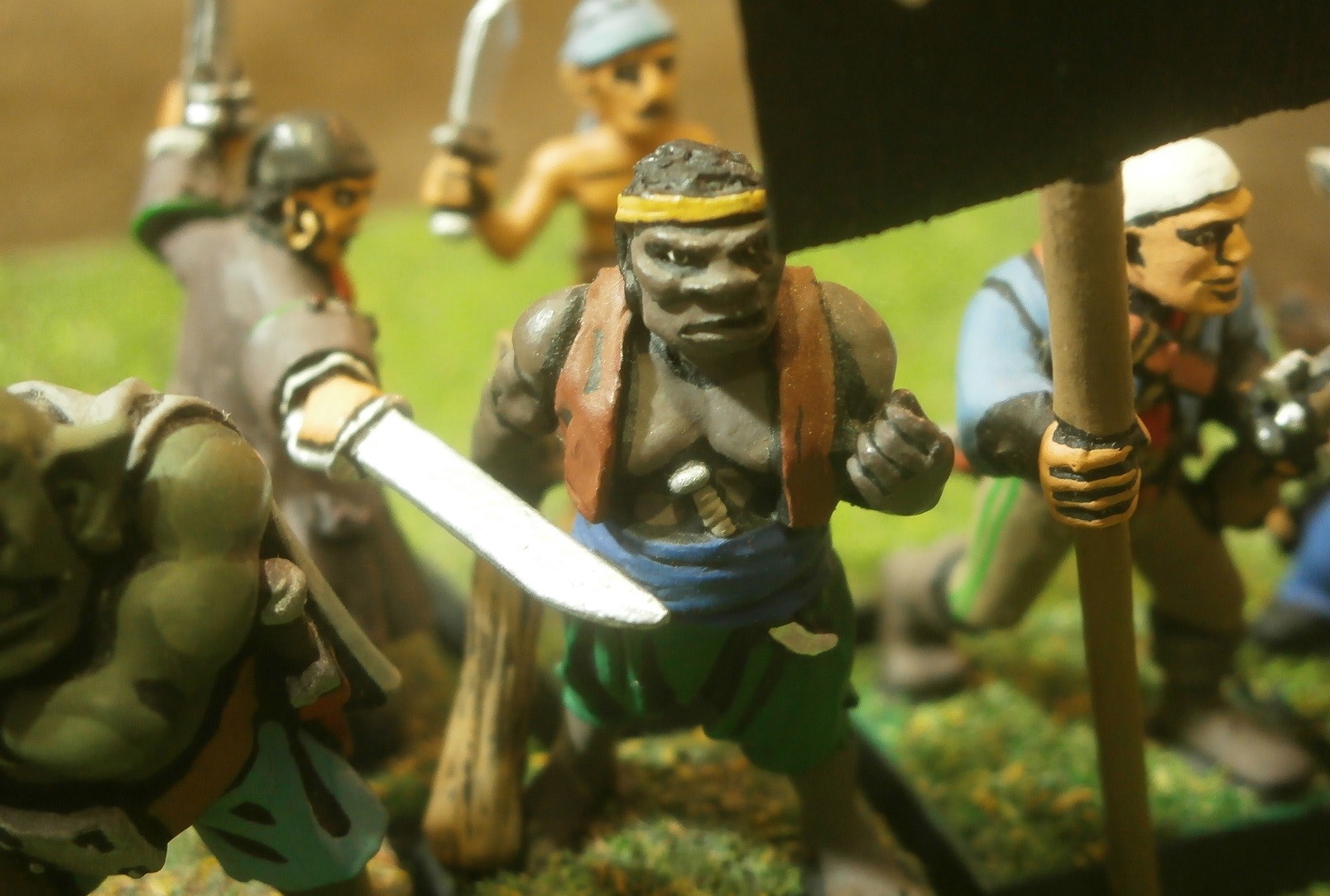
“Aye!” said Van Baas, pointing at the leadbelchers who had just turned their back on him. “Let’s start with them.”

With that, at last, his surviving crew began moving at a pace forwards.
As the leadbelchers fired a blast at Kroll’s crew, much of which buried itself in the grassy slope leading up to them, Volker noticed the dwarven lord seemed to be tiring.
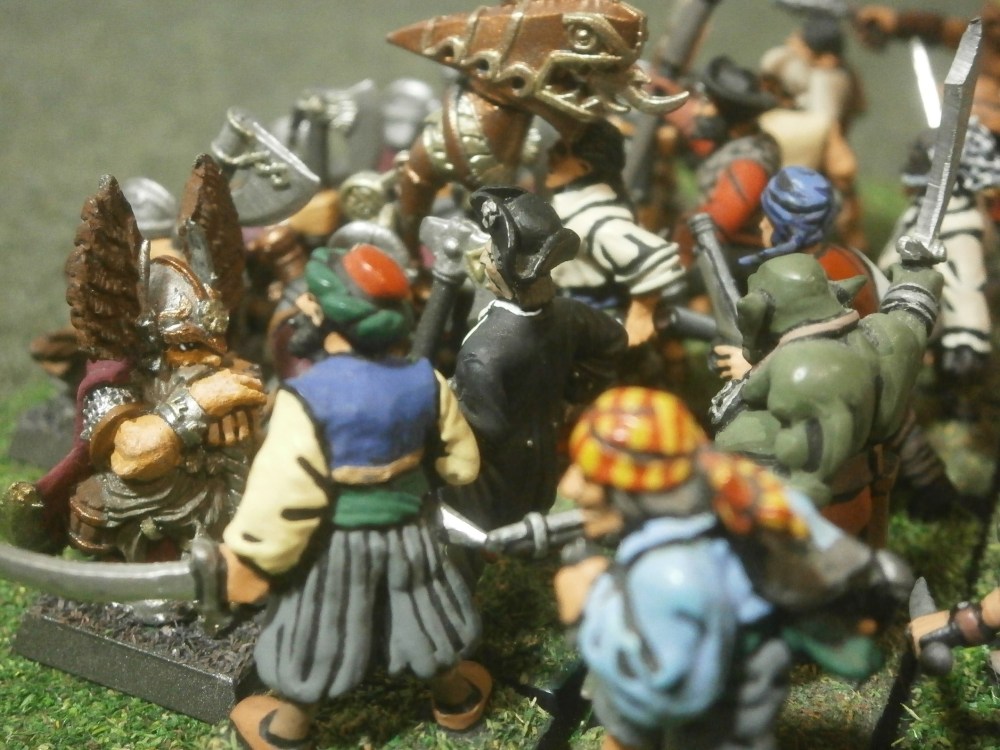
Using an unnaturally precise lash from his enchanted whip as a distraction, coiling the thane’s arm and yanking it aside, he swung his cutlass deftly between Irongrim’s helmet and gorget, cutting his head clean off! With two more their own also killed, even the stout hearted dwarfs lost the will to fight, and so turned to flee. They were cut down by their longer-legged pursuers, however, and Volker and his crew found themselves in combat with the ogres!
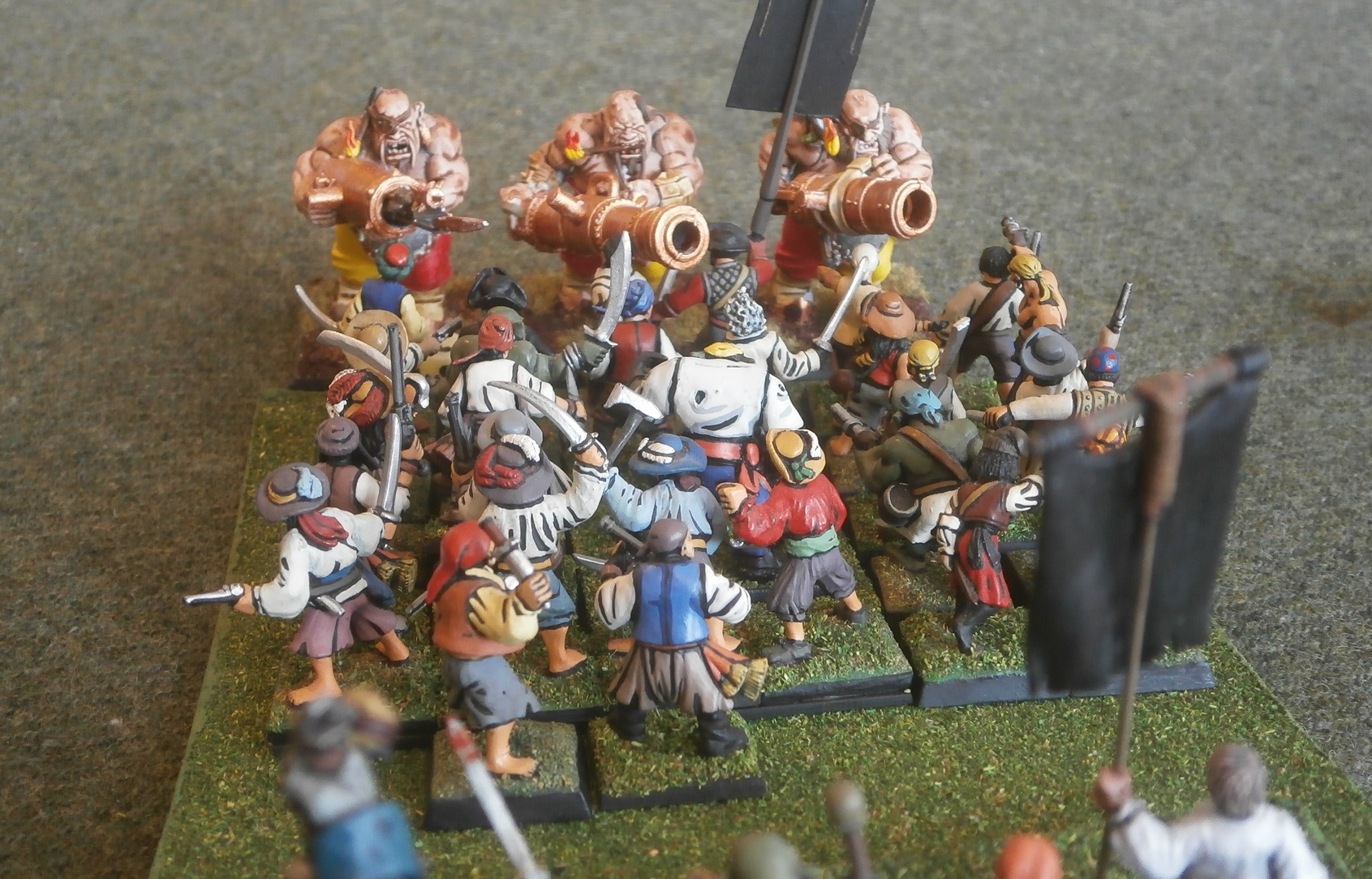
So thwarted in his intention to take on the ogres himself, Kroll surveyed the ground below the hill-top and decided he would break off from his crew and take on the dwarven crossbows by himself.

But he stumbled a little as he descended the slippery grass of the slope towards them, which gave the dwarfs time to flee away out of his reach, streaming through the militia crossbowmen and out the other side.

Kroll cursed, as it seemed he was not going to get to grips properly with any enemy of note at all that day.

The Portomaggioran ogres had quite the opposite problem, for now Captain Van Baas led the last of his crew in a charge against their rear, while Volker’s blunderbuss company came in on their flank, so that they were surrounded by attackers on three sides!

The wizard Arcabar saw his chance of harming the foe was slipping out of his grasp, and, in clumsy haste, somewhat foolishly attempted to conjure a magical flame cage about the enemy’s harbour guard swordsmen.
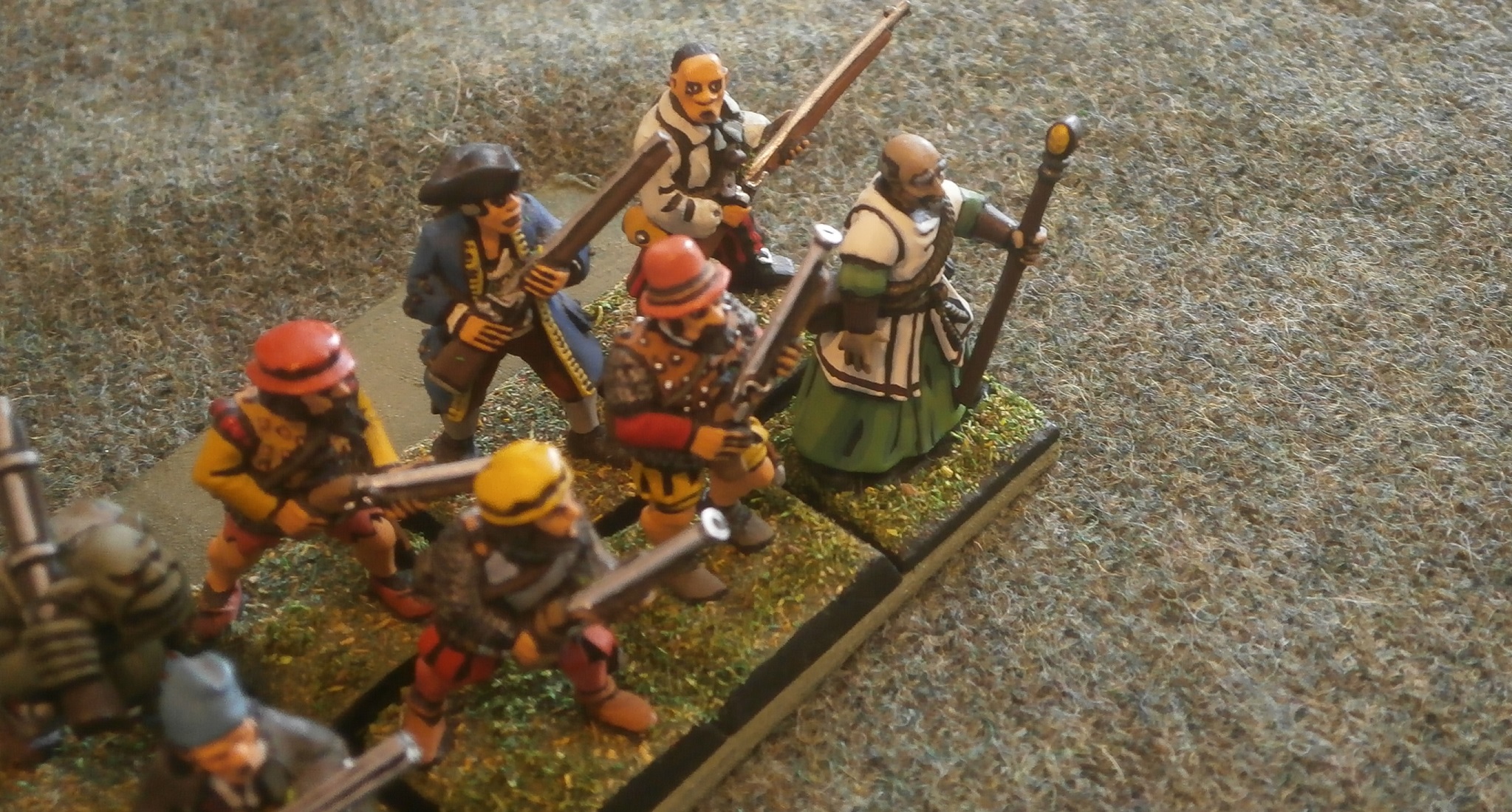
Too hastily, however, for although the spell was brought into being, killing two of the enemy, he allowed its etheric energies to swirl beyond his control, causing an explosion of etheric heat to burst from him, scalding his arm and killing four of the handgunners beside him (torn apart by a combination of the magical heat and the explosions of their powder flasks and pieces)!

Seeing little opportunity for the kind of mayhem he liked, Captain Fark commanded his goblins to shift over so that the gunners could sight the foe better …
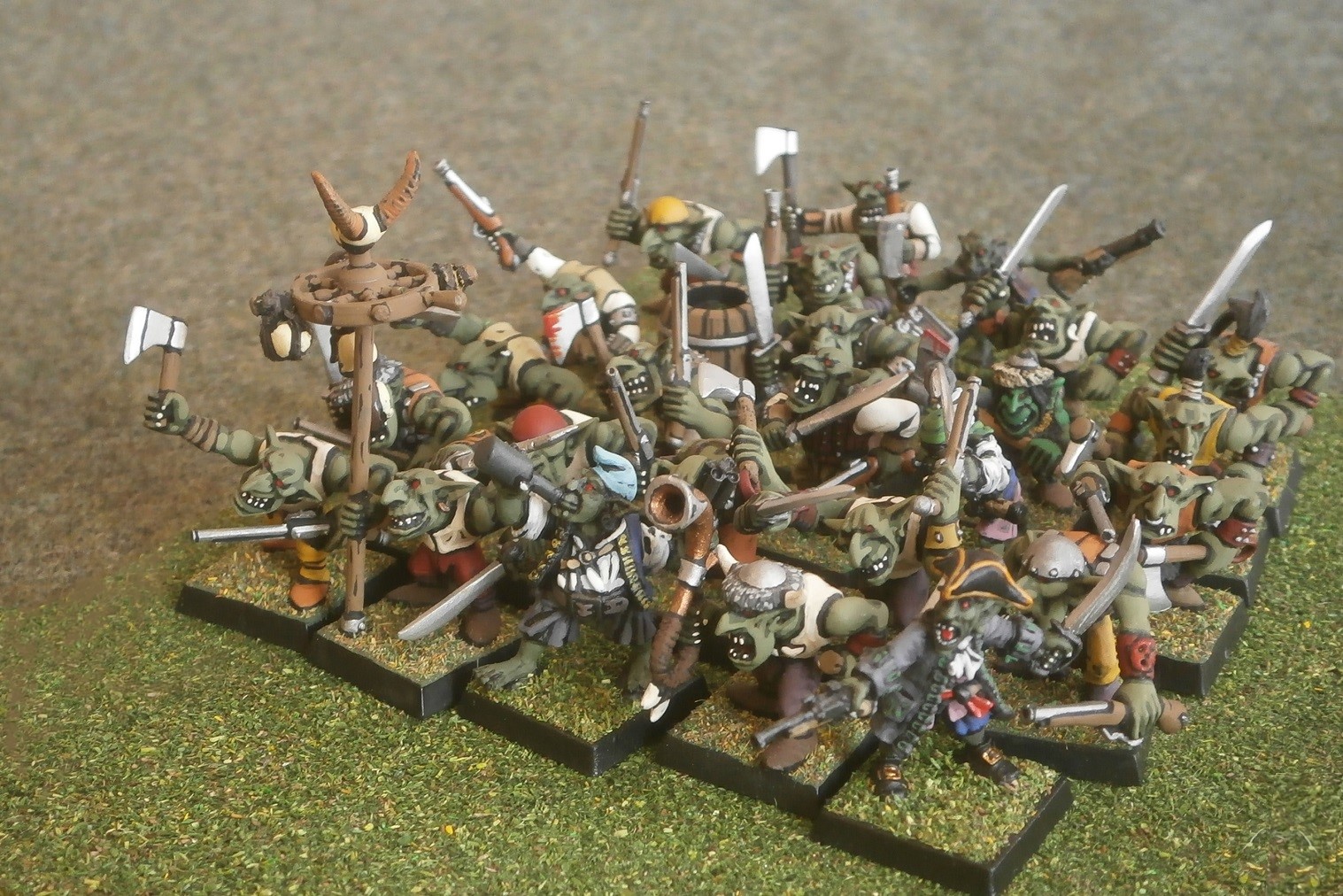
… allowing the swivels to so severely maul the militia crossbowmen that they broke and fled away. Kroll cursed again. Would no-one stand their ground against him?
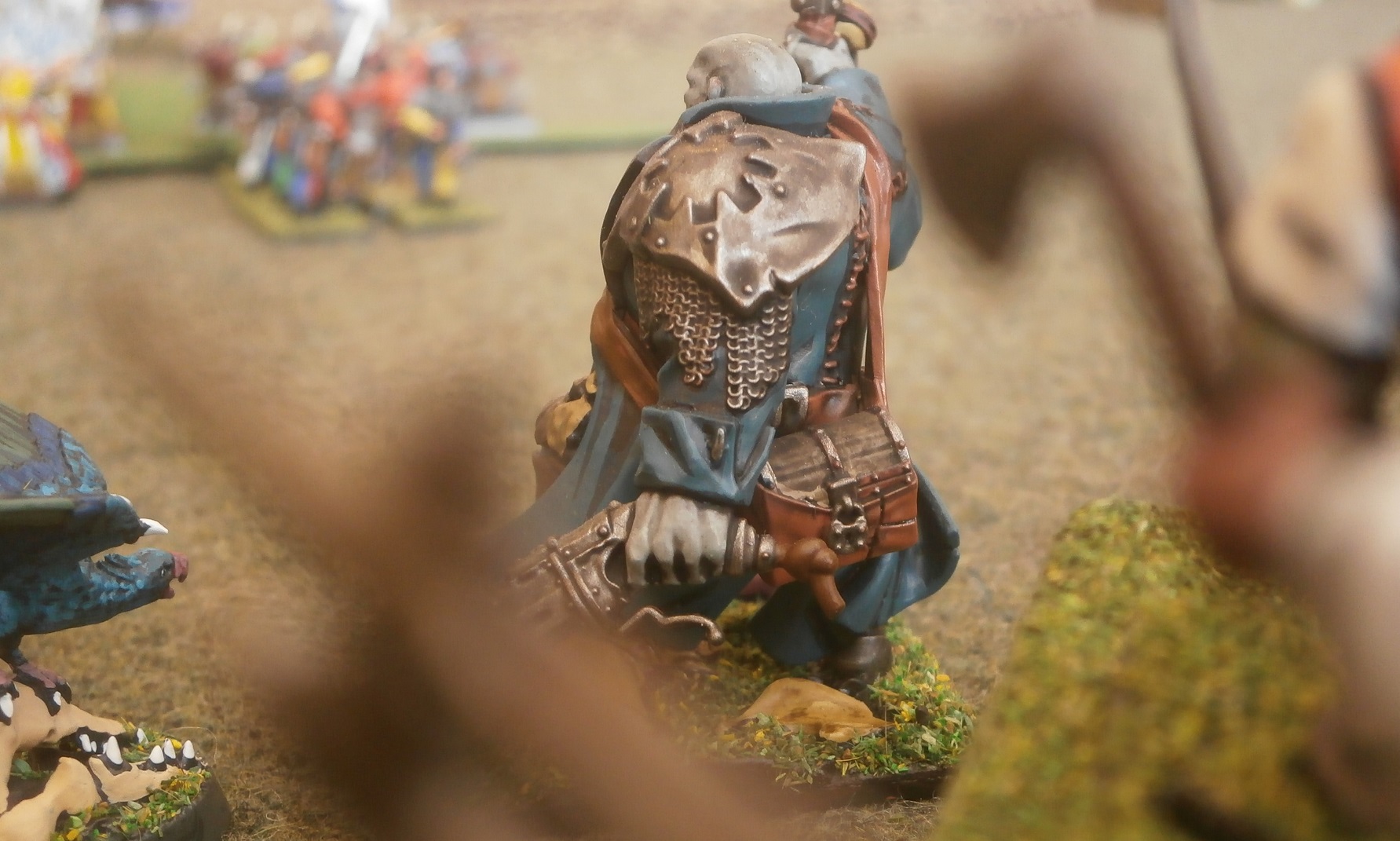
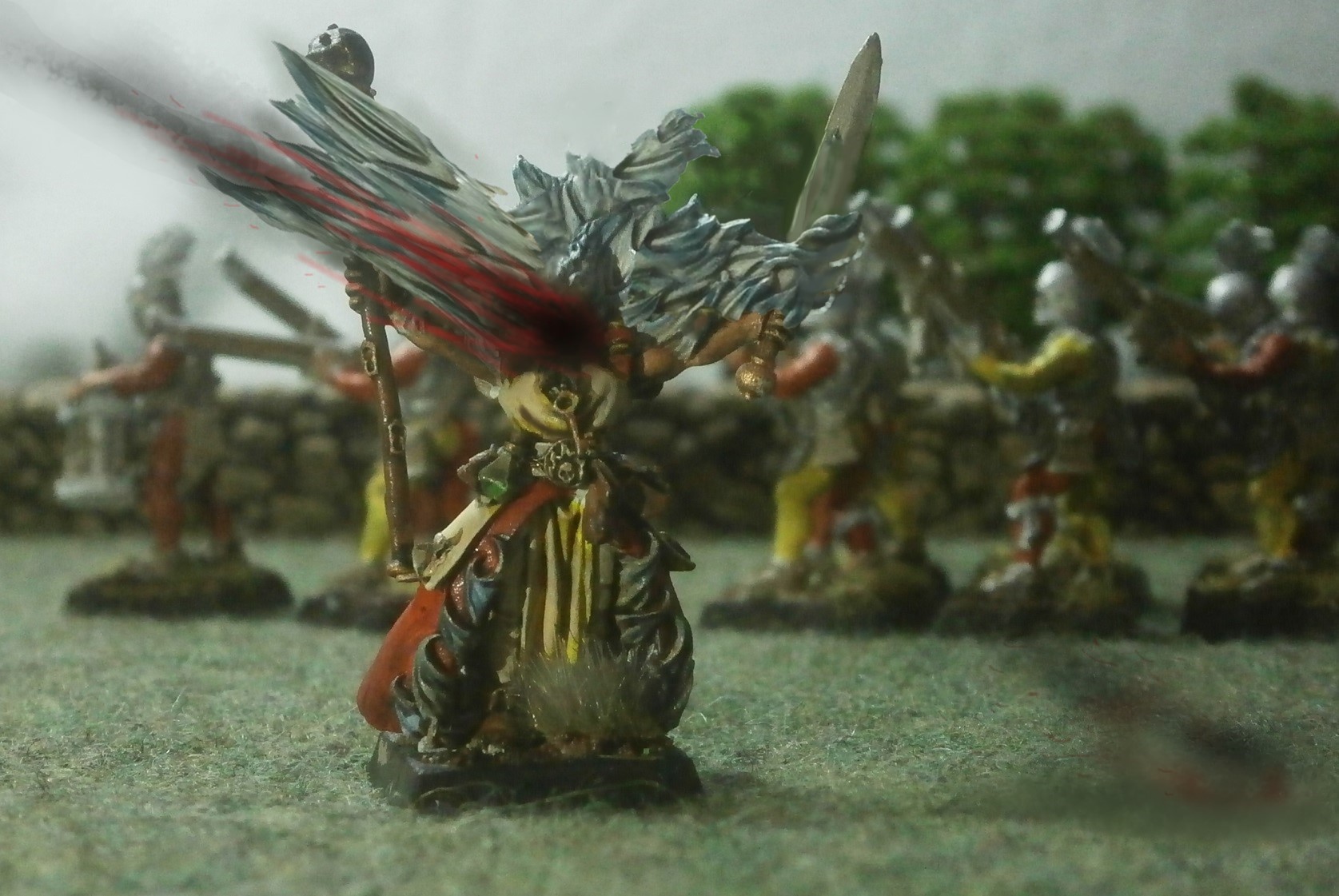
Then he laughed as he saw a chainshot kill no less than seven of the fleeing dwarfs, leaving but one lone survivor reeling in confusion! He laughed even louder when another shot, this time plain old roundshot, took the enemy wizards’ head clean off!
Now came a moment that all who witnessed would remember for the rest of their days.

Admiral Volker, his blood well and truly up, lashed so cruelly with his enchanted cat o’ nine tails, that he killed two of the enemy ogres before anyone else could land a blow. Stunned himself at what he had achieved, he stood panting with exhaustion as the rest of the pirates hacked the last ogre down brutally and quickly.
And so ended the fighting at Eclano. Lord Nero led the last of his garrison force away, shouting orders for all to hurry back to the safety of the city walls, with the organ gun and last few pistoliers in tow, leaving the villa and the rest of Eclano to be plundered by the celebratory Sartosans.

The tale most often recounted during the drunken revels of the next few days was that of Admiral Volker’s whip: pinning a dwarven lord’s arm to allow the removal of his head, then so viciously slicing the leathery flesh of the enemy brutes that not one but two fell dead to its attentions!
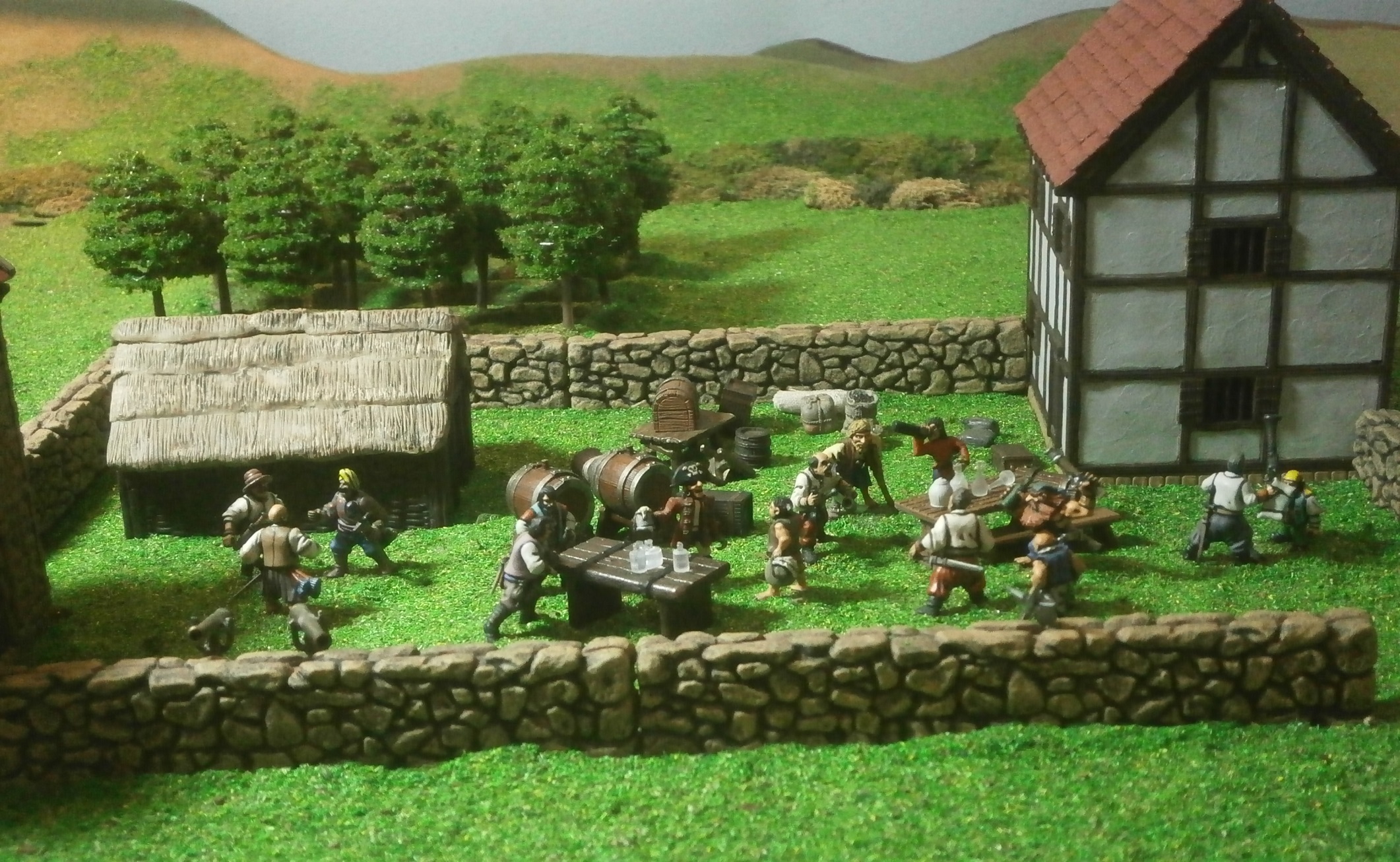
It was close to the time that the Sartosan fleet would vote regarding whether to have a new admiral, but what with these stories and the glut of loot taken from Eclano and Scalea, it seemed the outcome was certain. Admiral Volker had become a legend in his own lifetime!
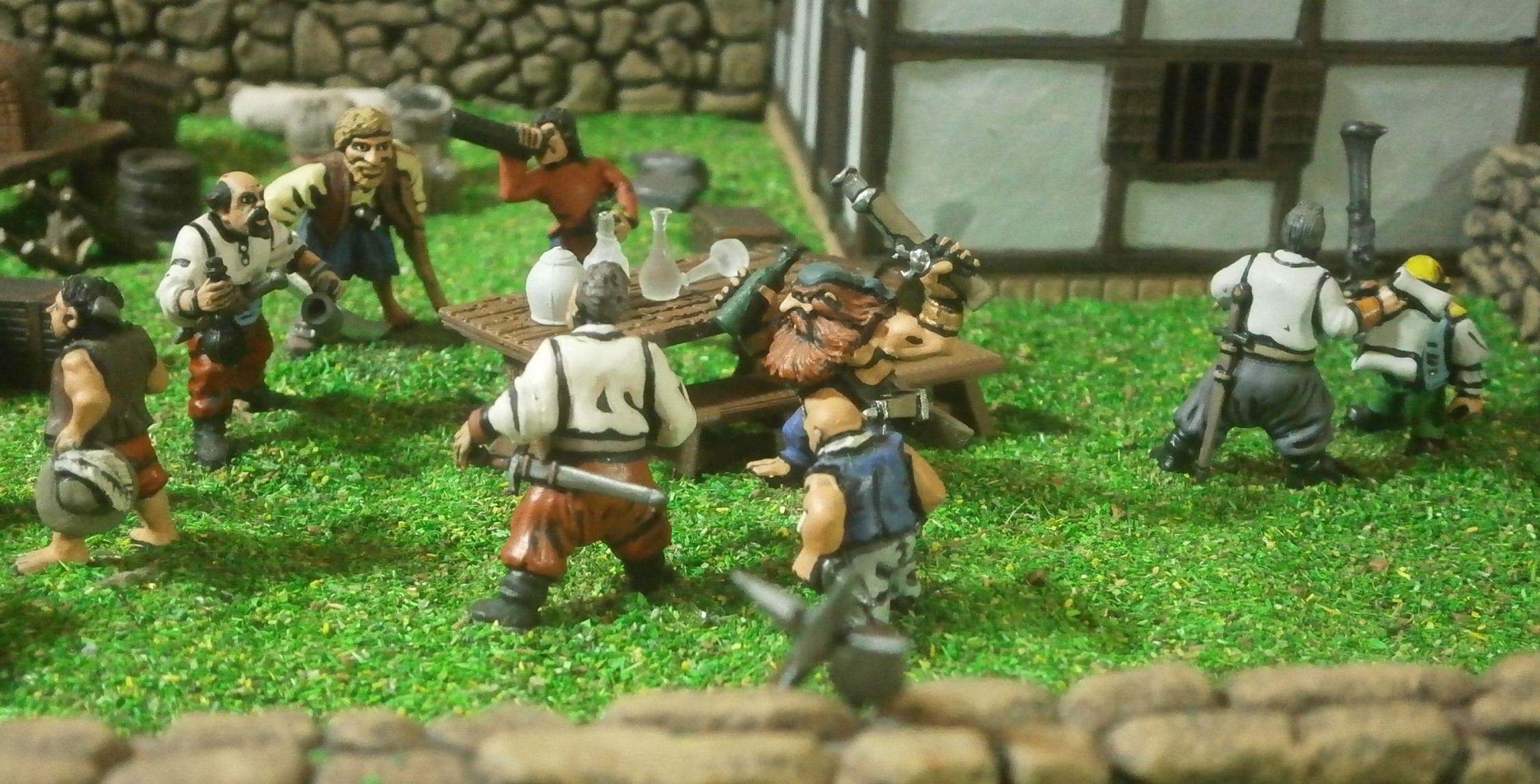
In this hour of need in Portomaggiore, where was Lord Alessio? It seemed that the VMC commander, General Valckenburgh, was not the only defender of a realm to have been absent when the pirates came. Or perhaps, more accurately, that Admiral Volker was a proven expert at targeting his cruel raids just when a realm was at its weakest – itself another reason that he should and would be re-elected as the fleet’s commander.

Next Installment: Part 42

 BigSmallWorlds
Well done Padre! Your stories are always a joy, and this is no exception. I envy your players and I can’t thank you enough for sharing this with all of us.
LikeLiked by 1 person